
The nurse who holds the next four hours
A head nurse plans the unit’s month. A charge nurse holds the next four hours. At 5:45 in the morning the charge nurse is the person who knows that the machine at Bed 6 was released at 5:30, that the nurse covering Beds 9 to 12 has never connected a catheter alone, that Mr. Reyes gained 4.1 kilograms over the weekend, and that the physician on duty is on his way from the ward.
When one patient’s pressure falls at 7:10 and another patient’s needle alarm sounds at 7:11, the charge nurse decides who goes where. Most charge nurses learn this by doing it, often on the day the regular charge nurse calls in sick. Clinical skill carries over. Much of the rest does not: reading a staffing rule, building an assignment by need rather than headcount, keeping the whole floor in view while your own hands are busy, and saying the words that move a problem to the person who can fix it.
Figure 1 · What this series will help you do
Charge duty is a role a staff nurse takes for a shift. It is not the head nurse post, which carries continuing responsibility for the unit and has its own track. Completing this series does not appoint anyone to either role; appointment is the employer’s decision.
What this series is, and is not
It is study material written independently from published guidelines, textbooks, research, and Philippine regulations. It is not a certificate. The Department of Health (DOH) licensing rules for dialysis facilities and the Philippine Society of Nephrology (PSN) standards for hemodialysis clinics set the requirements for dialysis nurses, including structured renal dialysis training and life support certificates.1,2 Neither defines the charge nurse role separately. This series is not that training and is not affiliated with or endorsed by DOH, PSN, or Philippine Health Insurance Corporation (PhilHealth). Use it to prepare, to review, and to support orientation in your own unit.
Who can hold this role
Charge Nurse: qualifications at a glance
- Not defined separately in the DOH or PSN hemodialysis rules. In practice, a dialysis nurse who meets the hemodialysis nurse requirements: PRC license (R.A. 9173) and training in nursing care of renal dialysis patients. DOH, PSN
- Current Basic Life Support (BLS); DOH requires at least one nurse trained in Advanced Cardiovascular Life Support (ACLS) per shift, and the charge nurse is often that nurse. DOH, PSN
- Designated by the head nurse or employer for the shift; completing a study series is not an appointment.
Sources: DOH Administrative Order No. 2012-0001, Sec. V.B.2.a; Philippine Society of Nephrology (2024), Guidelines for nephrologists in the operation of hemodialysis clinics, Sec. III.A; Republic Act No. 10862. A summary for orientation, not legal advice: check the current issuances, and your unit’s license and PhilHealth accreditation. The full table for every role is on the Academy home.
A module and a half a week
The eighteen modules follow a charge shift from the first gate to the last handoff. Part 1 opens the floor. Part 2 watches the patients across many chairs. Part 3 guards the safety systems: infection, water, emergencies, and downtime. Part 4 is about people: handoffs, delegation, coaching, patients, and families. Part 5 brings it together: the record, improvement, ethics, and an integrated shift.
Figure 2 · How to use the series
Eighteen modules in five parts
Study the modules in order. Each one builds on the habits of the one before.
Part 1 · Taking the floor
 Module 1
Taking Charge: Authority, Boundaries, and the Shift You Inherit
Who decides what, reading a rule by who wrote it, the two staffing ratios side by side, and the authority to pause.
 Module 2
The Opening Sweep: Five Gates Before the First Connection
People, physician, water and machines, emergency readiness, and stations; why a blank result is a red result; holding with an owner and a time.
 Module 3
Building the Assignment: Acuity, Competence, and Breaks
Weighting patients by need, matching tasks to competence, keeping your own load light, and planning breaks so ratios never quietly double.
 Module 4
The Live Board: Rounding, Huddles, and Interruptions
Three levels of awareness, a board the whole team can read, rounds by the clock, three-minute huddles, and tasks protected from interruption.
Part 2 · Clinical oversight across many chairs
 Module 5
Sorting Risk Before Connection
The long gap, Now, Today, and This month, the speed of fluid removal, trends over snapshots, falls and glucose, and closing a result loop.
 Module 6
The Order, the Machine, and the Minutes
What each line of the order does, the read-aloud three-way check, why delivered time decides the dose, and the patient who asks to stop early.
 Module 7
Mid-Session Surveillance: Pressure, Cramps, Glucose, and the Patient Who Goes Quiet
Why pressure falls, the first response inside the protocol, cramps, low blood sugar during dialysis, the drowsy patient, and falls at disconnection.
 Module 8
Watching Every Access on the Floor
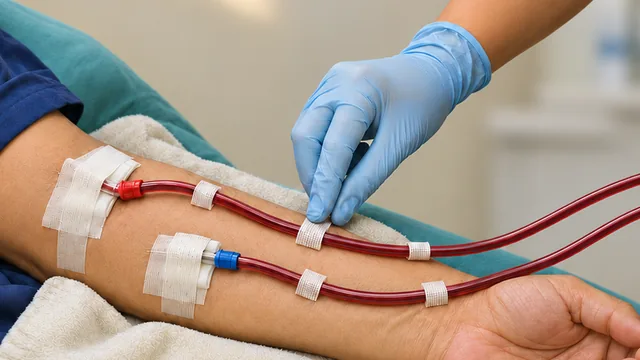
Why the alarm misses a dislodged needle, the first minute of bleeding, findings that mean do not needle today, and catheters on a busy floor.
 Module 9
Medicines, Heparin, and Blood on the Floor
Reconciliation at every return, high-alert medicines, the independent double-check, pump arithmetic, and transfusion during dialysis.
Part 3 · Safety systems the charge nurse guards
 Module 10
Infection Prevention in Real Time
How dialysis units spread bloodborne infection, the core interventions, clean and dirty workflows, honest observation, and a possible cluster.
 Module 11
Water and Machines: Hold, Escalate, Release
The water treatment chain, reading the log, a symptom pattern in neighboring chairs, machine alarms, and restarting only on signatures.
 Module 12
Leading the First Ten Minutes of an Emergency
Arrest on the dialysis floor, circuit cause or bystander, roles out loud with a watcher, closed-loop commands, and the handoff out.
 Module 13
Downtime, Typhoons, and Getting Through the Day
The first fifteen minutes of a power or water failure, paper when the system fails, prioritizing with the physician, and a signed restart.
Part 4 · People and communication
 Module 14
Handoffs That Close the Loop
Why structured handoffs work, I-PASS on the dialysis floor, Situation-Background-Assessment-Recommendation (SBAR) calls with read-back, bedside handover, and closing the board.
 Module 15
Delegation, Coaching, and Speaking Up
The five rights of delegation, feedback that works, coaching on the floor, speaking up in a Filipino workplace, and when coaching is not enough.
 Module 16
Patients, Families, and Transitions Beyond the Chair
Teach-back, treatment burden, admissions and transfers, red flags in other modalities, and goals-of-care requests.
Part 5 · Records, improvement, and integrity
 Module 17
The Record, the Claim, and Learning From What Went Wrong
A good record, where the record meets the PhilHealth claim, never fabricating, responding to an incident, and improving one thing.
 Module 18
Ethics, Resilience, and the Integrated Shift
Choice and safety, privacy on an open floor, conflict, moral distress and fatigue, and a capstone shift from the first gate to the last handoff.
The same seven steps every time
Figure 3 · How to work through a module
- ObjectivesRead what you should be able to do by the end.
- Big pictureA plain-words summary and the key terms, before any detail.
- Opening caseA fictional shift problem. Decide what you would do first.
- LessonShort parts with pictures, tables, and worked examples.
- Case reviewCompare your answer with one sound response.
- Skills checklistPractice with a preceptor on real or training equipment.
- Self-assessmentFive questions drawn from a larger bank, with explanations.
New terms are explained the first time they appear, and every page ends with a glossary. Abbreviations are spelled out at first use. If a sentence still reads like jargon, check the glossary, then ask your preceptor to show you the real object on the unit: most of this work makes sense faster when you can see and touch the equipment.
The series at a glance
Each module takes about 75 to 90 minutes to read and work through. Skills checklists are completed on the unit with a facilitator.
| No. | Module | Lessons | Opening case | Skills checklist | Practice |
|---|---|---|---|---|---|
| 1 | Taking Charge: Authority, Boundaries, and the Shift You Inherit |
| “Use the PSN ratio today” | Taking charge: lanes, rules, and the pause | 15 questions · 3 real situations |
| 2 | The Opening Sweep: Five Gates Before the First Connection |
| It’s 5:55 and the chlorine log is blank | The opening sweep | 15 questions · 3 real situations |
| 3 | Building the Assignment: Acuity, Competence, and Breaks |
| “Four each, like always” | Building an assignment | 15 questions · 3 real situations |
| 4 | The Live Board: Rounding, Huddles, and Interruptions |
| “Nobody told me Bed 7 was dropping” | Keeping the floor in view | 15 questions · 3 real situations |
| 5 | Sorting Risk Before Connection |
| Monday, 4.1 kilograms | Pre-dialysis risk sort and Situation-Background-Assessment-Recommendation (SBAR) call | 15 questions · 3 real situations |
| 6 | The Order, the Machine, and the Minutes |
| “She always asks to come off early” | Order, machine, minutes | 15 questions · 3 real situations |
| 7 | Mid-Session Surveillance: Pressure, Cramps, Glucose, and the Patient Who Goes Quiet |
| “Lola is just sleeping” | Mid-session surveillance | 15 questions · 3 real situations |
| 8 | Watching Every Access on the Floor |
| Under the blanket | Access oversight | 15 questions · 3 real situations |
| 9 | Medicines, Heparin, and Blood on the Floor |
| 1,000 or 10,000? | Medicines and blood | 15 questions · 3 real situations |
| 10 | Infection Prevention in Real Time |
| Two positives in a month | Infection prevention on the floor | 15 questions · 3 real situations |
| 11 | Water and Machines: Hold, Escalate, Release |
| Headache and nausea in three chairs | Hold, escalate, release | 15 questions · 3 real situations |
| 12 | Leading the First Ten Minutes of an Emergency |
| Bed 9 is not breathing | Leading the first ten minutes | 15 questions · 3 real situations |
| 13 | Downtime, Typhoons, and Getting Through the Day |
| Brownout at 8:10 | Leading through downtime | 15 questions · 3 real situations |
| 14 | Handoffs That Close the Loop |
| “I thought you’d called” | Handoffs and calls | 15 questions · 3 real situations |
| 15 | Delegation, Coaching, and Speaking Up |
| “I didn’t want to embarrass her” | Delegation, coaching, speaking up | 15 questions · 3 real situations |
| 16 | Patients, Families, and Transitions Beyond the Chair |
| The fistula that came back clotted | Patients, families, and transitions | 15 questions · 3 real situations |
| 17 | The Record, the Claim, and Learning From What Went Wrong |
| “Just write four hours” | The record and one improvement | 15 questions · 3 real situations |
| 18 | Ethics, Resilience, and the Integrated Shift |
| The integrated shift | Capstone: the integrated shift | 15 questions · 3 real situations |
Self-assessment is not sign-off
The questions at the end of each module are for practice. Each visit draws eight from a bank of fifteen, and every question explains its best answer. The questions were written for this series.
Competence is shown on the unit, not on a screen: opening a shift, building an assignment, leading a deterioration or bleeding emergency, holding for a water problem, handing off, and coaching. Each module has a skills checklist for a facilitator, usually the head nurse or an experienced charge nurse, to complete while watching you work. The final assessment adds an exam, seven observed stations, six supervised shifts, and an improvement project.
End-of-course examination. When you have finished every module, take the end-of-course examination. It draws questions at random from all 18 modules, so no two sittings are the same.
What the series is built on
The series is built from published sources. Physiology follows standard dialysis texts.3 Clinical statements follow the guidelines of the National Kidney Foundation Kidney Disease Outcomes Quality Initiative (KDOQI), the European Best Practice Guidelines, the United States Centers for Disease Control and Prevention, and the research they rest on.4,5,6 Philippine requirements come from the DOH licensing and water orders, the PSN standards, and PhilHealth circulars.1,7,2,8 Leadership and communication content draws on research on handoffs, huddles, interruptions, delegation, and nurse staffing.9,10,11 Each module lists its own sources.
Where the evidence is strong, the text says so. Where a practice rests on observation, expert opinion, or local custom, the text says that instead. Limits, doses, and cut-off values are left to your unit’s protocol and the attending nephrologist. Where Philippine data are missing, the series uses data from the United States and other countries and says so.
Using the series in a training program
A head nurse, nurse educator, or experienced charge nurse can use these modules as the guided-study part of charge-nurse orientation. The trainer and preceptor page gathers the proposed hours, completion criteria, and every skills checklist in one printable place. These are proposals for a provider to adapt and validate on its own equipment; they are not requirements of any regulator.

