Nephrology Nursing Track · By Role · Module 17 of 18
The Record, the Claim, and Learning From What Went Wrong
A good record, where the record meets the PhilHealth claim, never fabricating, responding to an incident, and improving one thing.
PublishedNailathalaGipatikPepalwal:ReferencesMga SanggunianMga TinubdanReng Reperensya:4Audience: Experienced hemodialysis nurses who take charge of a shift · nurses being prepared for charge duty · head nurses and educators who orient themRead timeOras ng pagbasaOras sa pagbasaOras ning pamamasa:
This module is study material for charge nurses in hemodialysis units. It explains the reasoning behind common decisions; it is not a protocol. On the floor, follow your unit’s protocol and always ask the attending nephrologist for guidance. Doses, limits, and cut-off values are set by your unit. Every case is fictional.
Learning objectives
After this module you should be able to
Write a record that matches what happened, with times, actions, and who was told.
Explain where the shift record meets the Philippine Health Insurance Corporation (PhilHealth) claim, and where it does not.
Correct a record properly, and refuse to fabricate one.
Respond to an incident: protect the patient, preserve evidence, report, and support staff.
Turn one recurring problem into a measured improvement using a run chart.
Pre-testBefore you read, answer the 8 self-assessment questions and note your score. After the module, select New set of questions and compare. The difference is what you learned; the questions you still miss are what to reread.
Start here
The big picture, in plain words
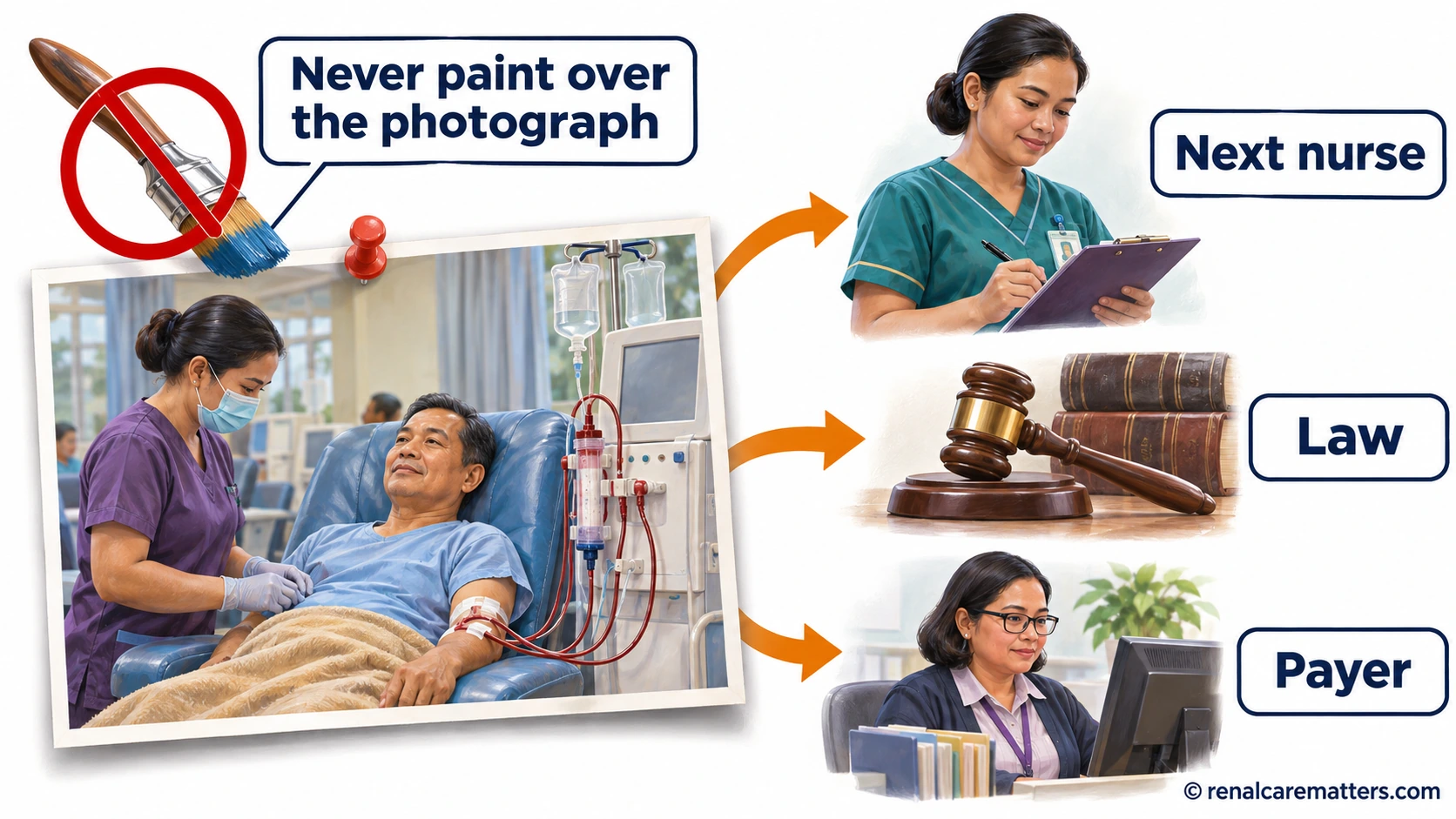
In plain wordsA treatment record is a photograph of the session. If someone paints over the photograph to make it look better, it is no longer evidence of anything.
The record has three readers. The next nurse acts on it. The law relies on it. The payer pays on it, for hemodialysis (HD) sessions and peritoneal dialysis (PD) packages alike. A record that says four hours when the patient had three hours and twenty minutes misleads all three, and the first reader, the next nurse, is the one who can hurt the patient with it.
Figure 1 · Key terms for this module
Late entryA record written after the event, labeled late, with the true event time.
CorrectionA single line through the error, the correct entry, date, time, and signature.
IncidentAn event that harmed or could have harmed a patient.
Run chartA graph of a measure over time with a median line, used to see whether a change worked.
MedianThe middle value when all values are sorted.
Opening case · fictional
Case: “Just write four hours”
At the end of the month, a staff nurse asks the charge nurse, Paolo, to “fix” six records where sessions were shortened, so the PhilHealth claims look complete. She says the claims officer told her short sessions cause problems.
PhilHealth covers up to 156 hemodialysis sessions a year for registered patients with chronic kidney disease stage 5, at 6,350 pesos per session since October 2024.1,2
Before reading on, decide:
What is Paolo’s answer?
What is the right way to correct a record?
What improvement project hides inside this request?
Keep your answers in mind. The lesson gives you what you need, and the case review near the end shows one sound response.
Lesson · part 1
A good record
Write the times (start, end, events), what you saw, what you did, who you told, what they decided, and how the patient responded. Late entries are labeled late, with the true event time. Corrections are a single line through the error, the correct entry, the date, the time, and your signature. Electronic records keep an audit trail of every change; anyone can see what was changed and when.
Lesson · part 2
Where the record meets the claim
The claim depends on the record, not the other way around. A shortened session is recorded as shortened. How payer rules apply to a short session is a question for the claims officer and the head nurse (the PhilHealth Claims and Head Nurse tracks cover it), not a reason to change what happened.
Figure 2. The record is a photograph of the session, read by the next nurse, the law, and the payer.
The money is large, which is why accuracy is scrutinized. In the first half of 2025, PhilHealth paid about 27 billion pesos for more than two million hemodialysis claims.3
Lesson · part 3
Never fabricate
Writing four hours when three hours and twenty minutes were delivered is falsification. It harms the patient (the next nurse believes the dose was given), the nurse (her license), and the unit (its accreditation and its claims). The charge nurse says no, explains why, and tells the head nurse about the request so the pressure behind it can be addressed.
Stop and callA request to change a record so it no longer matches what happened: refuse, explain, and report the request to the head nurse.
Lesson · part 4
When something goes wrong
Protect the patient first. Tell the physician. Preserve the evidence: lines, dialyzer, labels, syringes, logs. Report through the unit’s system. Support the staff involved; the nurse who made the error is often the second person hurt by it.
An investigation asks how the system allowed the error, not only who made it: workload, interruptions, look-alike packaging, unclear orders. The fixes that work best change the system (a separated shelf, a protected task) rather than asking people to try harder.
Lesson · part 5
Improve one thing
Pick one problem that keeps coming back: late starts, shortened sessions, missed glucose checks. Define one measure. Collect it every day or week on a simple run chart. Try one change and watch whether the line moves.4
Figure 3. Six or more points in a row on one side of the median suggests a real shift, not noise.
Read the run chart with a simple rule: six or more consecutive points on one side of the median suggest a real shift, not noise. One good week proves nothing; a run does.
On the floor · The project that started with a refusal
After Paolo refuses to change the six records, he asks why sessions are being shortened. He counts four weeks of sessions: 31 of 240 shortened, most for cramps on high-gain days, some for late transport, some for alarms. That count becomes his improvement project, below.
Illustrative scenario. Names and details are invented.
On the floor
Real situations: problems and solutions
These are fictional but typical. For each one, cover the answer, decide what you would do, then compare. Where a step depends on local rules, your unit’s procedure and your supervisor’s direction come first.
The machine log and the record disagree
What you see
The machine shows 3 h 20 min; the record says 4 h.
What is likely going on
The record was written from the plan, not the session.
What to do
Investigate, correct with a single line and a note, and record the truth.
Why it matters
The record is a photograph.
An error by a friend
What you see
A colleague you like gave the wrong dose.
What is likely going on
Loyalty and safety pulling apart.
What to do
Report through the system, and support her through it.
Why it matters
Reporting fixes the system that let her fail.
“Just sign here”
What you see
The claims officer asks you to sign for a session you did not supervise.
What is likely going on
Paperwork pressure.
What to do
Sign only what you did or saw. Refer the rest to the nurse who did it.
Why it matters
Your signature is a statement of fact.
Field notes
The record is a photograph.
Late is labeled late.
Measure before you change.
Case review
Back to the case: “Just write four hours”
Paolo’s answer. No. The records stay as they are, because they describe what happened. He explains why to the staff nurse, documents the request, and tells the head nurse so that the pressure on short sessions can be dealt with honestly with the claims officer.
Correcting a record. If a record contains a genuine error, draw a single line through it, write the correct entry, and add the date, time, and signature. Never erase, white out, or rewrite a page.
The improvement project (Head Nurse toolkit #c10). Baseline over four weeks: 31 of 240 sessions shortened (12.9%), median 10 minutes each; 14 early stops for cramps, 9 late starts from transport, 8 machine alarms. The change tested: a pre-session fluid check and an attending review whenever the planned ultrafiltration rate would exceed 13 mL/kg/h, aimed at cramps. Next four weeks: 18 of 236 shortened (7.6%), with cramp-related stops down from 14 to 5. The run chart shows seven consecutive weekly points below the median. Paolo reports it at the unit meeting and starts on transport next.
Skills lab · with your preceptor
Skills checklist: The record and one improvement
Audit five of your own records against the machine logs, correct one simulated error properly, and present a run chart. Your preceptor rates each step as satisfactory, needs practice, or not observed. Steps marked Critical must all be satisfactory before sign-off. This checklist supports supervised learning; your unit’s own procedure and competency form are the authority. A printable version of every checklist is on the trainer page.
CriticalWrites an event entry with times, actions, who was told, and what was decided.
CriticalCorrects a record with a single line, the correct entry, date, time, and signature.
CriticalRefuses a request to falsify a record and reports it.
Lists what evidence to preserve after an incident.
Chooses one measure and plots it on a run chart with a median.
Reads a run chart using the six-point rule.
Placement activity. Run one improvement measure for at least eight weeks and present the run chart to the head nurse.
Self-assessment
Check your understanding
Each visit draws 8 questions at random from this module’s 15-question bank. Choose the single best answer for each, then select Check answers; an explanation appears under the best answer. Select New set of questions for a different mix. A good target is 7 of 8 on two different sets. Nothing you select is sent anywhere; scoring happens in your browser.
Philippine Health Insurance Corporation. (2024). PhilHealth Circular No. 2024-0023: Institutionalization of 156 hemodialysis sessions and coverage expansion (Revision 2).
Philippine Health Insurance Corporation. (2025, March 27). PhilHealth’s expanded benefits bring financial relief to dialysis patients. Retrieved November 24, 2026, from https://www.philhealth.gov.ph/news/up/article/2025/news_67e9e793775ed.php
Untalan, S. (2025, June 23). PhilHealth expands coverage for kidney disease, heart conditions, emergency outpatient care. GMA News Online. Retrieved November 24, 2026, from https://www.gmanetwork.com/news/topstories/nation/950268/philhealth-kidney-disease-heart-conditions-outpatient-care/story
Perla, R. J., Provost, L. P., & Murray, S. K. (2011). The run chart: A simple analytical tool for learning from variation in healthcare processes. BMJ Quality & Safety, 20(1), 46–51. https://doi.org/10.1136/bmjqs.2009.037895
Educational study material for nurses. Does not replace the attending nephrologist’s orders, the unit’s protocols, required training and certification, or supervised practice.