The doctor in the room
For four hours at a time, a hemodialysis (HD) machine takes over part of the work of two failed kidneys. Most sessions are uneventful. Some are not: blood pressure falls, a patient has chest pain, a fever starts, or an alarm will not clear. The physician on duty is the doctor in the room when that happens.
Most physicians on duty are not nephrologists. Medical school teaches the healthy kidney and the failing kidney, but very little about the patient who has no kidney function at all and lives by a machine three times a week. That patient breaks many rules of general medicine. A liter of intravenous fluid that would help another patient can put this one in pulmonary edema. A “normal” laboratory result may be alarming, and an alarming one may be this patient’s normal.
Figure 1 · What this series will help you do
The series is written in plain language. Every new term is explained when it first appears, and every module has figures, a case, a skills checklist, and a self-assessment.
What this series is, and is not
It is study material written independently from published guidelines, textbooks, and research. It is not a certificate, and it does not replace the requirements for physicians on duty in the Philippines. The Philippine Society of Nephrology (PSN) standards for hemodialysis clinics expect a physician on duty to hold a current advanced cardiac life support (ACLS) certificate and a certificate from a PSN-conducted or PSN-accredited course for physicians on duty, and to work under the supervision of the attending nephrologist and the clinical head of the unit.1 This series is not that course and is not affiliated with or endorsed by PSN. Use it to prepare, to review, and to support orientation in your own unit.
Start with what you need for your first shift
The series has 32 modules in seven parts. You do not need all of them before your first duty. Each module is marked with one of three tiers.
Figure 2 · The three tiers
Modules open as they are completed and reviewed. A module marked “In preparation” is planned but not yet published.
Thirty-two modules in seven parts
Study the modules in order within your tier. The parts follow a physician’s own path: the patient, the treatment, one session, emergencies, long-term care, and the unit.
Part 1 · Starting out

Part 2 · The patient is different
 Module 2Essentials
Life Without Kidney Function I: Water, Salt, Potassium, and Acid
What healthy kidneys do each day, what builds up between sessions, why a fluid bolus behaves differently, and why potassium and acid rise.
Part 3 · The treatment
 Module 5Essentials
Inside the Machine: How Blood Is Cleaned
The blood circuit, the dialyzer, diffusion and ultrafiltration, the machine’s monitors, and what the common alarms mean.
 Module 9Essentials
The Lifeline I: Fistulas and Grafts
How to examine a fistula or graft, recognize narrowing, clotting, infection, and aneurysm, and control bleeding.
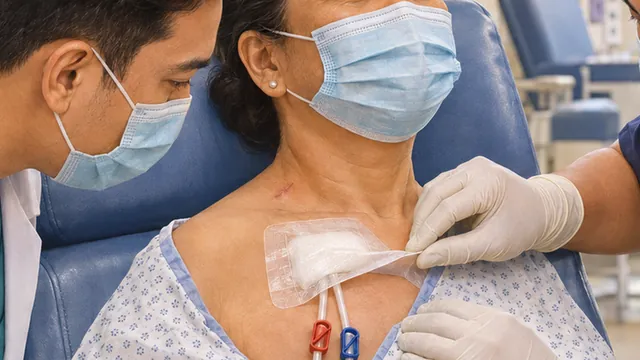 Module 10Essentials
The Lifeline II: Catheters
Catheter types, exit-site and tunnel checks, poor flow, infection, and catheter emergencies.
Part 4 · The session
 Module 11Essentials
Safe to Start, Safe to Go Home
A focused assessment before the session, the decision to start, delay, or transfer, and the check before the patient leaves.
Part 5 · Emergencies in the chair
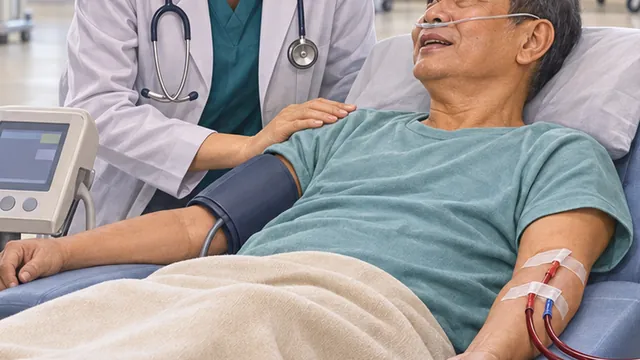 Module 13Essentials
When the Pressure Falls
Why blood pressure falls during dialysis, the stepwise response, and how to tell a simple drop from a dangerous cause.
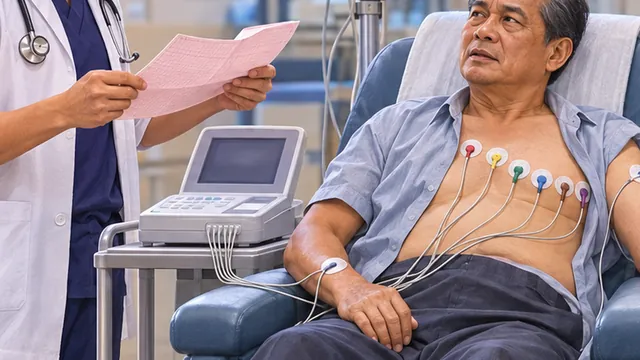 Module 15Essentials
Heart Emergencies in the Chair: Chest Pain, Arrhythmia, and Cardiac Arrest
Sorting chest pain by cause, reading the electrocardiogram in a dialysis patient, and leading resuscitation beside a dialysis machine.
 Module 16Essentials
When the Circuit Fails: Air, Hemolysis, Reactions, and Blood Loss
Air embolism, hemolysis, dialyzer reactions, needle dislodgement, and clotting, and when the blood must not be returned.
Part 6 · The long game
Part 7 · The unit and the system
The same seven steps every time
Figure 3 · How to work through a module
- ObjectivesRead what you should be able to do by the end.
- Big pictureA plain-words summary and the key terms, before any detail.
- Opening caseA fictional shift problem. Decide what you would do first.
- LessonShort parts with pictures, tables, and worked examples.
- Case reviewCompare your answer with one sound response.
- Skills checklistPractice with a preceptor on real or training equipment.
- Self-assessmentFive questions drawn from a larger bank, with explanations.
New terms are explained the first time they appear, and every page ends with a glossary. Abbreviations are spelled out at first use. If a sentence still reads like jargon, check the glossary, then ask your preceptor to show you the real object on the unit: most of this work makes sense faster when you can see and touch the equipment.
The series at a glance
Each module takes about 45 to 75 minutes to read and work through. Skills checklists are completed on the unit with a preceptor.
| No. | Module | Lessons | Opening case | Skills checklist | Practice |
|---|---|---|---|---|---|
| 1 | Your Role on the Dialysis Floor |
| The first Monday | Start-of-shift readiness round | 15 questions · 5 real situations |
| 2 | Life Without Kidney Function I: Water, Salt, Potassium, and Acid |
| One liter, fast | Bedside volume assessment | 15 questions · 5 real situations |
| 3 | Life Without Kidney Function II: Uremia, Residual Function, and Starting Dialysis | — | In preparation | ||
| 4 | Life Without Kidney Function III: Heart, Blood, Bone, and Defenses | — | In preparation | ||
| 5 | Inside the Machine: How Blood Is Cleaned |
| The venous pressure alarm | Circuit and alarm walk-through on a training machine | 15 questions · 5 real situations |
| 6 | Water and Dialysate: The Hidden Half of the Treatment | — | In preparation | ||
| 7 | Reading the Dialysis Order and Judging the Dose | — | In preparation | ||
| 8 | Dry Weight: Finding the Right Amount of Fluid | — | In preparation | ||
| 9 | The Lifeline I: Fistulas and Grafts |
| The thrill is gone | Full access examination | 15 questions · 5 real situations |
| 10 | The Lifeline II: Catheters |
| The catheter that would only push | Exit-site inspection and hub handling | 15 questions · 5 real situations |
| 11 | Safe to Start, Safe to Go Home |
| She walked in breathless. | Pre-dialysis clearance note and post-dialysis discharge check | 15 questions · 5 real situations |
| 12 | First Sessions and Unusual Sessions | — | In preparation | ||
| 13 | When the Pressure Falls |
| Hour three | Hypotension response on a simulated patient | 15 questions · 5 real situations |
| 14 | High Blood Pressure and the Breathless Patient | — | In preparation | ||
| 15 | Heart Emergencies in the Chair: Chest Pain, Arrhythmia, and Cardiac Arrest |
| Palpitations at the end of the long weekend | 12-lead ECG at the chairside, and mock code as team leader | 15 questions · 5 real situations |
| 16 | When the Circuit Fails: Air, Hemolysis, Reactions, and Blood Loss |
| Three patients, one complaint. | Emergency disconnect and manual blood return on a training circuit | 15 questions · 5 real situations |
| 17 | The Shivering Patient: Fever and Bloodstream Infection | — | In preparation | ||
| 18 | The Confused or Seizing Patient: Potassium, Sugar, and the Brain | — | In preparation | ||
| 19 | Bleeding and Heparin | — | In preparation | ||
| 20 | Prescribing Without Kidneys | — | In preparation | ||
| 21 | Blood and Bone: Anemia and Mineral Disorders | — | In preparation | ||
| 22 | Diabetes on Dialysis | — | In preparation | ||
| 23 | Food, Fluid, and Muscle | — | In preparation | ||
| 24 | Symptoms in the Chair and at Home: Cramps, Itch, Sleep, Pain, and Fatigue | — | In preparation | ||
| 25 | Special Patients: Frailty, Complex Illness, and Pregnancy | — | In preparation | ||
| 26 | The Person in the Chair: Mood, Burden, and Choices About Care | — | In preparation | ||
| 27 | Other Roads: Transplant, Peritoneal Dialysis, and Conservative Care | — | In preparation | ||
| 28 | Outside the Unit: Surgery, Contrast, Hospital Stays, and Travel | — | In preparation | ||
| 29 | A Clean Unit: Hepatitis, HIV, Tuberculosis, and Vaccines | — | In preparation | ||
| 30 | When the Power or Water Fails | — | In preparation | ||
| 31 | Rules, Records, and Quality | — | In preparation | ||
| 32 | Putting It Together: Bedside Skills and a Simulated Shift | — | In preparation |
Self-assessment is not sign-off
The questions at the end of each module are for practice. Each visit draws eight from a bank of fifteen, and every question explains its best answer. The questions were written for this series.
Competence is shown on the unit, not on a screen: examining an access, assessing a patient before a session, responding to a fall in blood pressure, and calling the attending nephrologist with a clear report. Each module has a skills checklist for a preceptor, usually the attending nephrologist or a senior physician on duty, to complete while watching you work.
End-of-course examination. When you have finished every module, take the end-of-course examination. It draws questions at random from all 9 modules, so no two sittings are the same.
What the series is built on
The series is built from published sources. Physiology follows standard textbooks.2,3 Clinical recommendations follow the guidelines of Kidney Disease: Improving Global Outcomes (KDIGO) and its conference reports, and the research they rest on.4 Philippine expectations for physicians on duty come from the Department of Health (DOH) licensing order for dialysis facilities and the PSN standards for hemodialysis clinics.5,1 Each module lists its own sources.
Where the evidence is strong, the text says so. Where a practice rests on observation, expert opinion, or local custom, the text says that instead. Doses and cut-off values are left to your unit’s protocol and the attending nephrologist.
Using the series in a training program
An attending nephrologist, medical director, or senior physician on duty can use these modules as the guided-study part of unit orientation. The trainer and preceptor page gathers the proposed hours, completion criteria, and every skills checklist in one printable place. These are proposals for a provider to adapt and validate on its own equipment; they are not requirements of any regulator.