
The physician who signs
A hemodialysis (HD) unit is a small hospital that runs on borrowed physiology. For four hours, three times a week, each patient’s blood leaves the body, crosses a membrane bathed in about 120 liters of fluid your unit made from tap water, and comes back. Between sessions, the patient carries everything a kidney would have cleared. The unit is safe only when the water was released, the machines were tested, the staff on the floor can do what they are assigned, and someone notices when one of those is not true.
The clinical head is the physician whose name is on the appointment. You are accountable for the clinical system: the policies, the competency of the people who follow them, the quality program, and the decision to hold or restart a service when something fails. You are not the owner, the billing office, the water technician, or every patient’s attending nephrologist. Much of this track is about knowing exactly where your authority starts and stops, and making sure every decision has an owner.
Figure 1 · What this track will help you do
The track is written in plain language. Every new term is explained when it first appears, and every module has figures, a case, a calculator, a skills checklist, and a self-assessment. Modules 9 to 14 rehearse the decisions that arrive with pressure attached: an owner, a family, a reporter, a regulator.
What this series is, and is not
It is a training track written independently from published laws, regulations, guidelines, and research. It is not a license, a DOH or PhilHealth requirement, PSN attestation, continuing professional development (CPD) credit, or legal advice. It does not replace your appointment terms, your unit’s approved policies, or the attending nephrologist, who is always asked for guidance on a patient’s care.
Nine weeks of study, in five parts
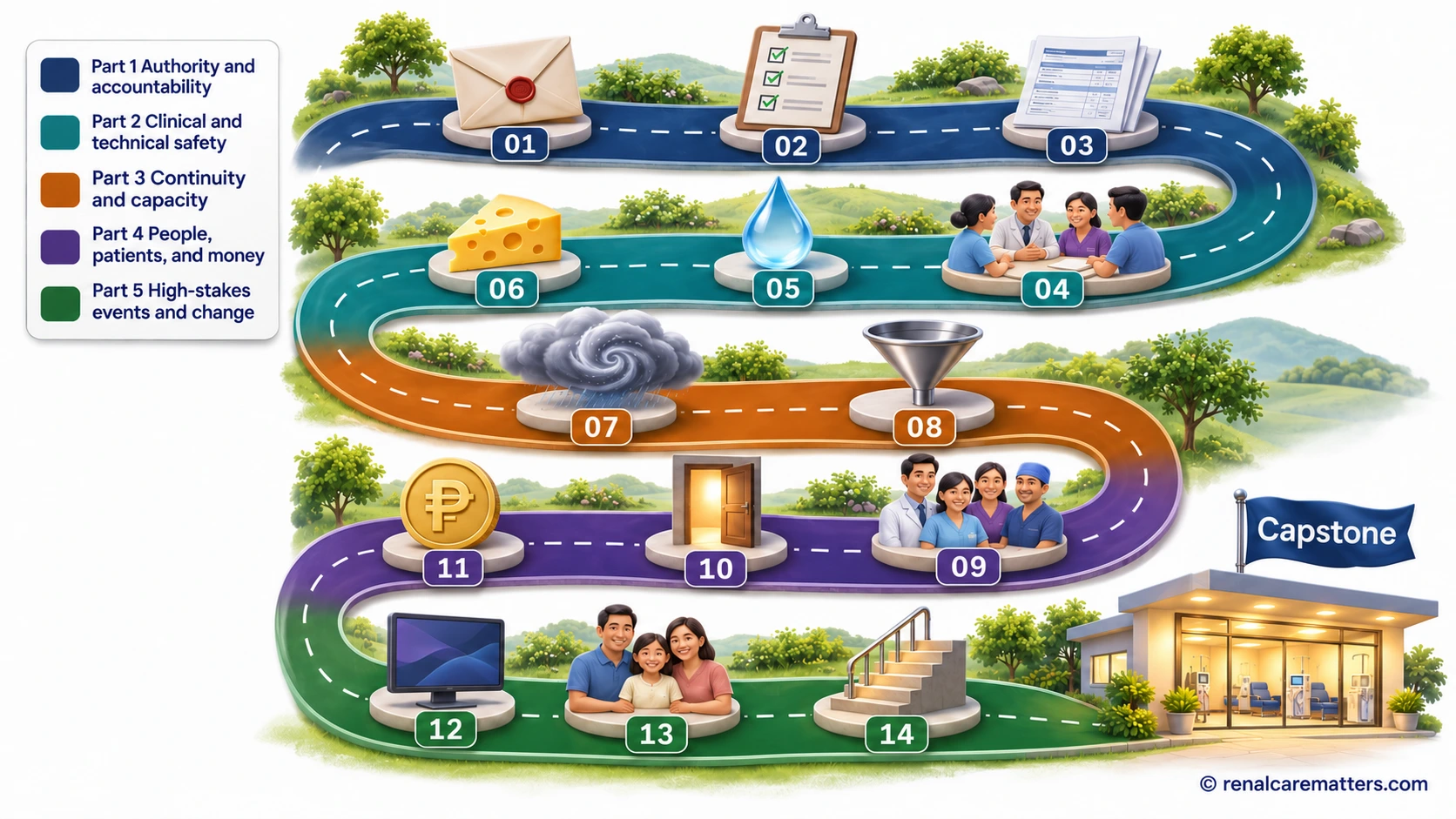
The fourteen modules are grouped into five parts that follow the order a new clinical head meets the work: first the authority you hold, then the barriers that keep patients safe, then the days when the system is stressed, then the people and money that run it, and last the events that test it in public.
Figure 3 · The five parts
Fourteen modules in five parts
Study the modules in order. Each one starts from why a control exists, moves to what the evidence and the rules say, and ends with what a clinical head does on Monday morning.
Part 1 · Authority and accountability
 Module 1
Before You Sign: Authority and Appointment
What a clinical head owns, the authority matrix, the questions to settle with the owner, and when to refuse an appointment.
 Module 2
Licensing and Inspection Readiness
Which DOH rule governs what, changes that need approval first, the three-source tracer, and closing a finding with proof.
 Module 3
PhilHealth: Accreditation, the Package, and the Claim
Provider status, the 156-session package and what it must include, the chart-to-claim trace, and talking to a patient about a disputed charge.
Part 2 · Clinical and technical safety
 Module 4
Clinical Oversight: Coverage, Pathways, and Rights
Who covers each shift, the readiness huddle, care pathways that do not leak, the transfer handoff, and patient rights.
 Module 5
Infection, Water, and Machines: The Invisible Barriers
Why dialysis is an infection-prone setting, what water can do to a patient, reading a water log, and two-signature release.
 Module 6
Risk Management and Proving Improvement
Writing a risk, scoring it honestly, the hierarchy of fixes, rates with denominators, and telling improvement from research.
Part 3 · Continuity and capacity
 Module 7
The Dialysis Clock: Disasters and Continuity
Why dialysis patients have a deadline in days, dependencies that fail together, the patient tracker, and a signed restart.
 Module 8
Safe Capacity, Supply, and the Board Brief
Counting safe slots, the limiting resource, reorder points, and a one-page brief an owner can act on.
Part 4 · People, patients, and money
 Module 9
Leading the Workforce Under Pressure
Competence-matched staffing, protecting the person who speaks up, separating safety from discipline, and burnout.
 Module 10
Access, Conflict, and Transitions
Why patients miss sessions, safety before scheduling, involuntary transfer, social assistance, and closing referrals.
 Module 11
Money, Procurement, and Conflicts of Interest
Reading the finances, the cost of a shortage, qualifying a substitute, disclosure and recusal, and disputes between clinicians.
Part 5 · High-stakes events and change
 Module 12
When the System Goes Dark: Downtime and Privacy
The minimum safe data set, the paper bridge, reconciliation, and what the Data Privacy Act asks when a roster leaks.
 Module 13
Serious Events, Families, and Outside Scrutiny
The first fifteen minutes, looking for a shared exposure, talking with a family, the reporter on the line, and supporting staff.
 Module 14
New Services, Handover, and Your First 90 Days
Judging a new technology such as hemodiafiltration on evidence, staged launches with stop rules, handover, and a 30-60-90 plan.
The same seven steps every time
Figure 4 · How to work through a module
- ObjectivesRead what you should be able to do by the end.
- Big pictureA plain-words summary and the key terms, before any detail.
- Opening caseA fictional shift problem. Decide what you would do first.
- LessonShort parts with pictures, tables, and worked examples.
- Case reviewCompare your answer with one sound response.
- Skills checklistPractice with a preceptor on real or training equipment.
- Self-assessmentFive questions drawn from a larger bank, with explanations.
New terms are explained the first time they appear, and every page ends with a glossary. Abbreviations are spelled out at first use. If a sentence still reads like jargon, check the glossary, then ask your preceptor to show you the real object on the unit: most of this work makes sense faster when you can see and touch the equipment.
The series at a glance
Each module takes about 60 to 90 minutes to read and work through, plus a practice session at your own unit (about 18 to 20 hours of reading in all). Skills checklists are completed with a preceptor in simulation.
| No. | Module | Lessons | Opening case | Skills checklist | Practice |
|---|---|---|---|---|---|
| 1 | Before You Sign: Authority and Appointment |
| Four sites by Monday | Authority matrix and pre-appointment meeting | 15 questions · 3 real situations |
| 2 | Licensing and Inspection Readiness |
| Two machines and an empty bay | Three-source tracer and finding record | 15 questions · 3 real situations |
| 3 | PhilHealth: Accreditation, the Package, and the Claim |
| The session on two dates | Chart-to-claim trace and patient explanation | 15 questions · 3 real situations |
| 4 | Clinical Oversight: Coverage, Pathways, and Rights |
| Before the first patient connects | Shift readiness and closed-loop escalation | 15 questions · 3 real situations |
| 5 | Infection, Water, and Machines: The Invisible Barriers |
| Two patients have rigors | Infection prevention audit, water-log review, and two-signature release | 15 questions · 3 real situations |
| 6 | Risk Management and Proving Improvement |
| The order caught in time | Risk score, causal timeline, and effectiveness check | 15 questions · 3 real situations |
| 7 | The Dialysis Clock: Disasters and Continuity |
| The road is flooded | Continuity activation and patient tracker | 15 questions · 3 real situations |
| 8 | Safe Capacity, Supply, and the Board Brief |
| Eighteen on the schedule | Safe capacity, reorder point, and board brief | 15 questions · 3 real situations |
| 9 | Leading the Workforce Under Pressure |
| The nurse who calls out | Staffing decision and protected escalation | 15 questions · 3 real situations |
| 10 | Access, Conflict, and Transitions |
| The family at reception | Reception safety, access barriers, and continuity | 15 questions · 3 real situations |
| 11 | Money, Procurement, and Conflicts of Interest |
| Three days of stock | Resource decision and conflict of interest | 15 questions · 3 real situations |
| 12 | When the System Goes Dark: Downtime and Privacy |
| The chart goes dark | Downtime treatment, reconciliation, and breach escalation | 15 questions · 3 real situations |
| 13 | Serious Events, Families, and Outside Scrutiny |
| A second patient feels unwell | Serious event command and family conversation | 15 questions · 3 real situations |
| 14 | New Services, Handover, and Your First 90 Days |
| The night shift already announced | Technology appraisal, go/no-go brief, and handover | 15 questions · 3 real situations |
Self-assessment is not sign-off
Each module ends with a self-assessment of 8 questions drawn at random from a bank of 15; the mastery mark is 7 of 8 on two different sets. The end-of-track examination draws 40 questions from all fourteen banks. The capstone is a three-hour defense of a written unit plan before a senior clinical head, scored on ten gates, two of them critical.
End-of-course examination. When you have finished every module, take the end-of-course examination. It draws questions at random from all 14 modules, so no two sittings are the same.
What the series is built on
The track is built from published sources. Philippine requirements follow the Department of Health (DOH) licensing and water orders, PhilHealth circulars, the Philippine Society of Nephrology (PSN) hemodialysis guidelines, and the laws on disaster risk reduction and data privacy.1,2,3,4,5,6,7 Clinical and operational statements follow the trials and guidelines they rest on, including the National Kidney Foundation Kidney Disease Outcomes Quality Initiative (KDOQI), the International Organization for Standardization (ISO) water standard, and the Centers for Disease Control and Prevention (CDC) dialysis recommendations.8,9,10
Where the evidence is strong, the text says so. Where a practice rests on observation, expert opinion, or local custom, the text says that instead. Where Philippine data are missing, the track uses data from the United States and other countries and says so. Regulatory statements were checked against public sources on November 24, 2026. One issuance, DOH Department Circular 2026-0112 on interim licensing of hemodialysis clinics, was confirmed by title only; its text must be read before any rule in it is applied.11
Using the series in a training program
A nephrology program director, a senior clinical head, or a hospital medical director can use these modules as the guided-study part of a clinical head’s orientation. The trainer and preceptor page gathers the proposed hours, completion criteria, and every skills checklist in one printable place. These are proposals for a provider to adapt and validate on its own equipment; they are not requirements of any regulator.


