A study series for the people behind the machines
A hemodialysis (HD) technician prepares the station, sets up and checks the machine, helps watch the treatment, cleans and resets the station, and keeps the records that prove each step was done. The tasks are technical. The purpose behind them is plain: every patient receives the right treatment, on safe equipment, with clean water, every time.
The series has twelve modules. It begins with the dialysis unit and your place in the team, and moves through kidney failure and the science of dialysis. It then covers infection prevention, machines, water, vascular access, the treatment session, emergencies, and dialyzer reprocessing. The last module brings all of it together in a practical assessment.
Figure 1 · What makes this series easier to study
The series is free. It needs no account, and nothing you answer is sent to any server.
What this series is, and is not
This is study material. It is not a license, a certificate of training, or proof of competence, and it carries no Continuing Professional Development (CPD) units. In the Philippines, the Department of Health (DOH) licenses dialysis facilities, and what a technician may do is set by the facility under that license and by the supervising nurse and nephrologist.1,2 Skills are learned, and signed off, on real equipment with a preceptor.
One foundation, three technical roles
A dialysis unit depends on three kinds of technical staff, grouped here as the Renal Technician Program. Most people start at the chairside as a dialysis technician. From there, two specialist branches open up: the water room and the workshop. The three study series share the same format, so you can move between them.
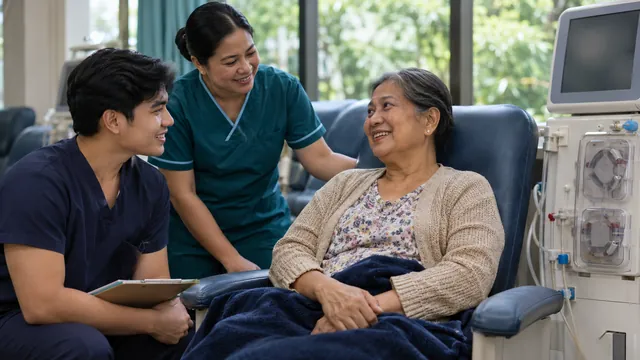 Foundation · chairsideDialysis TechnicianStations, machines, the blood circuit, the treatment session, and safe teamwork with the dialysis nurse.
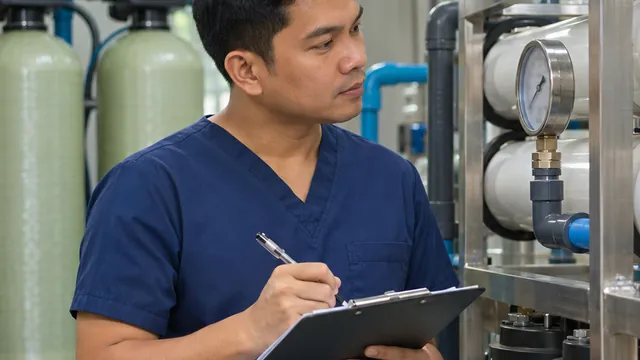 Specialist branch · water roomWater Treatment System TechnicianPretreatment, carbon tanks, reverse osmosis, the distribution loop, daily testing, sampling, and disinfection.
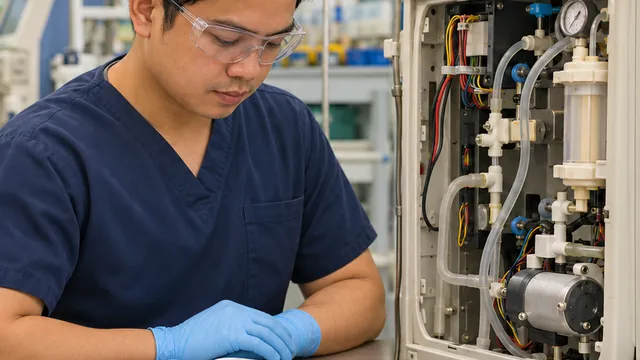 Specialist branch · workshopHemodialysis Center Biomedical TechnicianHow dialysis machines work inside, preventive maintenance, calibration, safety testing, troubleshooting, and return to service.
Start with this series whichever role you are aiming for. Water treatment and biomedical technicians need the same foundation. The water they produce and the machines they repair end at a patient, and they must understand what that patient is going through.
Twelve modules, in order
Study the modules in order, because each one builds on the one before. If you tick the box on a module’s self-assessment, your result appears on that module’s card here. It is stored only in this browser.
Module 1
The Dialysis Unit and the Technician’s Role
How a dialysis unit runs during a shift, who does what, how to confirm a patient’s identity, and how to report and record a problem.
 Module 2
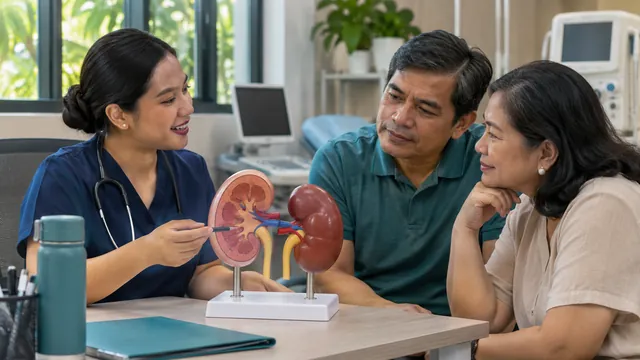
Kidneys and Kidney Failure
What healthy kidneys do, what goes wrong when they fail, and how to read and report simple changes in weight, symptoms, and laboratory results.
 Module 3
Treatment Options and Living with Kidney Failure
The five ways kidney failure is treated, what home dialysis involves, and how to listen, explain the basics, and refer questions.
 Module 4
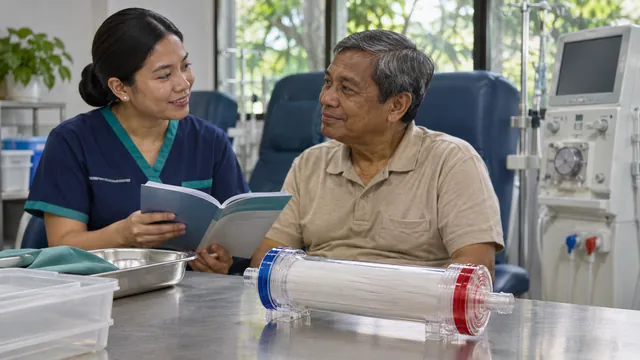
Principles of Hemodialysis
How a dialyzer removes wastes and water, what dialysate is for, how the fluid numbers differ, and what adequacy tests measure.
 Module 5
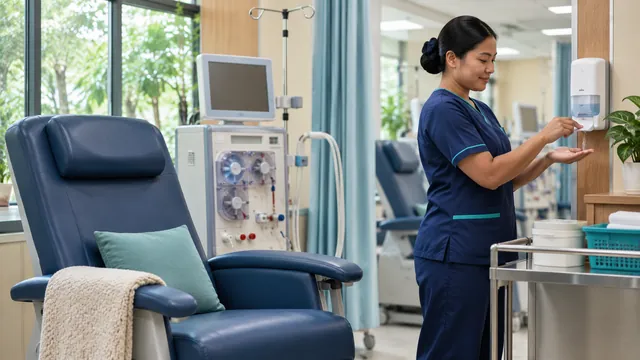
Dialysis Infection Prevention and Waste Management
Hand hygiene, protective equipment, clean and used areas, station turnover and contact time, waste sorting, and what to do after a blood exposure.
 Module 6
Machines, Dialyzers, and the Extracorporeal Circuit
The blood path and the dialysate path, operating the machine from switch-on to shutdown, priming step by step, machine disinfection, and what to do when a machine fails a check.
 Module 7
Water Treatment, Concentrates, and Dialysate
How tap water becomes dialysis water, which test checks what, how concentrates become dialysate, and how to respond to an out-of-range result.
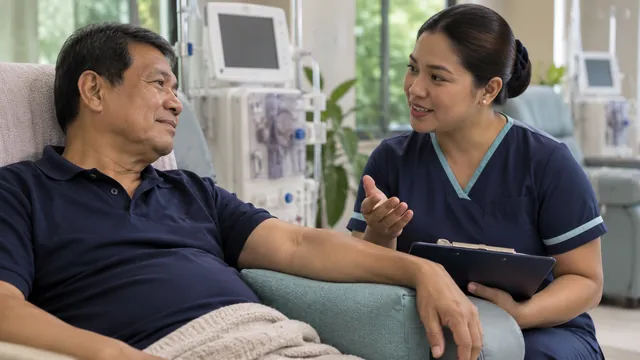 Module 8
Vascular Access Recognition and Protection
Fistulas, grafts, and catheters; how to protect the access in everyday care; and the changes that must be reported at once.
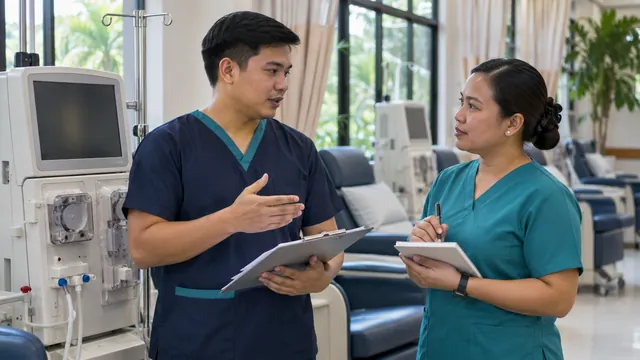 Module 9
The Hemodialysis Session
One treatment from arrival to station turnover: what to verify before, what to watch during, a chairside guide to every machine alarm, and how to finish and hand over.
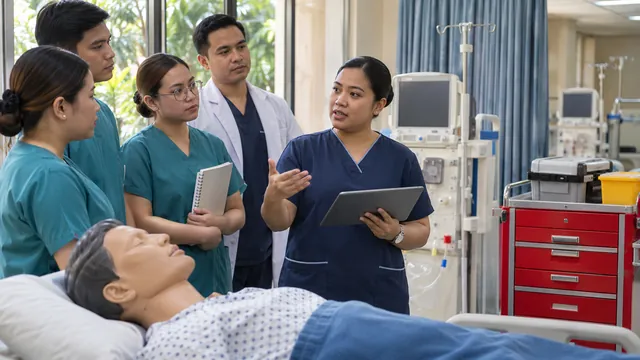 Module 10
Complications and Emergency Response
Recognizing trouble during dialysis, calling for help, working in an emergency team, and responding to water, power, and facility failures.
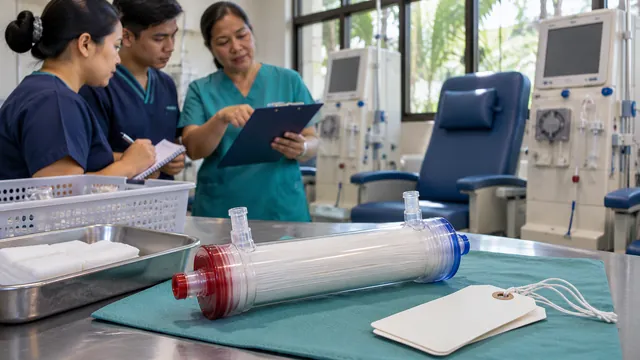 Module 11
Dialyzer Reprocessing and Equipment Quality
The life of a reprocessed dialyzer; manual, semi-automated, and automated reprocessing step by step; total cell volume and leak tests; germicide checks before use; and the records that make a dialyzer traceable.
 Module 12
Integrated Practice and Competency Assessment
Everything together: readiness checks, urgent reports, records and improvement, five practical stations, the logbook, and the examination blueprint.
The same seven steps every time
Figure 2 · How to work through a module
- ObjectivesRead what you should be able to do by the end.
- Big pictureA plain-words summary and the key terms, before any detail.
- Opening caseA fictional shift problem. Decide what you would do first.
- LessonShort parts with pictures, tables, and worked examples.
- Case reviewCompare your answer with one sound response.
- Skills checklistPractice with a preceptor on real or training equipment.
- Self-assessmentFive questions drawn from a larger bank, with explanations.
New terms are explained the first time they appear, and every page ends with a glossary. Abbreviations are spelled out at first use. If a sentence still reads like jargon, check the glossary, then ask your preceptor to show you the real object on the unit: most of this work makes sense faster when you can see and touch the equipment.
The series at a glance
The hours are a proposed design for a provider-led program of about three months: 72 classroom hours, 60 skills-lab hours, and 168 hours of supervised placement, 300 hours in all. They are a planning proposal. They are not a regulatory requirement.
| No. | Module | Lessons | Opening case | Skills checklist | Practice | Classroom (h) | Skills lab (h) | Placement (h) |
|---|---|---|---|---|---|---|---|---|
| 1 | The Dialysis Unit and the Technician’s Role |
| A name that almost matched | Shift-start verification and handoff | 21 questions · 4 real situations | 6 | 4 | 10 |
| 2 | Kidneys and Kidney Failure |
| Swelling and fatigue before dialysis | Mock renal trend review | 22 questions · 4 real situations | 8 | 2 | 10 |
| 3 | Treatment Options and Living with Kidney Failure |
| Making treatment fit everyday life | Treatment-options conversation | 21 questions · 4 real situations | 8 | 2 | 10 |
| 4 | Principles of Hemodialysis |
| Which number is the fluid removal goal? | Mock dialysis record and membrane demonstration | 22 questions · 4 real situations | 8 | 4 | 10 |
| 5 | Dialysis Infection Prevention and Waste Management |
| The cuff looks clean | Simulated dialysis station turnover | 22 questions · 4 real situations | 6 | 6 | 14 |
| 6 | Machines, Dialyzers, and the Extracorporeal Circuit |
| Failed before the first treatment | Unconnected training machine | 20 questions · 4 real situations | 6 | 8 | 16 |
| 7 | Water Treatment, Concentrates, and Dialysate |
| First-shift total chlorine result | Simulated water log and exception response | 22 questions · 4 real situations | 6 | 6 | 16 |
| 8 | Vascular Access Recognition and Protection |
| The usual vibration is gone | Access recognition and handoff | 21 questions · 4 real situations | 6 | 6 | 14 |
| 9 | The Hemodialysis Session |
| An unexpected pre-treatment weight | Simulated session and exception handoff | 20 questions · 4 real situations | 6 | 8 | 18 |
| 10 | Complications and Emergency Response |
| Sudden chest pain at the station | Emergency drill and utility tabletop | 22 questions · 5 real situations | 6 | 6 | 16 |
| 11 | Dialyzer Reprocessing and Equipment Quality |
| A passed check with an unreadable label | Traceability and quality simulation | 23 questions · 4 real situations | 4 | 4 | 12 |
| 12 | Integrated Practice and Competency Assessment |
| Two holds at shift start | Five practical stations | 22 questions · 4 real situations | 2 | 4 | 22 |
| Total | 72 | 60 | 168 |
Self-assessment is not sign-off
The questions at the end of each module are for practice. Each visit draws five from a bank of fifteen, and every question explains its best answer. Retry as often as you like.
Skills work differently. Nobody learns to ride a motorcycle from the owner’s manual, and nobody can learn or be judged on setting up a circuit, testing water for chlorine, or answering an alarm from a screen. Each module therefore has a skills checklist that a preceptor completes while watching you work on the unit’s own equipment. Steps marked Critical are the steps where a mistake can reach a patient. Every one of them must be done correctly before sign-off.
Figure 3 · Three levels of learning a skill
End-of-course examination. When you have finished every module, take the end-of-course examination. It draws questions at random from all 12 modules, so no two sittings are the same.
What the series is built on
The scope follows Philippine expectations for dialysis facilities and internationally used technician curricula. Two Philippine sources set what applies locally: the DOH licensing order for dialysis facilities and the Philippine Society of Nephrology (PSN) guidelines for hemodialysis clinics.1,2 International sources served as a check that nothing important was left out: the Medical Education Institute (MEI) Core Curriculum for the Dialysis Technician, the United States certification outlines for the Certified Clinical Hemodialysis Technician (CCHT) and Certified Hemodialysis Technologist/Technician (CHT), the United States federal personnel standard for dialysis technicians, and the infection-prevention guidance of the Centers for Disease Control and Prevention (CDC).3,4,5,6,7 Each module lists its own sources.
International credentials and rules are used here only to map topics. They do not apply to Philippine practice. Tasks such as needle insertion, catheter care, and giving medicines are assigned differently from one country to another.
Using the series in a training program
A head nurse, chief technician, or training provider can use these modules as the guided-study part of a supervised program. The trainer and preceptor page gathers the proposed hours, completion criteria, and every skills checklist in one printable place. These are proposals for a provider to adapt and validate on its own equipment; they are not requirements of any regulator.