Nephrology Nursing Track · By Role · Module 10 of 18
Infection Prevention in Real Time
How dialysis units spread bloodborne infection, the core interventions, clean and dirty workflows, honest observation, and a possible cluster.
PublishedNailathalaGipatikPepalwal:ReferencesMga SanggunianMga TinubdanReng Reperensya:6Audience: Experienced hemodialysis nurses who take charge of a shift · nurses being prepared for charge duty · head nurses and educators who orient themRead timeOras ng pagbasaOras sa pagbasaOras ning pamamasa:
This module is study material for charge nurses in hemodialysis units. It explains the reasoning behind common decisions; it is not a protocol. On the floor, follow your unit’s protocol and always ask the attending nephrologist for guidance. Doses, limits, and cut-off values are set by your unit. Every case is fictional.
Learning objectives
After this module you should be able to
Explain why dialysis patients and units spread bloodborne and bloodstream infections.
Keep clean and contaminated workflows apart on a busy floor.
Observe practice honestly and give feedback the same shift.
Recognize a possible cluster and escalate it the same day.
Protect staff from sharps injuries and splashes, and know the post-exposure steps.
Pre-testBefore you read, answer the 8 self-assessment questions and note your score. After the module, select New set of questions and compare. The difference is what you learned; the questions you still miss are what to reread.
Start here
The big picture, in plain words
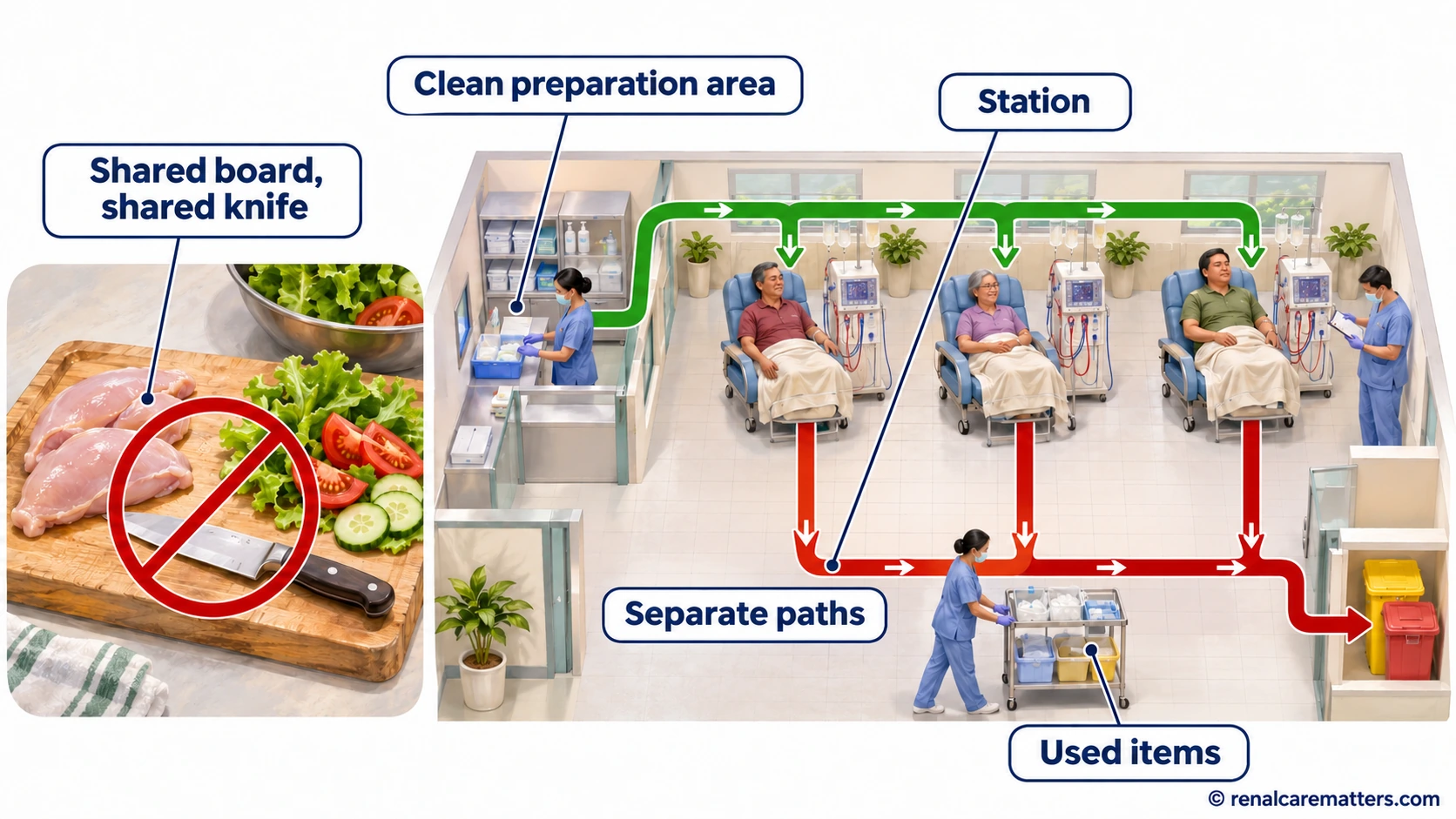
In plain wordsA kitchen that cuts raw chicken and salad on the same board, with the same knife, by the same hands, will make someone sick even if every cook is careful most of the time.
A dialysis floor for people with chronic kidney disease (CKD) is a shared kitchen with blood. Many patients sit close together, surfaces and equipment are shared, every session opens the bloodstream, and staff move quickly between chairs. Hepatitis B can survive on surfaces for at least a week.1 One lapse at a crowded moment can carry it from one patient to the next. The kitchen picture holds; the difference is that on a dialysis floor the “food” is the patient’s own blood.
Figure 1 · Key terms for this module
Hepatitis B virus (HBV)A virus spread by blood that survives on surfaces for days.
Hepatitis C virus (HCV)A virus spread by blood; dialysis units have had outbreaks.
Bloodstream infectionInfection in the blood, most often from a catheter.
ClusterTwo or more new infections of the same kind linked by time, place, or staff.
Single-dose vialA vial meant for one patient, one time.
Post-exposure processThe steps after a needlestick or splash, done within hours.
Opening case · fictional
Case: Two positives in a month
At a 20-station unit, two patients with previously negative hepatitis C antibody tests turn positive within one month. Both dialyze on the Monday-Wednesday-Friday afternoon shift, at neighboring stations.
The charge nurse that afternoon, Nurse Divina Reyes, notices that medicines are prepared on one end of the same counter where used blood tubes are set down after sampling.
Before reading on, decide:
Is this a cluster?
What does Divina do today?
What does she change at the counter?
Keep your answers in mind. The lesson gives you what you need, and the case review near the end shows one sound response.
Lesson · part 1
Why dialysis units spread infection
From 2008 to 2011, hepatitis C outbreaks in several United States dialysis units caused at least 46 new infections. Investigators linked them to breaches in handling injectable medicines, in hand hygiene, and in disinfection.2 In a Dutch unit, gene sequencing traced two new infections to incidents during a single session that the source patient and both new cases attended.3
Figure 2. Clean and dirty never cross. A dialysis floor is a shared kitchen with blood.
The reverse is also true. In a Belgian multicenter study, strict infection control, without isolating patients, reduced the yearly hepatitis C seroconversion rate from 1.4% to 0%.4 Practice, not luck, decides.
Lesson · part 2
The core interventions
The United States Centers for Disease Control and Prevention (CDC) core interventions for dialysis bloodstream infections include surveillance with feedback, hand hygiene audits, catheter and access care observations, staff competency checks, patient education, chlorhexidine skin antisepsis, catheter hub disinfection, and antimicrobial ointment where indicated.5 In a United States collaborative, facilities that adopted them together saw bloodstream infections fall from 1.09 to 0.89 per 100 patient-months and access-related infections from 0.73 to 0.42; the modeled decreases were 32% and 54%.6 The study had no randomized control group, but the size and consistency of the fall are hard to explain any other way.
Lesson · part 3
Clean and dirty never cross
Prepare medicines in a clean area away from the stations and from anywhere blood is handled. Use single-dose vials once. Nothing taken to a station goes back to the clean cart, not even an unopened alcohol swab. Clean and disinfect machines and chairs between patients, after the patient has left the station.
On the floor · The swab that went back
Nurse Kat finishes a catheter connection and carries the unused swabs in her gloved hand back toward the clean cart. The charge nurse, walking past, says quietly, “Those stay at the station. Bin them.” Kat drops them in the bin. Two seconds, said privately, the same minute. That is what changes habits.
Illustrative scenario. Names and details are invented.
Lesson · part 4
Observe honestly, feed back the same shift
A charge nurse who watches two hand hygiene opportunities per nurse per shift and speaks to each nurse right away changes practice more than a monthly poster. Count honestly. An audit that shows 100% every month is probably not looking closely.
Small numbers carry large uncertainty. Report the count with its confidence interval so nobody mistakes noise for improvement (Head Nurse toolkit #c5).
Lesson · part 5
A possible cluster: the same day
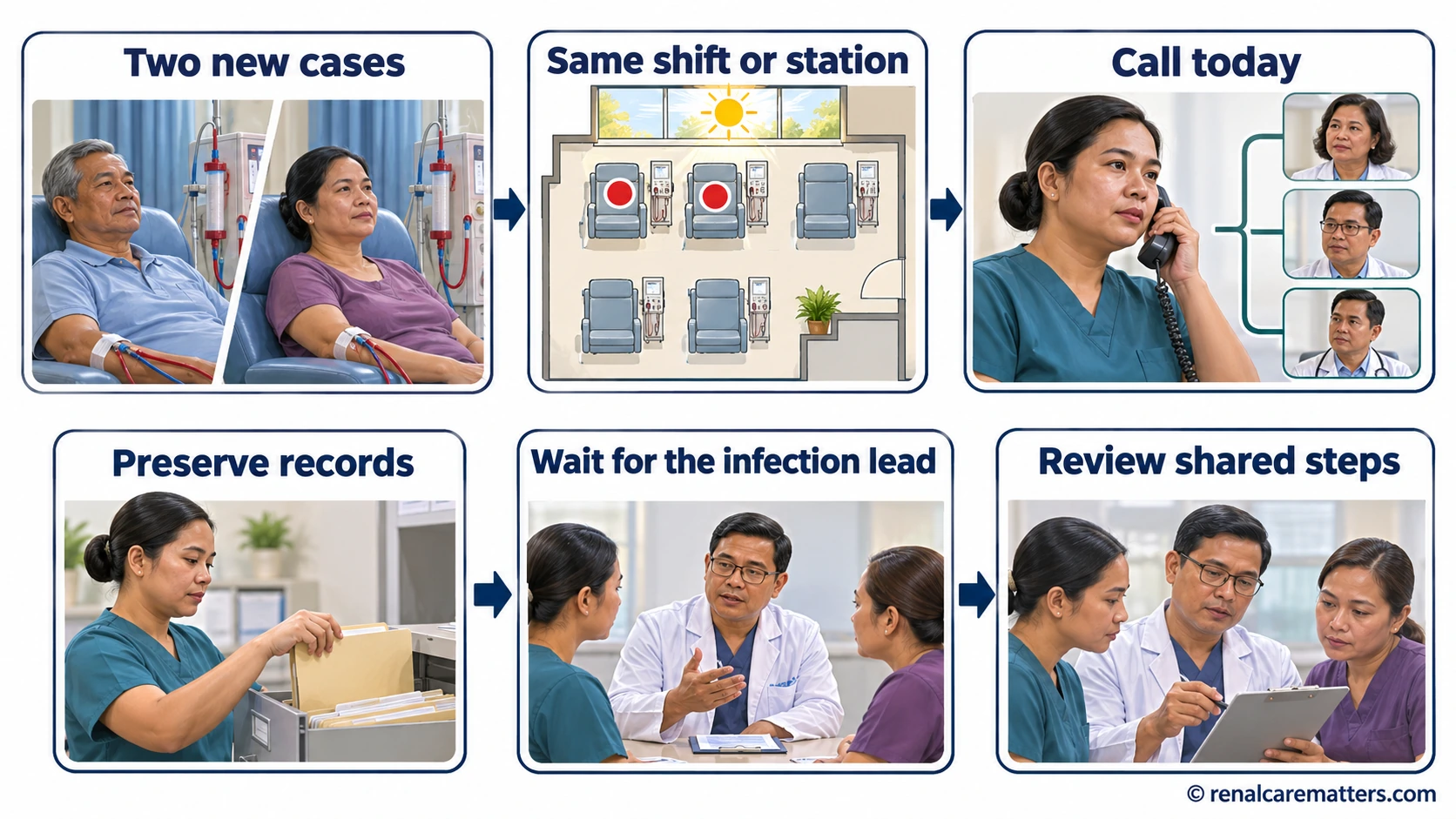
Two new infections of the same kind in a short time, linked by shift, station, or staff, are a possible cluster. Do not wait for a third.
Figure 3. Two new infections linked by shift or station is a possible cluster. Call the same day.
Figure 4 · The same day
CallThe head nurse, the infection prevention lead, and the attending nephrologist.
PreserveRecords, assignment sheets, and station lists for the period.
WaitDo not move patients or reassign stations in ways that destroy the evidence before the infection lead decides.
ReviewWalk through the shared steps: medicine preparation, sampling, cleaning, hand hygiene.
Testing, isolation, and machine decisions belong to the infection lead and the physician under the unit protocol and the newest Philippine Society of Nephrology (PSN) guidance on bloodborne viruses. The charge nurse’s job is to notice, call, and keep the evidence intact.
Lesson · part 6
Protecting the staff
Sharps go into the container at the chair, never recapped by hand. Wear eye protection for connection and disconnection. Know the post-exposure process and its phone number, because hepatitis B and HIV (human immunodeficiency virus) exposures need assessment within hours. A charge nurse who sees a needlestick sends the nurse for assessment now and covers her patients.
On the floor
Real situations: problems and solutions
These are fictional but typical. For each one, cover the answer, decide what you would do, then compare. Where a step depends on local rules, your unit’s procedure and your supervisor’s direction come first.
A multi-dose vial at a station
What you see
A multi-dose vial sits on a patient’s chair table.
What is likely going on
A shortcut that has caused outbreaks.
What to do
Remove and discard it per protocol, and report the observation.
Why it matters
Shared vials spread hepatitis C.
Gloves not changed
What you see
A busy nurse moves between patients without changing gloves.
What is likely going on
Time pressure.
What to do
Speak to her quietly, right then, and log the observation.
Why it matters
Feedback the same shift changes practice.
A new positive at 4 p.m.
What you see
A patient’s new hepatitis result arrives late in the day.
What is likely going on
A possible new infection.
What to do
Inform the attending and the infection lead today, and follow the protocol for station assignment.
Why it matters
One day’s delay can mean more exposures.
Field notes
Clean never meets dirty.
Watch, then speak the same shift.
Two linked cases: call today.
Case review
Back to the case: Two positives in a month
Is it a cluster? Two new hepatitis C positives linked by shift and neighboring stations are a possible cluster. Divina does not wait for a third.
Today. She calls the head nurse, the infection prevention lead, and the attending nephrologist. She preserves the assignment sheets and station lists. She does not move patients on her own; the infection lead decides testing and station changes.
The counter. That afternoon she moves medicine preparation to a separate clean area away from where blood tubes are put down, and tells the next charge nurse why. She does a hand hygiene tally: 15 of 24 opportunities, 62.5%, with a 95% confidence interval of roughly 43% to 79% (Head Nurse toolkit #c5). The number is imprecise; its value is the conversation it starts. She gives feedback to each nurse the same day and repeats the tally next week.
Skills lab · with your preceptor
Skills checklist: Infection prevention on the floor
Observe a full shift for infection prevention and simulate the first steps for a possible cluster. Your preceptor rates each step as satisfactory, needs practice, or not observed. Steps marked Critical must all be satisfactory before sign-off. This checklist supports supervised learning; your unit’s own procedure and competency form are the authority. A printable version of every checklist is on the trainer page.
Explains three ways infection spreads in a dialysis unit.
CriticalKeeps medicine preparation in a clean area away from blood handling.
CriticalStops anything taken to a station from returning to the clean cart.
Observes hand hygiene and gives feedback privately the same shift.
Reports an observation rate with its uncertainty.
CriticalEscalates a possible cluster the same day and preserves records.
CriticalStates the post-exposure steps and the phone number.
Placement activity. For two weeks, tally two hand hygiene opportunities per nurse per shift and review the results with the infection lead.
Self-assessment
Check your understanding
Each visit draws 8 questions at random from this module’s 15-question bank. Choose the single best answer for each, then select Check answers; an explanation appears under the best answer. Select New set of questions for a different mix. A good target is 7 of 8 on two different sets. Nothing you select is sent anywhere; scoring happens in your browser.
Centers for Disease Control and Prevention. (2001). Recommendations for preventing transmission of infections among chronic hemodialysis patients. MMWR Recommendations and Reports, 50(RR-5), 1–43. https://www.cdc.gov/mmwr/preview/mmwrhtml/rr5005a1.htm
Mbaeyi, C., & Thompson, N. D. (2013). Hepatitis C virus screening and management of seroconversions in hemodialysis facilities. Seminars in Dialysis, 26(4), 439–446. https://doi.org/10.1111/sdi.12097
Heikens, E., Hetem, D. J., Jousma-Rutjes, J. P. W., Nijhuis, W., Boland, G. J., Hommes, N. H., Thang, O. H. D., & Schuurman, R. (2019). Hepatitis C virus transmission in a Dutch haemodialysis unit: Detailed outbreak investigation using NS5A gene sequencing. Journal of Hospital Infection, 101(3), 333–338. https://doi.org/10.1016/j.jhin.2018.11.015
Fabrizi, F., Messa, P., & Martin, P. (2008). Transmission of hepatitis C virus infection in hemodialysis: Current concepts. International Journal of Artificial Organs, 31(12), 1004–1016. https://doi.org/10.1177/039139880803101204
Centers for Disease Control and Prevention. (n.d.). Dialysis safety: Core interventions. Retrieved November 23, 2026, from https://www.cdc.gov/dialysis-safety/hcp/clinical-safety/
Patel, P. R., Yi, S. H., Booth, S., Bren, V., Downham, G., Hess, S., Kelley, K., Lincoln, M., Morrissette, K., Lindberg, C., Jernigan, J. A., & Kallen, A. J. (2013). Bloodstream infection rates in outpatient hemodialysis facilities participating in a collaborative prevention effort: A quality improvement report. American Journal of Kidney Diseases, 62(2), 322–330. https://doi.org/10.1053/j.ajkd.2013.03.011
Educational study material for nurses. Does not replace the attending nephrologist’s orders, the unit’s protocols, required training and certification, or supervised practice.