Nephrology Nursing Track · By Role · Module 3 of 18
Building the Assignment: Acuity, Competence, and Breaks
Weighting patients by need, matching tasks to competence, keeping your own load light, and planning breaks so ratios never quietly double.
PublishedNailathalaGipatikPepalwal:ReferencesMga SanggunianMga TinubdanReng Reperensya:3Audience: Experienced hemodialysis nurses who take charge of a shift · nurses being prepared for charge duty · head nurses and educators who orient themRead timeOras ng pagbasaOras sa pagbasaOras ning pamamasa:
This module is study material for charge nurses in hemodialysis units. It explains the reasoning behind common decisions; it is not a protocol. On the floor, follow your unit’s protocol and always ask the attending nephrologist for guidance. Doses, limits, and cut-off values are set by your unit. Every case is fictional.
Learning objectives
After this module you should be able to
Weight each patient by what they need, not just count heads.
Match each task to a nurse’s verified competence, including orientees.
Keep your own load light enough to stay free for the floor.
Plan staggered breaks so that no nurse ever covers more running machines than is safe.
Rebuild the assignment when the shift changes, and tell the team.
Pre-testBefore you read, answer the 8 self-assessment questions and note your score. After the module, select New set of questions and compare. The difference is what you learned; the questions you still miss are what to reread.
Start here
The big picture, in plain words
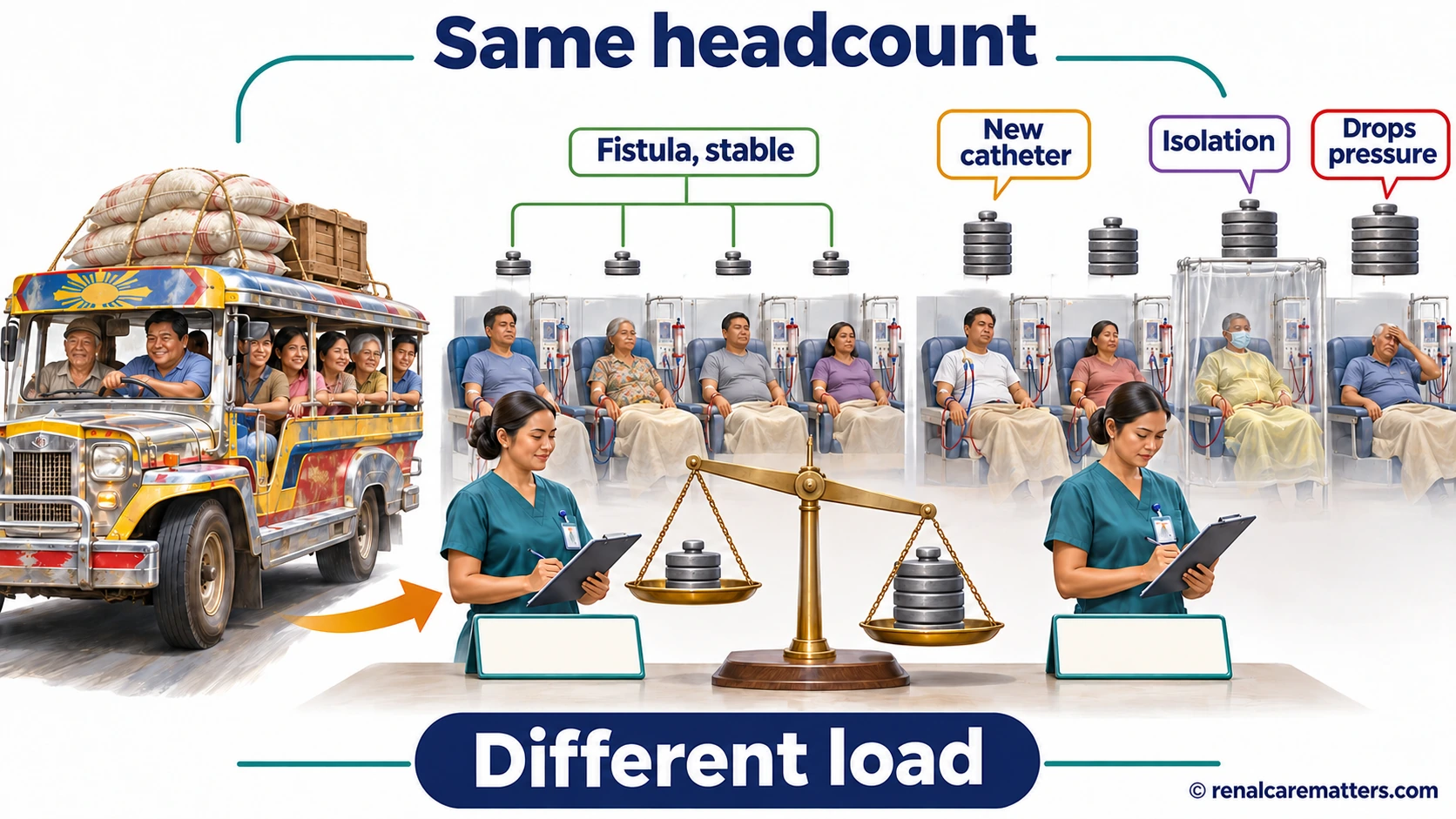
In plain wordsLoading a jeepney is not only counting passengers. A jeepney with twelve adults is not the same as one with eight adults, three sacks of rice, and a crate of chickens. The driver who counts only heads gets stuck on the first hill.
An assignment that counts only patients makes the same mistake. Four patients with mature fistulas and steady pressures take less nursing than two patients with new catheters, one of whom drops her pressure every session. The work is in the needs, and the needs change during the shift.
Figure 1 · Key terms for this module
AcuityHow much nursing attention a patient is likely to need today.
CompetenceA skill a nurse has performed correctly while a qualified person observed and signed.
OrienteeA nurse in orientation who works under a named resource nurse.
Resource nurseThe experienced nurse an orientee calls for help.
Break coverThe nurse who watches another nurse’s patients during her break.
LoadThe total nursing need assigned to one nurse.
Opening case · fictional
Case: “Four each, like always”
At a 12-station unit in Quezon City, Nurse Joy Bautista takes charge with three staff nurses: Arnel (eight years in dialysis), Kris (two years), and Mika (third week of orientation). Twelve patients are booked: two with new tunneled catheters, one with frequent low blood pressure during dialysis, one hepatitis B surface antigen (HBsAg)-positive patient in the isolation room, one blind patient who needs help walking, and seven stable patients with fistulas.
The habit at this unit is “four each, the charge nurse takes none.” Breaks are decided at 8:00 by whoever is hungry first.
Before reading on, decide:
Why does “four each” fail here?
Build a better assignment.
How will breaks work so that no nurse covers too many running machines?
Keep your answers in mind. The lesson gives you what you need, and the case review near the end shows one sound response.
Lesson · part 1
Acuity, simply
Give each patient points for the things that take nursing time or need watching: a new or problem access, a catheter connection, a history of low pressure or arrhythmia during dialysis, isolation, limited mobility or confusion, a first session, a blood transfusion or intravenous (IV) medicine today. Add them up for each nurse.
Figure 2. Same headcount, different load. An assignment that counts only patients misses the work hidden in their needs.
Patient need (example scale; your unit sets its own)
Points
Stable patient, mature fistula or graft
1
Add: new or problem access, needling help
+1
Catheter connection and disconnection
3 (instead of 1)
Add: frequent low pressure or arrhythmia during dialysis
+2
Add: isolation
+2
Add: needs help walking, confused, or new to dialysis
+1
Add: transfusion or IV medicine during the session
+1
Be honest about what this is. Points are a tool for seeing the load, not a validated score. No acuity tool for outpatient hemodialysis has been shown in trials to improve patient outcomes. You use one because it makes invisible work visible on the board, so the whole team can see why an assignment is fair.
Lesson · part 2
Competence is specific
“Two years’ experience” tells you little. Can she cannulate a new fistula? Connect a catheter alone with aseptic technique? Recognize air in the venous line? An orientee assigned four patients is a staff nurse on paper and a learner in fact.
The national guidelines for nursing delegation summarize the match as five rights: the right task, the right circumstance, the right person, the right communication, and the right supervision. Nursing judgment itself cannot be delegated.1 These guidelines are from the United States, but the logic applies to any unit: you assign a task only to someone who can do it, in today’s conditions, with clear instructions and someone watching.
Keep a simple competence list where the charge nurse can see it: each nurse, and which high-risk tasks are signed off (catheter connection, new fistula needling, isolation care, transfusion). An orientee always has a named resource nurse on the board.
On the floor · “I’ve seen it done many times”
Mika, the orientee, tells the charge nurse she is comfortable connecting the catheter patient in Bed 7; she has watched it many times. Her competence record shows catheter connection not yet signed off.
The charge nurse pairs her with Arnel for that connection. Arnel watches, Mika does it, and Arnel signs the first of three observed connections in her record. Mika learns; the patient is safe; the record shows the truth.
Illustrative scenario. Names and details are invented.
Lesson · part 3
The charge nurse’s own load
A charge nurse with four patients of her own cannot leave her chairs when another nurse’s patient collapses. On a heavy morning, keep two chairs or none, placed near the center of the floor where you can see the rest.
In a United States study that asked 427 emergency nurse leaders and educators what charge nurses must be able to do, the top five competencies were managing patient flow, communication, situational awareness, clinical decision-making, and the nurse-patient assignment.2 The setting was the emergency department, not dialysis, but every one of those five needs free attention, and a full assignment uses it up.
RememberThe charge nurse needs free eyes. Every chair you take is attention you cannot give the floor.
Lesson · part 4
Breaks are part of the assignment
Breaks are when ratios quietly double. If two nurses on a four-nurse floor take their break together, the other two each cover six or eight running machines for half an hour.
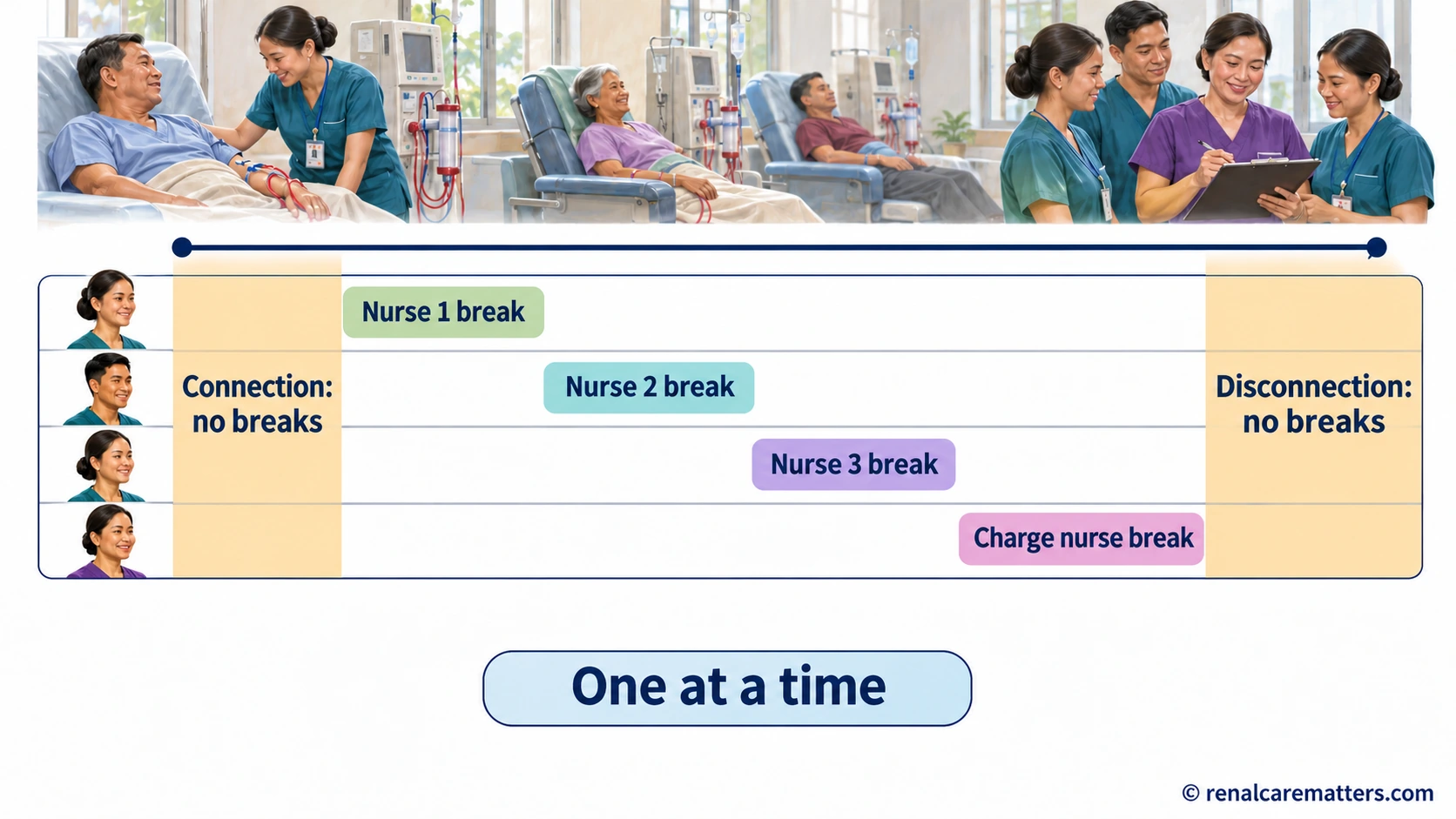
Figure 3. Breaks are part of the assignment: one at a time, never in the first or last half hour of the sessions.
Plan breaks at 6:00, when you build the assignment, not at 8:00 when people are hungry. Three rules:
One break at a time, and never two neighboring pods together.
No breaks in the first 30 minutes after connection or the last 30 before disconnection, when most low-pressure, needle, and bleeding problems happen.
Brief the covering nurse on each patient’s one key risk: “Bed 4 drops after the second hour.”
Breaks are not optional for the nurse either. In a study of hospital nurses’ logbooks, the odds of making an error were about three times higher on shifts lasting 12.5 hours or more.3 Tired nurses make the errors that charts record.
Lesson · part 5
Rebuild when things change
The assignment you write at 6:00 is a plan, not a promise. A patient arrives breathless; a nurse is pulled to the ward; a machine fails; an emergency takes two nurses for twenty minutes. When that happens, re-score the affected pods and move one patient rather than leaving one nurse overloaded. Tell the whole team at the next huddle (Module 4), and update the board.
On the floor · The ward pull at 7:30
At 7:30 the hospital nursing supervisor asks for one dialysis nurse to help on the medical ward for an hour. The charge nurse checks the board: taking Kris would leave Arnel and Mika covering eleven running machines, with Mika unable to do catheter care. She tells the supervisor what she can release safely (no one until the 9:00 disconnections, then Kris for an hour) and writes the request and her answer in the shift log. The supervisor sends a ward nurse to cover a different task instead.
Illustrative scenario. Names and details are invented.
On the floor
Real situations: problems and solutions
These are fictional but typical. For each one, cover the answer, decide what you would do, then compare. Where a step depends on local rules, your unit’s procedure and your supervisor’s direction come first.
The senior wants the easy pod
What you see
An experienced nurse asks for the stable patients again.
What is likely going on
Seniority is being treated as a right to the lightest load.
What to do
Show the points on the board, assign by need, and rotate fairly over the week.
Why it matters
Visible fairness prevents quiet resentment.
“I’m fine with a catheter”
What you see
An orientee says she can manage a catheter patient alone.
What is likely going on
Confidence is not competence.
What to do
Check the competence record; if not signed off, pair her with a signed-off nurse for that connection.
Why it matters
She learns under observation and the patient stays safe.
Skipping the break
What you see
A nurse says she will skip her break to finish charting.
What is likely going on
Workload is pushing rest aside.
What to do
Send her on her break and help with the charting later.
Why it matters
Tired nurses make the errors charts record.
Field notes
Points show load, not truth.
Breaks go on the board at 6:00.
The charge nurse needs free eyes.
Case review
Back to the case: “Four each, like always”
Why “four each” fails. It gives Mika a catheter she cannot manage alone and leaves Joy with no free attention for the floor. It also ignores the isolation room, which needs a nurse who can be seen from the station.
A better assignment, by points (Toolkit #c2). Two catheters (3 + 3 = 6), the low-pressure patient (1 + 2 = 3), isolation (1 + 2 = 3), the blind patient (1 + 1 = 2), and seven stable patients (7): 21 points. Arnel takes both catheters and one stable patient (7). Kris takes the low-pressure patient, the blind patient, and two stable patients (7). Mika takes four stable fistula patients (4), with Arnel as her named resource nurse. Joy takes the isolation patient (3), because the room is beside the station and she can see the floor through its window. Twelve patients, 21 points, and the charge nurse carries the lightest load.
Breaks (Toolkit #c3). Written on the board at 6:00: Mika at 8:00 (Kris covers), Arnel at 8:30 (Joy covers), Kris at 9:00 (Arnel covers), Joy at 9:30 (Arnel covers). None in the first or last half hour of the sessions, and never two at once. Be honest about what a break does: for those thirty minutes the covering nurse watches her own pod and a second one. That is why only one break runs at a time, why it falls in the calmer middle of the session, why the covering nurse is told each patient’s one key risk, and why the charge nurse keeps her own load light enough to step in. Toolkit #c1 shows the worst break window in numbers.
Skills lab · with your preceptor
Skills checklist: Building an assignment
Build assignments for two synthetic twelve-patient floors, one with an orientee, and explain each choice to a facilitator. Your preceptor rates each step as satisfactory, needs practice, or not observed. Steps marked Critical must all be satisfactory before sign-off. This checklist supports supervised learning; your unit’s own procedure and competency form are the authority. A printable version of every checklist is on the trainer page.
Scores each patient and explains each point.
CriticalMatches catheter care and new-access needling only to nurses signed off for them.
CriticalNames a resource nurse for every orientee on the board.
Keeps own load at two chairs or fewer on a heavy shift, near the center of the floor.
CriticalWrites staggered breaks on the board at assignment time, avoiding the first and last half hour.
CriticalChecks that no break window leaves a nurse above the unit’s limit.
Re-scores and moves one patient after a simulated change.
Answers a request to release a nurse with what can be released safely, and records it.
Placement activity. For one week, photograph each morning’s board (no patient names) and review the points and breaks with the head nurse.
Self-assessment
Check your understanding
Each visit draws 8 questions at random from this module’s 15-question bank. Choose the single best answer for each, then select Check answers; an explanation appears under the best answer. Select New set of questions for a different mix. A good target is 7 of 8 on two different sets. Nothing you select is sent anywhere; scoring happens in your browser.
American Nurses Association & National Council of State Boards of Nursing. (2019). National guidelines for nursing delegation. Retrieved November 24, 2026, from https://www.nursingworld.org/globalassets/practiceandpolicy/nursing-excellence/ana-position-statements/nursing-practice/ana-ncsbn-joint-statement-on-delegation.pdf
Wolf, L., Delao, A., Simon, C., Clark, P., & Burchill, C. N. (2024). Ensuring throughput: Development and validation of charge nurse competencies for United States emergency care settings. Journal of Emergency Nursing, 50(4), 523–536. https://doi.org/10.1016/j.jen.2024.02.009
Rogers, A. E., Hwang, W.-T., Scott, L. D., Aiken, L. H., & Dinges, D. F. (2004). The working hours of hospital staff nurses and patient safety. Health Affairs, 23(4), 202–212. https://doi.org/10.1377/hlthaff.23.4.202
Educational study material for nurses. Does not replace the attending nephrologist’s orders, the unit’s protocols, required training and certification, or supervised practice.