The person who keeps the unit open
A hemodialysis unit runs on a timetable that patients cannot skip. Each patient needs a chair, a tested machine, released water, a competent nurse, a physician on duty, the right supplies, and a claim that is paid, three times a week, every week. The operations manager is the person who makes sure those pieces arrive together, and who notices first when one of them will not.
You do not prescribe, assign nurses, or release a water system. You run the systems that let the people who do those things work safely: the roster, the evidence index, the schedule, the stockroom, the data, the claims, the budget, the payroll, and the plan for the day the power fails. Much of this track is about knowing which decisions are yours, which belong to someone else, and how to make sure every decision has an owner.
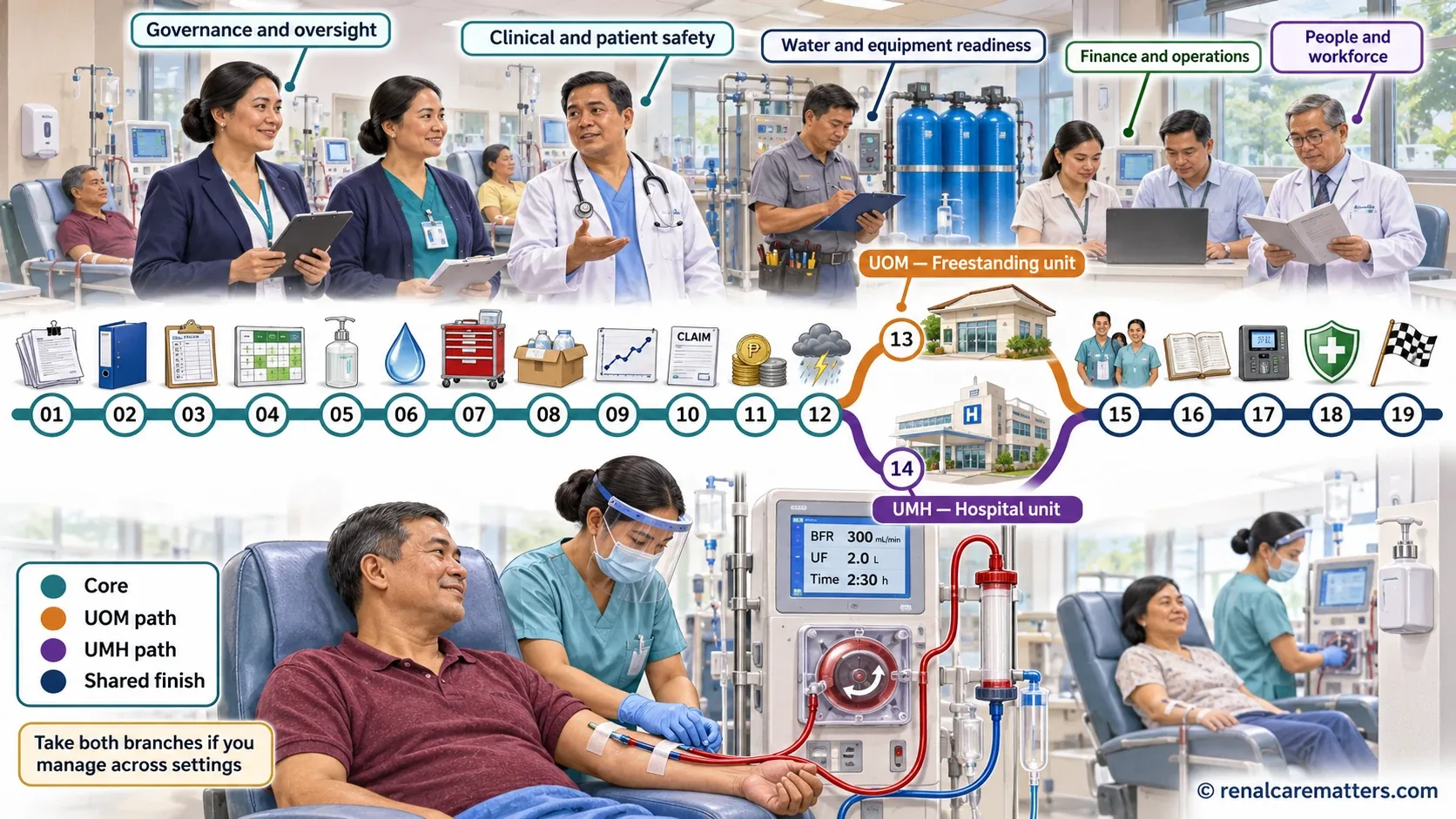
Figure 2 · What this track will help you do
The track is written in plain language. Every new term is explained when it first appears. Each module has figures, a field case, a supervised-practice checklist, and a self-assessment. Module 13 is for freestanding units and Module 14 for hospital units; study the one that fits your setting, or both.
What this series is, and is not
It is a training track written independently from published laws, regulations, guidelines, and research. It is not a license, a Department of Health (DOH) or PhilHealth requirement, continuing professional development (CPD) credit, or legal, tax, or labor advice. It does not replace your appointment terms, your unit’s approved policies, or the clinicians and technicians who own clinical and technical decisions.
Who can hold this role
Unit Operations Manager/Unit Manager: qualifications at a glance
- At least 2 years of proven success in operations management, or as head of a unit or department with at least 5 employees. PSN
- Bachelor’s degree in operations management, business administration, or a medically related 4-year course; master’s in hospital or business administration preferred. PSN
- A separate manager is required for non-hospital HDCs with more than 15 stations; smaller units may combine the role. PSN
Sources: DOH Administrative Order No. 2012-0001, Sec. V.B.2.a; Philippine Society of Nephrology (2024), Guidelines for nephrologists in the operation of hemodialysis clinics, Sec. III.A; Republic Act No. 10862. A summary for orientation, not legal advice: check the current issuances, and your unit’s license and PhilHealth accreditation. The full table for every role is on the Academy home.
Nineteen modules in four parts
The modules follow the order a new manager meets the work: first the authority and the barriers that keep patients safe, then the setting you work in, then the people and money behind the service, and last a capstone that joins them.
Figure 3 · The four parts
Nineteen modules in four parts
Study the modules in order. Each one starts from why a control exists, moves to what the evidence and the rules say, and ends with what a manager does on Monday morning.
Part 1 · Running a safe unit
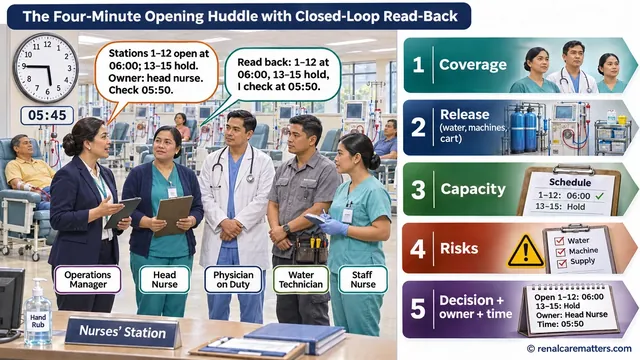 Module 1
Who Runs the Dialysis Unit
Decision rights, the four authority lines, the closed-loop opening huddle, and escalation that ends with an owner.
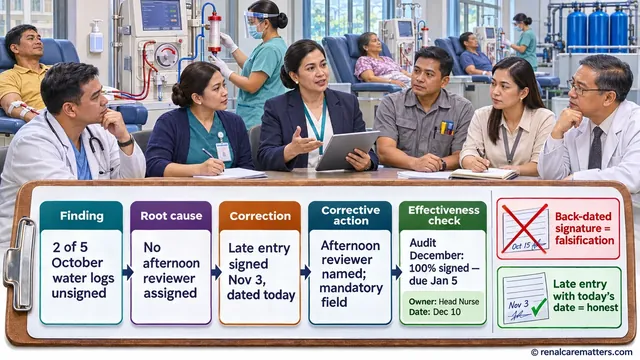 Module 2
Licensure, Accreditation, and Survey Readiness
What the Department of Health (DOH) license, PhilHealth accreditation, and Philippine Society of Nephrology (PSN) attestation each cover, the evidence index, tracers, and a corrective and preventive action (CAPA) that works.
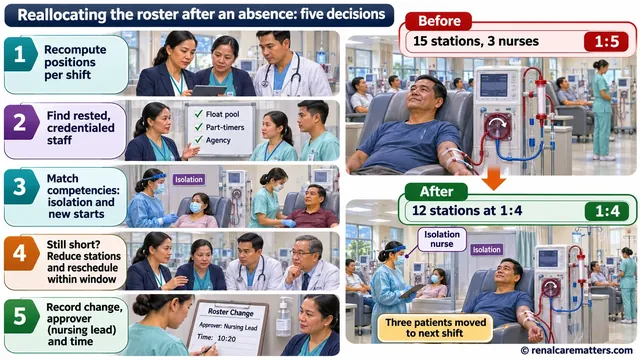 Module 3
Staffing, Rostering, and Competency
Ratios as ceilings, the relief factor, the competency matrix, and reallocating safely after an absence.
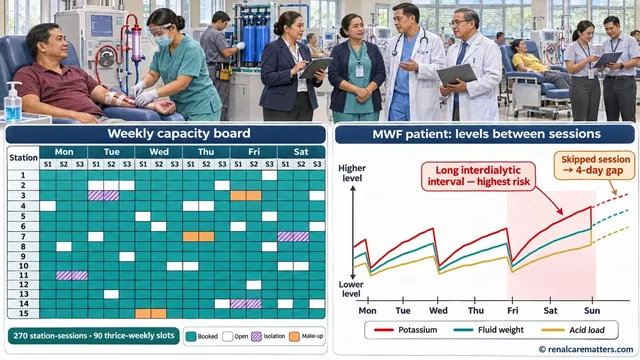 Module 4
Capacity, Access, and Patient Flow
Station-sessions, the long-gap day, rescheduling after a missed session, referrals, and holiday weeks.
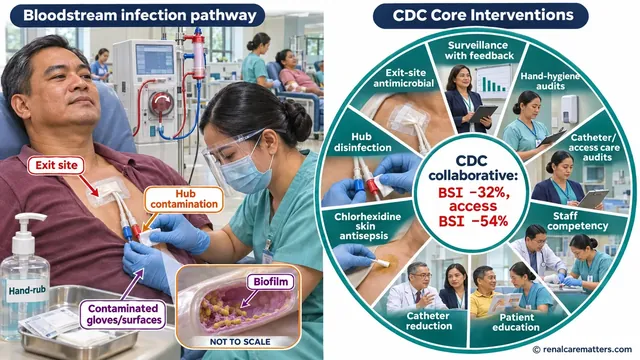 Module 5
Infection Prevention and Surveillance
How infections reach dialysis patients, the Centers for Disease Control and Prevention (CDC) core interventions, rates with denominators, and serology results that trigger action.
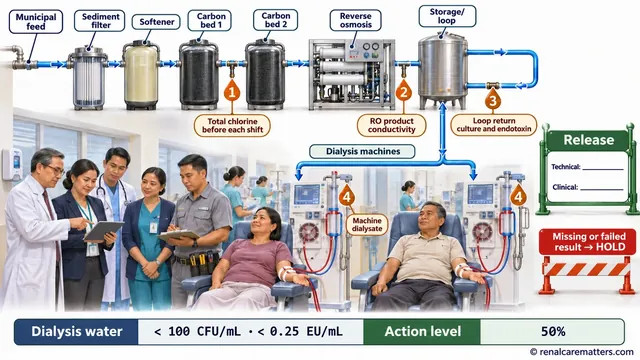 Module 6
Water and Dialysate Readiness
The water pathway, the log a manager must read, completeness checks, and the hold-and-release rule.
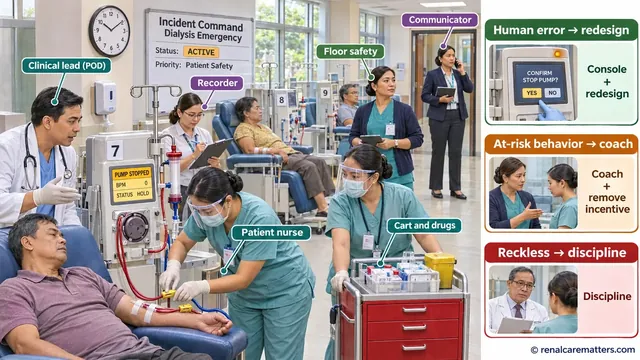 Module 7
Emergency Readiness and Incident Command
Incident command on a dialysis floor, the readiness checklist, alarms, drills, and evacuation.
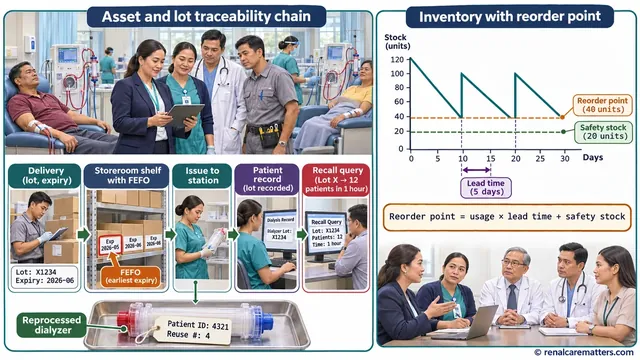 Module 8
Equipment, Supplies, and Procurement
The asset register, lot traceability, reorder points, qualifying a substitute, and a one-hour recall.
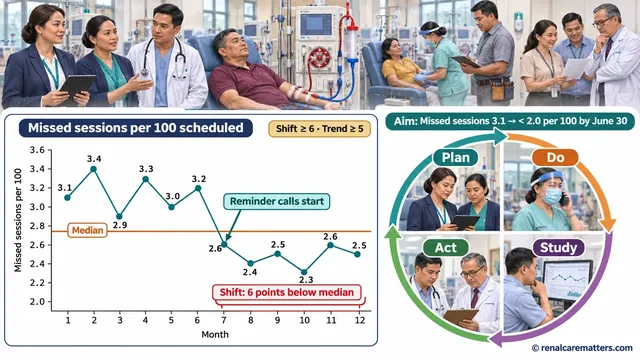 Module 9
Quality Measurement and Improvement
Indicators with definitions, the data dictionary, run charts, Plan-Do-Study-Act (PDSA) cycles, and the quality assessment and performance improvement (QAPI) meeting.
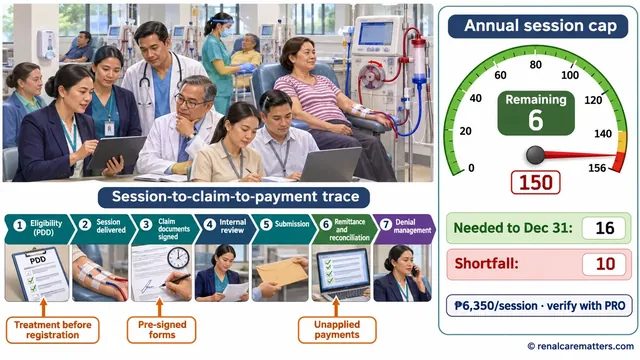 Module 10
PhilHealth Claims, Documentation, and Privacy
The session-to-payment chain, where claims fail, the 156-session cap, and need-to-know privacy.
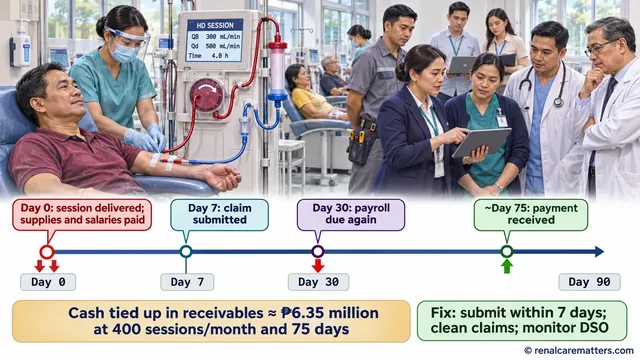 Module 11
Budgeting, Cost per Treatment, and Cash
Cost per treatment, break-even, revenue recognition versus cash, and why a profitable unit can run out of money.
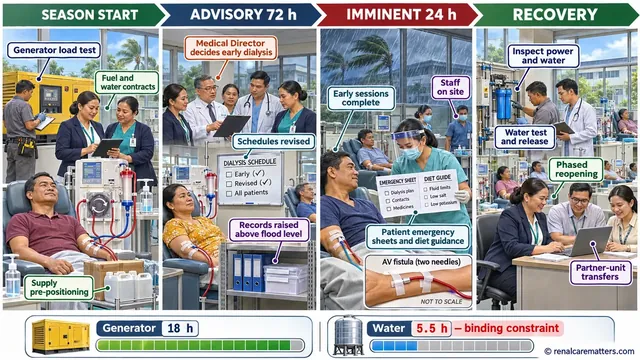 Module 12
Continuity During Outages and Disasters
The dialysis clock, a phased typhoon plan, outage autonomy, partner units, and a signed restart.
Part 2 · Your setting
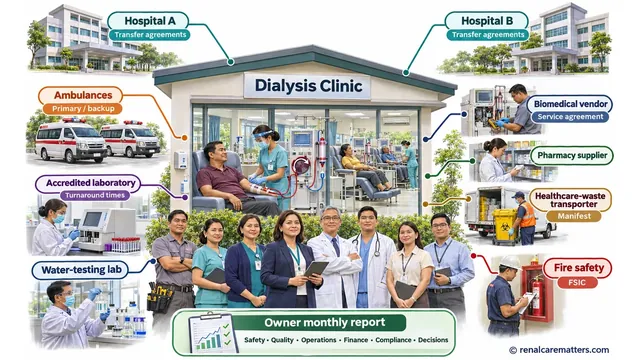 Module 13
Running a Freestanding Unit
The freestanding ecosystem, transfers to hospital, healthcare waste, utilities, and contracts.
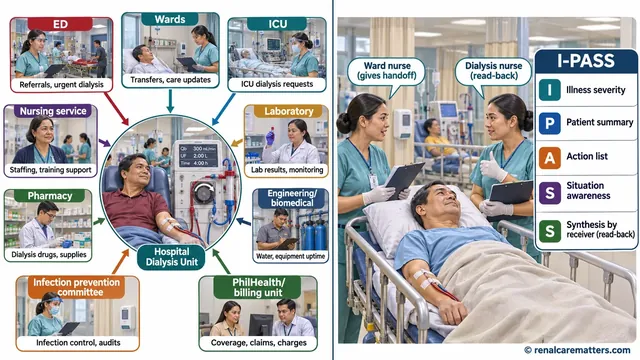 Module 14
Managing Hospital Dialysis Interfaces
Wards, the intensive care unit (ICU), and the emergency room as customers, structured handoffs, and balancing outpatient and inpatient demand.
Part 3 · People and money
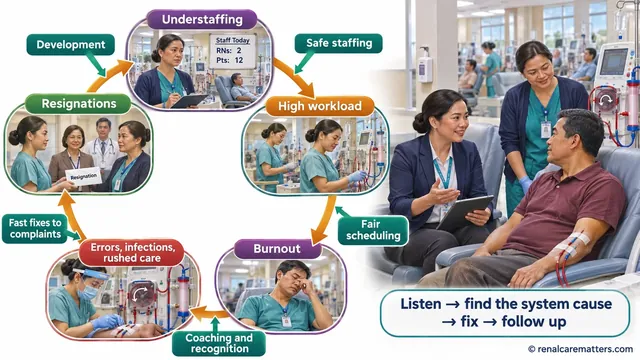 Module 15
Leadership, Communication, and Patient Experience
Burnout and safety, coaching conversations, grievances that become system fixes, and the so-called difficult patient.
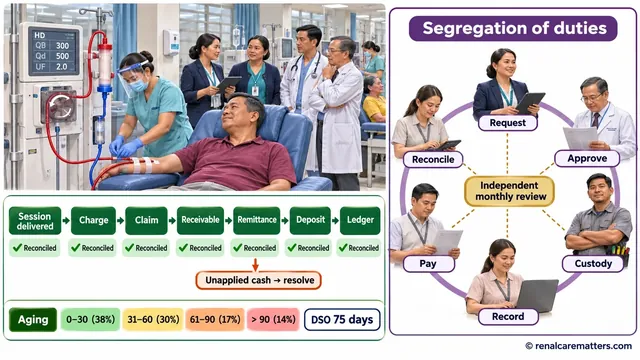 Module 16
Unit Accounting, Internal Controls, and Month-End Close
Session-to-cash, segregation of duties, the three-way match, imprest funds, and investigating a variance.
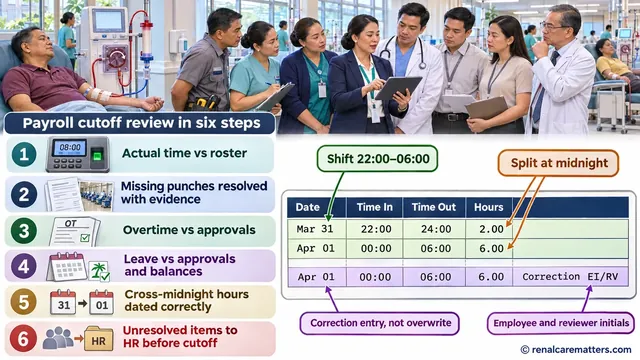 Module 17
Attendance, Timekeeping, and Salary Controls
Roster to timecard to payroll, premium pay, the payroll cutoff review, and a payslip staff can check.
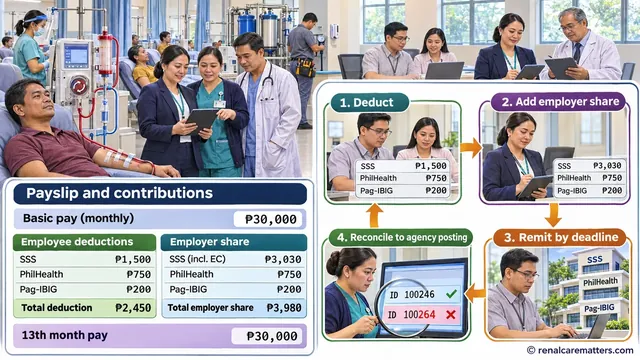 Module 18
Employee Benefits, Leave, and Payroll Remittances
SSS, PhilHealth, and Pag-IBIG contributions, the remittance trace, 13th-month pay, and statutory leaves.
Part 4 · Capstone
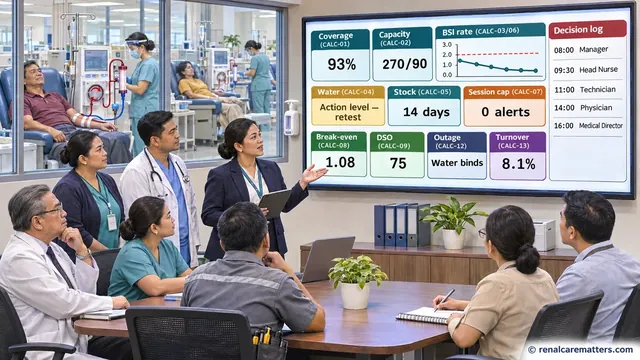
The same seven steps every time
Figure 4 · How to work through a module
- ObjectivesRead what you should be able to do by the end.
- Big pictureA plain-words summary and the key terms, before any detail.
- Opening caseA fictional shift problem. Decide what you would do first.
- LessonShort parts with pictures, tables, and worked examples.
- Case reviewCompare your answer with one sound response.
- Skills checklistPractice with a preceptor on real or training equipment.
- Self-assessmentFive questions drawn from a larger bank, with explanations.
New terms are explained the first time they appear, and every page ends with a glossary. Abbreviations are spelled out at first use. If a sentence still reads like jargon, check the glossary, then ask your preceptor to show you the real object on the unit: most of this work makes sense faster when you can see and touch the equipment.
The series at a glance
Each module takes about 40 to 45 minutes to read, plus a 45-minute supervised practice at your own unit (the capstone practice runs 120 minutes): about 14 hours of reading and 15 hours of practice in all.
| No. | Module | Lessons | Opening case | Skills checklist | Practice |
|---|---|---|---|---|---|
| 1 | Who Runs the Dialysis Unit |
| The 05:30 phone call | Supervised practice | 15 questions |
| 2 | Licensure, Accreditation, and Survey Readiness |
| The unannounced inspection | Supervised practice | 15 questions |
| 3 | Staffing, Rostering, and Competency |
| The competent but exhausted nurse | Supervised practice | 15 questions |
| 4 | Capacity, Access, and Patient Flow |
| The holiday week | Supervised practice | 15 questions |
| 5 | Infection Prevention and Surveillance |
| The unread result | Supervised practice | 15 questions |
| 6 | Water and Dialysate Readiness |
| The copied value | Supervised practice | 15 questions |
| 7 | Emergency Readiness and Incident Command |
| The silenced alarm | Supervised practice | 15 questions |
| 8 | Equipment, Supplies, and Procurement |
| The cheaper dialyzer | Supervised practice | 15 questions |
| 9 | Quality Measurement and Improvement |
| The improving number that was not real | Supervised practice | 15 questions |
| 10 | PhilHealth Claims, Documentation, and Privacy |
| The denied batch | Supervised practice | 15 questions |
| 11 | Budgeting, Cost per Treatment, and Cash |
| Profitable but broke | Supervised practice | 15 questions |
| 12 | Continuity During Outages and Disasters |
| The brownout that lasted | Supervised practice | 15 questions |
| 13 | Running a Freestanding Unit |
| The transfer that took two hours | Supervised practice | 15 questions |
| 14 | Managing Hospital Dialysis Interfaces |
| The patient who arrived unprepared | Supervised practice | 15 questions |
| 15 | Leadership, Communication, and Patient Experience |
| The "difficult" patient | Supervised practice | 15 questions |
| 16 | Unit Accounting, Internal Controls, and Month-End Close |
| The missing erythropoiesis-stimulating agent (ESA) vials | Supervised practice | 15 questions |
| 17 | Attendance, Timekeeping, and Salary Controls |
| The holiday that crossed midnight | Supervised practice | 15 questions |
| 18 | Employee Benefits, Leave, and Payroll Remittances |
| Deducted but not posted | Supervised practice | 15 questions |
| 19 | Integrated Readiness and Improvement Capstone |
| The week before Signal No. 3 | Capstone portfolio and safety gates | 15 questions |
Self-assessment is not sign-off
Each module ends with a self-assessment of 5 questions drawn at random from a bank of 15; the mastery mark is 4 of 5 on two different sets. The end-of-track examination draws 40 questions from all nineteen banks. The capstone is a timed readiness exercise followed by a portfolio defense before a senior manager and the unit’s clinical leads.
End-of-course examination. When you have finished every module, take the end-of-course examination. It draws questions at random from all 19 modules, so no two sittings are the same.
What the series is built on
The track is built from published sources. Philippine requirements follow the Department of Health (DOH) licensing and water orders, PhilHealth circulars, the Philippine Society of Nephrology (PSN) hemodialysis guidelines, the Data Privacy Act, the Labor Code, and the current wage and contribution issuances.1,2,3,4,5,6 Clinical and operational statements follow the trials, cohorts, and guidelines they rest on, including the Centers for Disease Control and Prevention (CDC) dialysis recommendations and the International Organization for Standardization (ISO) water standard.7,8,9
Where the evidence is strong, the text says so. Where a practice rests on observation, regulation, or expert opinion, the text says that instead. Where Philippine data are missing, the track uses data from the United States and other countries and says so. Regulatory and contribution figures were checked against public sources on November 24, 2026; they change often, so confirm them before use.
Using the series in a training program
A unit administrator, a senior operations manager, or a hospital department head can use these modules as the guided-study part of a new manager’s orientation. The trainer and preceptor page gathers the proposed hours, completion criteria, and every skills checklist in one printable place. These are proposals for a provider to adapt and validate on its own equipment; they are not requirements of any regulator.



