Nephrology Nursing Track · By Role · Module 12 of 18
Leading the First Ten Minutes of an Emergency
Arrest on the dialysis floor, circuit cause or bystander, roles out loud with a watcher, closed-loop commands, and the handoff out.
PublishedNailathalaGipatikPepalwal:ReferencesMga SanggunianMga TinubdanReng Reperensya:7Audience: Experienced hemodialysis nurses who take charge of a shift · nurses being prepared for charge duty · head nurses and educators who orient themRead timeOras ng pagbasaOras sa pagbasaOras ning pamamasa:
This module is study material for charge nurses in hemodialysis units. It explains the reasoning behind common decisions; it is not a protocol. On the floor, follow your unit’s protocol and always ask the attending nephrologist for guidance. Doses, limits, and cut-off values are set by your unit. Every case is fictional.
Learning objectives
After this module you should be able to
Explain why cardiac arrest happens on the dialysis floor and when risk is highest.
Decide in seconds whether the dialysis circuit is the cause of a collapse or a bystander.
Assign roles out loud, including one nurse who watches every other patient.
Use directed, closed-loop communication under pressure.
Hand off to the physician, the code team, or the ambulance crew with the dialysis details they need.
Pre-testBefore you read, answer the 8 self-assessment questions and note your score. After the module, select New set of questions and compare. The difference is what you learned; the questions you still miss are what to reread.
Start here
The big picture, in plain words
In plain wordsA good fire captain arriving at a burning house does not grab the hose. She stands where she can see everything, gives each firefighter one job, and makes sure someone is watching the house next door.
In a dialysis emergency, the charge nurse’s hands are often needed too. But her first job is to lead: name the problem, assign the roles, decide what to do with the circuit, and keep the other patients safe. A patient with chronic kidney disease (CKD) can deteriorate in minutes, and a unit with eleven other machines running does not pause because one patient is in trouble.
Figure 1 · Key terms for this module
Cardiopulmonary resuscitation (CPR)Chest compressions and breathing support during cardiac arrest.
DefibrillatorA device that delivers a shock to restore a normal heart rhythm.
Shockable rhythmA heart rhythm that a shock can correct.
CircuitThe lines, dialyzer, and machine through which blood flows outside the body.
Closed-loop communicationA command that is repeated back and reported done.
WatcherThe nurse assigned to every other patient during an emergency.
Opening case · fictional
Case: Bed 9 is not breathing
Tuesday, 7:05. Mr. Leonardo Ramos, 71, is an hour into his first session after the long gap. He slumps in his chair. No pulse. The charge nurse, Nurse Ana Villareal, is at Bed 2.
Eleven other patients are connected. Ana has three nurses: Arnel, Kris, and Mika. The physician on duty is on the ward, about five minutes away.
Before reading on, decide:
What are Ana’s first three commands?
What happens to the circuit?
Who watches the other eleven patients?
Keep your answers in mind. The lesson gives you what you need, and the case review near the end shows one sound response.
Lesson · part 1
Why arrest happens on the dialysis floor
Sudden cardiac death is the most common cause of death in patients on hemodialysis, and risk peaks after the long gap.1,2 In a registry of 398 cardiac arrests in United States dialysis clinics, staff started CPR in 81.4% of cases and applied a defibrillator before the ambulance arrived in 52.3%. Staff-started CPR was associated with about three times the odds of leaving hospital alive. The first rhythm was not shockable in 66%.3
The lesson is that readiness and speed matter more than the rhythm. A unit that starts compressions in the first minute gives its patients the best chance the evidence shows.
Lesson · part 2
Is the circuit the cause or a bystander?
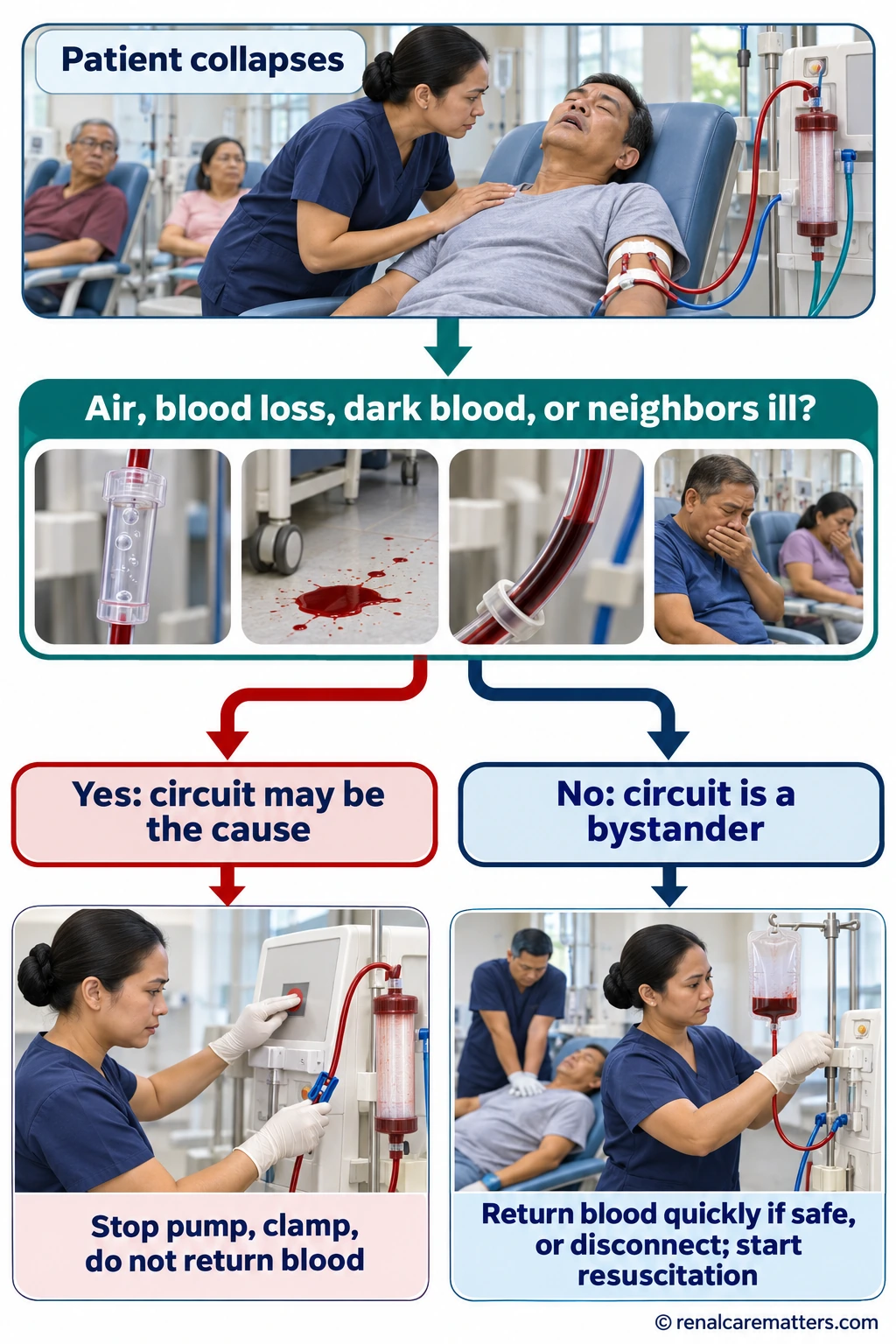
Ask in seconds: is there air in the venous line, blood on the floor, dark blood in the line, a wrong dialysate, or a pattern of symptoms in neighboring chairs?
Figure 2. Circuit cause or bystander: a decision made in seconds that decides whether blood goes back.
Yes: the circuit may be the cause. Stop the pump, clamp, and do not return blood that may contain air or hemolyzed cells.
No: the circuit is a bystander. Per protocol, return the blood if it can be done quickly and safely, or disconnect, and start resuscitation without delay.
RememberDo not return blood that may contain air or burst red cells. When in doubt, stop, clamp, and resuscitate.
Lesson · part 3
Roles out loud
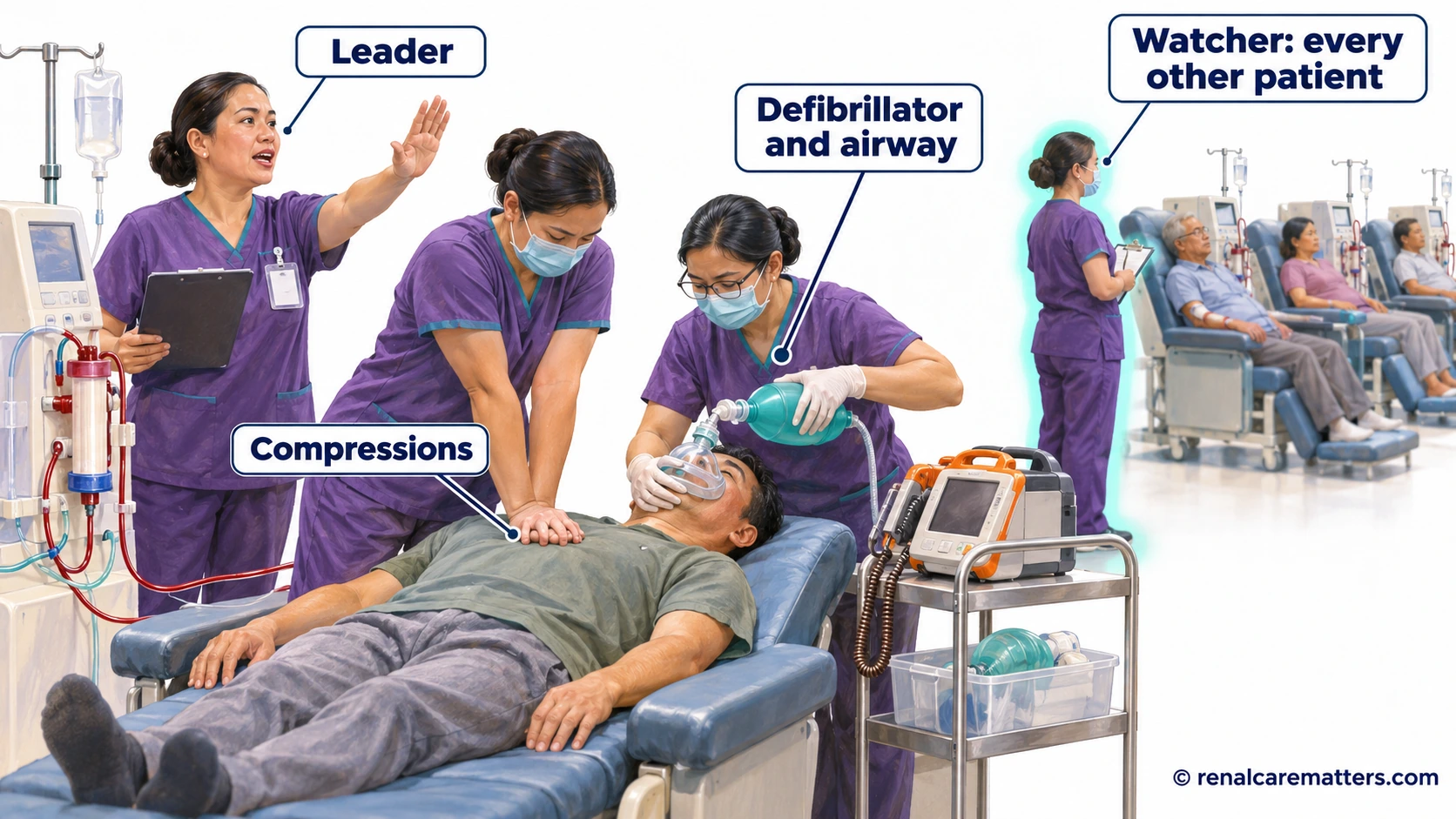
Say the roles aloud, using names: “Arnel, compressions. Kris, defibrillator and airway bag. Mika, watch every other patient and tell me if anyone changes. I’ll call the physician and lead.”
Figure 3. Roles out loud, including the one most specific to dialysis: the nurse who watches everyone else.
The watcher is the role most often forgotten and the one most specific to dialysis. Eleven other patients are still connected, some still losing pressure, some with needles that can dislodge while everyone looks at Bed 9.
Lesson · part 4
Directed, closed-loop communication
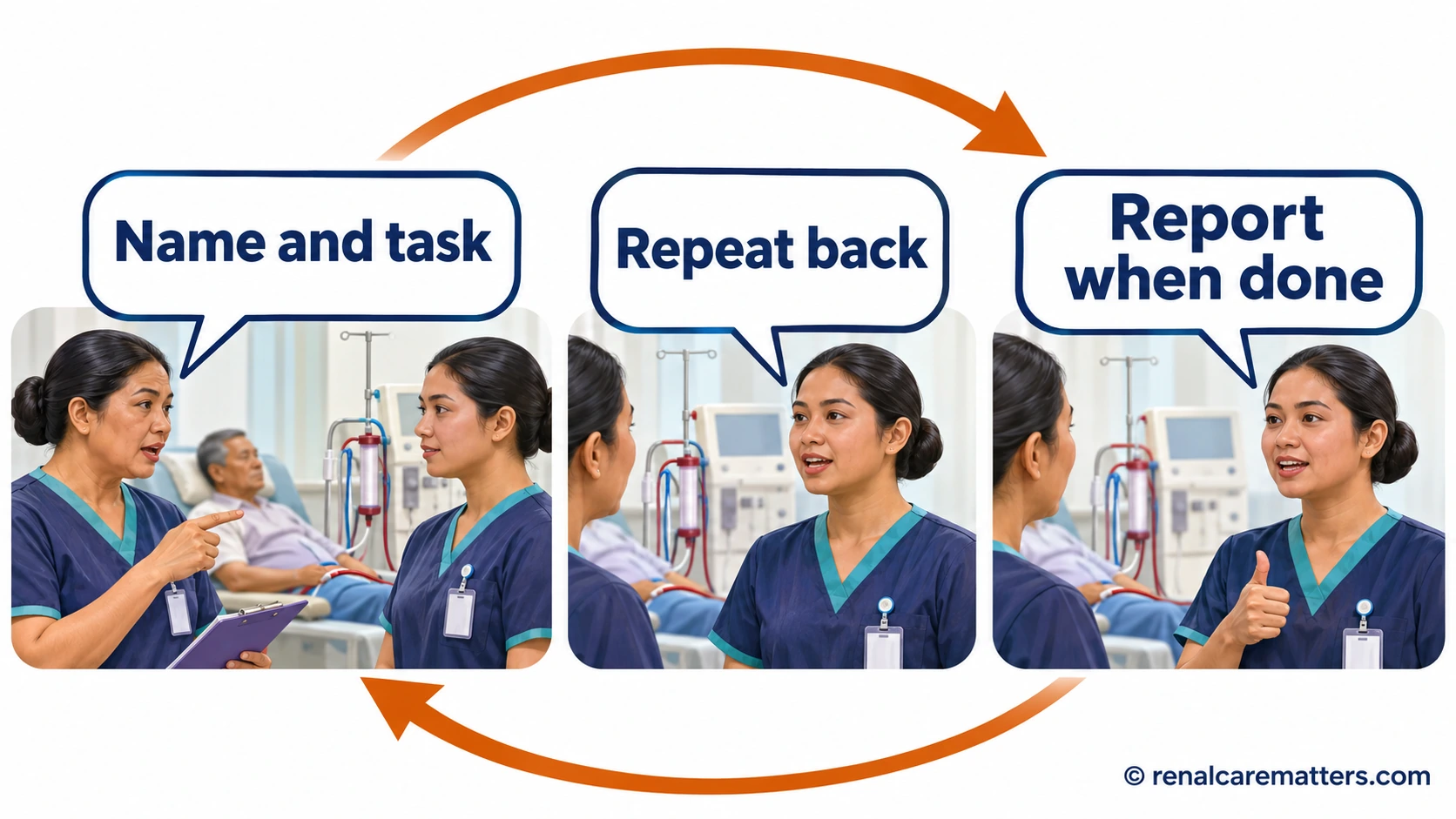
Name the person, give one task, and expect a report back. In operating-theater emergency simulations, requests that used both a named recipient and a closed loop were completed every time, against 81% for requests that used neither or only one.4 This was simulation, not patient outcomes, but the result fits what teams experience: unnamed requests (“someone get the cart”) are the ones nobody does.
Figure 4. Name and task, repeat back, report when done.
Figure 5 · Three beats
Name and task“Kris, bring the defibrillator.”
Repeat back“Bringing the defibrillator.”
Report done“Pads on.”
Lesson · part 5
Resuscitation standards
Follow current basic and advanced life support guidance: the American Heart Association 2025 updates, and the European Resuscitation Council (ERC) 2025 chapter on special circumstances, which addresses patients on dialysis.5,6 High potassium is a reversible cause to consider in a dialysis patient; its treatment follows the physician’s orders.
Lesson · part 6
The handoff to the physician or ambulance
When the physician, the code team, or the ambulance arrives, give a structured handoff: who, what happened and when, what was done, the dialysis details, and what is still pending.7 Dialysis details the receiving team cannot guess: time on the machine, fluid removed, the last potassium, the access type, and whether blood was returned.
On the floor · Two emergencies at once
At 7:09 Mika, the watcher, calls: “Bed 4, pressure 88 over 50, he’s yawning.” Ana is leading the code at Bed 9. She does not leave. At the next rhythm check she sends Kris to Bed 4: “Kris, Bed 4: stop fluid removal, lay him flat, recheck in two minutes, report to me.” Kris repeats it back and goes. Arnel continues compressions; Ana takes the defibrillator. When two things happen at once, the charge nurse keeps the sicker patient and sends her most experienced available nurse to the other, with a named task and a report-back time.
Illustrative scenario. Names and details are invented.
On the floor
Real situations: problems and solutions
These are fictional but typical. For each one, cover the answer, decide what you would do, then compare. Where a step depends on local rules, your unit’s procedure and your supervisor’s direction come first.
Air in the venous line
What you see
You see air bubbles in the return line of a patient who is short of breath.
What is likely going on
Possible air embolism.
What to do
Clamp, stop the pump, position per protocol, give oxygen, and call.
Why it matters
Returning that blood would return the air.
Two emergencies at once
What you see
A second patient deteriorates while you lead a code.
What is likely going on
The floor does not pause.
What to do
Keep the sicker patient, send your most experienced available nurse to the other with a named task and a report time.
Why it matters
The watcher exists for exactly this.
The family arrives during CPR
What you see
A patient’s son walks in during resuscitation.
What is likely going on
A frightened relative.
What to do
If staff allow, assign one person to stay with him and explain what is happening.
Why it matters
Families remember how they were treated.
Field notes
Lead before you grab.
Someone watches the rest.
Name, task, report back.
Case review
Back to the case: Bed 9 is not breathing
The first three commands. “Bed 9, no pulse. Arnel, compressions. Kris, defibrillator. Mika, watch everyone else.”
The circuit. At 7:05:30 Ana checks: no air, no blood loss, normal line color. The circuit is a bystander. She stops the pump, returns the blood per protocol in under a minute because it is quick and safe, and disconnects. At 7:06 she calls the physician: “Code at Bed 9.” Pads are on at 7:06:30; the rhythm is not shockable; CPR continues.
The other eleven. Mika watches them. At 7:09 she reports Bed 4’s falling pressure, and Ana sends Kris with a named task. At 7:10 the physician arrives and Ana hands off: “Mr. Ramos, 71, after the long gap, arrested at 7:05, one hour on dialysis, 0.9 liters removed, Friday potassium 6.1, fistula, blood returned and disconnected at 7:06; CPR since 7:05; not shockable at 7:07.” Bed 4 was caught only because someone was watching.
Skills lab · with your preceptor
Skills checklist: Leading the first ten minutes
Two simulated emergencies on a training manikin at a dialysis chair: one where the circuit is a bystander, one with air or suspected hemolysis. A facilitator adds a second deterioration elsewhere. Your preceptor rates each step as satisfactory, needs practice, or not observed. Steps marked Critical must all be satisfactory before sign-off. This checklist supports supervised learning; your unit’s own procedure and competency form are the authority. A printable version of every checklist is on the trainer page.
CriticalRecognizes the arrest and starts CPR within the first minute.
CriticalMakes the circuit cause-or-bystander decision in seconds and states it.
CriticalDoes not return blood when air or hemolysis is suspected.
CriticalAssigns roles by name, including the watcher.
Uses directed, closed-loop commands.
Handles a second deterioration without leaving the code leaderless.
CriticalGives a structured handoff with time on machine, fluid removed, last potassium, access, and blood return.
Placement activity. Lead one unannounced emergency drill on your unit as team leader, with the head nurse observing.
Self-assessment
Check your understanding
Each visit draws 8 questions at random from this module’s 15-question bank. Choose the single best answer for each, then select Check answers; an explanation appears under the best answer. Select New set of questions for a different mix. A good target is 7 of 8 on two different sets. Nothing you select is sent anywhere; scoring happens in your browser.
Foley, R. N., Gilbertson, D. T., Murray, T., & Collins, A. J. (2011). Long interdialytic interval and mortality among patients receiving hemodialysis. New England Journal of Medicine, 365(12), 1099–1107. https://doi.org/10.1056/NEJMoa1103313
Pun, P. H., Lehrich, R. W., Smith, S. R., & Middleton, J. P. (2007). Predictors of survival after cardiac arrest in outpatient hemodialysis clinics. Clinical Journal of the American Society of Nephrology, 2(3), 491–500. https://doi.org/10.2215/CJN.02360706
Pun, P. H., Dupre, M. E., Starks, M. A., Tyson, C., Vellano, K., Svetkey, L. P., Hansen, S., Frizzelle, B. G., McNally, B., Jollis, J. G., Al-Khatib, S. M., Granger, C. B., & CARES Surveillance Group. (2019). Outcomes for hemodialysis patients given cardiopulmonary resuscitation for cardiac arrest at outpatient dialysis clinics. Journal of the American Society of Nephrology, 30(3), 461–470. https://doi.org/10.1681/ASN.2018090911
Lee, H., Merry, A. F., Woodward-Krohn, R., & Weller, J. M. (2025). Use and effectiveness of directed, closed-loop communication in the operating theatre: Mixed methods analysis of simulated clinical emergencies. British Journal of Anaesthesia, 135(5), 1279–1285. https://doi.org/10.1016/j.bja.2025.05.015
Kleinman, M. E., Buick, J. E., Huber, N., Idris, A. H., Levy, M., Morgan, S. G., Nassal, M. M. J., Neth, M. R., Norii, T., Nunnally, M. E., Rodriguez, A. J., Walsh, B. K., & Drennan, I. R. (2025). Part 7: Adult basic life support: 2025 American Heart Association guidelines for cardiopulmonary resuscitation and emergency cardiovascular care. Circulation, 152(16_suppl_2), S448–S478. https://doi.org/10.1161/CIR.0000000000001369
Lott, C., Karageorgos, V., Abelairas-Gomez, C., Alfonzo, A., Bierens, J., Cantellow, S., Debaty, G., Einav, S., Fischer, M., González-Salvado, V., Greif, R., Metelmann, B., Metelmann, C., Meyer, T., Paal, P., Peran, D., Scapigliati, A., Spartinou, A., Thies, K., . . . Deakin, C. D. (2025). European Resuscitation Council guidelines 2025 special circumstances in resuscitation. Resuscitation, 215(Suppl. 1), Article 110753. https://doi.org/10.1016/j.resuscitation.2025.110753
Starmer, A. J., Spector, N. D., Srivastava, R., West, D. C., Rosenbluth, G., Allen, A. D., Noble, E. L., Tse, L. L., Dalal, A. K., Keohane, C. A., Lipsitz, S. R., Rothschild, J. M., Wien, M. F., Yoon, C. S., Zigmont, K. R., Wilson, K. M., O'Toole, J. K., Solan, L. G., Aylor, M., . . . I-PASS Study Group. (2014). Changes in medical errors after implementation of a handoff program. New England Journal of Medicine, 371(19), 1803–1812. https://doi.org/10.1056/NEJMsa1405556
Educational study material for nurses. Does not replace the attending nephrologist’s orders, the unit’s protocols, required training and certification, or supervised practice.