Nephrology Nursing Track · By Role · Module 11 of 18
Water and Machines: Hold, Escalate, Release
The water treatment chain, reading the log, a symptom pattern in neighboring chairs, machine alarms, and restarting only on signatures.
PublishedNailathalaGipatikPepalwal:ReferencesMga SanggunianMga TinubdanReng Reperensya:6Audience: Experienced hemodialysis nurses who take charge of a shift · nurses being prepared for charge duty · head nurses and educators who orient themRead timeOras ng pagbasaOras sa pagbasaOras ning pamamasa:
This module is study material for charge nurses in hemodialysis units. It explains the reasoning behind common decisions; it is not a protocol. On the floor, follow your unit’s protocol and always ask the attending nephrologist for guidance. Doses, limits, and cut-off values are set by your unit. Every case is fictional.
Learning objectives
After this module you should be able to
Follow water through the treatment chain and say what each stage removes.
Read the water log before opening and recognize an incomplete or abnormal entry.
Hold treatment when water or a machine is not released, and escalate.
Lead the first steps when several patients react in a pattern that suggests water or dialysate.
Reopen only on a signed release from the authorized people.
Pre-testBefore you read, answer the 8 self-assessment questions and note your score. After the module, select New set of questions and compare. The difference is what you learned; the questions you still miss are what to reread.
Start here
The big picture, in plain words
In plain wordsA water refilling station sells water you can drink. A dialysis water room makes water that touches your blood across a thin membrane, more than a hundred liters each session. The standard is not “drinkable”; it is “safe in the bloodstream.”
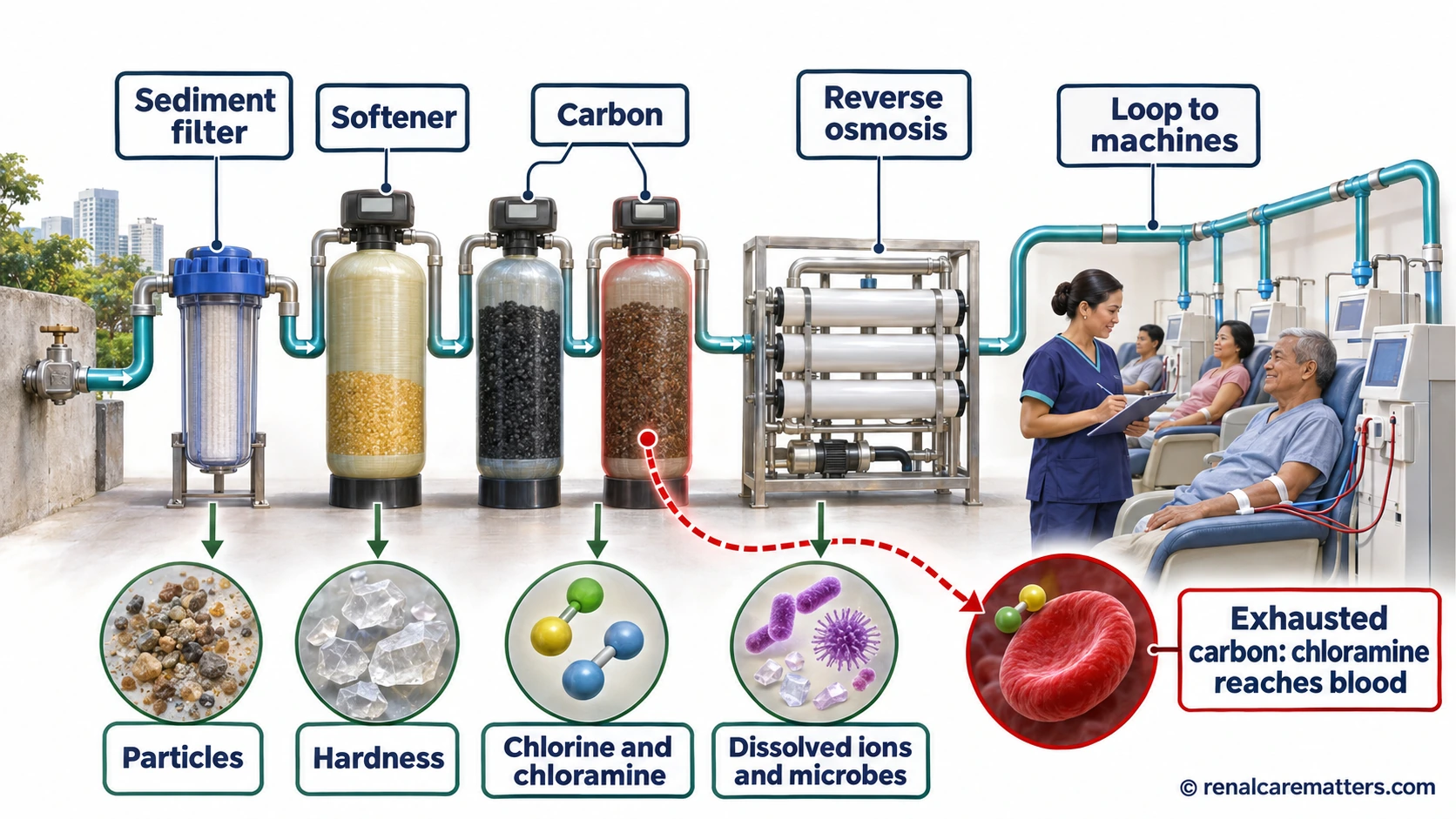
The treatment chain removes particles, hardness, chlorine and chloramine, dissolved ions, and microbes in turn. Each stage protects the next. If one fails, the next may be overwhelmed, and a contaminant can reach the patient within one shift.1 The charge nurse does not run the water room. She makes sure nobody connects a patient to water that has not been released.
Figure 1 · Key terms for this module
Carbon tankRemoves chlorine and chloramine.
Reverse osmosis (RO)A membrane that removes most dissolved ions and many microbes.
Distribution loopThe pipes that carry treated water to the machines.
EndotoxinFragments of bacteria that can cause fever and inflammation.
Conductivity alarmA machine alarm that the dialysate mix may be wrong.
ReleaseThe authorized technical lead’s signed statement that water or a machine is fit to use.
Opening case · fictional
Case: Headache and nausea in three chairs
At 7:20, three patients in neighboring stations complain of nausea and headache; one also has chest tightness and back pain. All three started between 6:30 and 6:45. The morning chlorine entry was signed at 5:40 as “within limit.”
The water technician mentions that the carbon tank was backwashed late the night before. The charge nurse is Ramon Aquino. Nine other patients are connected.
Before reading on, decide:
What could connect the three patients?
What are the first steps, in order?
Who can restart the unit, and on what basis?
Keep your answers in mind. The lesson gives you what you need, and the case review near the end shows one sound response.
Lesson · part 1
The treatment chain and what fails
Carbon removes chlorine and chloramine. When carbon is exhausted or bypassed, chloramine reaches the patient and damages red cells, causing hemolysis.2 Aluminum and fluoride in dialysis water have caused fatal outbreaks in the past.3 Bacteria and endotoxins grow in stagnant pipes and can cause fever and chills during dialysis.
Figure 2. The water treatment chain. Each stage protects the next; when carbon is exhausted, chloramine reaches the blood.
Lesson · part 2
Reading the water log
Before opening, check that the day’s tests are entered, signed, and timed, and that any out-of-range entry has an action written beside it. The numerical limits and the testing schedule are in the unit’s approved water protocol under Department of Health (DOH) administrative order (AO) 2013-0003 and the applicable standards; the charge nurse does not set or change them.4 This module deliberately gives no numbers. A charge nurse who carries numbers in her head, instead of reading the protocol, will one day use an old one.
RememberNo numbers in your head. Numbers live in the protocol; your job is to see that they were checked and signed.
Lesson · part 3
A symptom pattern in neighboring chairs
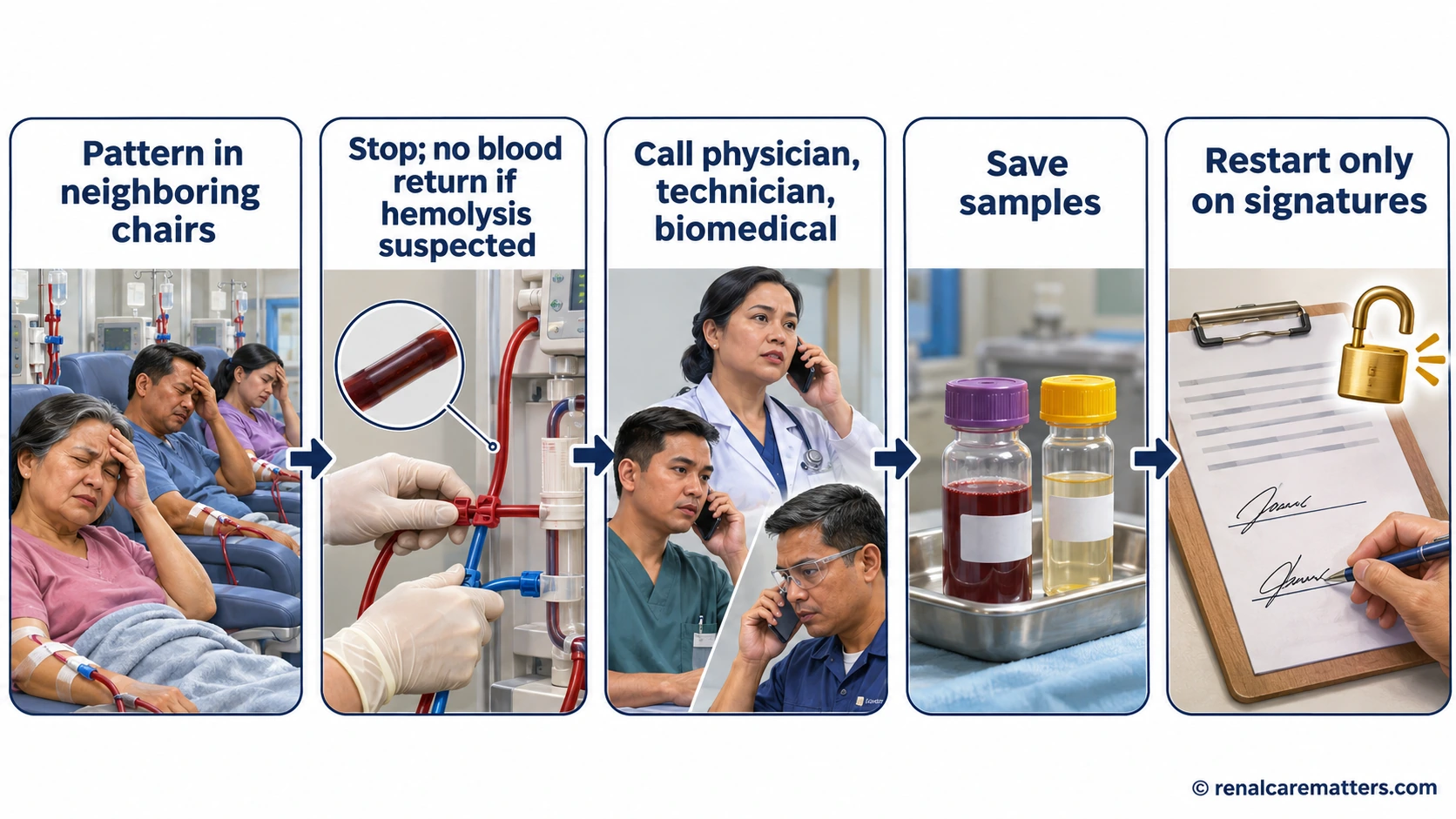
Several patients with similar symptoms soon after starting point to something they share: the water, a batch of dialysate concentrate, a batch of dialyzers or lines, or the room. Act on the pattern without waiting for proof.5,6
Figure 3. Hold, escalate, release. Restart only on signatures.
Figure 4 · First steps, per your unit’s protocol
Stop dialysis in affected patientsDo not return the blood if hemolysis is suspected: dark or port-wine-colored blood in the venous line, back pain, chest tightness.
CallThe physician on duty and the attending nephrologist; the water technician and the biomedical lead.
Hold new connectionsNobody else starts on that water or batch.
Save evidencePatient blood samples, the dialysate, a water sample, lines and dialyzers, labeled with times.
Watch everyone elseOne nurse assigned to the other patients’ symptoms and pressures.
Stop and callSuspected hemolysis (dark venous-line blood, back pain, chest tightness): stop, do not return the blood, and call the physician now.
Lesson · part 4
Machines
A machine is used only after release by the biomedical staff. A tagged machine stays out of the bay. If a machine alarms for conductivity or temperature, do not override the alarm to keep going. Take the patient off per protocol if needed, take the machine out of use, tag it, and tell the technician.
On the floor · The alarm that kept coming back
At 8:10 a conductivity alarm sounds at Bed 6. The staff nurse silences it twice. The charge nurse stops at the chair: the alarm means the dialysate mix may be wrong. She has the patient taken off per protocol, moves him to a released machine, tags Machine 6, and calls the biomedical technician. The technician finds a cracked concentrate line. Twice silenced, one more time would have been dialysis with the wrong fluid.
Illustrative scenario. Names and details are invented.
Lesson · part 5
Restart needs signatures
Reopening after a water or machine event requires the authorized technical lead’s release and the medical director’s agreement, in writing, per the unit protocol. A charge nurse never restarts on “it should be fine now.” There is no automatic restart rule.
On the floor
Real situations: problems and solutions
These are fictional but typical. For each one, cover the answer, decide what you would do, then compare. Where a step depends on local rules, your unit’s procedure and your supervisor’s direction come first.
“Go ahead, I’ll sign later”
What you see
The technician says the water is fine and he will sign the log later.
What is likely going on
Pressure to start on time.
What to do
Wait for the signature.
Why it matters
An unsigned result is an unknown result.
Conductivity alarm on one machine
What you see
One machine alarms for conductivity.
What is likely going on
The dialysate mix may be wrong.
What to do
Take the patient off per protocol if needed, remove the machine from use, tag it, and call biomedical.
Why it matters
Silencing the alarm does not fix the fluid.
Brownout at 8:00
What you see
The power fails during the first shift.
What is likely going on
Water and machines may both be affected.
What to do
Follow Module 13: patients first, then calls, then the board.
Why it matters
Water and power failures often come together.
Field notes
Drinkable is not dialyzable.
Numbers live in the protocol.
Restart means signatures.
Case review
Back to the case: Headache and nausea in three chairs
What connects them. Three similar reactions in neighboring stations soon after starting point to a shared cause: water, dialysate concentrate, a batch of disposables, or the room. Back pain and chest tightness in one patient raise the possibility of hemolysis.
The timeline. 7:20 symptoms in three chairs. 7:21 Ramon stops the three sessions, without returning the blood of the patient whose venous line looks dark, and calls the physician on duty. 7:23 he holds new connections and assigns one nurse to watch the other nine patients. 7:25 he calls the water technician and the biomedical lead. 7:30 the attending is informed; blood samples, dialysate, and a water sample are saved and labeled. 7:45 the technician retests total chlorine at the point of use: above the unit’s limit; the carbon bed is exhausted.
Restart. The carbon is replaced by 9:30. The technical lead signs the release and the medical director agrees in writing at 10:10. The affected patients are assessed by the physician; one is admitted. The remaining morning patients are rescheduled for the afternoon with full time. Ramon reopens only on signatures.
Skills lab · with your preceptor
Skills checklist: Hold, escalate, release
Read three sample water logs (one complete, one incomplete, one with an out-of-range entry) and run a tabletop water event with the technician. Your preceptor rates each step as satisfactory, needs practice, or not observed. Steps marked Critical must all be satisfactory before sign-off. This checklist supports supervised learning; your unit’s own procedure and competency form are the authority. A printable version of every checklist is on the trainer page.
Names each stage of the treatment chain and what it removes.
CriticalIdentifies an incomplete or unsigned log entry as a hold.
CriticalRecognizes a symptom pattern in neighboring chairs as a possible shared cause.
CriticalStops dialysis without returning blood when hemolysis is suspected.
CriticalCalls the physician, technician, and biomedical lead, and holds new connections.
Assigns a nurse to watch the other patients.
Saves and labels evidence.
CriticalRequires a signed release before restart.
Placement activity. Spend one morning with the water technician during the daily tests, and review the log together.
Self-assessment
Check your understanding
Each visit draws 8 questions at random from this module’s 15-question bank. Choose the single best answer for each, then select Check answers; an explanation appears under the best answer. Select New set of questions for a different mix. A good target is 7 of 8 on two different sets. Nothing you select is sent anywhere; scoring happens in your browser.
International Organization for Standardization. (2024). Preparation and quality management of fluids for haemodialysis and related therapies: Part 3. Water for haemodialysis and related therapies (ISO Standard No. 23500-3:2024, 2nd ed.). ISO.
Tipple, M. A., Shusterman, N., Bland, L. A., McCarthy, M. A., Favero, M. S., Arduino, M. J., Reid, M. H., & Jarvis, W. R. (1991). Illness in hemodialysis patients after exposure to chloramine contaminated dialysate. ASAIO Transactions, 37(4), 588–591. https://pubmed.ncbi.nlm.nih.gov/1768494/
Department of Health. (2013). Administrative Order No. 2013-0003: Implementing guidelines in the analysis, monitoring and maintenance of water used in dialysis facilities. Republic of the Philippines.
Greenberg, K. I., & Choi, M. J. (2021). Hemodialysis emergencies: Core curriculum 2021. American Journal of Kidney Diseases, 77(5), 796–809. https://doi.org/10.1053/j.ajkd.2020.11.024
Saha, M., & Allon, M. (2017). Diagnosis, treatment, and prevention of hemodialysis emergencies. Clinical Journal of the American Society of Nephrology, 12(2), 357–369. https://doi.org/10.2215/CJN.05260516
Educational study material for nurses. Does not replace the attending nephrologist’s orders, the unit’s protocols, required training and certification, or supervised practice.