Nephrology Nursing Track · By Role · Module 2 of 18
The Opening Sweep: Five Gates Before the First Connection
People, physician, water and machines, emergency readiness, and stations; why a blank result is a red result; holding with an owner and a time.
PublishedNailathalaGipatikPepalwal:ReferencesMga SanggunianMga TinubdanReng Reperensya:6Audience: Experienced hemodialysis nurses who take charge of a shift · nurses being prepared for charge duty · head nurses and educators who orient themRead timeOras ng pagbasaOras sa pagbasaOras ning pamamasa:
This module is study material for charge nurses in hemodialysis units. It explains the reasoning behind common decisions; it is not a protocol. On the floor, follow your unit’s protocol and always ask the attending nephrologist for guidance. Doses, limits, and cut-off values are set by your unit. Every case is fictional.
Learning objectives
After this module you should be able to
Run the five opening gates in a fixed order and say what each one protects.
Treat a missing result as an abnormal result.
Check that an emergency cart is complete, sealed, and ready in about five minutes.
Prepare isolation stations and keep tagged machines out of use before patients arrive.
Hold the first connection when a gate is closed, tell waiting patients why, and name an owner and a time.
Pre-testBefore you read, answer the 8 self-assessment questions and note your score. After the module, select New set of questions and compare. The difference is what you learned; the questions you still miss are what to reread.
Start here
The big picture, in plain words
In plain wordsA pilot does not take off because the plane looked fine yesterday. She walks around it, reads a checklist aloud, and waits for the tower. The checklist exists because the most dangerous errors are the ones nobody notices on an ordinary morning.
The walk-around is a good model, but a dialysis unit differs in one way that matters: the checks belong to several people. The technician tests the water, the biomedical staff release the machines, the head nurse builds the roster, and the physician answers the phone. The charge nurse does not perform all five checks herself. She confirms that each one was done, signed, and is current before the first needle goes in.
Figure 1 · Key terms for this module
Opening gateA condition that must be true before the first patient connects.
HoldA decision not to start, with a named owner and a time to look again.
Total chlorineA water test for chlorine and chloramine, done before treatment each day under the unit’s protocol.
Machine releaseThe biomedical staff’s signed statement that a machine passed its checks.
Red tagA label that takes a machine out of use until it is repaired and released.
Isolation stationA dedicated area, machine, and equipment for a patient with hepatitis B.
Opening case · fictional
Case: It’s 5:55 and the chlorine log is blank
At a freestanding unit in Bulacan, Nurse Paolo Mendoza takes charge at 5:30. By 5:55, eleven patients are seated in their chairs. The total chlorine test for the morning has not been entered; the water technician, Mang Ruben, texts that he is stuck in traffic on MacArthur Highway. The night nurse says, “It was fine last night.”
The emergency cart seal is intact, but yesterday’s defibrillator check strip is missing from the log. A patient in Bed 3 says she has work at noon and asks why they are not starting.
Before reading on, decide:
Can Paolo start the first connections?
What does he do about the emergency cart?
What does he tell the eleven waiting patients?
Keep your answers in mind. The lesson gives you what you need, and the case review near the end shows one sound response.
Lesson · part 1
Five gates before the first connection
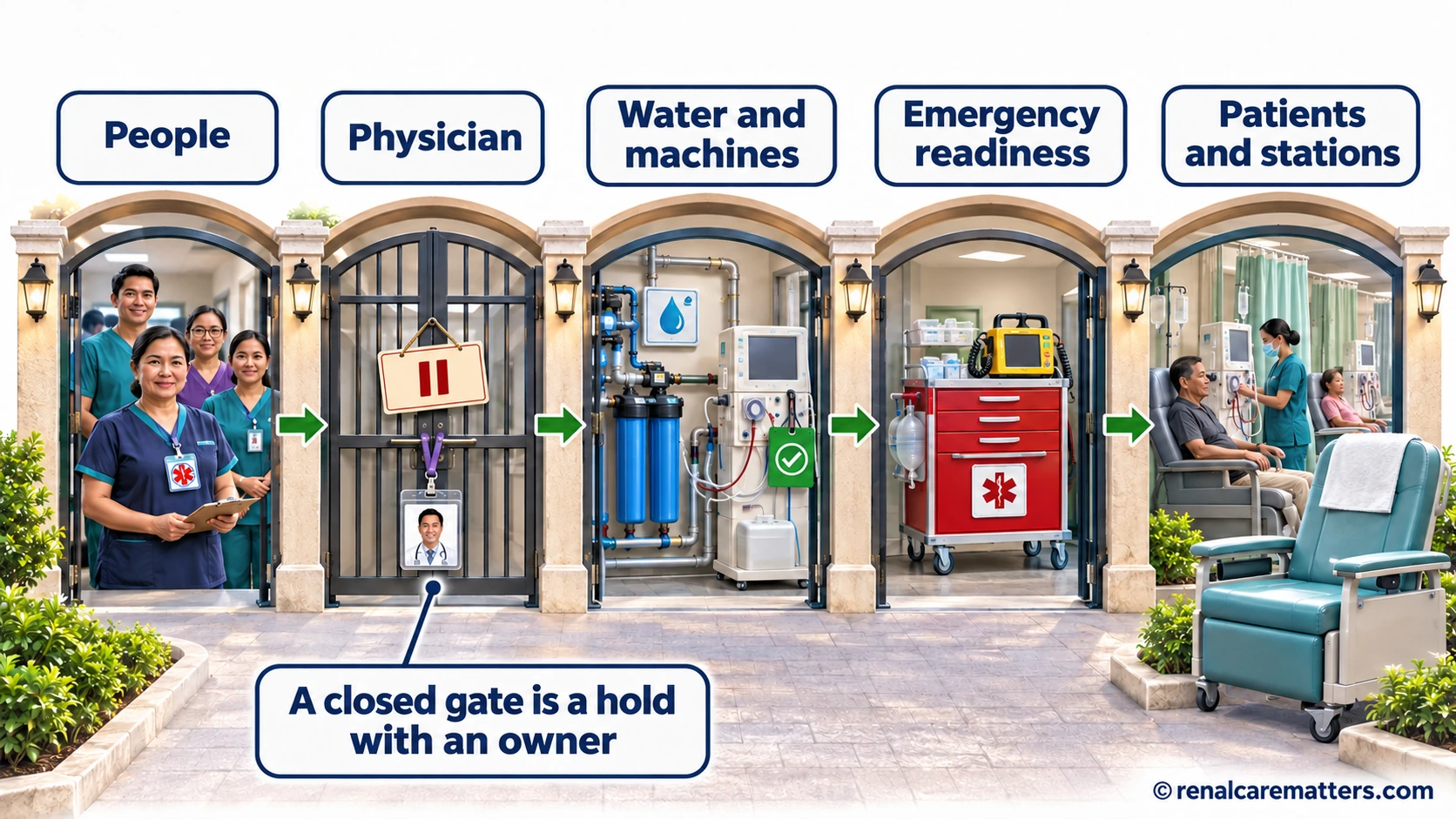
Run the same five gates in the same order every morning, so a busy day cannot skip one.
Figure 2. Five gates before the first connection. A closed gate is a hold with an owner and a time, not a reason to start anyway.
Gate
What must be true
Who owns it
1. People
Enough nurses who can work alone for the stations you will run; at least one Advanced Cardiovascular Life Support (ACLS)-trained nurse on the floor; nobody counted who is not cleared
Head nurse (roster); charge nurse (today’s check)
2. Physician
The physician on duty is present, or reachable within the unit’s agreed time, by a number tested this morning
Medical director (schedule); charge nurse (the test call)
3. Water and machines
Today’s water checks done and signed; every machine in use released; tagged machines set apart
Water and biomedical staff
4. Emergency readiness
Cart sealed and in date; defibrillator checked; suction and oxygen working
Charge nurse or the nurse assigned
5. Patients and stations
Isolation stations prepared; each patient’s order current; flags from the previous shift reviewed
Charge nurse with the staff nurses
The United States Centers for Disease Control and Prevention (CDC) core interventions for dialysis units rest on the same idea: a few checks done reliably every day protect more patients than many checks done occasionally.1 The order of the five gates matters less than doing them the same way every day.
RememberA gate is either open or closed. “Probably fine” is closed.
Lesson · part 2
Why a blank result is a red result
Chlorine and chloramine in city water are harmless to drink. In dialysis they are not. They cross the dialyzer membrane into the blood, where chloramine damages red cells and causes hemolysis, the bursting of red cells. Outbreaks have followed exhausted carbon filters and changes in the city water supply.2,3
The difference is volume. A person drinks about two liters of water a day. A patient on dialysis is exposed to well over a hundred liters of dialysis fluid in one session, across a membrane thinner than paper, directly into the blood. Small amounts that the gut would never notice can harm a dialysis patient.
So a missing test means “unknown,” and unknown water is treated as unsafe until the technician tests it and signs the result. The limits themselves are in the unit’s approved water protocol under Department of Health (DOH) administrative order (AO) 2013-0003; the charge nurse does not set or change them.4 Module 11 goes deeper into water.
On the floor · “It was fine last night”
At a hospital unit in Quezon City, the night nurse tells the incoming charge nurse that the water was tested at 9 p.m. and was fine. The morning test is not done. The charge nurse asks: “Was the carbon tank backwashed after 9 p.m.?” It was, at 11 p.m.
A backwash, a change in the city water, or a long weekend can change the result overnight. Last night’s result describes last night’s water. The morning test is done at 5:50, inside the unit’s limit, and signed. The first patient connects at 6:00.
Illustrative scenario. Names and details are invented.
Lesson · part 3
The emergency cart in five minutes
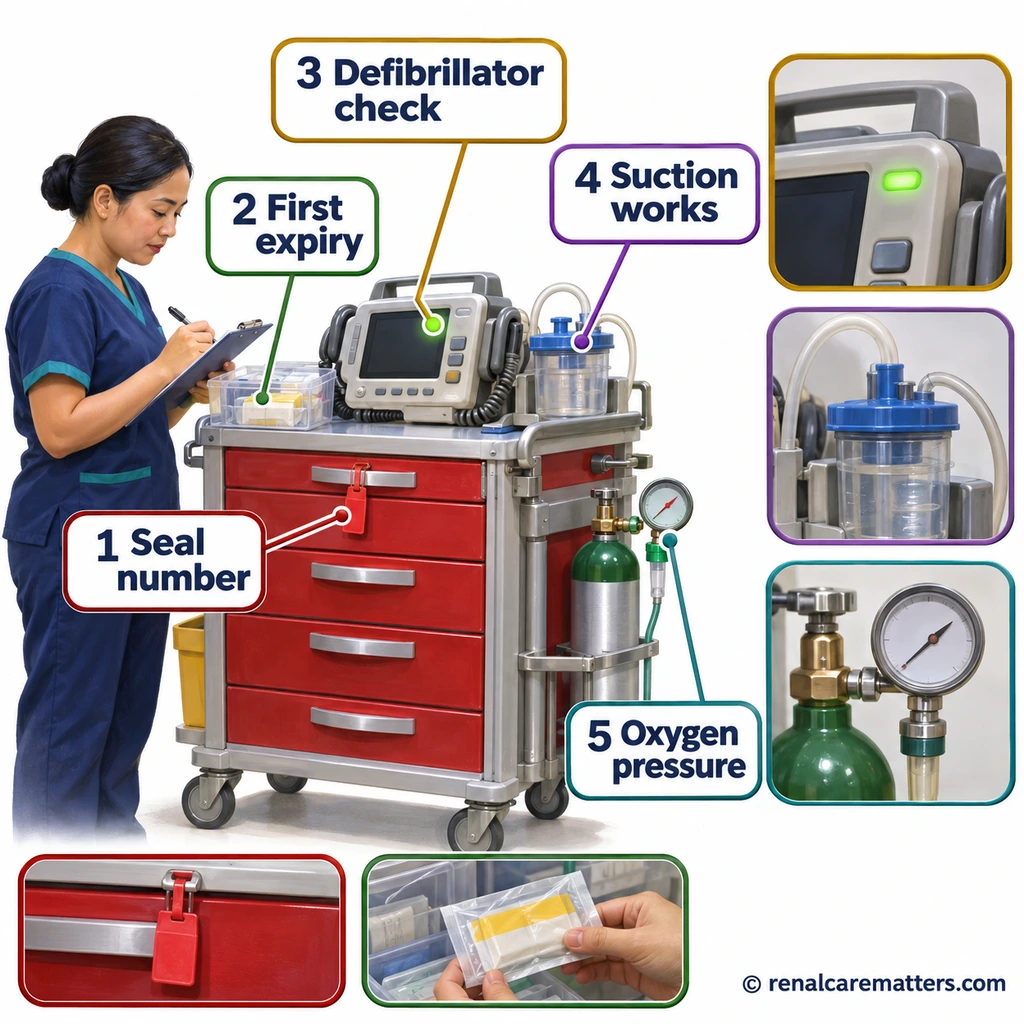
Five checks, in the same order:
Figure 3. The emergency cart in five minutes: seal, first expiry, defibrillator, suction, oxygen.
Figure 4 · The five-minute cart check
SealThe seal number matches the log. If it is broken or does not match, do the full content check before patients connect.
First expiryThe item due to expire first is still in date.
DefibrillatorThe self-test or manual check is done and logged. If it fails, borrow one and tell the head nurse.
SuctionIt turns on and pulls.
OxygenThe cylinder pressure is enough for the shift, per the unit’s rule.
Why this matters: in a registry of 398 cardiac arrests in United States dialysis clinics, staff started cardiopulmonary resuscitation (CPR) before the ambulance arrived in most cases, and staff-started CPR was associated with about three times the odds of leaving hospital alive.5 That only works when the cart and the defibrillator are ready at 6:01, not at 6:30.
On the floor · The seal that did not match
Nurse Liza Cruz finds seal number 41207 on the cart. The log says 41206. Nobody remembers opening it. She does the full content check before the first connection and finds the adrenaline box missing, used during a ward emergency the evening before and never replaced. She gets a replacement from the pharmacy, reseals the cart, logs the new number, and writes a near-miss report. Ten minutes, and the next arrest will have adrenaline.
Illustrative scenario. Names and details are invented.
Lesson · part 4
Stations and machines before patients arrive
Patients with hepatitis B surface antigen (HBsAg) need a dedicated room or area, machine, equipment, and staff member, as the CDC recommends; hepatitis B can survive on surfaces for at least seven days.6 Prepare that station before the patient walks in. A patient who arrives to find his station not ready sits in the waiting area while staff hurry, and hurrying is when boundaries slip.
A machine with a red tag stays out of the bay. Move it physically, or block it, so nobody plugs it in at 6:10 because it is the only free one. Confirm that every machine you will use today has a current release.
Read the previous shift’s flags: a patient who was admitted, a new dry weight, a pending potassium, a new access. Those flags are why the order you are about to run may already be out of date.
Lesson · part 5
Holding with an owner and a time
A closed gate is a hold, not a failure. A good hold has three parts: who will open it (“Mang Ruben, testing at 6:10”), what you tell the waiting patients, and whether the minutes lost can be added back at the end.
Tell patients plainly: “The water test for this morning is not done yet. We will start about twenty minutes late. You will get your full time.” Patients accept a delay when they understand it. They lose trust when they see staff hide it, or when they are rushed off the machine at the end to make up the time.
Count the cost honestly. Fifteen minutes lost for eleven patients is 165 patient-minutes, close to one full session in a single morning. If the minutes are not added back, they are dialysis that never happened (Module 6). Agree with the next shift’s charge nurse on a later start for her first chairs, so the morning patients get their full time.
On the floor · The patient with work at noon
Mrs. Joanna Lim, 44, works the noon shift at a mall pharmacy. She asks to start now or to come off twenty minutes early. The charge nurse explains why the hold exists, offers to call her supervisor to explain the delay, and asks the attending nephrologist whether any change is safe. She does not quietly shorten Mrs. Lim’s treatment to keep her happy. The supervisor agrees to a later start for the day.
Illustrative scenario. Names and details are invented.
RememberA hold has a name and a time. Without both, it is just a delay.
On the floor
Real situations: problems and solutions
These are fictional but typical. For each one, cover the answer, decide what you would do, then compare. Where a step depends on local rules, your unit’s procedure and your supervisor’s direction come first.
The seal number that does not match
What you see
The emergency cart seal reads one number; the log says another.
What is likely going on
The cart was opened and resealed without a log entry, or not resealed at all.
What to do
Do the full content check before the first connection, replace what is missing, reseal, and report a near miss.
Why it matters
The next arrest will need everything in that cart.
Voicemail at 5:50
What you see
The physician on duty’s phone goes to voicemail.
What is likely going on
He may be on the ward or driving.
What to do
Call the backup number. Do not start the first connection until a physician is reachable, per your protocol.
Why it matters
The physician gate is open only when someone can answer.
“I have work at noon”
What you see
A patient asks to start now or come off early.
What is likely going on
The hold is costing her something real.
What to do
Explain the hold, offer to call her employer, and ask the attending whether any change is safe. Do not quietly shorten her treatment.
Why it matters
Trust grows when patients understand delays.
Field notes
Same gates, same order, every morning.
Test the physician’s number; do not assume it.
A hold has a name and a time.
Case review
Back to the case: It’s 5:55 and the chlorine log is blank
Can Paolo start? No. A missing water result is an abnormal result. He holds every connection until Mang Ruben tests and signs. He does not accept “it was fine last night,” because the carbon tanks and the city water can change overnight.
The cart. The seal is intact, so a full content count is not needed, but the defibrillator check is. He runs it now. If it fails, he borrows one from the ward and tells the head nurse before the first connection.
The patients. He tells them the reason, the expected delay, and that their full time will be given. Mang Ruben arrives at 6:05; the result is entered at 6:12. Eleven patients start between 6:15 and 6:40 instead of 6:00 to 6:25. Paolo asks the second-shift charge nurse to start her first four chairs fifteen minutes later so the morning patients get their full four hours (Toolkit #c4 counts the minutes).
The system fix. Paolo writes one line in the shift log and one in the improvement file: “Water test delayed by traffic; no backup tester.” The head nurse trains a second staff member to run the morning test under the technician’s protocol. That second line is how a habit changes.
Skills lab · with your preceptor
Skills checklist: The opening sweep
Run the five gates on a real morning with a facilitator watching, then a second time on a simulated morning with one gate deliberately closed. Your preceptor rates each step as satisfactory, needs practice, or not observed. Steps marked Critical must all be satisfactory before sign-off. This checklist supports supervised learning; your unit’s own procedure and competency form are the authority. A printable version of every checklist is on the trainer page.
CriticalRuns the five gates in the same order and states what each protects.
CriticalTreats a missing water result as a hold and does not connect.
Completes the five-minute cart check and logs the seal number.
CriticalRuns or confirms the defibrillator check and knows where to borrow one.
CriticalPlaces a red-tagged machine out of the bay.
Prepares the isolation station before the patient arrives.
Tests the physician’s number and has the backup number ready.
CriticalGives waiting patients a hold message with the reason, the delay, and the plan for full time.
Writes a one-line improvement note when a gate was closed by a system gap.
Placement activity. For one week, record each morning’s gates and any gate that was closed, why, and for how long. Review the list with the head nurse.
Self-assessment
Check your understanding
Each visit draws 8 questions at random from this module’s 15-question bank. Choose the single best answer for each, then select Check answers; an explanation appears under the best answer. Select New set of questions for a different mix. A good target is 7 of 8 on two different sets. Nothing you select is sent anywhere; scoring happens in your browser.
Centers for Disease Control and Prevention. (n.d.). Dialysis safety: Core interventions. Retrieved November 23, 2026, from https://www.cdc.gov/dialysis-safety/hcp/clinical-safety/
Tipple, M. A., Shusterman, N., Bland, L. A., McCarthy, M. A., Favero, M. S., Arduino, M. J., Reid, M. H., & Jarvis, W. R. (1991). Illness in hemodialysis patients after exposure to chloramine contaminated dialysate. ASAIO Transactions, 37(4), 588–591. https://pubmed.ncbi.nlm.nih.gov/1768494/
Department of Health. (2013). Administrative Order No. 2013-0003: Implementing guidelines in the analysis, monitoring and maintenance of water used in dialysis facilities. Republic of the Philippines.
Pun, P. H., Dupre, M. E., Starks, M. A., Tyson, C., Vellano, K., Svetkey, L. P., Hansen, S., Frizzelle, B. G., McNally, B., Jollis, J. G., Al-Khatib, S. M., Granger, C. B., & CARES Surveillance Group. (2019). Outcomes for hemodialysis patients given cardiopulmonary resuscitation for cardiac arrest at outpatient dialysis clinics. Journal of the American Society of Nephrology, 30(3), 461–470. https://doi.org/10.1681/ASN.2018090911
Centers for Disease Control and Prevention. (2001). Recommendations for preventing transmission of infections among chronic hemodialysis patients. MMWR Recommendations and Reports, 50(RR-5), 1–43. https://www.cdc.gov/mmwr/preview/mmwrhtml/rr5005a1.htm
Educational study material for nurses. Does not replace the attending nephrologist’s orders, the unit’s protocols, required training and certification, or supervised practice.