“Yes, I understand”
- What you see
- A patient agrees to everything you say.
- What is likely going on
- Politeness, not understanding.
- What to do
- Ask her to show or say what she will do.
- Why it matters
- Teach-back finds the gap.
Teach-back, treatment burden, admissions and transfers, red flags in other modalities, and goals-of-care requests.

This module is study material for charge nurses in hemodialysis units. It explains the reasoning behind common decisions; it is not a protocol. On the floor, follow your unit’s protocol and always ask the attending nephrologist for guidance. Doses, limits, and cut-off values are set by your unit. Every case is fictional.
Teaching is not finished until the patient can say or show what to do, in their own words. Teach-back finds the gap between what we said and what they understood, and it puts the burden of clarity on the teacher, not the learner.
Figure 1 · Key terms for this module
Mrs. Lourdes Ocampo, 60, was admitted to a medical ward for pneumonia. The dialysis unit’s summary never reached the ward. The ward nurse did not know which arm held her fistula, and a blood pressure cuff was put on it overnight.
Mrs. Ocampo returned to the dialysis unit five days later with a fistula that had clotted, and a temporary catheter in her neck.
Before reading on, decide:
Keep your answers in mind. The lesson gives you what you need, and the case review near the end shows one sound response.
A systematic review of teach-back in chronic kidney disease found it associated with better knowledge and self-management.1 Ask in a way that puts the burden on you: “So I know I explained it clearly, can you tell me what you will do if your fistula bleeds at home?” If the answer is wrong or partial, teach again, differently, and ask again.
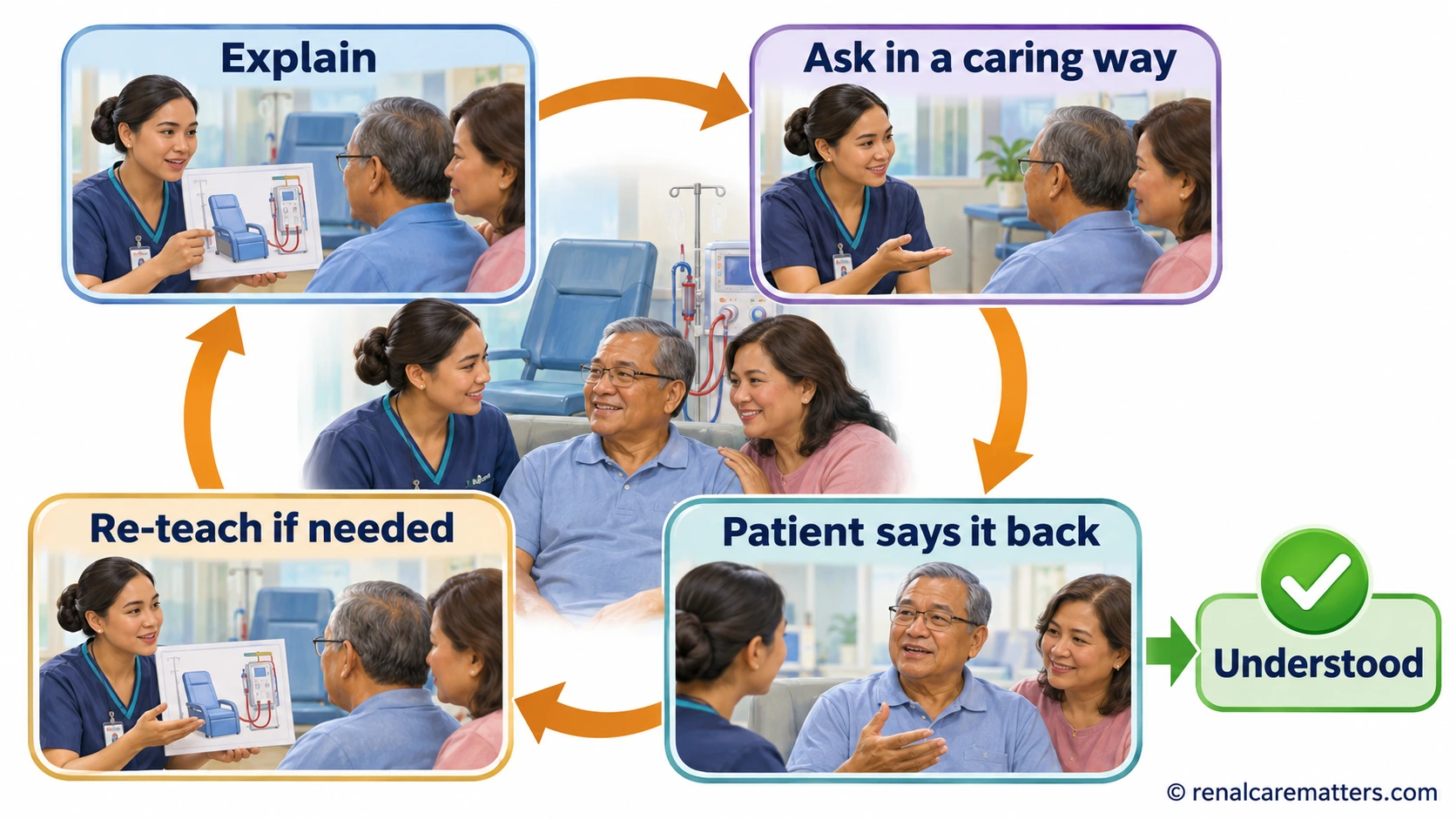
Health literacy varies widely, and it matters. In a United States dialysis cohort, limited health literacy was associated with higher mortality.2 A patient who nods and says “yes” to everything may be being polite, not understanding.
Missed and shortened sessions are associated with higher mortality.3 Their reasons are usually practical: transport, cost, work, symptoms after dialysis, depression, family duties. A charge nurse who asks “What makes it hard to come?” finds problems a lecture on adherence never will, and many of them have fixable answers: a different slot, a different ride, a referral to the social worker.
Every admission, transfer, or travel session needs a summary that travels with the patient: the prescription, dry weight, access type and the arm rules, last laboratory results, hepatitis status with dates, current medicines, allergies, and the unit’s phone number. The charge nurse makes sure it goes, and calls when the patient returns, to reconcile medicines (Module 9) and to check the access.
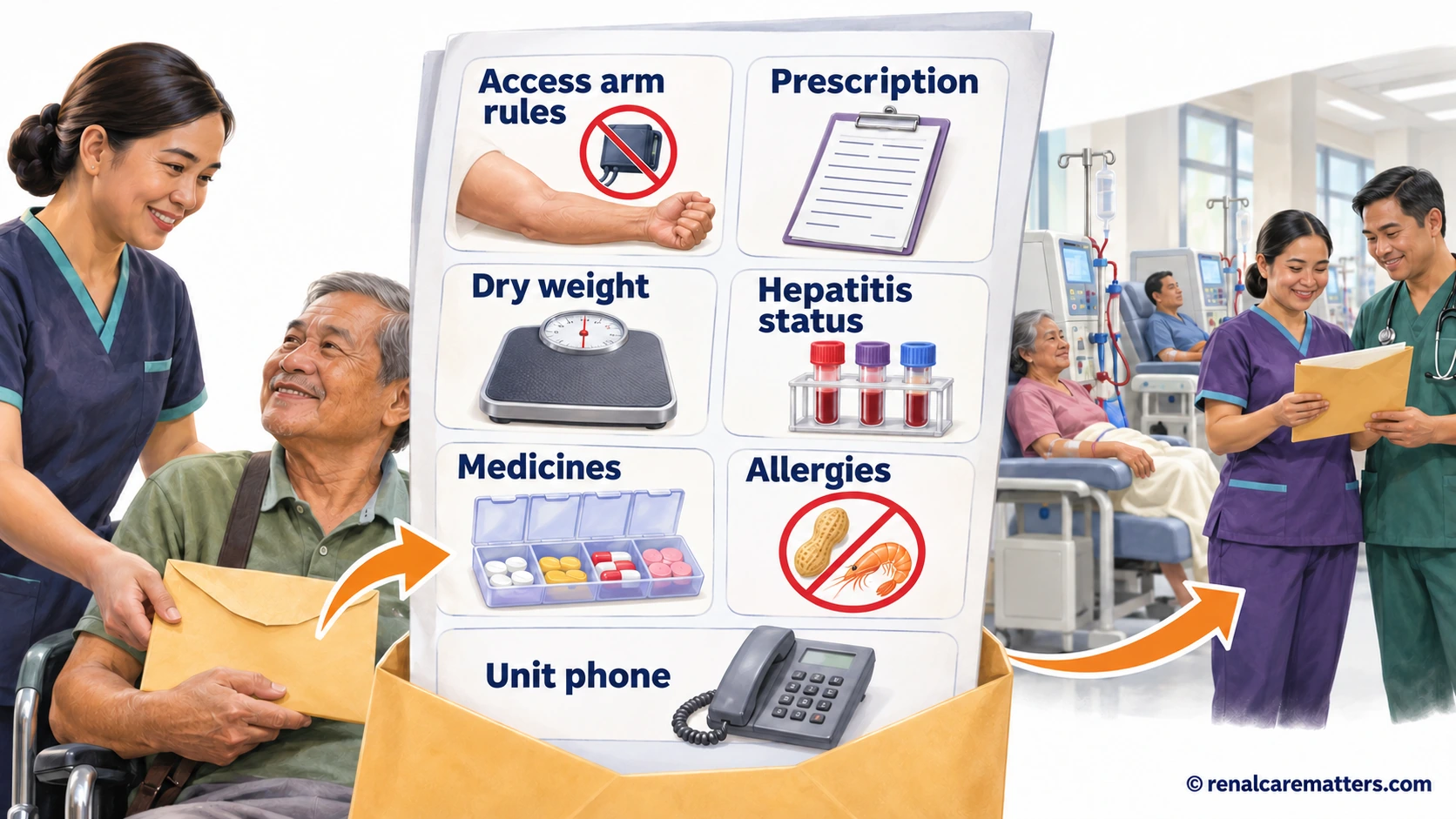
When Mr. Peter Uy is admitted from the unit with a fever, the charge nurse sends the summary with him and also calls the ward: “He has a right forearm fistula. No blood pressure cuff, intravenous (IV), or blood draw on the right arm. His dry weight is 58. Please call us before any dialysis decision.” The ward nurse writes “NO Blood pressure (BP)/IV RIGHT ARM” on the whiteboard above his bed. A five-minute call saves an access.
Illustrative scenario. Names and details are invented.
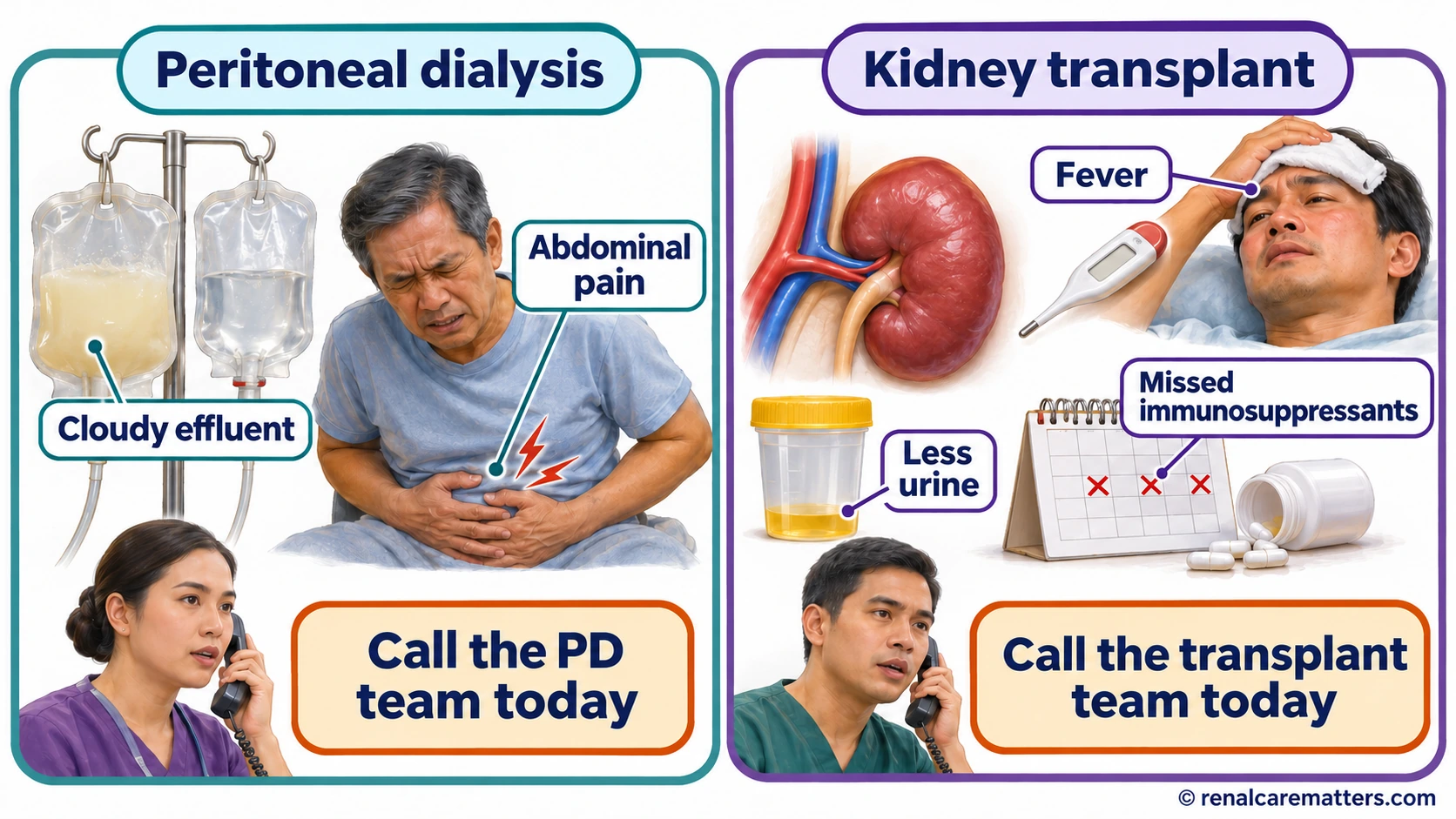
Hemodialysis nurses also meet patients on peritoneal dialysis and kidney transplant recipients, at the unit or on the phone. Some findings need the specialist team the same day.
Some patients want to talk about stopping dialysis or about conservative care without dialysis. The charge nurse listens, writes down what the patient said in their own words, and arranges a conversation with the attending nephrologist and the family. She does not decide, dismiss, or argue. A patient who raises it is asking to be heard.
These are fictional but typical. For each one, cover the answer, decide what you would do, then compare. Where a step depends on local rules, your unit’s procedure and your supervisor’s direction come first.
What should travel. A summary with the access arm and its rules (no blood pressure cuff, intravenous line, or blood draw on that arm), the prescription, dry weight, hepatitis status with dates, current medicines, allergies, recent laboratory results, and the unit’s phone number.
Who makes sure it goes. The charge nurse on the shift when the patient is admitted. She sends the summary and calls the ward. When the patient returns, she reconciles medicines and checks the access.
Teaching the family. Using teach-back with her son: “If anyone reaches for her left arm with a cuff or a needle, what will you say?” “Not this arm. Use the other one.” Mrs. Ocampo also gets a wristband or card that says the same. The charge nurse records the clotted fistula as an incident with the system fix: every admission triggers a summary and a call.
Teach one patient and one family member using teach-back, prepare a transfer summary, and role-play a goals-of-care request. Your preceptor rates each step as satisfactory, needs practice, or not observed. Steps marked Critical must all be satisfactory before sign-off. This checklist supports supervised learning; your unit’s own procedure and competency form are the authority. A printable version of every checklist is on the trainer page.
Each visit draws 8 questions at random from this module’s 15-question bank. Choose the single best answer for each, then select Check answers; an explanation appears under the best answer. Select New set of questions for a different mix. A good target is 7 of 8 on two different sets. Nothing you select is sent anywhere; scoring happens in your browser.

Internal Medicine · Nephrology · Nutrition · Philippines · PRC 0105184
Educational study material for nurses. Does not replace the attending nephrologist’s orders, the unit’s protocols, required training and certification, or supervised practice.

Scan and save