Nephrology Nursing Track · By Role · Module 5 of 18
Sorting Risk Before Connection
The long gap, Now, Today, and This month, the speed of fluid removal, trends over snapshots, falls and glucose, and closing a result loop.
PublishedNailathalaGipatikPepalwal:ReferencesMga SanggunianMga TinubdanReng Reperensya:5Audience: Experienced hemodialysis nurses who take charge of a shift · nurses being prepared for charge duty · head nurses and educators who orient themRead timeOras ng pagbasaOras sa pagbasaOras ning pamamasa:
This module is study material for charge nurses in hemodialysis units. It explains the reasoning behind common decisions; it is not a protocol. On the floor, follow your unit’s protocol and always ask the attending nephrologist for guidance. Doses, limits, and cut-off values are set by your unit. Every case is fictional.
Learning objectives
After this module you should be able to
Explain why the first session after the two-day gap carries the most risk.
Sort each pre-dialysis finding into Now, Today, or This month, and act at the right speed.
Calculate the ultrafiltration rate in mL/kg/h and explain why a high rate matters.
Read weight, pressure, and laboratory trends rather than single values.
Identify patients at risk of falls and of low blood sugar before connection.
Close the loop on a critical result so that a named person owns the next step.
Pre-testBefore you read, answer the 8 self-assessment questions and note your score. After the module, select New set of questions and compare. The difference is what you learned; the questions you still miss are what to reread.
Start here
The big picture, in plain words
In plain wordsA working kidney is a water treatment plant that runs day and night. Dialysis is a truck that comes three times a week and hauls everything away at once. Between visits, water, salt, potassium, and acid pile up.
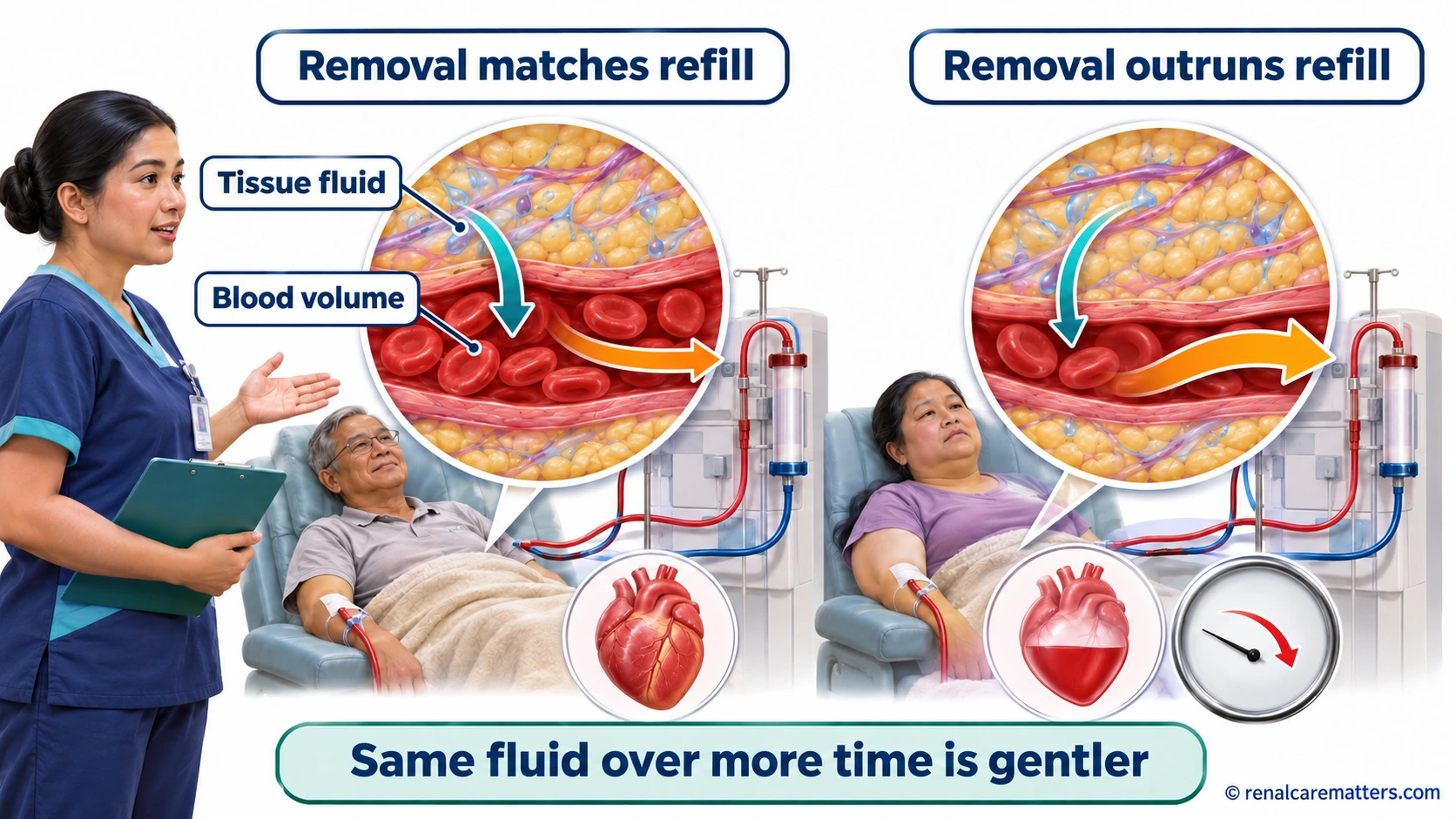
The truck picture explains the sawtooth pattern: levels climb between sessions and fall during them. It hides one thing. The truck can only take away what has reached the blood. In chronic kidney disease (CKD) stage 5, there is little or no other exit. Fluid sitting in the tissues has to move back into the blood vessels before the machine can remove it. Take too much, too fast, and the blood empties faster than the tissues can refill it. That is why the assessment before connection decides how hard the session can push.
Figure 1 · Key terms for this module
Interdialytic weight gain (IDWG)Weight gained between the end of one session and the start of the next; almost all of it is water.
Dry weightThe target weight at the end of a session, set by the attending nephrologist.
Ultrafiltration (UF)Removal of water from the blood across the dialyzer membrane.
Ultrafiltration rate (UFR)Fluid removed per hour per kilogram of body weight, in mL/kg/h.
OrthopneaBreathlessness when lying flat.
Critical resultA laboratory value that needs a clinician’s decision within a set time under unit policy.
Opening case · fictional
Case: Monday, 4.1 kilograms
Mr. Danilo Reyes, 67, has diabetes and heart failure. He dialyzes Monday, Wednesday, and Friday. On Monday at 6:00 his weight is 4.1 kilograms above his dry weight of 62 kilograms. His pressure is 168/94. He tells the nurse he slept on two pillows instead of one.
His Friday potassium, reported on Saturday, was 6.4 mmol/L. There is no note that anyone called a physician. The staff nurse plans to remove the full 4.1 liters in four hours. The charge nurse, Grace Valdez, is reviewing the floor before the first connections.
Before reading on, decide:
Which findings belong in the Now lane?
What is the planned ultrafiltration rate, and why does it matter?
Who owns the potassium result, and what does Grace say on the phone?
Keep your answers in mind. The lesson gives you what you need, and the case review near the end shows one sound response.
Lesson · part 1
Why Monday is the riskiest day
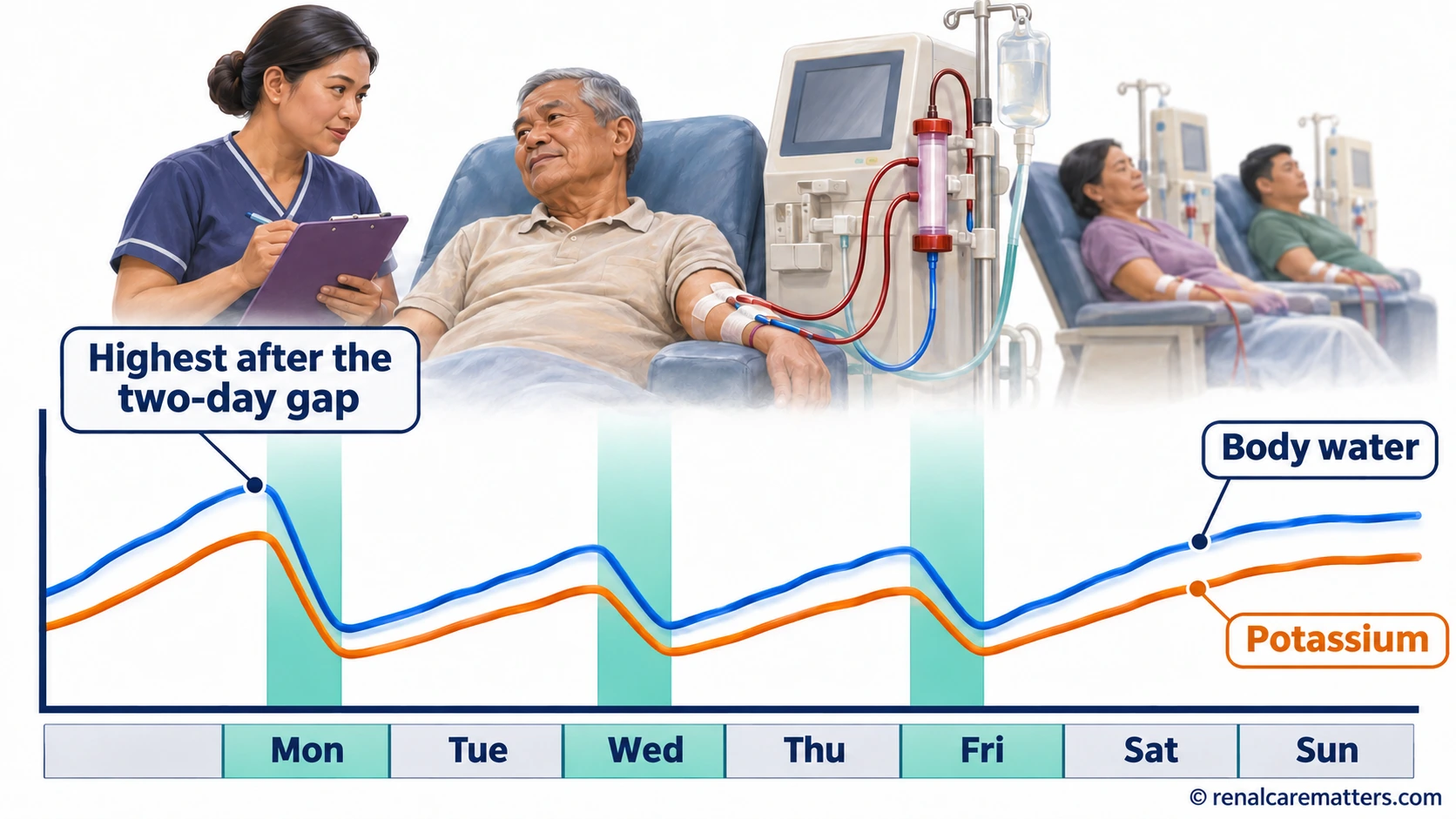
In a large United States cohort of patients on thrice-weekly dialysis, all-cause mortality on the day after the two-day gap was 22.1 per 100 person-years, against 18.0 on other days. Cardiac deaths and admissions for heart attack were also higher.1 The study is observational, but the mechanism fits: the most water and potassium of the week, and the longest time for both to build.
Figure 2. Burst and drift. Water and potassium build between sessions and peak before the first session after the two-day gap.
So Monday and Tuesday mornings deserve the slowest, most careful look before connection. The patient who also missed Friday is the riskiest patient of the week.
Lesson · part 2
Now, Today, This month
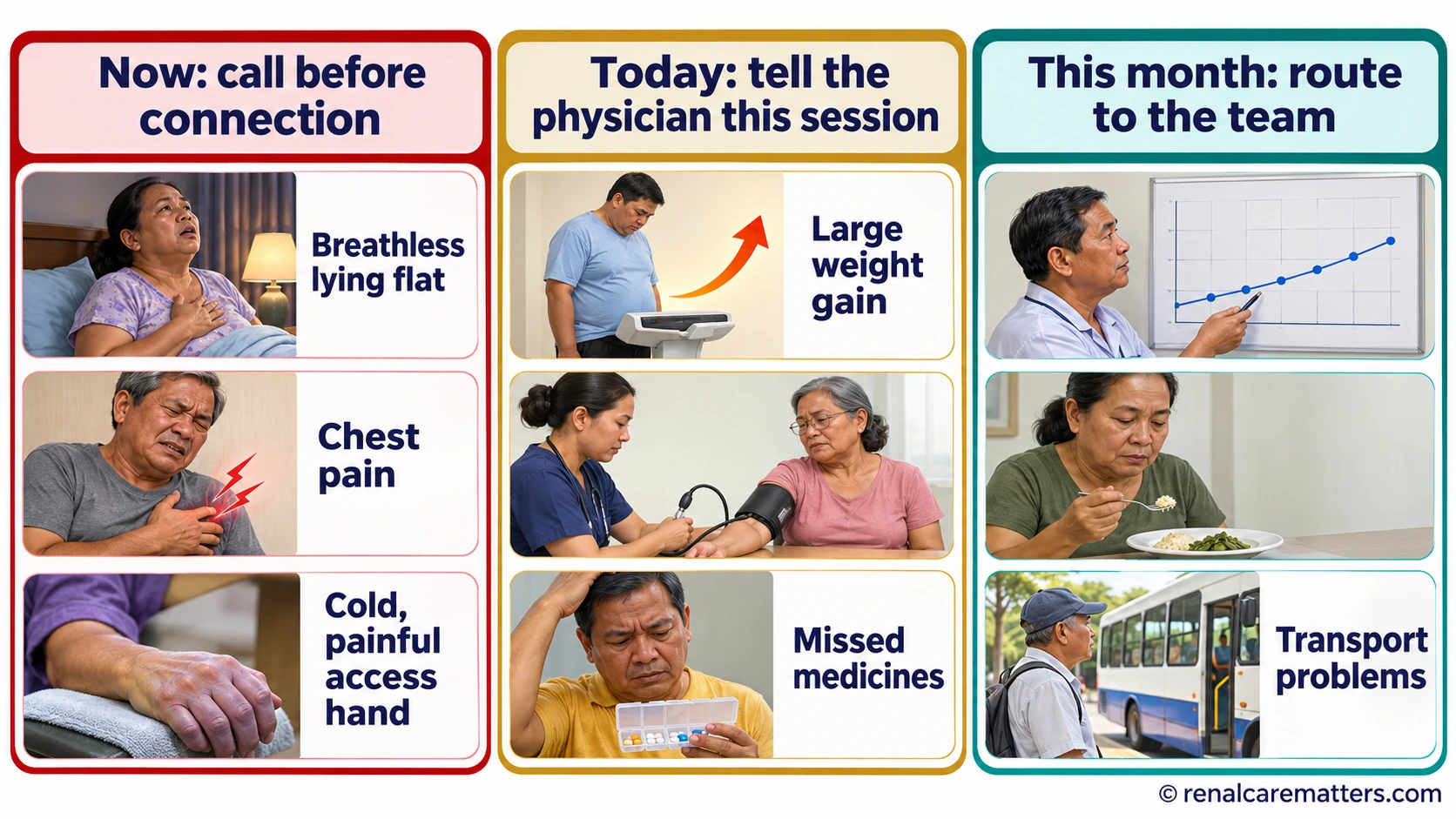
Sort every finding by how fast someone must decide.
Figure 3. Now, Today, This month. Sort every pre-dialysis finding by how fast someone must decide.
Lane
Examples
What you do
Now
New breathlessness or orthopnea; chest pain or palpitations; new confusion; a potassium above the unit’s critical value with no documented plan; fever or chills with a catheter; a cold, pale, or painful access hand
Call the physician before connection
Today
Weight gain above the unit’s threshold; pressure well above or below the patient’s usual; missed medicines; a fall since the last session; insulin taken without breakfast
Tell the physician during this session
This month
A weight slowly rising over weeks; poor appetite; low mood; transport or money problems
Route to the attending nephrologist or the team
The thresholds for potassium, weight gain, and pressure are your unit’s. The lanes are about speed, not about who is to blame.
Lesson · part 3
Fluid and the speed of removal
An ultrafiltration rate above 13 mL/kg/h, compared with 10 or less, was associated with 59% higher all-cause and 71% higher cardiovascular mortality in a cohort drawn from a large trial.2 Imaging studies show parts of the heart muscle working less well during sessions with large or fast fluid removal, a finding called myocardial stunning.3
Figure 4. Removal versus refill. When the machine removes water faster than the tissues can refill the blood, pressure falls.
Both findings are observational. No trial has shown that capping the rate at any number saves lives, which is why the attending nephrologist, not the nurse, sets the plan. The charge nurse’s job is to notice when the planned rate is high and to ask before connection, not after the pressure falls.
Ultrafiltration rate = fluid to remove (mL) ÷ hours ÷ dry weight (kg). Example: 3,000 mL over 4 hours in a 60-kg patient = 3,000 ÷ 4 ÷ 60 = 12.5 mL/kg/h.
On the floor · Same fluid, different patients
Two patients on the same shift each need 3,000 mL removed over four hours. Mrs. Lourdes Navarro weighs 45 kilograms; Mr. Eduardo Salcedo weighs 80. For Mrs. Navarro, 3,000 ÷ 4 ÷ 45 = about 17 mL/kg/h. For Mr. Salcedo, 3,000 ÷ 4 ÷ 80 = about 9 mL/kg/h. The same number on the screen is a very different demand on two hearts. The charge nurse flags Mrs. Navarro to the physician before connection.
Illustrative scenario. Names and details are invented.
Lesson · part 4
Trends, not snapshots
A weight gain of 3 kilograms is routine for one patient and alarming for another. A potassium of 5.8 that has been 5.7 for months differs from 5.8 after 4.6 last month. Look at the last three sessions and the last two laboratory sets before you decide what a number means.
Watch for two patterns. A pre-dialysis weight creeping up with a post-dialysis pressure creeping down can mean the dry weight is now set too low, or that the patient is gaining flesh. A patient who has lost muscle after an illness may be overloaded at an unchanged dry weight, because the same weight now carries more water. Both are Today findings for the physician.
Lesson · part 5
Falls and low blood sugar
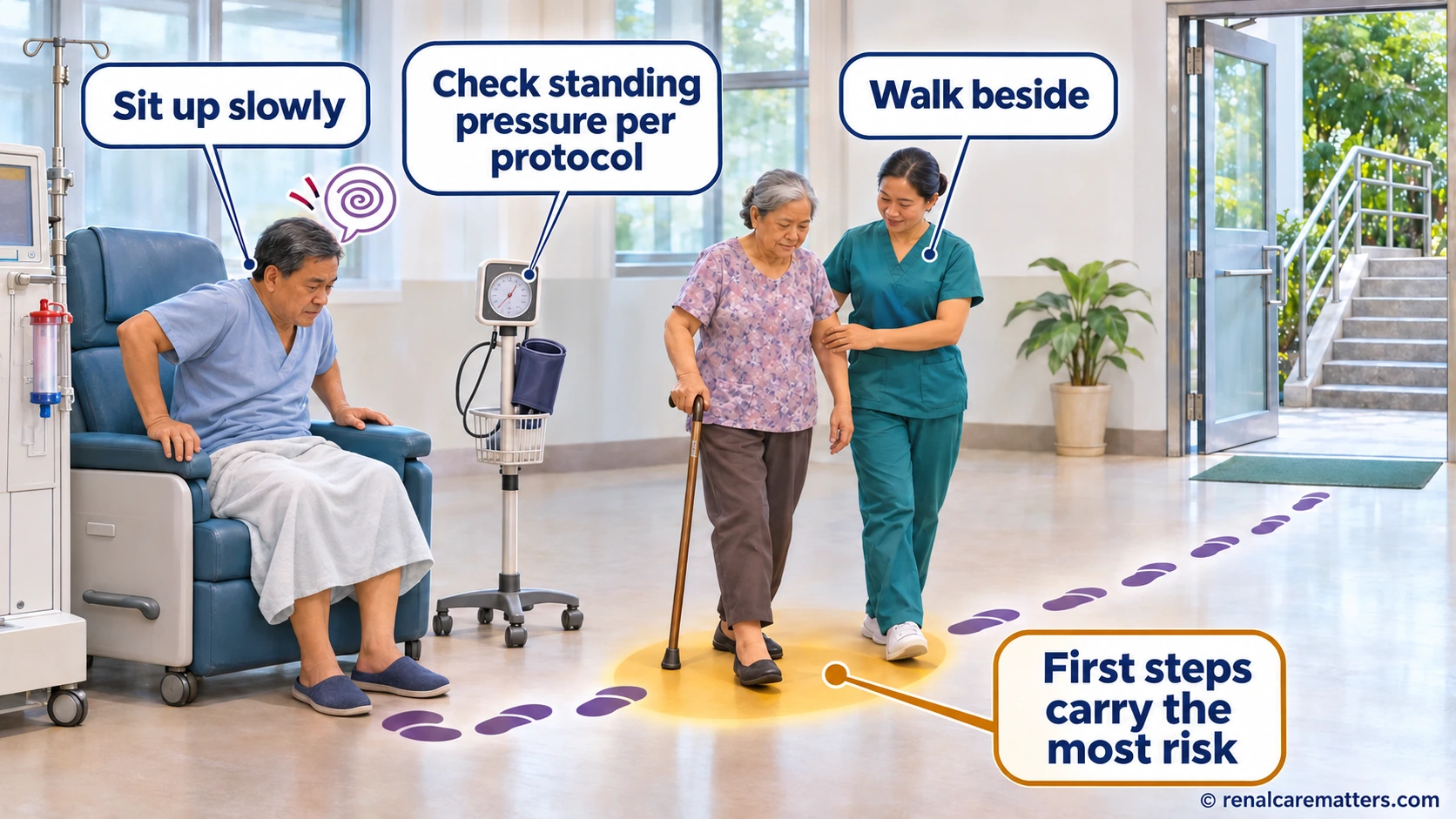
Older patients on hemodialysis fall often. In a prospective cohort of patients aged 65 and older, there were 1.60 falls per person-year, nearly half fell at least once, and 19% of falls caused injury.4 Risk is highest just after the session, when pressure is lowest (Module 7).
Figure 5. The riskiest steps are the first ones after the session, when pressure is lowest.
Glucose falls during dialysis too. In a 2026 study that used continuous glucose monitoring in 40 adults with insulin-treated diabetes, mean glucose fell 32% during dialysis to its lowest point at about two hours, and 20% of participants had low blood sugar during a session.5 Before connection, ask every patient on insulin or a sulfonylurea two questions: “Did you take your diabetes medicine today?” and “What did you eat?”
Lesson · part 6
Closing the loop on a result
A critical result is closed only when five links hold: received, told to a physician, decided, recorded, and owned (who does what next, by when). Mr. Reyes’s potassium broke at the second link. Nobody did anything wrong on purpose; the result arrived on a Saturday and no named person owned it.
RememberIf a result does not have a named owner, it belongs to the charge nurse until it does.
On the floor
Real situations: problems and solutions
These are fictional but typical. For each one, cover the answer, decide what you would do, then compare. Where a step depends on local rules, your unit’s procedure and your supervisor’s direction come first.
The usual gain, the unusual night
What you see
A patient at her usual weight gain says she slept sitting up.
What is likely going on
Orthopnea can appear before the scale changes.
What to do
Treat it as a Now finding and call before connection.
Why it matters
The patient tells you where the water is.
The result nobody owns
What you see
A critical potassium from Saturday has no note of a call.
What is likely going on
Weekend results have no named owner.
What to do
Call the physician now, then ask the head nurse to fix how weekend results reach a named person.
Why it matters
Five links, or it is not closed.
“I don’t want to be weighed”
What you see
A patient refuses the scale.
What is likely going on
Pain, dizziness, or embarrassment may be behind it.
What to do
Ask why, weigh seated if possible, and record the reason and what was done.
Why it matters
Without a weight, the fluid plan is a guess.
Field notes
Monday mornings get the slow look.
Compare with the patient’s own trend.
Ask about insulin and breakfast.
Case review
Back to the case: Monday, 4.1 kilograms
The Now lane. Orthopnea and an unaddressed potassium of 6.4 after the long gap. Either one alone is a Now finding.
The planned rate (Toolkit #c7). 4.1 liters over four hours is 1,025 mL per hour. Divided by the dry weight of 62 kilograms, that is 16.5 mL/kg/h, above the 13 associated with harm. At four hours, the most that stays at or below 13 is 13 × 62 × 4 = 3,224 mL. Options for the attending: remove about 3.2 liters today and see him again tomorrow, extend the session (4.1 liters over five hours is about 13.2 mL/kg/h), or something else the physician decides. Grace presents the numbers; the physician chooses.
The call. Before connection, Grace calls the physician on duty: “Mr. Reyes, 67, Monday after the long gap, up 4.1 kilograms, slept on two pillows, pressure 168/94. Friday potassium was 6.4 with no documented plan. The planned rate is 16.5 mL/kg/h. I need a decision on the fluid goal, and whether you want a repeat potassium and an electrocardiogram (ECG) before we start.” The physician orders both, sets the fluid goal, and extends the session. Grace records the decision and who owns the repeat potassium. She also asks the head nurse to fix how weekend results reach a named person.
Skills lab · with your preceptor
Skills checklist: Pre-dialysis risk sort and Situation-Background-Assessment-Recommendation (SBAR) call
Review three synthetic patients before a shift, sort the findings, calculate the rates, and make one call to a facilitator playing the physician. Your preceptor rates each step as satisfactory, needs practice, or not observed. Steps marked Critical must all be satisfactory before sign-off. This checklist supports supervised learning; your unit’s own procedure and competency form are the authority. A printable version of every checklist is on the trainer page.
CriticalSorts ten findings into Now, Today, and This month, and explains why.
CriticalCalculates the ultrafiltration rate in mL/kg/h for each patient.
Identifies the long-gap session and the patient who missed a session.
Compares today’s values with the patient’s own trend.
CriticalAsks about diabetes medicine and food before connection.
Screens for fall risk and plans help at disconnection.
CriticalMakes an SBAR (Situation, Background, Assessment, Recommendation) call that asks for a specific decision.
CriticalDoes not connect on the old plan while a Now finding is unresolved.
CriticalRecords who owns each pending result.
Placement activity. For two weeks, list every Monday patient with a planned rate above 13 mL/kg/h or an open critical result, and what was decided.
Self-assessment
Check your understanding
Each visit draws 8 questions at random from this module’s 15-question bank. Choose the single best answer for each, then select Check answers; an explanation appears under the best answer. Select New set of questions for a different mix. A good target is 7 of 8 on two different sets. Nothing you select is sent anywhere; scoring happens in your browser.
Foley, R. N., Gilbertson, D. T., Murray, T., & Collins, A. J. (2011). Long interdialytic interval and mortality among patients receiving hemodialysis. New England Journal of Medicine, 365(12), 1099–1107. https://doi.org/10.1056/NEJMoa1103313
Flythe, J. E., Kimmel, S. E., & Brunelli, S. M. (2011). Rapid fluid removal during dialysis is associated with cardiovascular morbidity and mortality. Kidney International, 79(2), 250–257. https://doi.org/10.1038/ki.2010.383
Burton, J. O., Jefferies, H. J., Selby, N. M., & McIntyre, C. W. (2009). Hemodialysis-induced cardiac injury: Determinants and associated outcomes. Clinical Journal of the American Society of Nephrology, 4(5), 914–920. https://doi.org/10.2215/CJN.03900808
Cook, W. L., Tomlinson, G., Donaldson, M., Markowitz, S. N., Naglie, G., Sobolev, B., & Jassal, S. V. (2006). Falls and fall-related injuries in older dialysis patients. Clinical Journal of the American Society of Nephrology, 1(6), 1197–1204. https://doi.org/10.2215/CJN.01650506
Liarakos, A. L., Randhay, A., Leelarathna, L., Crabtree, T. S. J., Doleman, B., Eldehni, M. T., Selby, N. M., Taal, M. W., Idris, I., & Wilmot, E. G. (2026). Continuous glucose monitoring in adults with diabetes receiving haemodialysis: Identifying dialysis-specific glycaemic patterns and associations with volume status and intradialytic hypoglycaemia. Diabetes, Obesity and Metabolism, 28(7), 6062–6072. https://doi.org/10.1111/dom.70808
Educational study material for nurses. Does not replace the attending nephrologist’s orders, the unit’s protocols, required training and certification, or supervised practice.