The arrest that happens on a machine
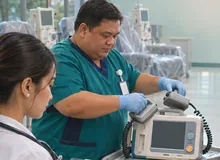
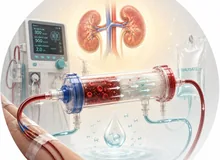
Cardiac arrest is the most feared event in a dialysis unit, and it is not rare. Dialysis clinics see sudden arrest often enough that resuscitation training for every staff member and a defibrillator on site are standard expectations abroad.1 When it happens, the patient is usually already in a chair, already monitored, already surrounded by trained people, and connected to an extracorporeal circuit that holds a few hundred milliliters of their blood. Those facts help and complicate at the same time.
A large registry study from the United States followed 398 arrests inside outpatient dialysis clinics. Two in three began with a rhythm that a shock cannot fix. Staff started cardiopulmonary resuscitation (CPR) in 81.4% of events, and staff-started CPR was associated with about three times the odds of leaving hospital alive with good brain function. The study was observational, so it shows an association, not proof; but it also shows that in about one event in five, nobody started compressions before the ambulance came.1 This course exists to close that gap.
Figure 1 · What this course will help your team do
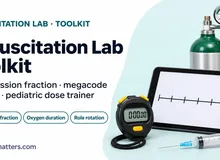
The course is cross-track. A nurse assistant needs the Basic Life Support (BLS) modules and the circuit basics; a physician-on-duty needs everything. Each module says who it is for. Part 4 (children) is essential for pediatric dialysis teams and recommended for everyone. The Megacode Practice Lab holds the algorithm recognition trainer, the timed megacodes, and the facilitator recorder; the Emergency Quick Cards are what you open during a real event.
Clinically reviewed
Signed off by Dr. William Gregory Rivero on November 28, 2026. It is not an American Heart Association (AHA) course and gives no certification. Your unit protocol decides every real event.
What this series is, and is not
It is an original reviewer written from the 2025 AHA and AHA/American Academy of Pediatrics (AAP) guidelines, the 2025 European Resuscitation Council (ERC) special-circumstances guideline, kidney guidance, and peer-reviewed research. It is not the AHA BLS, Advanced Cardiovascular Life Support (ACLS) or Pediatric Advanced Life Support (PALS) course, it does not reproduce their manuals or algorithm charts, and it gives no certification or continuing professional development (CPD) units. Philippine rules require current BLS for dialysis nurses and current ACLS for the physician-on-duty and at least one nurse per shift;2,3 those certificates come only from an authorized training center.
Placement pre-test
Transferring from another unit, or already experienced in this role? Take the placement pre-test: a short check of up to 5 questions for each module, drawn from that module’s own question bank. Score 80% or better and the module becomes optional reading for you, so you study only what you need.
Results stay on this device. The certificate still needs every module quiz; for a module you placed out of, go straight to its self-assessment.
Thirteen modules in five parts
The modules follow the order of a real event: be ready, recognize which algorithm you are in, start BLS, run the adult algorithms, manage the dialysis-specific problems, adapt for children, and finish well after the pulse returns.
Figure 2 · The five parts
Which modules for which role
| Role | Core path | Readiness level |
|---|---|---|
| Nurse assistant, support staff, dietitian, social worker, occupational therapist (OT)/physical therapist (PT), records officer | Modules 1, 2, 3, 4, 7 (first two sections), 13 | BLS |
| Dialysis, water treatment, biomedical and reprocessing technicians | Modules 1 to 4, 7, 9, 13 | BLS |
| Hemodialysis, charge and head nurses; peritoneal dialysis (PD) and transplant nurses | All modules; Part 4 recommended | ALS |
| Physician-on-duty, attending nephrologist, clinical head, trainees, vascular surgeon | All modules | ALS |
| Pediatric dialysis nurse, attending pediatric nephrologist | All modules; Part 4 essential | PALS |
The readiness levels are an Academy recommendation. Only two are verified Philippine rules: current BLS for dialysis nurses, and current ACLS for the physician-on-duty and at least one nurse on every shift.2,3
Thirteen modules in five parts
Study in order the first time. Each module opens with a timed case, teaches the algorithm with its reasons, and ends with an interactive megacode you can run alone or with your team.
Part 1 · Readiness and recognition
 Module 1
Ready Before the Collapse
Why dialysis units see arrests, the single chain of survival, the morning defibrillator and cart check, and the realities of freestanding units and ambulance transfer.
 Module 2
How Resuscitation Algorithms Think
Triggers, the five decision questions, branches and why they matter, parallel team tasks, reassessment, and transitions between algorithms.
 Module 3
Recognizing the Right Algorithm
Arrest versus respiratory arrest versus deterioration with a pulse, shockable or not, stable or not, pulse or no pulse, and the potassium electrocardiogram (ECG).
Part 2 · Adult BLS and ALS
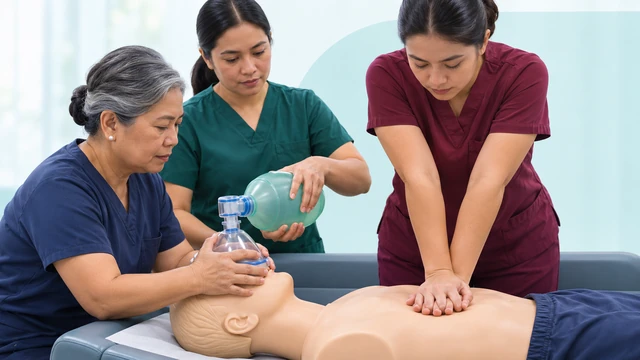 Module 4
BLS at the Dialysis Chair
Flattening the recliner, compressions that work, the defibrillator at the chair, bag-mask ventilation by two rescuers, and choking.
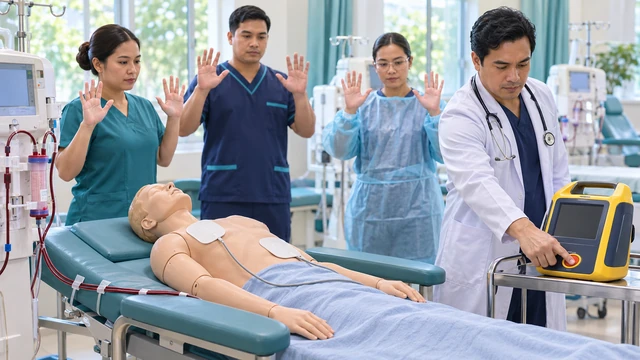 Module 5
Adult Cardiac Arrest: Shockable and Nonshockable
Shock-first logic for ventricular fibrillation (VF) and pulseless ventricular tachycardia (VT), epinephrine timing, antiarrhythmics, capnography, and the reversible causes that dominate in dialysis.
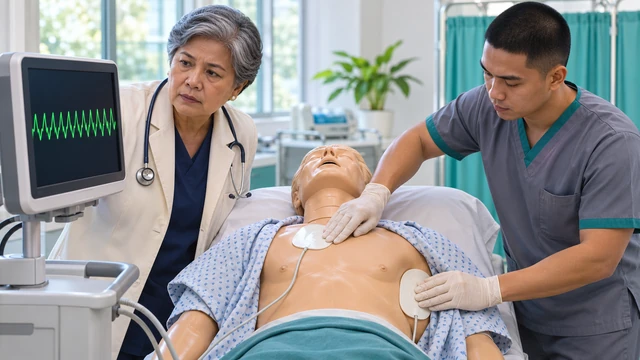 Module 6
Bradycardia and Tachycardia With a Pulse
Stability first, atropine and pacing, the bradycardia, renal failure, atrioventricular nodal blockade, shock and hyperkalemia (BRASH) syndrome, adenosine and its cautions, synchronized cardioversion, and when a rhythm becomes an arrest.
Part 3 · The dialysis difference
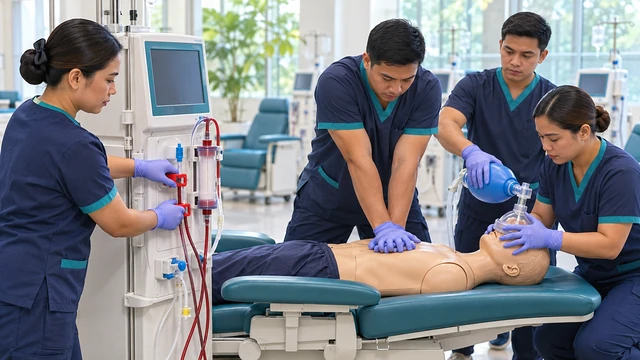 Module 7
Arrest in the Dialysis Chair: Machine, Circuit and Access
The circuit nurse role, stopping fluid removal, whether the blood goes back, defibrillating near a machine, and using the access safely.
 Module 8
Hyperkalemia: With a Pulse and in Arrest
Membrane physiology, the potassium ECG and its blind spots, protect-shift-remove, where AHA and ERC disagree, and dialysis after the pulse returns.
 Module 9
Circuit Emergencies That Become Resuscitations
Needle dislodgement and hemorrhage, hemolysis, severe dialyzer reaction and anaphylaxis, hypoglycemia, and opioid-associated emergencies.
Part 4 · Children
 Module 10
Pediatric BLS and the Child Who Is Getting Worse
Infant and child definitions, the 2025 infant compression technique, respiratory failure first, and slow heart rate with poor perfusion.
 Module 11
Pediatric Arrest and Rhythms During Dialysis
Weight-based doses, volumes and energies said aloud, concentration traps, extracorporeal volume, and the circuit and access in a child.
Part 5 · After the first minutes
 Module 12
Pulse Restored: ROSC, Transfer and Handover
Confirming ROSC, the first ten minutes after the pulse returns, what a freestanding unit can do, and a handover the ambulance can use.
 Module 13
Team, Code Status, Debrief and Practice
Roles and closed-loop orders, leadership handover, code status and families, the five-question debrief, performance reports, and drill cadence.
The same seven steps every time
Figure 3 · How to work through a module
- ObjectivesRead what you should be able to do by the end.
- Big pictureA plain-words summary and the key terms, before any detail.
- Opening caseA fictional shift problem. Decide what you would do first.
- LessonShort parts with pictures, tables, and worked examples.
- Case reviewCompare your answer with one sound response.
- Skills checklistPractice with a preceptor on real or training equipment.
- Self-assessmentFive questions drawn from a larger bank, with explanations.
New terms are explained the first time they appear, and every page ends with a glossary. Abbreviations are spelled out at first use. If a sentence still reads like jargon, check the glossary, then ask your preceptor to show you the real object on the unit: most of this work makes sense faster when you can see and touch the equipment.
The series at a glance
Each module plans 45 minutes of guided study, 30 minutes of interactive case and self-assessment, and a 15-minute team drill: about 20 hours in all, plus the quarterly integrated megacode. These are educational planning hours, not a Department of Health (DOH), Philippine Society of Nephrology (PSN) or certification requirement.
| No. | Module | Lessons | Opening case | Skills checklist | Practice | Classroom (h) | Skills lab (h) | Placement (h) |
|---|---|---|---|---|---|---|---|---|
| 1 | Ready Before the Collapse |
| The 5:40 a.m. check | A morning readiness check and a role huddle | 10 questions · 3 real situations | 1 | 1 | 1 |
| 2 | How Resuscitation Algorithms Think |
| Box by box | Five questions and an announced transition | 10 questions · 3 real situations | 1 | 1 | 0 |
| 3 | Recognizing the Right Algorithm |
| “It looks like another low blood pressure (BP)” | Recognition at the chair | 10 questions · 3 real situations | 1 | 1 | 0 |
| 4 | BLS at the Dialysis Chair |
| The chair that would not recline | BLS at the dialysis chair | 10 questions · 3 real situations | 1 | 1 | 1 |
| 5 | Adult Cardiac Arrest: Shockable and Nonshockable |
| Collapse at Station 7 | Leading adult cardiac arrest | 10 questions · 3 real situations | 1 | 1 | 1 |
| 6 | Bradycardia and Tachycardia With a Pulse |
| Slow rhythm, worsening perfusion | Peri-arrest rhythm decisions | 10 questions · 3 real situations | 1 | 1 | 1 |
| 7 | Arrest in the Dialysis Chair: Machine, Circuit and Access |
| Station 7, the circuit | Circuit nurse in a dialysis arrest | 10 questions · 3 real situations | 1 | 1 | 1 |
| 8 | Hyperkalemia: With a Pulse and in Arrest |
| The missed session | Hyperkalemia with a pulse and in arrest | 10 questions · 3 real situations | 1 | 1 | 1 |
| 9 | Circuit Emergencies That Become Resuscitations |
| Needle out | Circuit emergencies on the edge of arrest | 10 questions · 3 real situations | 1 | 1 | 1 |
| 10 | Pediatric BLS and the Child Who Is Getting Worse |
| The child becoming quiet | Pediatric BLS and early recognition | 10 questions · 3 real situations | 1 | 1 | 1 |
| 11 | Pediatric Arrest and Rhythms During Dialysis |
| Pediatric arrest during dialysis | Pediatric megacode with dose checks | 10 questions · 3 real situations | 1 | 1 | 1 |
| 12 | Pulse Restored: ROSC, Transfer and Handover |
| Pulse restored, now what? | Post-ROSC care and handover | 10 questions · 3 real situations | 1 | 1 | 0 |
| 13 | Team, Code Status, Debrief and Practice |
| The debrief nobody wanted | Team leadership and debrief | 10 questions · 3 real situations | 1 | 1 | 0 |
| Total | 13 | 13 | 9 |
Self-assessment is not sign-off
Each module ends with a self-assessment of 5 questions drawn at random from a bank of 10; aim for 4 of 5 on two different sets. Every question explains the best answer and why the others fail. The end-of-course self-study check draws three questions from each module (39 in all); the proposed pass is 32. The observed assessment on the trainer page has five stations, each passed at 8 of 10 with every critical criterion met. A high written score never makes up for a safety-critical error: compressions not started, a shock delivered while someone touches the patient, contaminated blood returned, or an adult dose given to a child.
Separately, the Megacode Practice Lab scores algorithm recognition and timed megacodes on your device only. Simulation success is an educational result, not a prediction of patient survival.
End-of-course examination. When you have finished every module, take the end-of-course examination. It draws questions at random from all 13 modules, so no two sittings are the same.
Personal study record
Need to show your head nurse or preceptor how far you have gone? Make a one-page study record: the modules you finished, your best quiz score and the date you passed each, the time you spent on each module page, your end-of-course examination result, and the date each checklist was signed off. Each module with a skills or competency checklist has a Preceptor sign-off box at the end of that section; enter the date your preceptor signed it, or enter it in the table below. Print it or save it as a PDF.
It is a record of your own self-study, not a certificate and not CPD units, and it stays on this device. Your signed checklists and the unit’s competency form remain the official record.
What the series is built on
Adult content follows the 2025 AHA guidelines for adult basic life support,4 adult advanced life support,5 special circumstances,6 post-cardiac arrest care,7 systems of care,8 ethics,9 and resuscitation education.10 Pediatric content follows the 2025 AHA and American Academy of Pediatrics guidelines for pediatric basic and advanced life support.11,12 Dialysis-specific steps follow the ERC 2025 special-circumstances guideline, which has a section on cardiac arrest during hemodialysis that the AHA chapter does not,13 and the UK Kidney Association hyperkalemia guideline.14
Where the AHA and the ERC disagree, most importantly on drug treatment of hyperkalemic cardiac arrest, the modules show both positions with their grades and leave the choice to your unit protocol. AHA grades are quoted as Class of Recommendation (COR) and Level of Evidence (LOE); they are never translated into another system. Research findings name the design and size, and observational findings say “associated with.” Sources were checked on November 28, 2026.
Using the series in a training program
A charge nurse, head nurse, physician-on-duty or clinical head can use this page as the facilitator kit for unit drills. The trainer and preceptor page gathers the proposed hours, completion criteria, and every skills checklist in one printable place. These are proposals for a provider to adapt and validate on its own equipment; they are not requirements of any regulator.