The room behind the dialysis floor
Many Philippine hemodialysis units reuse each patient’s dialyzer. After a session it goes to a small room behind the floor, where a technician rinses it, cleans it, tests it, fills it with germicide, labels it, and stores it until the same patient returns. Done well, reuse is uneventful. Done badly, it has given patients fever and rigors, bloodstream infection, hepatitis C, and a dose of disinfectant.1,2,3
The outcome studies of reuse are weak in both directions. The harms that are well documented come from execution: a germicide mixed unevenly, water that was not clean, a label that was not checked.4,3 That is the technician’s work, and it is why this track exists.
Figure 1 · What this track will help you do
The rule that runs through all twelve modules: if you cannot prove it, do not release it. The track pairs with the Reprocessing Technician Toolkit, six training calculators that never give a release decision.
What this series is, and is not
It is study material written independently from Philippine issuances, international standards and published research. It is not a license, a TESDA qualification, PSN technician training, or a Philippine Health Insurance Corporation (PhilHealth) staffing credential. PSN guidance expects dialysis technicians to complete a structured training program of three months or longer;5 this track can form the guided-study part of such a program but is not that program. It does not authorize the release of any dialyzer: that authority is granted by the facility after an observed practical assessment on its own equipment.
Who can hold this role
Dialyzer Reprocessing Technician: qualifications at a glance
- DOH lists daily reprocessor calibration, collection, reprocessing, acceptance testing, labeling, reuse records and storage among dialysis technician duties. DOH
- High school graduate who has completed a structured technician training program of 3 months or longer. PSN
- No separate PRC license. Release authority is granted by the facility after an observed practical assessment on its own reprocessor.
- Reuse must follow the unit’s approved program; PhilHealth cites up to 5 total uses per dialyzer and TCV of at least 80%. PhilHealth
Sources: DOH Administrative Order No. 2012-0001, Sec. V.B.2.a; Philippine Society of Nephrology (2024), Guidelines for nephrologists in the operation of hemodialysis clinics, Sec. III.A; Republic Act No. 10862. A summary for orientation, not legal advice: check the current issuances, and your unit’s license and PhilHealth accreditation. The full table for every role is on the Academy home.
One body of knowledge, three jobs
Reprocessing is one technical competency shared by several jobs. The track teaches it once. What each job may do with it differs.
| Pathway | Who | Emphasis | What completion never grants |
|---|---|---|---|
| Reprocessing operator | Staff hired into the reuse room | All twelve modules; workplace hours in receiving, processing, testing, storage and handoff | Release authority, which the facility grants after the operator practical assessment |
| Dialysis Technician | Learners on the Dialysis Technician track | Builds on Dialysis Technician Module 11; adds the evidence, water, germicide and acceptance-gate depth | Credit for Modules 7 to 10 by title similarity alone |
| Biomedical Equipment Technician | Staff who service reprocessors and water systems | Modules 1 to 6 and 11; the 96 processing hours become setup verification, measurement assurance and fault analysis | Any clinical release authority |
A person who holds two roles must pass both practical gates.
Twelve modules, 480 planned hours
Study the modules in order. Each one starts from a plain picture, moves to the mechanism and the evidence, and ends with what you do at the bench, in the record, and when something fails.
Part 1 · Foundations
 Module 1
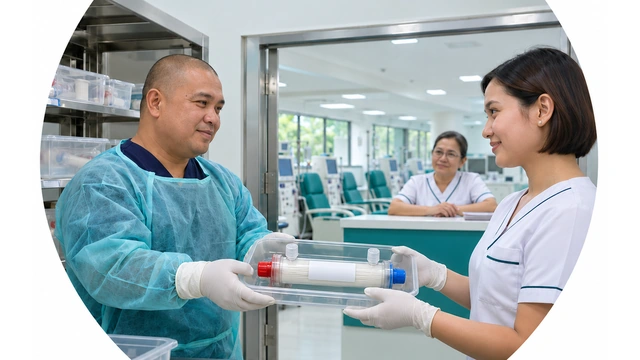
The Reuse Room and Your Place in It
One proficiency and three jobs, who decides what, the limits of your scope, and what to do when two people disagree about a dialyzer.
 Module 2
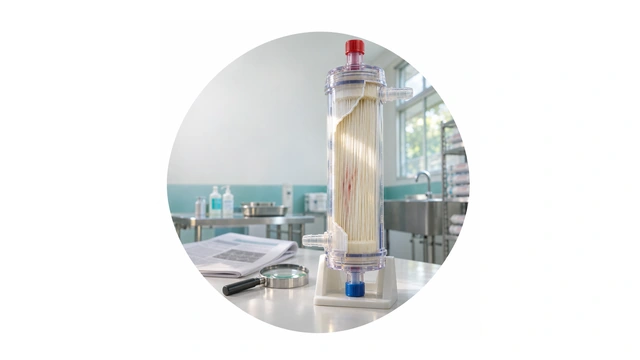
The Dialyzer and Why Reuse Exists
How a dialyzer cleans blood, what clotting and germicides do to it, and what the research on reuse does and does not show.
 Module 3
The Rules: Philippine Governance and Other Countries
DOH, PSN and PhilHealth requirements, how other countries differ, and why the strictest rule that applies wins.
Part 2 · Safety and supplies
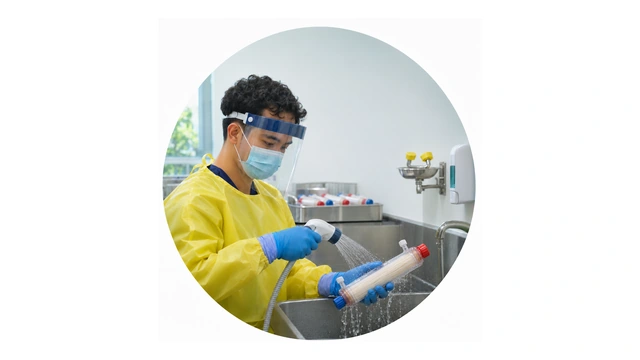 Module 4
Infection Prevention and Protecting Yourself
How bloodborne viruses spread in a dialysis unit, clean and dirty flow, protective equipment, eligibility by infection status, and exposure response.
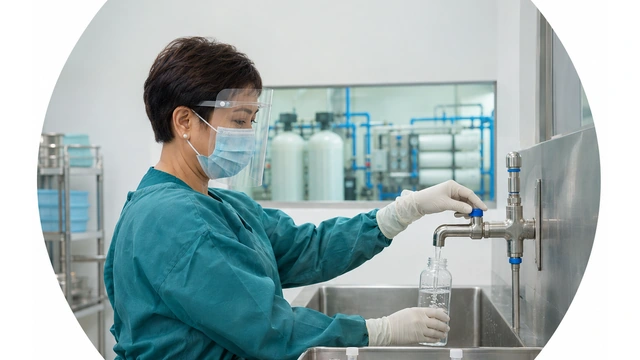 Module 5
Water for Reprocessing
Why water quality matters even more in the reuse room, the DOH monitoring schedule, ISO limits and action levels, and sampling.
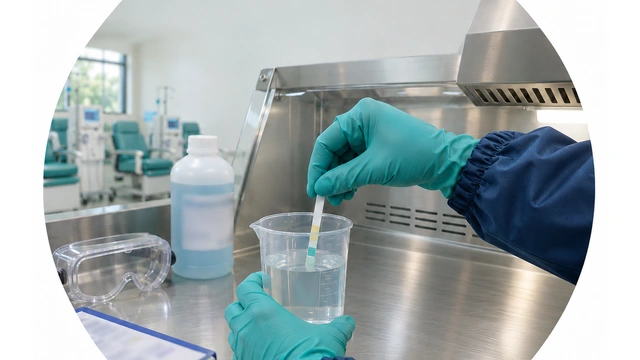 Module 6
Germicides and Chemical Safety
How the common germicides kill, why mixing and potency matter, and how to protect your lungs, eyes and skin.
Part 3 · The cycle
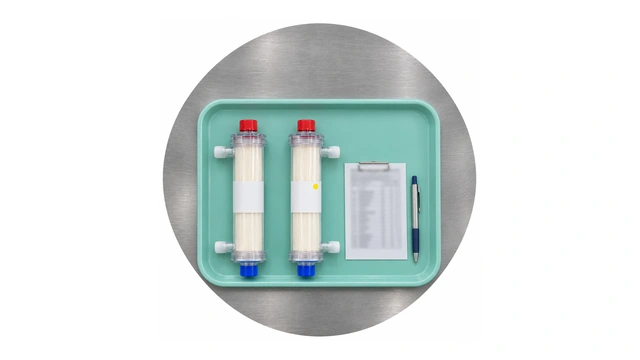 Module 7
Identity and Chain of Custody
Labels, two identifiers, similar names, transport, and a use count that is never reset.
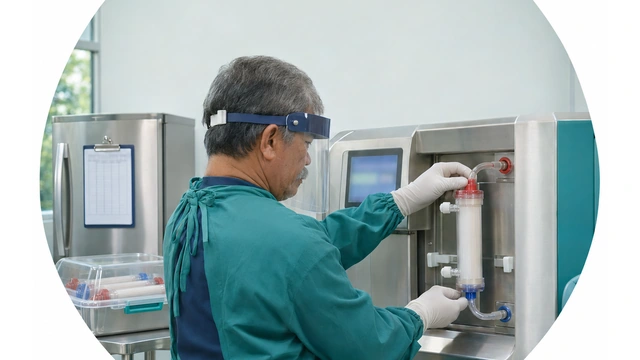 Module 8
Receiving, Rinsing and Cleaning
Time to processing, rinsing and reverse ultrafiltration, header cleaning, cleaning agents, and what the approved procedure controls.
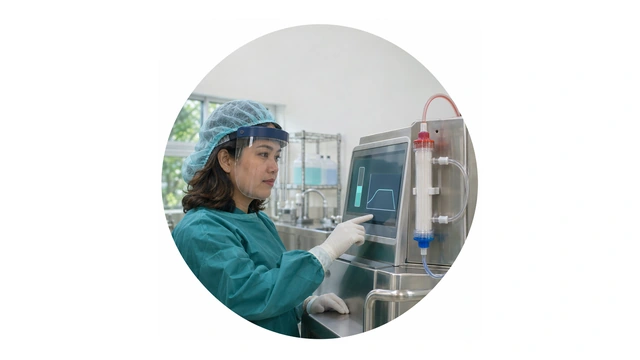 Module 9
Performance Testing and Acceptance
Total cell volume and its baseline, the integrity test, inspection, independent acceptance gates, and repeats without gaming.
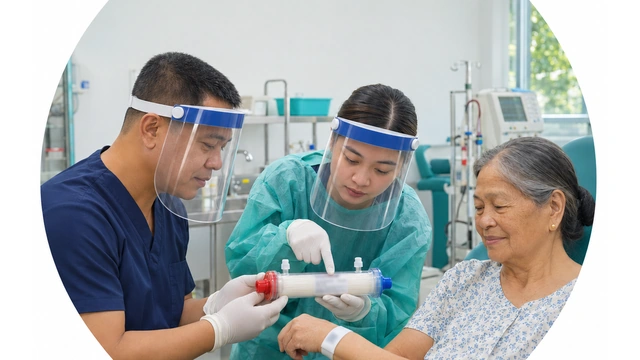 Module 10
Disinfect, Store, Rinse and Hand Off
Germicide fill and contact time, storage and expiry, rinsing, presence and residual tests, and two-person verification with the nurse.
Part 4 · When things go wrong, and getting better
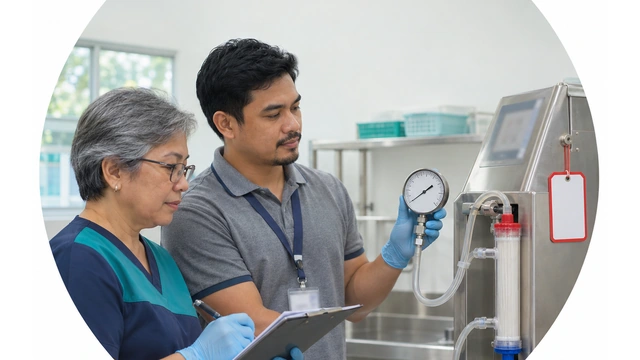 Module 11
Machines, Faults and When Things Go Wrong
Reprocessor calibration, service boundaries, tracing dialyzers after a fault, reactions in patients, quarantine, and power or water failure.
 Module 12
Records, Quality and the Capstone
What a complete record proves, audits, reuse numbers without perverse incentives, waste, and the integrated capstone.
The same seven steps every time
Figure 2 · How to work through a module
- ObjectivesRead what you should be able to do by the end.
- Big pictureA plain-words summary and the key terms, before any detail.
- Opening caseA fictional shift problem. Decide what you would do first.
- LessonShort parts with pictures, tables, and worked examples.
- Case reviewCompare your answer with one sound response.
- Skills checklistPractice with a preceptor on real or training equipment.
- Self-assessmentFive questions drawn from a larger bank, with explanations.
New terms are explained the first time they appear, and every page ends with a glossary. Abbreviations are spelled out at first use. If a sentence still reads like jargon, check the glossary, then ask your preceptor to show you the real object on the unit: most of this work makes sense faster when you can see and touch the equipment.
The series at a glance
Theory 84 hours, skills lab 60 hours, supervised workplace 336 hours, over at least three calendar months. These are academy design proposals, not requirements of any regulator. Extend supervised practice until competence is demonstrated.
| No. | Module | Lessons | Opening case | Skills checklist | Practice | Classroom (h) | Skills lab (h) | Placement (h) |
|---|---|---|---|---|---|---|---|---|
| 1 | The Reuse Room and Your Place in It |
| A quiz is not a key | Responsibility map and escalation drill | 12 questions | 8 | 6 | 24 |
| 2 | The Dialyzer and Why Reuse Exists |
| The fourth use | Reading a dialyzer and its history | 12 questions | 6 | 2 | 0 |
| 3 | The Rules: Philippine Governance and Other Countries |
| The transfer patient | Rule-finding and use-count drill | 12 questions | 6 | 4 | 0 |
| 4 | Infection Prevention and Protecting Yourself |
| A splash at the header | Protective equipment and exposure drill | 12 questions | 6 | 4 | 0 |
| 5 | Water for Reprocessing |
| Monday morning | Water sampling and log review | 12 questions | 6 | 6 | 40 |
| 6 | Germicides and Chemical Safety |
| The bottom of the container | Germicide preparation and spill drill | 12 questions | 6 | 4 | 0 |
| 7 | Identity and Chain of Custody |
| Two Santoses | Labeling and hand-over drill | 12 questions | 4 | 4 | 40 |
| 8 | Receiving, Rinsing and Cleaning |
| Three hours in the hallway | Receiving and cleaning on a training dialyzer | 12 questions | 6 | 6 | 48 |
| 9 | Performance Testing and Acceptance |
| Seventy-nine and eighty | Acceptance decisions on ten records | 12 questions | 6 | 4 | 48 |
| 10 | Disinfect, Store, Rinse and Hand Off |
| The strip at the wrong minute | Storage, residual testing and handoff | 12 questions | 10 | 8 | 48 |
| 11 | Machines, Faults and When Things Go Wrong |
| A week out of calibration | Fault, trace-back and continuity drill | 12 questions | 12 | 6 | 40 |
| 12 | Records, Quality and the Capstone |
| A good-looking month | Record audit and capstone | 12 questions | 8 | 6 | 48 |
| Total | 84 | 60 | 336 |
Self-assessment is not sign-off
Each module ends with a self-assessment of 5 questions drawn from a bank of 12. The mastery mark is 4 of 5 on two different sets. The questions are for learning; they show what to reread, not whether you can do the work.
| Milestone | What it involves | Who records it |
|---|---|---|
| 1 · Knowledge | All twelve self-assessments and the end-of-track examination (40 questions from all banks) | You, in your own learning record |
| 2 · Faculty check | Short-answer questions marked by a person and kept off the public pages | Nurse educator or chief technician |
| 3 · Supervised practice | Workplace hours on the unit’s own reprocessor, logged with the equipment model and standard operating procedure (SOP) version | Assessor |
| 4 · Practical assessment | Six observed full cycles, including one failed volume test and one failed integrity test handled correctly; two two-person handoffs; one water sample; one splash drill | Assessor, every critical item met |
| 5 · Facility authorization | A written decision by the facility on the scope you may perform | Medical director or designate |
A score never hides a critical failure. Watching a video, ticking a box, or time on a page is not observed performance. Milestone 5 is a decision made outside this website.
End-of-course examination. When you have finished every module, take the end-of-course examination. It draws questions at random from all 12 modules, so no two sittings are the same.
What the series is built on
Philippine requirements follow the Department of Health (DOH) licensing order for dialysis facilities and its water monitoring order, the Philippine Society of Nephrology (PSN) hemodialysis guidelines, and PhilHealth’s hemodialysis circulars.6,7,5,8,9 International comparisons use the United States conditions for coverage and Malaysia’s 2026 national standards, each labeled with its country.10,11 Technical content follows the reprocessing standard of the Association for the Advancement of Medical Instrumentation (AAMI) and the International Organization for Standardization (ISO) 23500 series for dialysis fluids.12,13
The research behind the teaching is cited in each module: outcome studies of reuse, the clearance analysis of the Hemodialysis (HEMO) Study, outbreak investigations by the Centers for Disease Control and Prevention (CDC), and occupational exposure studies.4,14,1,15 Where the evidence is strong, the text says so; where it rests on observation or a single small study, it says that instead.
Reconfirm the PhilHealth circulars, the DOH water order details and the editions of the AAMI and ISO standards your facility follows before any compliance decision.
Using the series in a training program
A head nurse, chief technician or medical director can use these modules as the guided-study part of a reuse-room training program. The trainer and preceptor page gathers the proposed hours, completion criteria, and every skills checklist in one printable place. These are proposals for a provider to adapt and validate on its own equipment; they are not requirements of any regulator.