Membrane physiology, the potassium ECG and its blind spots, protect-shift-remove, where AHA and ERC disagree, and dialysis after the pulse returns.
PublishedNailathalaGipatikPepalwal:ReferencesMga SanggunianMga TinubdanReng Reperensya:6Audience: Every member of the dialysis shift team: hemodialysis nurses, charge and head nurses, physicians-on-duty, attending nephrologists, dialysis and biomedical technicians, nurse assistants and support staff · pediatric dialysis teams for Part 4Read timeOras ng pagbasaOras sa pagbasaOras ning pamamasa:
This module is study material for dialysis teams. It explains the reasoning behind resuscitation decisions; it is not a unit protocol, an order set, or certification. Doses and energies are quoted from the 2025 American Heart Association (AHA) guidelines and the European Resuscitation Council (ERC) where named, so you can recognize them; give medicines only within your license and your unit’s approved protocol. Escalation always follows your unit protocol, and you always ask the attending nephrologist for guidance. Every case, name, and identifier is fictional.
Learning objectives
After this module you should be able to
Explain how high extracellular potassium brings the heart’s resting membrane potential toward threshold, and how calcium protects it.
Treat hyperkalemia with a pulse in three steps (protect, shift, remove), keeping a stable connected patient on dialysis.
State the 2025 American Heart Association (AHA) position on calcium, bicarbonate, insulin-glucose and inhaled beta-agonists in hyperkalemic cardiac arrest, with grades.
Compare the ERC 2025 hyperkalemic-arrest treatment with the AHA position, and explain why the unit protocol must choose.
Plan glucose monitoring after insulin and the decision about dialysis after the pulse returns.
Classroom 1 hSkills lab 1 hSupervised placement 1 h
Pre-testBefore you read, answer the 5 self-assessment questions and note your score. After the module, select New set of questions and compare. The difference is what you learned; the questions you still miss are what to reread.
Start here
The big picture, in plain words
In plain wordsThink of each heart muscle cell as a spring-loaded trap. Normally the spring is pulled back a long way, so it takes a strong, deliberate signal to spring it, and it resets cleanly after each beat. High potassium outside the cell lets the spring partly relax. At first the trap fires too easily; then, as it relaxes further, it can no longer reset at all, and the heart slows, widens and stops.
The picture has a limit. The “spring” is the resting membrane potential, set mainly by the ratio of potassium inside to potassium outside the cell. As outside potassium rises, the cell sits closer to its firing threshold. Sodium channels, which drive the fast upstroke of each beat, are partly inactivated when the cell sits closer to zero, so conduction slows: that is the widening QRS. Calcium does not change potassium at all. It raises the threshold, restoring the gap between where the cell sits and where it fires. That is why calcium protects the heart for a time but treats nothing.
In a dialysis unit, hyperkalemia is the reversible cause most likely to be on the list, and the one with the most disagreement between guidelines once the heart has stopped. This module separates the two situations clearly, because the treatments and the evidence are different.
Figure 1 · Key terms for this module
HyperkalemiaA serum potassium above the normal range; your unit sets its action thresholds.
Resting membrane potentialThe voltage across a resting cell membrane, set mainly by the potassium gradient.
Membrane stabilizationRaising the firing threshold with intravenous calcium; it does not lower potassium.
ShiftingMoving potassium into cells with insulin (given with glucose) or a beta-agonist such as salbutamol.
RemovalTaking potassium out of the body; in kidney failure, mainly by dialysis.
Hyperkalemic cardiac arrestCardiac arrest in which high potassium is the suspected cause.
Opening case · fictional
Case: The missed session
Mr. Eduardo Panganiban, 55, missed his Saturday session to attend a family wake in Batangas. He arrives at 6:10 a.m. on Monday, weak, with heavy legs. His pre-dialysis potassium is sent; the laboratory says 45 minutes. His electrocardiogram (ECG) shows tall, narrow T waves and a QRS that looks slightly wide. Heart rate 58, blood pressure 130/80. He is connected and dialysis starts at 6:30.
At 6:50, before the result is back, his rhythm slows to 40 and becomes wide. At 6:55 he is unresponsive and pulseless; the monitor shows a slow, wide, organized rhythm.
Before reading on, decide:
What should have happened between 6:10 and 6:30?
At 6:55, which algorithm is he in, and what is treated first?
What do the AHA and the ERC say about potassium drugs now, and who decides for your unit?
Keep your answers in mind. The lesson gives you what you need, and the case review near the end shows one sound response.
Lesson · part 1
Hyperkalemia with a pulse: protect, shift, remove
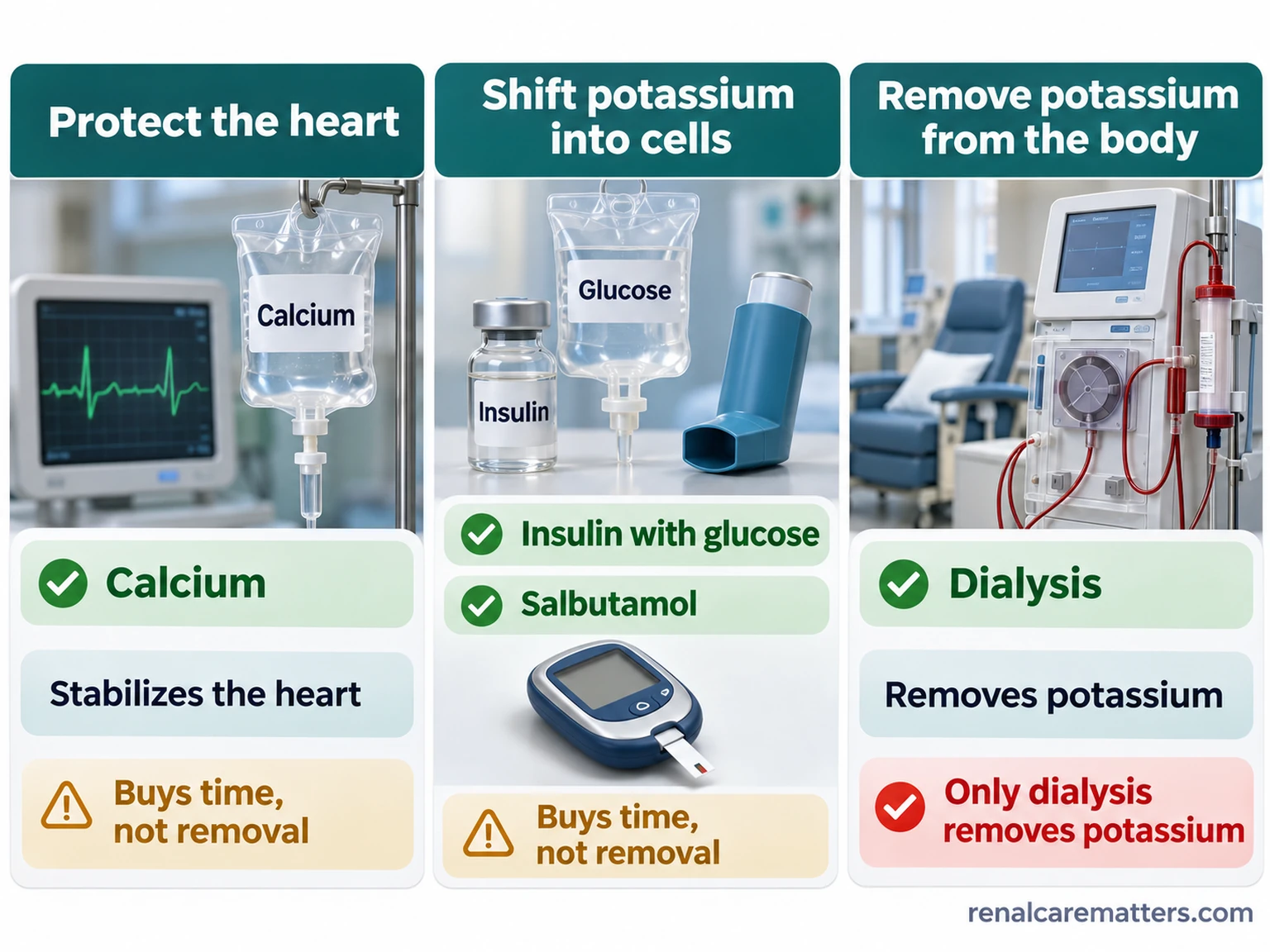
A patient with high potassium and a pulse is in a race, but one you can usually win. The plan has three steps, each with a different purpose, and each step buys time for the next. The doses below are those of the European Resuscitation Council (ERC) 2025 guideline, quoted so you can recognize them;1 the UK Kidney Association guideline gives similar regimens;2 your unit order set decides.
Figure 2. Protect, shift, remove. Only dialysis removes potassium; the other steps buy time.
Step
What
ERC 2025 regimen (patients with circulation)
What it does and does not do
Protect
Intravenous calcium when the ECG shows potassium changes
10 mL of 10% calcium chloride intravenous (IV) for severe hyperkalemia with ECG changes
Restores the threshold gap within minutes; lasts a short time; does not lower potassium
Shift
Insulin with glucose; nebulized salbutamol as an adjunct
10 units soluble insulin with 25 g glucose IV; if pre-treatment glucose is below 7 mmol/L, follow with 10% glucose at 50 mL an hour for 5 hours. Salbutamol 10 to 20 mg nebulized as an adjunct
Moves potassium into cells; total body potassium unchanged; effect wears off
Remove
Dialysis
Dialysis for severe hyperkalemia resisting medical treatment
The only real removal in a patient on dialysis
Insulin-based treatment causes hypoglycemia often in patients with kidney failure, because insulin is cleared by the kidneys and its effect lasts longer.3 Check capillary glucose regularly for several hours after insulin, as your order set specifies, and give the follow-on glucose it calls for.
For a connected, stable patient, the most important rule is negative: do not stop dialysis. Card 10, signed off for this Academy, puts it plainly: dialysis is the treatment; calcium and insulin only buy time.
RememberProtect with calcium, shift with insulin and glucose (plus salbutamol), remove with dialysis. Check glucose for hours after insulin, and keep a stable patient dialyzing.
Lesson · part 2
The ECG, the laboratory, and the minutes in between
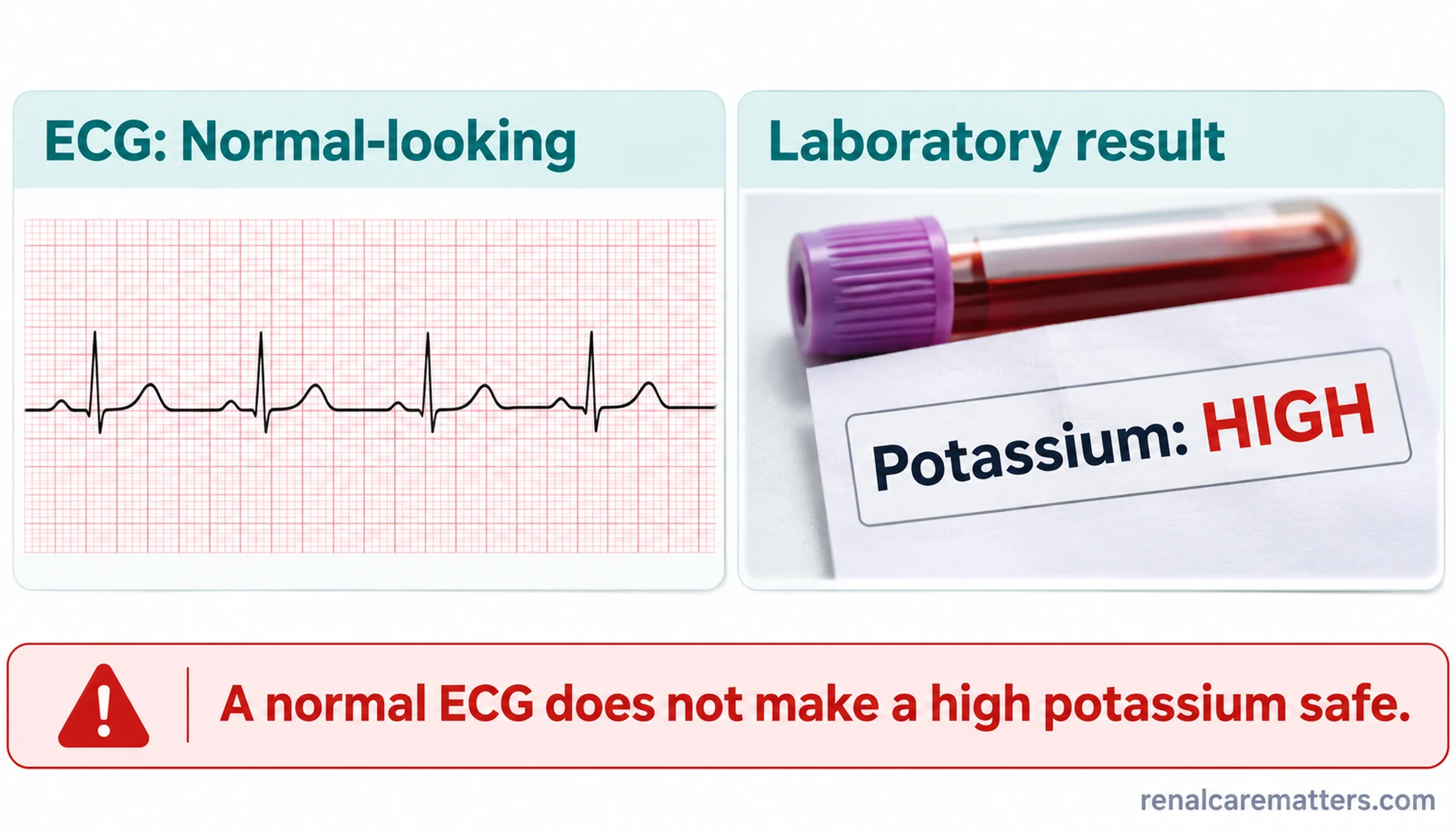
Treatment of hyperkalemia with ECG changes does not wait for the laboratory. Treatment of a high laboratory value does not wait for ECG changes. Both errors happen because each test is treated as the confirmation of the other.
Figure 3. A normal ECG does not make a high potassium safe.
You have
What it means
What to do
Typical ECG changes, no result yet
Potassium is likely high and affecting the heart now
Protect and shift per order set; call the physician; dialyze
High result, normal ECG
ECG changes are often absent at high values
Treat the value per order set; dialyze
High result, sample hemolyzed
Possibly falsely high
Repeat the sample, but treat at once if the ECG is abnormal
Slow wide rhythm, story of a missed session
Potassium until proven otherwise
Treat now; pads on; pacing and arrest may follow
In a retrospective review of hospital patients with high potassium, the typical ECG changes were often missing, even at high values.4 The progression from peaked T waves to a sine wave is a teaching pattern, not a warning system; the jump from “slightly wide” to arrest can take minutes, as it did in the case.
RememberECG changes do not wait for the laboratory, and a high value does not wait for ECG changes. A story of missed dialysis plus a slow wide rhythm is treated now.
Lesson · part 3
Hyperkalemic cardiac arrest: where the guidelines differ
Once the patient is pulseless, cardiac arrest comes first: compressions, the rhythm check, epinephrine on the right path. Potassium becomes the reversible cause to treat during cardiopulmonary resuscitation (CPR). Here the major guidelines diverge, and the course shows both positions side by side rather than blending them.
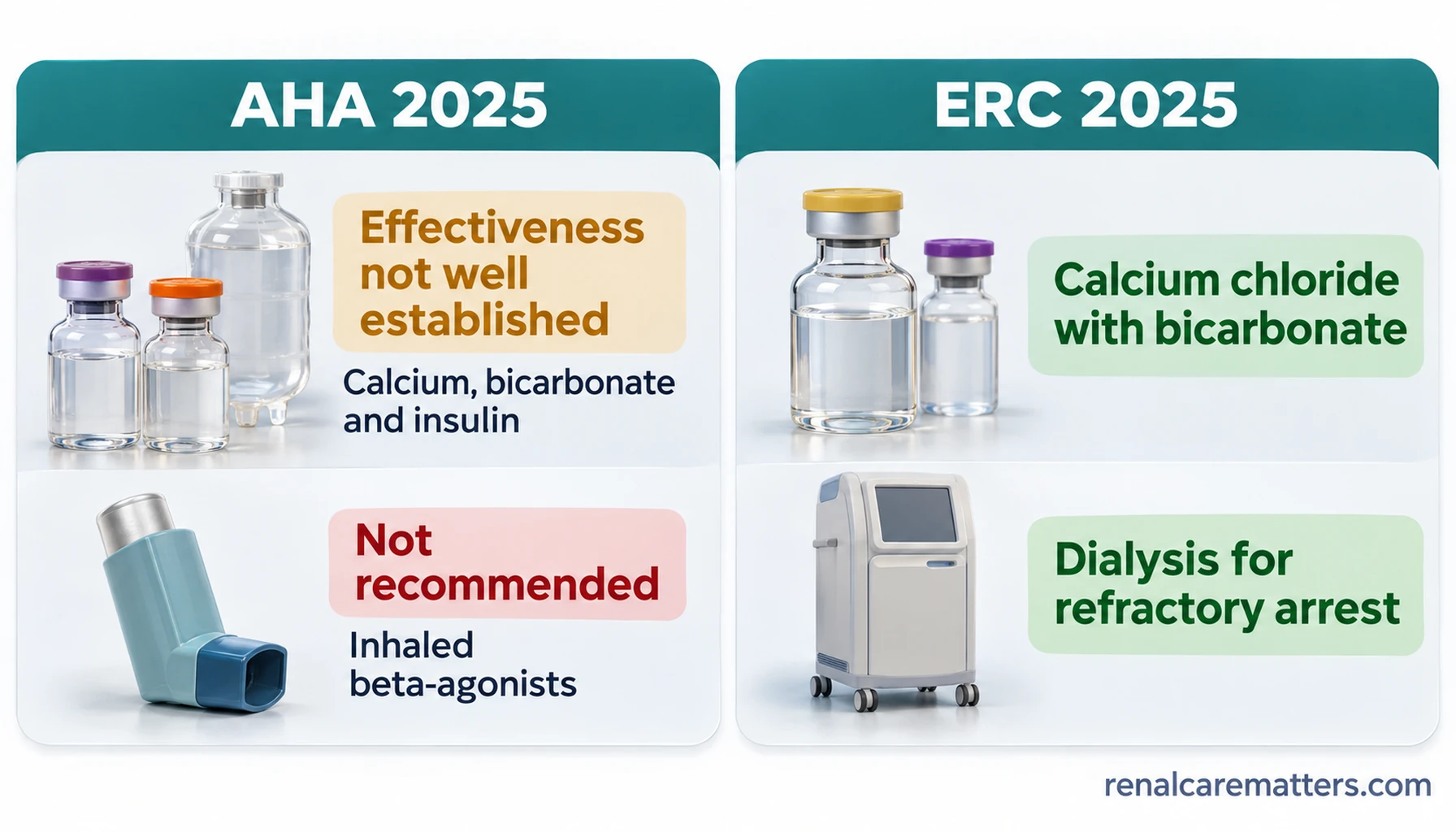
Figure 4. In hyperkalemic arrest, the AHA and the ERC differ. Your unit protocol chooses; the course shows both.
Effectiveness not well established (Class of Recommendation (COR) 2b, Level of Evidence (LOE) C-LD)
10 mL of 10% calcium chloride IV as a rapid bolus; consider repeating if arrest is refractory or prolonged
Sodium bicarbonate
Effectiveness not well established (COR 2b, LOE C-EO)
50 mmol IV, in the arrest setting only, given through a separate line or with a flush between it and calcium
Insulin and glucose
Effectiveness not well established (COR 2b, LOE C-EO)
No arrest-specific dose given; general regimen applies
Inhaled beta-agonists
Not recommended (COR 3: No Benefit, LOE C-EO)
No arrest-specific dose given
Dialysis
Not addressed in the arrest recommendations
Definitive; rarely used in arrest; feasible during CPR in case reports; consider for refractory severe hyperkalemia per local protocol
Why the difference? The underlying evidence is thin. An International Liaison Committee on Resuscitation (ILCOR) systematic review found insufficient evidence to recommend for or against calcium or bicarbonate in hyperkalemic arrest; almost no studies included patients in arrest.6 The AHA reads that gap as “effectiveness not well established,” and cautions that drug therapy must not interrupt CPR. The ERC reads the same physiology and case experience as reason enough to give calcium and bicarbonate. Neither position is proven by a trial in arrested patients.
Two practical rules hold under both: calcium and bicarbonate are never given through the same line without a flush, because they precipitate; and none of these drugs is worth a pause in compressions. Card 1 already states the position this Academy uses: guidelines differ, and your unit protocol decides.
RememberIn hyperkalemic arrest, CPR comes first. The AHA calls calcium, bicarbonate and insulin of uncertain effectiveness and advises against inhaled beta-agonists; the ERC gives calcium chloride with bicarbonate. Your unit protocol chooses, written down in advance.
Lesson · part 4
After return of spontaneous circulation (ROSC): potassium rebounds, and dialysis is the plan
A pulse after hyperkalemic arrest is not the end of the potassium problem. Calcium wears off; insulin and salbutamol move potassium into cells only for hours; the potassium is still in the body. The ERC notes that dialysis may be needed early in the post-resuscitation period.1 In a freestanding unit, that usually means transfer to a hospital that can dialyze an unstable patient.
After return of spontaneous circulation (ROSC)
Why
Who decides
Repeat potassium and glucose
Potassium rebounds; insulin causes late hypoglycemia
Physician-on-duty
Continuous ECG
Recurrent arrhythmia
Physician-on-duty
Restarting dialysis in your unit
Only if the patient is stable enough and the attending agrees
Attending nephrologist
Transfer for dialysis in hospital
Unstable patients need monitored dialysis
Attending nephrologist and receiving team
Review the prescription and the reason for the missed session
Prevent the next one
Attending nephrologist, social worker, head nurse
Do not restart dialysis after ROSC without the attending nephrologist, even when the potassium is the obvious cause (Card 1). The decision weighs the benefit of removal against the risk of starting a circuit in a patient whose pressure may not tolerate it.
RememberAfter ROSC, potassium comes back. Recheck potassium and glucose, keep the monitor on, and let the attending nephrologist decide where and when dialysis restarts.
Stop and callPotassium above your unit’s action threshold, any potassium ECG change, or a slow wide rhythm: start the order set while you call the physician-on-duty and the attending nephrologist. Follow your unit protocol, and always ask the attending nephrologist for guidance before stopping or restarting dialysis.
On the floor
Real situations: problems and solutions
These are fictional but typical. For each one, cover the answer, decide what you would do, then compare. Where a step depends on local rules, your unit’s procedure and your supervisor’s direction come first.
Waiting for the result
What you see
A patient with peaked T waves and a missed session is connected while staff wait 45 minutes for the potassium.
What is likely going on
The ECG was not trusted until the laboratory confirmed it.
What to do
Start the order set (calcium for ECG changes, insulin with glucose) and connect promptly; call the physician.
Why it matters
ECG changes do not wait for the laboratory.
The 9 a.m. low sugar
What you see
Two hours after insulin for hyperkalemia, a patient becomes sweaty and confused.
What is likely going on
Hypoglycemia from prolonged insulin effect.
What to do
Check capillary glucose and treat per protocol; review the follow-on glucose order.
Why it matters
Insulin lasts longer in kidney failure.
One line, two drugs
What you see
During an arrest, calcium and bicarbonate are drawn up to go through the same line back to back.
What is likely going on
Risk of precipitation in the line.
What to do
Use separate lines or flush well between them, per protocol.
Why it matters
A blocked line in arrest wastes minutes.
Field notes
Write which framework your unit follows for hyperkalemic arrest on the order set itself.
Keep the hyperkalemia kit findable in seconds, not buried in the cart.
Case review
Back to the case: The missed session
6:10 to 6:30. Missed session plus weakness plus peaked T waves and a slightly wide QRS is hyperkalemia affecting the heart. The order set should have started before connection: intravenous calcium for the ECG changes, insulin with glucose (and salbutamol if prescribed), the monitor and pads on, and urgent connection to dialysis with the potassium bath the physician orders. The laboratory result was not needed to start.
6:55. He is in cardiac arrest with a slow, wide, organized rhythm and no pulse: pulseless electrical activity (PEA). Compressions start at once; the circuit nurse stops fluid removal and makes the blood decision (no circuit cause, so return or clamp and disconnect, per Module 7); epinephrine is given as soon as feasible on the nonshockable path. Potassium is the leading reversible cause.
The drugs. The AHA 2025 guideline calls the effectiveness of calcium, bicarbonate and insulin-glucose in hyperkalemic arrest not well established and advises against inhaled beta-agonists; the ERC 2025 guideline gives 10 mL of 10% calcium chloride with 50 mmol of sodium bicarbonate through separate lines, and considers dialysis for refractory arrest. The team follows whichever the unit protocol has adopted, decided before today, and never pauses compressions to give them. After ROSC, the attending nephrologist decides where dialysis continues.
Interactive case · fictional
Interactive case: The missed session
Work through a shift one decision at a time. The panel at the top changes with what you choose. After each choice you see why it is, or is not, the best move; after a weaker one you can try again or carry on and see where it leads. Your first choice at each step is scored. The score stays on this device and nothing is sent anywhere. In real practice, your unit’s protocol and the people responsible for each decision come first.
Skills checklist: Hyperkalemia with a pulse and in arrest
In two simulator scenarios, manage hyperkalemia with a pulse and hyperkalemic cardiac arrest while a supervisor observes. Your preceptor rates each step as satisfactory, needs practice, or not observed. Steps marked Critical must all be satisfactory before sign-off. This checklist supports supervised learning; your unit’s own procedure and competency form are the authority. A printable version of every checklist is on the trainer page.
CriticalStarts treatment for ECG changes without waiting for the laboratory result.
States protect, shift, remove, and what each step does and does not do.
CriticalKeeps a stable connected patient on dialysis and calls the attending nephrologist.
Orders glucose checks for several hours after insulin.
CriticalIn arrest, prioritizes compressions and the arrest algorithm before potassium drugs.
States the AHA and ERC positions accurately and follows the unit protocol.
CriticalNever gives calcium and bicarbonate in the same line without a flush.
After ROSC, rechecks potassium and glucose and does not restart dialysis without the attending.
Placement activity. Read your unit’s hyperkalemia order set with the physician-on-duty and note which framework (AHA, ERC, or local) it follows for arrest.
Self-assessment
Check your understanding
Each visit draws 5 questions at random from this module’s 10-question bank. Choose the single best answer for each, then select Check answers; an explanation appears under the best answer. Select New set of questions for a different mix. A good target is 4 of 5 on two different sets. Nothing you select is sent anywhere; scoring happens in your browser.
Lott, C., Karageorgos, V., Abelairas-Gomez, C., Alfonzo, A., Bierens, J., Cantellow, S., Debaty, G., Einav, S., Fischer, M., González-Salvado, V., Greif, R., Metelmann, B., Metelmann, C., Meyer, T., Paal, P., Peran, D., Scapigliati, A., Spartinou, A., Thies, K., . . . Deakin, C. D. (2025). European Resuscitation Council guidelines 2025 special circumstances in resuscitation. Resuscitation, 215(Suppl. 1), Article 110753. https://doi.org/10.1016/j.resuscitation.2025.110753
Apel, J., Reutrakul, S., & Baldwin, D. (2014). Hypoglycemia in the treatment of hyperkalemia with insulin in patients with end-stage renal disease. Clinical Kidney Journal, 7(3), 248–250. https://doi.org/10.1093/ckj/sfu026
Montague, B. T., Ouellette, J. R., & Buller, G. K. (2008). Retrospective review of the frequency of ECG changes in hyperkalemia. Clinical Journal of the American Society of Nephrology, 3(2), 324–330. https://doi.org/10.2215/CJN.04611007
Cao, D., Arens, A. M., Chow, S. L., Easter, S. R., Hoffman, R. S., Lagina, A. T., Lavonas, E. J., Patil, K. D., Sutherland, L. D., Tijssen, J. A., Wang, G. S., Zelop, C. M., Rodriguez, A. J., Drennan, I. R., & McBride, M. E. (2025). Part 10: Adult and pediatric special circumstances of resuscitation: 2025 American Heart Association guidelines for cardiopulmonary resuscitation and emergency cardiovascular care. Circulation, 152(16_suppl_2), S578–S672. https://doi.org/10.1161/CIR.0000000000001380
Jessen, M. K., Andersen, L. W., Djakow, J., Chong, N. K., Stankovic, N., Staehr, C., Vammen, L., Petersen, A. H., Johannsen, C. M., Eggertsen, M. A., Mortensen, S. Ø., Høybye, M., Nørholt, C., Holmberg, M. J., Granfeldt, A., & International Liaison Committee on Resuscitation (ILCOR) Advanced Paediatric Life Support Task Forces. (2025). Pharmacological interventions for the acute treatment of hyperkalaemia: A systematic review and meta-analysis. Resuscitation, 208, 110489. https://doi.org/10.1016/j.resuscitation.2025.110489
Educational reviewer and practice resource for dialysis teams. It is not an American Heart Association (AHA) course, it is not BLS, ACLS or PALS certification, and online completion does not establish hands-on competence. Staff certify through an authorized training center. Your unit’s approved protocol, crash-cart stock and machine manufacturer’s instructions govern every real event.