Infant and child definitions, the 2025 infant compression technique, respiratory failure first, and slow heart rate with poor perfusion.
PublishedNailathalaGipatikPepalwal:ReferencesMga SanggunianMga TinubdanReng Reperensya:2Audience: Every member of the dialysis shift team: hemodialysis nurses, charge and head nurses, physicians-on-duty, attending nephrologists, dialysis and biomedical technicians, nurse assistants and support staff · pediatric dialysis teams for Part 4Read timeOras ng pagbasaOras sa pagbasaOras ning pamamasa:
This module is study material for dialysis teams. It explains the reasoning behind resuscitation decisions; it is not a unit protocol, an order set, or certification. Doses and energies are quoted from the 2025 American Heart Association (AHA) guidelines and the European Resuscitation Council (ERC) where named, so you can recognize them; give medicines only within your license and your unit’s approved protocol. Escalation always follows your unit protocol, and you always ask the attending nephrologist for guidance. Every case, name, and identifier is fictional.
Learning objectives
After this module you should be able to
Apply the pediatric definitions (infant under about 1 year, child up to puberty) and choose the pediatric pathway early.
Perform infant and child compressions using the 2025 techniques, depths and ratios, without the two-finger technique.
Recognize respiratory failure as the usual road to pediatric arrest, and ventilate effectively with a correctly sized bag-mask.
Start compressions for a heart rate under 60 with poor perfusion despite effective oxygenated ventilation, and escalate as the 2025 guideline recommends.
Relieve severe choking in infants and children with the 2025 sequences, and use an automated external defibrillator (AED) with a pediatric attenuator when available.
Classroom 1 hSkills lab 1 hSupervised placement 1 h
Pre-testBefore you read, answer the 5 self-assessment questions and note your score. After the module, select New set of questions and compare. The difference is what you learned; the questions you still miss are what to reread.
Start here
The big picture, in plain words
In plain wordsIn adults, the heart usually fails first and breathing stops because the heart stopped. In children it is usually the other way around. The lungs fail first; oxygen falls; the heart slows; and only then does it stop. That means you can often see a child’s arrest coming, and the treatment that turns it around is usually air, not electricity.
The picture has a limit. Children on dialysis are not typical children. Many have heart strain from high blood pressure and fluid overload, electrolyte swings like adults on dialysis, and access through a central catheter. A child on dialysis can also have a primary cardiac arrest, from potassium or a rhythm problem. So the pediatric rule “think breathing first” sits beside the dialysis rule “think potassium and the circuit.”
This module is essential for pediatric dialysis teams and recommended for every unit that ever treats an adolescent or a small adult. It follows the 2025 American Heart Association (AHA) and American Academy of Pediatrics (AAP) pediatric basic and advanced life support guidelines.1,2
Figure 1 · Key terms for this module
InfantYounger than about 1 year (newborns follow neonatal guidance).
ChildFrom about 1 year to puberty; after puberty, adult guidance applies.
Respiratory failureBreathing that can no longer keep oxygen and carbon dioxide safe.
Two-thumb encircling techniqueBoth hands around an infant’s chest, thumbs compressing the sternum.
Pediatric attenuatorA pad or setting that reduces AED energy for small children.
Cardiopulmonary compromiseSigns that the heart and lungs are failing: poor perfusion, low blood pressure, altered mental status.
Opening case · fictional
Case: The child becoming quiet
Jun-Jun, 8, weighs 22 kg and has been on hemodialysis for six months through a tunneled catheter at a hospital pediatric dialysis unit in Manila. He gained 1.8 kg since his last session and arrives coughing, breathing fast at 40 a minute, with an oxygen saturation of 91% in room air. His mother says he slept sitting up.
Forty minutes into the session he becomes quiet. Pediatric dialysis nurse Ms. Aileen Cruz finds him drowsy and pale; his breathing is slow and shallow; saturation is 82%; his heart rate, 120 at the start, is now 54.
Before reading on, decide:
What is happening to Jun-Jun, in physiological order?
What is the first treatment, and who does it?
At what point would you start compressions?
Keep your answers in mind. The lesson gives you what you need, and the case review near the end shows one sound response.
Lesson · part 1
Infant, child, adult: choose the pathway early
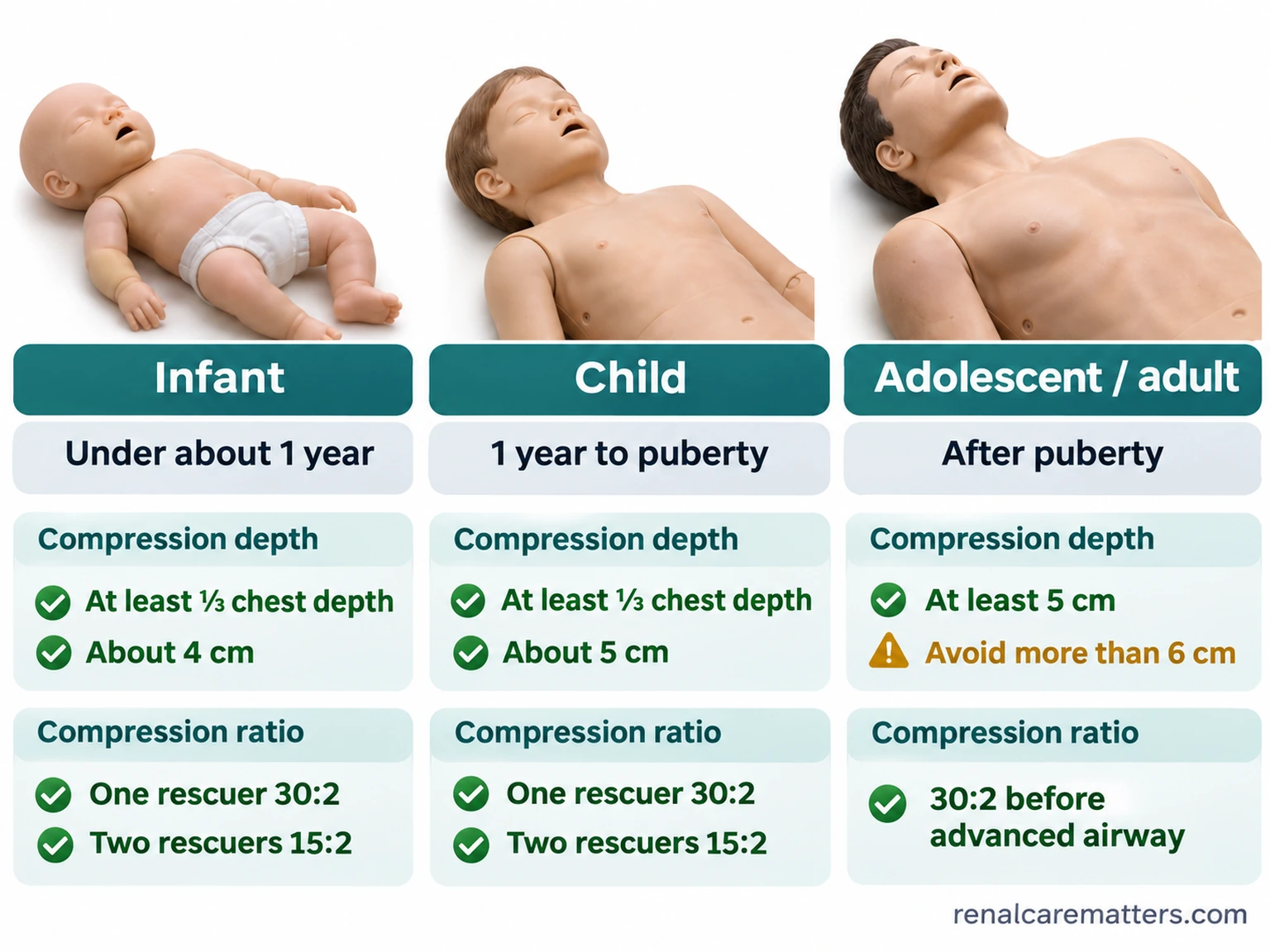
The 2025 pediatric guidelines apply to infants younger than about 1 year (excluding newborns) and to children up to puberty; after the onset of puberty, adult guidance applies.1 In a pediatric dialysis unit, most patients are children; an adolescent with signs of puberty is treated with adult Basic Life Support (BLS), while weight-based drug dosing may still apply until adult doses are reached.
Figure 2. Who counts as an infant, a child, or an adult for resuscitation, and how the technique changes.
Infant
Child (to puberty)
After puberty
Compression depth
At least one-third of the chest depth, about 4 cm
At least one-third of the chest depth, about 5 cm
5 to 6 cm
Technique
Two thumbs encircling, or heel of one hand
One or two hands
Two hands
Rate
100 to 120 a minute
100 to 120 a minute
100 to 120 a minute
Ratio, one rescuer
30:2
30:2
30:2
Ratio, two rescuers
15:2
15:2
30:2
With an advanced airway
Continuous compressions; a breath every 2 to 3 seconds
Same
Adult guidance
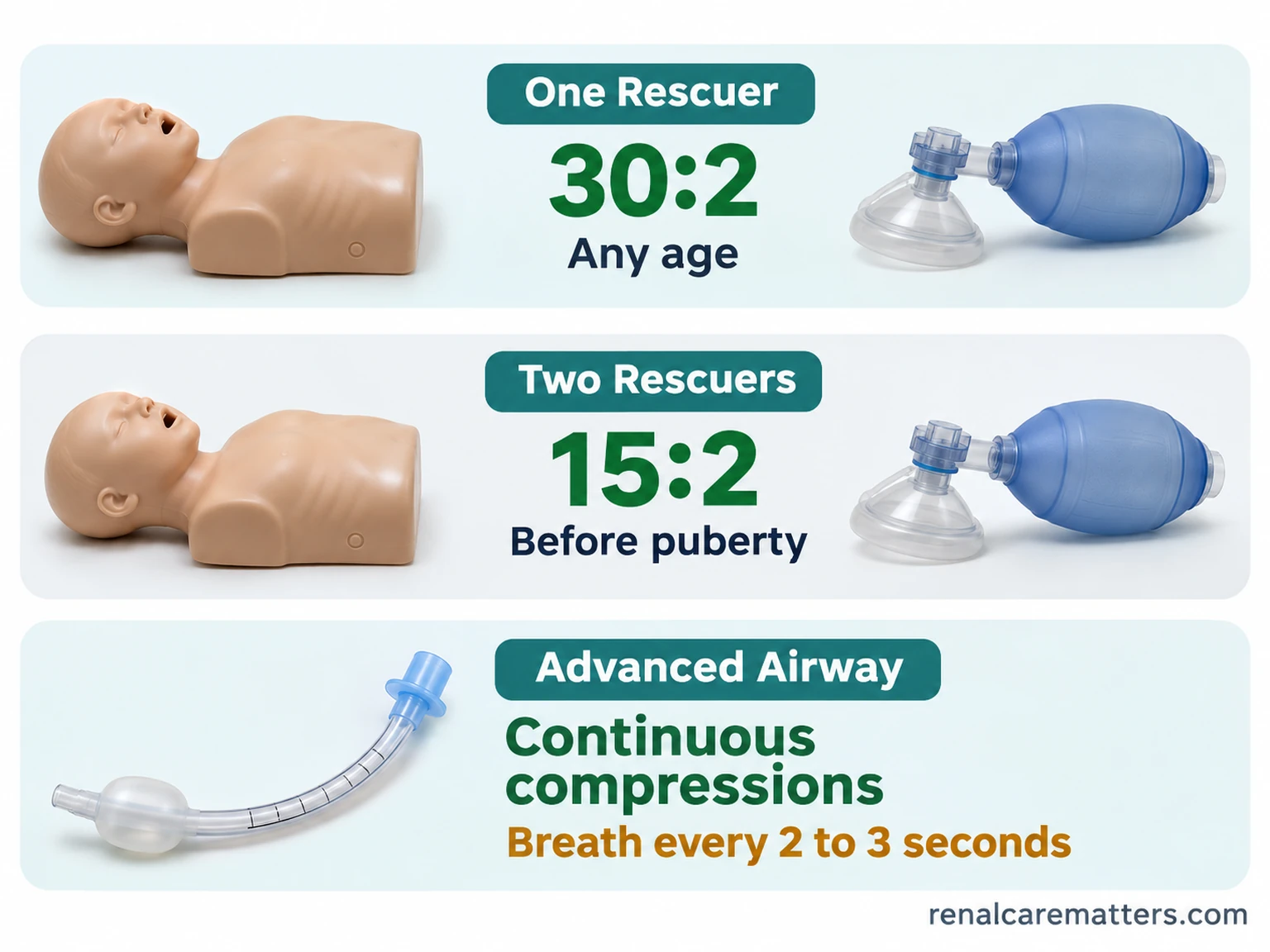
The ratios and the advanced-airway rate come from the 2025 pediatric cardiac arrest algorithm; the 2025 Pediatric Advanced Life Support (PALS) guideline suggests targeting 20 to 30 breaths a minute with an advanced airway (Class of Recommendation (COR) 2b, Level of Evidence (LOE) C-LD).2
RememberChoose the pediatric pathway early: before puberty, use pediatric depth, technique and ratios (15:2 with two rescuers).
Lesson · part 2
Infant and child compressions in 2025
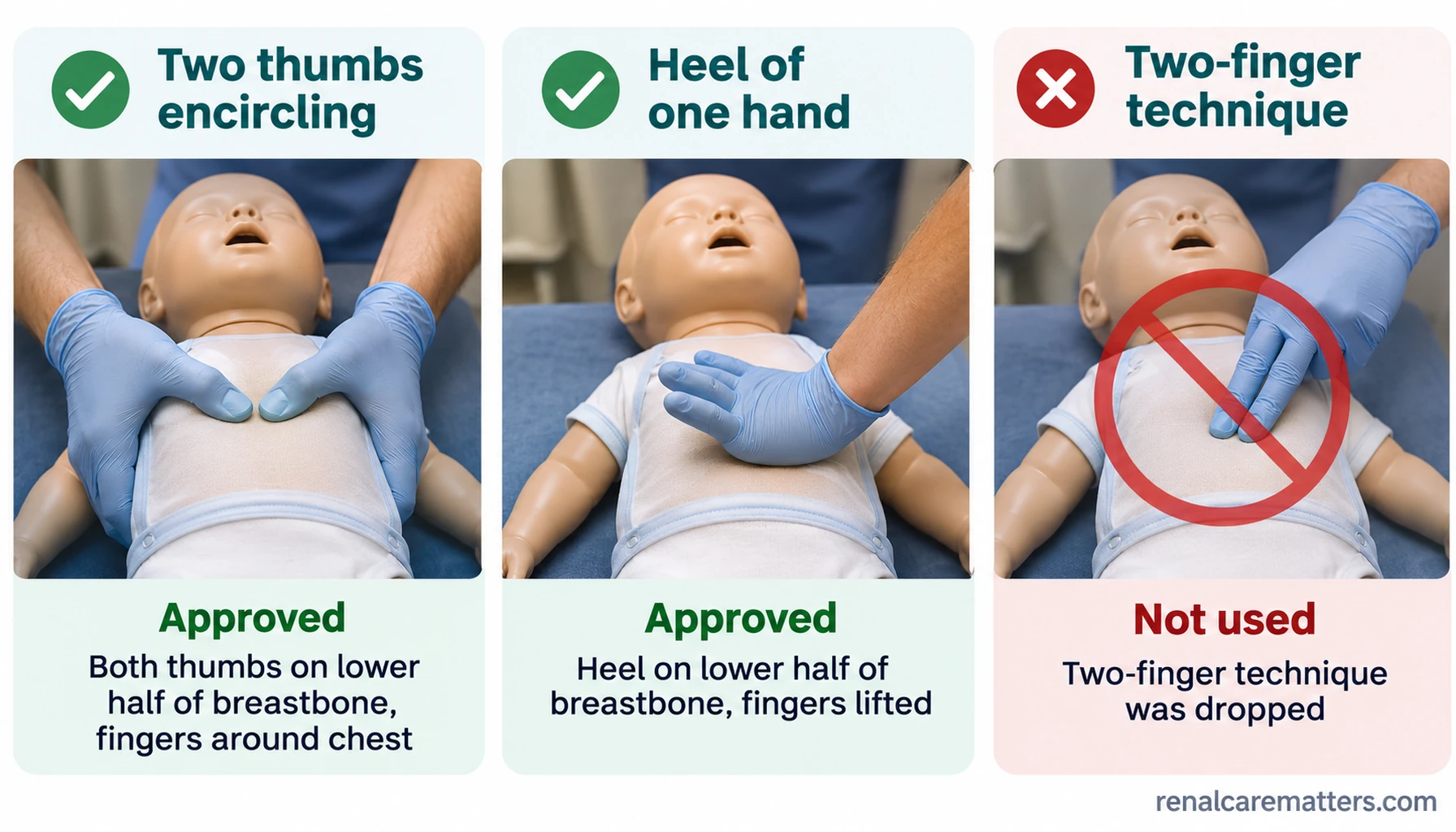
The 2025 pediatric BLS guideline eliminated the two-finger technique for infant chest compressions, because it often fails to reach the needed depth. For infants, the recommended techniques are the two-thumb encircling hands technique or the heel of one hand; if the rescuer cannot encircle the chest, compress with the heel of one hand.1
Figure 3. Infant compressions in 2025: two thumbs encircling, or the heel of one hand. The two-finger technique was dropped.
For cardiac arrest in a child, the guideline recommends immediate application and use of an automated external defibrillator, with a pediatric attenuator if available.1 If no attenuator or pediatric pads are available, an adult AED is still used: a shock for ventricular fibrillation (VF) matters more than the energy setting. Pediatric pads go anteroposterior on small children when they would otherwise touch.
Common error
Why it matters
Correction
Two fingers on an infant’s sternum
Too shallow
Two thumbs encircling, or the heel of one hand
Adult depth on a small child
Injury, no extra flow
One-third of the chest depth
30:2 with two rescuers before puberty
Too few breaths for a breathing-driven arrest
15:2
No AED because the child is small
VF untreated
Use an AED; attenuator if available
RememberNo more two-finger compressions: two thumbs encircling or the heel of one hand for infants. Use an AED in children, with an attenuator if you have one.
Lesson · part 3
Respiratory failure: the usual road to pediatric arrest
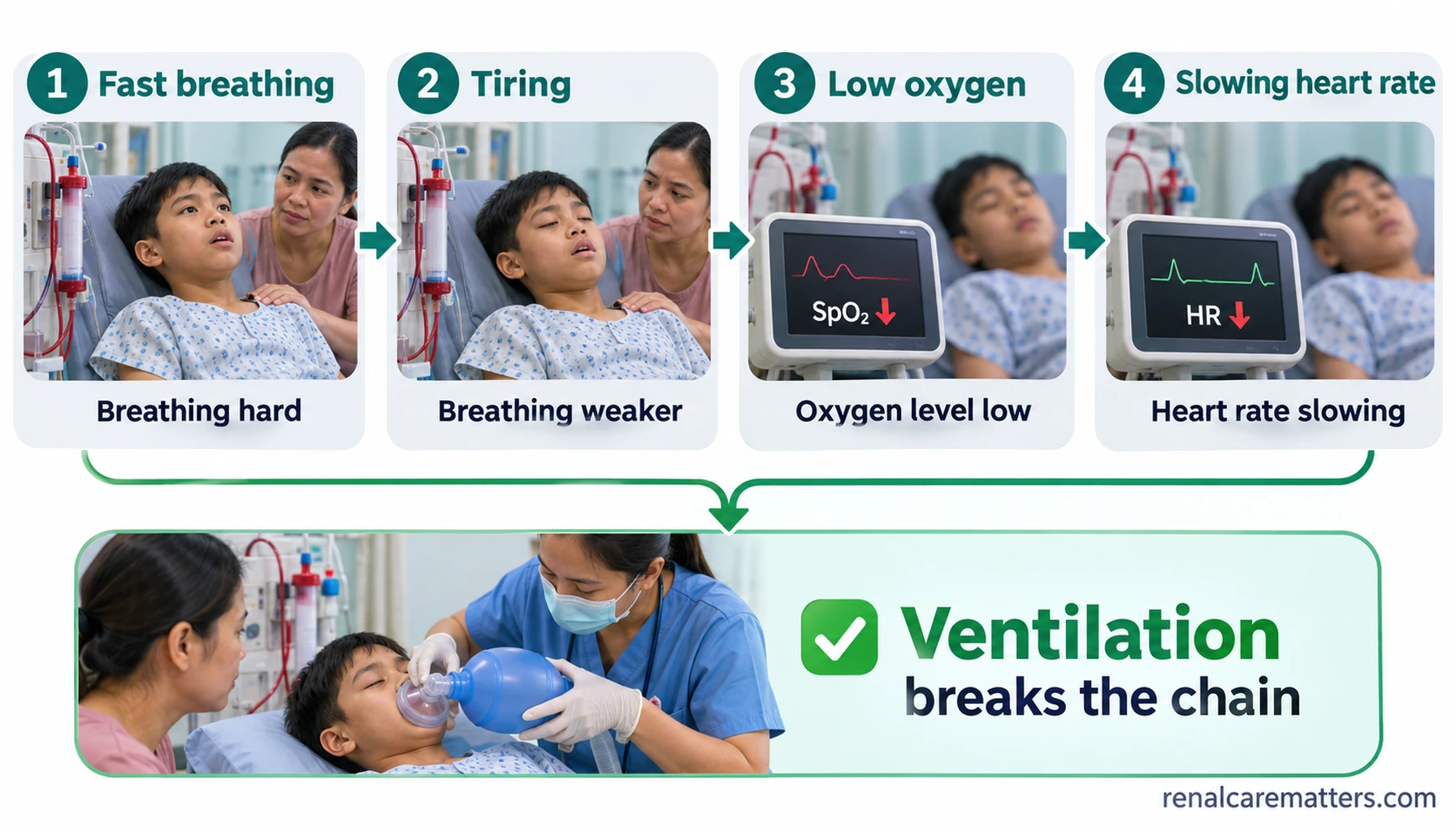
Most pediatric cardiac arrests are hypoxic: the lungs fail, oxygen falls, the heart muscle and the conduction system become starved, and the heart slows before it stops. The slowing is a late sign and an urgent one. In a child on dialysis, the commonest reason is fluid overload causing pulmonary edema; others are pneumonia, aspiration, sedative or opioid effects, and seizures.
Figure 4. In children, the heart usually stops because breathing failed first. Ventilation is the treatment that breaks the chain.
Stage
What you see
What you do
Respiratory distress
Fast breathing, retractions, nasal flaring, prefers to sit up
Oxygen, sit up if possible, call the physician; review fluid status
Respiratory failure
Tiring, slowing or shallow breaths, falling saturation, drowsiness
Open the airway; bag-mask ventilation with oxygen; call for help
Bradycardia with poor perfusion
Heart rate falling, pale or mottled, weak pulses
Effective oxygenated ventilation first; compressions if rate stays under 60 with compromise
Arrest
No pulse, not breathing normally
Pediatric cardiopulmonary resuscitation (CPR)
Bag-mask ventilation in a child needs the right mask size (from the bridge of the nose to the cleft of the chin, sparing the eyes), a smaller bag, and gentle breaths, just enough for chest rise. Effective ventilation alone often brings a slowing heart rate back up within seconds. For the dialysis circuit during respiratory distress, stop fluid removal only if the pressure is falling; in pulmonary edema, fluid removal may be part of the treatment, and that is the physician’s decision.
RememberIn children, the heart usually stops because breathing failed first. Effective bag-mask ventilation with oxygen is the treatment that breaks the chain.
Lesson · part 4
Pediatric bradycardia, and choking
For a child with bradycardia and cardiopulmonary compromise, the 2025 PALS guideline recommends starting CPR if the heart rate is under 60 a minute despite effective oxygenated ventilation (COR 1, LOE C-EO). If compromise persists after hypoxia and other causes are corrected, give intravenous or intraosseous epinephrine (COR 1, LOE C-EO). Atropine is recommended when bradycardia with compromise is caused by increased vagal tone or primary atrioventricular (AV) block, not by hypoxia (COR 1, LOE C-LD). Emergency transcutaneous pacing may be considered for complete heart block or sinus node dysfunction that does not respond to CPR (COR 2b, LOE C-EO).2
Child’s state
Action (PALS 2025)
Slow heart rate, perfusing well
Oxygen, monitor, find the cause (potassium, drugs, hypoxia)
Slow rate with compromise
Effective oxygenated ventilation first
Still under 60 with compromise despite ventilation
Start CPR
Compromise persists after correcting hypoxia
intravenous (IV) or intraosseous (IO) epinephrine
Vagal cause or primary AV block
Atropine
Choking
The 2025 pediatric BLS guideline separates infants and children. For an infant with severe foreign-body airway obstruction: repeated cycles of 5 back blows alternating with 5 chest thrusts, and no abdominal thrusts. For a child: repeated cycles of 5 back blows alternating with 5 abdominal thrusts.1 If the child becomes unresponsive, start CPR.
Figure 5. Pediatric ratios: 30:2 for one rescuer, 15:2 for two rescuers before puberty, and a breath every 2 to 3 seconds with an advanced airway.
RememberHeart rate under 60 with poor perfusion despite good ventilation: start compressions. Infant choking: back blows and chest thrusts; child choking: back blows and abdominal thrusts.
Stop and callA child on dialysis who is tiring, desaturating, drowsy or slowing: call for help and the pediatric cart, ventilate, and call the physician-on-duty and the attending pediatric nephrologist now. Follow your unit protocol.
On the floor
Real situations: problems and solutions
These are fictional but typical. For each one, cover the answer, decide what you would do, then compare. Where a step depends on local rules, your unit’s procedure and your supervisor’s direction come first.
The adult mask
What you see
During a pediatric drill, the only mask in the cart covers the child’s eyes.
What is likely going on
Wrong mask size; poor seal and eye injury risk.
What to do
Stock pediatric masks in all sizes; the mask fits from the bridge of the nose to the chin cleft.
Why it matters
Ventilation is the key pediatric treatment, and it fails with the wrong mask.
Two fingers out of habit
What you see
An experienced nurse uses two fingers on an infant manikin.
What is likely going on
An old habit from previous training.
What to do
Coach the two-thumb encircling or one-hand technique and recheck depth on the feedback device.
Why it matters
The two-finger technique was dropped because it does not reach depth.
The quiet bedtime
What you see
A child on evening dialysis falls “asleep” and the saturation is 85%.
What is likely going on
Possible respiratory failure mistaken for sleep.
What to do
Wake and assess; open the airway, give oxygen and ventilate if needed; call the physician.
Why it matters
Quiet children can be the sickest ones.
Field notes
Keep a laminated pediatric ratio and depth card on the pediatric cart.
Practice infant compressions on a feedback manikin each quarter.
Case review
Back to the case: The child becoming quiet
The physiology. Fluid gain of 1.8 kg in a 22 kg child, cough, orthopnea and fast breathing point to pulmonary edema. Over 40 minutes he moved from respiratory distress to respiratory failure: slow, shallow breaths, a saturation of 82%, drowsiness. The falling heart rate (120 to 54) is hypoxic bradycardia, a sign that arrest is close.
The first treatment. Ms. Cruz calls for help and the pediatric cart, opens the airway, and starts bag-mask ventilation with oxygen using a correctly sized mask, while a second nurse attaches the monitor and pads. Effective ventilation is the treatment most likely to bring his heart rate up. The physician-on-duty and the attending pediatric nephrologist are called; the circuit decision (whether fluid removal continues for the edema or stops for low pressure) is theirs.
Compressions. If, despite effective oxygenated ventilation, his heart rate stays under 60 a minute with poor perfusion, the team starts pediatric CPR: one-third of the chest depth, 100 to 120 a minute, 15:2 with two rescuers. If compromise persists after hypoxia is corrected, intravenous epinephrine is given by weight (Module 11). If he loses his pulse, the pediatric cardiac arrest algorithm begins.
Interactive case · fictional
Interactive case: The child becoming quiet
Work through a shift one decision at a time. The panel at the top changes with what you choose. After each choice you see why it is, or is not, the best move; after a weaker one you can try again or carry on and see where it leads. Your first choice at each step is scored. The score stays on this device and nothing is sent anywhere. In real practice, your unit’s protocol and the people responsible for each decision come first.
Skills lab · with your preceptor
Skills checklist: Pediatric BLS and early recognition
On infant and child manikins, perform compressions, bag-mask ventilation and a choking sequence while a supervisor observes. Your preceptor rates each step as satisfactory, needs practice, or not observed. Steps marked Critical must all be satisfactory before sign-off. This checklist supports supervised learning; your unit’s own procedure and competency form are the authority. A printable version of every checklist is on the trainer page.
Chooses the pediatric pathway correctly by age and signs of puberty.
CriticalCompresses an infant with two thumbs encircling or the heel of one hand, never two fingers.
CriticalCompresses one-third of the chest depth at 100 to 120 a minute with full recoil.
CriticalUses 15:2 with two rescuers before puberty.
CriticalSelects the correct mask size and ventilates with visible chest rise.
CriticalStarts compressions for a heart rate under 60 with poor perfusion despite effective ventilation.
Demonstrates infant (back blows and chest thrusts) and child (back blows and abdominal thrusts) choking sequences.
Uses an AED with a pediatric attenuator when available, or an adult AED when not.
Placement activity. Check the pediatric cart in your unit for mask and bag sizes, pediatric pads and attenuator, and list anything missing.
Self-assessment
Check your understanding
Each visit draws 5 questions at random from this module’s 10-question bank. Choose the single best answer for each, then select Check answers; an explanation appears under the best answer. Select New set of questions for a different mix. A good target is 4 of 5 on two different sets. Nothing you select is sent anywhere; scoring happens in your browser.
Joyner, B. L., Dewan, M., Bavare, A., de Caen, A., DiMaria, K., Donofrio-Odmann, J., Fosse, G., Haskell, S., Mahgoub, M., Meckler, G., Requist, J., Schexnayder, S. M., Olech Smith, M., Werho, D., & Raymond, T. T. (2025). Part 6: Pediatric basic life support: 2025 American Heart Association and American Academy of Pediatrics guidelines for cardiopulmonary resuscitation and emergency cardiovascular care. Circulation, 152(16_suppl_2), S424–S447. https://doi.org/10.1161/CIR.0000000000001370
Lasa, J. J., Dhillon, G. S., Duff, J. P., Hayes, J., Kamath-Rayne, B. D., Levy, A., Mahgoub, M., Morgan, R. W., McCormick, T., Roberts, J. S., Ross, C. E., Schexnayder, S. M., Sweberg, T., Valdés, S. O., & Topjian, A. A. (2025). Part 8: Pediatric advanced life support: 2025 American Heart Association and American Academy of Pediatrics guidelines for cardiopulmonary resuscitation and emergency cardiovascular care. Circulation, 152(16_suppl_2), S479–S537. https://doi.org/10.1161/CIR.0000000000001368
Educational reviewer and practice resource for dialysis teams. It is not an American Heart Association (AHA) course, it is not BLS, ACLS or PALS certification, and online completion does not establish hands-on competence. Staff certify through an authorized training center. Your unit’s approved protocol, crash-cart stock and machine manufacturer’s instructions govern every real event.