Arrest in the Dialysis Chair: Machine, Circuit and Access
The circuit nurse role, stopping fluid removal, whether the blood goes back, defibrillating near a machine, and using the access safely.
PublishedNailathalaGipatikPepalwal:ReferencesMga SanggunianMga TinubdanReng Reperensya:5Audience: Every member of the dialysis shift team: hemodialysis nurses, charge and head nurses, physicians-on-duty, attending nephrologists, dialysis and biomedical technicians, nurse assistants and support staff · pediatric dialysis teams for Part 4Read timeOras ng pagbasaOras sa pagbasaOras ning pamamasa:
This module is study material for dialysis teams. It explains the reasoning behind resuscitation decisions; it is not a unit protocol, an order set, or certification. Doses and energies are quoted from the 2025 American Heart Association (AHA) guidelines and the European Resuscitation Council (ERC) where named, so you can recognize them; give medicines only within your license and your unit’s approved protocol. Escalation always follows your unit protocol, and you always ask the attending nephrologist for guidance. Every case, name, and identifier is fictional.
Learning objectives
After this module you should be able to
Act as the circuit nurse in an arrest: stop fluid removal and the blood pump, make the blood decision, and announce it, without ever delaying compressions or a shock.
Decide whether the blood in the circuit is returned or discarded, and never return blood after air, hemolysis or a severe reaction.
Defibrillate safely beside a dialysis machine: dry surfaces, hands off the patient and lines, and disconnection unless the machine is rated defibrillation-proof.
Use a fistula needle or a dialysis catheter for resuscitation drugs safely, including aspirating the catheter lock and clamping between uses.
Recognize and manage suspected air embolism, and explain where the guidelines disagree on positioning.
Classroom 1 hSkills lab 1 hSupervised placement 1 h
Pre-testBefore you read, answer the 5 self-assessment questions and note your score. After the module, select New set of questions and compare. The difference is what you learned; the questions you still miss are what to reread.
Start here
The big picture, in plain words
In plain wordsPicture a patient in arrest as a house on fire with a garden hose still attached and running. Before anyone can work safely, somebody has to turn off the tap and decide whether the water in the hose goes back into the tank or onto the ground. That person must not get in the way of the firefighters. In a dialysis arrest, the hose is the blood circuit, and that somebody is the circuit nurse.
The picture has a limit. The “water” in a dialysis circuit is the patient’s own blood, often a few hundred milliliters in an adult and a much larger share of the blood volume in a small child. Returning it can restore volume the patient badly needs; returning it after air, hemolysis or a reaction can kill. And the circuit is not just a hazard: the access that feeds it is already in a large vein, ready for drugs.
General resuscitation guidelines say almost nothing about this. The 2025 American Heart Association (AHA) special-circumstances chapter does not address cardiac arrest during hemodialysis; the European Resuscitation Council (ERC) 2025 special-circumstances guideline does, in a few sentences: a trained dialysis nurse or technician operates the machine; stop dialysis and return the patient’s blood volume with a fluid bolus; disconnect the patient unless the equipment is defibrillation-proof, and beware of wet surfaces; leave the access open and use it for drugs; and expect that dialysis may be needed early after return of spontaneous circulation (ROSC).1 This module turns those sentences into a role. It matches the signed-off Card 1 of the Emergency Quick Cards line by line.
Figure 1 · Key terms for this module
Circuit nurseThe dialysis nurse (or trained technician) who manages the machine and circuit during an arrest, and nothing else until the circuit is safe.
Blood return (rinse-back)Returning the blood in the circuit to the patient with saline.
Clamp and disconnectStopping the pump, clamping the lines, and separating the patient from the circuit without returning the blood.
Defibrillation-proofA rating given by the manufacturer that the equipment and its patient connections withstand a defibrillator shock.
Catheter lockThe anticoagulant or antimicrobial solution left in each catheter limb between sessions.
WatcherThe staff member who keeps every other patient safe during the arrest.
Opening case · fictional
Case: Station 7, the circuit
At 9:40 a.m., Mr. Arnel Gutierrez, 61, arrests two hours into his session (the same event as Module 5). He dialyzes through a left forearm fistula with two needles; his fluid removal goal is 3.2 L, and 2.1 L has been removed. The chair is wet near the arm where a saline bag dripped earlier.
Nurse Ms. Camille Ortiz is his assigned nurse. Compressions have started. The defibrillator is coming. Ms. Ortiz stands at the machine with her hands on the blood pump button. Another nurse calls out, “Disconnect him so we can move him!” The technician asks, “Do we return the blood?”
Before reading on, decide:
What does Ms. Ortiz do in her first 60 seconds, and in what order?
Should the blood go back? What would change your answer?
What has to be true before the first shock?
Keep your answers in mind. The lesson gives you what you need, and the case review near the end shows one sound response.
Lesson · part 1
One person owns the circuit
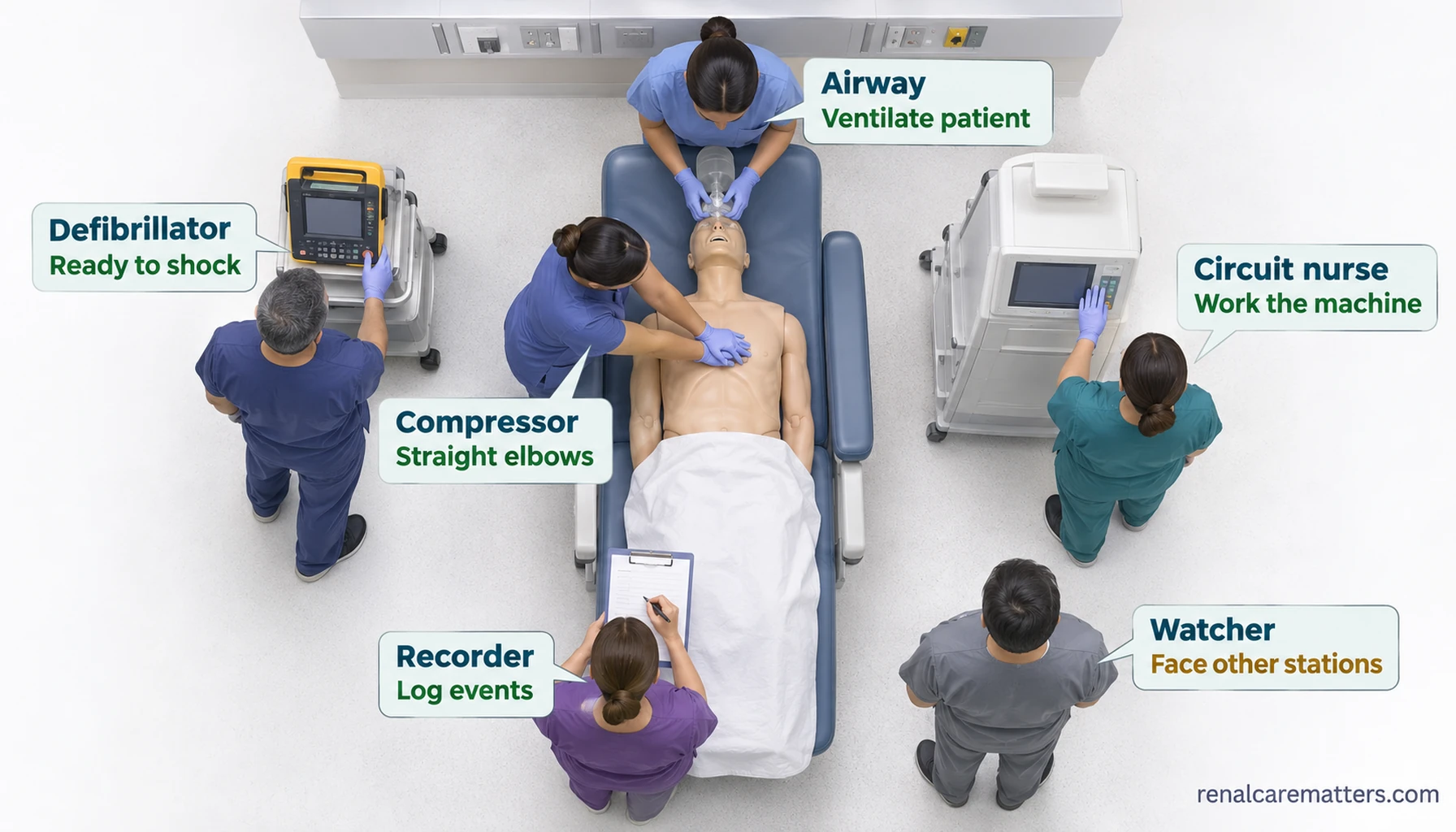
In most dialysis arrests the circuit is managed by whoever is closest, while also trying to help with compressions or fetch the cart. That splits attention at the worst moment. The ERC recommends that a trained dialysis nurse or technician operates the machine.1 This course names that person the circuit nurse: usually the patient’s own nurse, who knows the access, the fluid removed, and the machine.
Figure 2. Where everyone stands. The circuit nurse works the machine without ever crossing the compressors.
Circuit nurse does
Circuit nurse does not
Stops fluid removal at once
Stop compressions to reach the machine
Stops the blood pump when the blood decision requires it
Leave the circuit to fetch equipment
Announces the blood decision aloud: “Blood returned,” or “Clamped, not returned”
Return blood after air, hemolysis or a severe reaction
Makes the access safe for drugs and tells the leader which port to use
Leave an access open, unclamped or unsecured
Reports time on the machine, fluid removed, and the last potassium
Restart dialysis without the attending nephrologist
The circuit nurse works from the machine side of the chair and never crosses the compressor. In a three-person team, the circuit nurse makes the circuit safe in the first minute, then joins compressions or recording. The circuit decision is announced once, clearly, and the recorder writes it down with the time.
RememberThe circuit has one owner. Stop fluid removal first, announce the blood decision aloud, and never stop compressions for the machine.
Lesson · part 2
Does the blood go back?
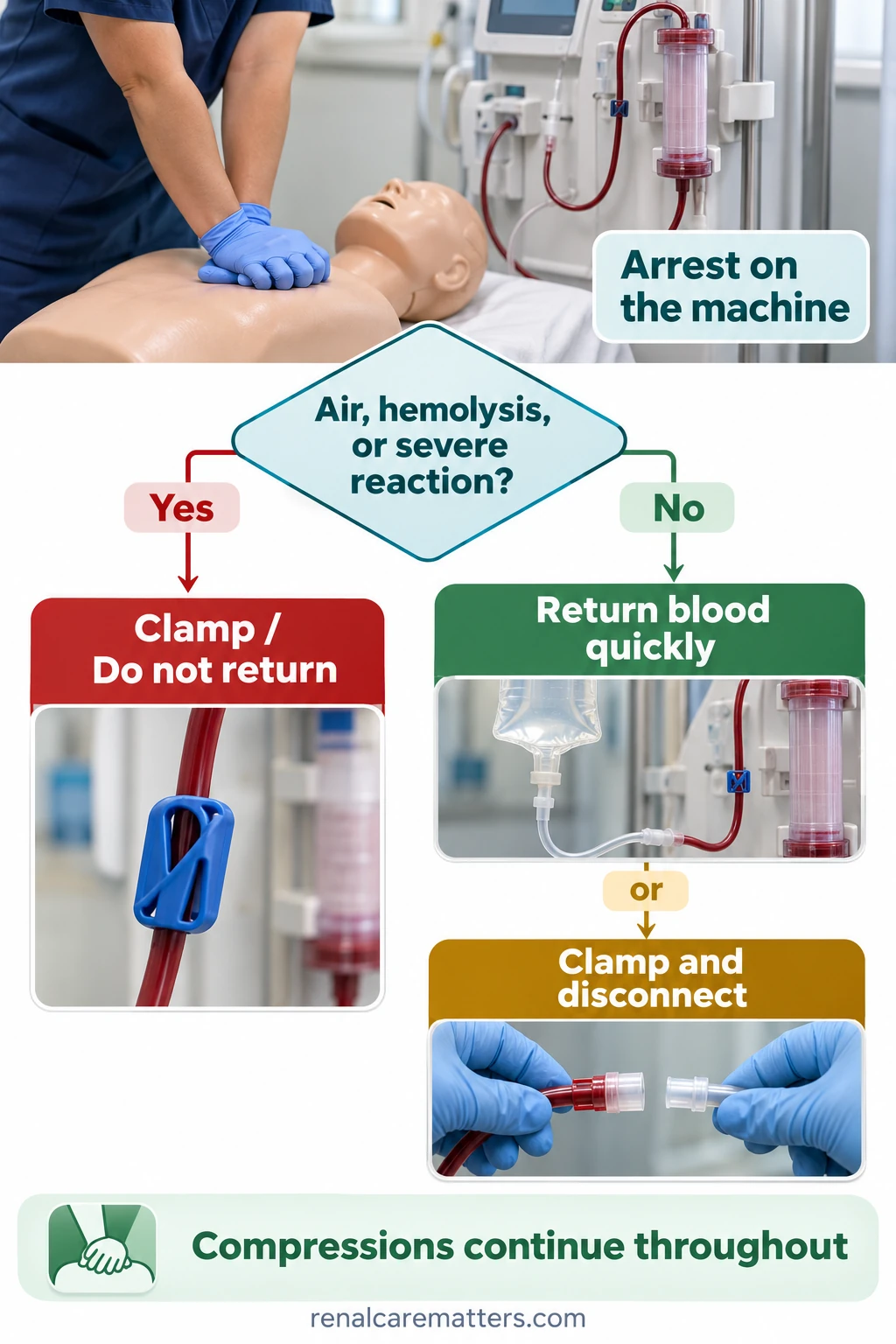
The first action is the same in every arrest: stop fluid removal. A patient in arrest has no circulation to spare, and continued fluid removal only empties it further. What happens next depends on why the patient arrested and on whether the blood in the circuit is safe.
Figure 3. Return or clamp. Contaminated blood never goes back; otherwise, return it quickly or clamp and disconnect, and never pause compressions to decide.
The blood carries potassium released from broken red cells
Severe dialyzer reaction or anaphylaxis
Clamp, do not return
The circuit blood carries the trigger
Line separation or needle dislodgement with an open line end
Do not return through the open end
Contamination and air
Any other arrest, circuit sound
Return the blood quickly with saline, or clamp and disconnect
Returns volume; the access stays in place for drugs
The ERC states the principle as “stop dialysis and return the patient’s blood volume with a fluid bolus.”1 Card 1 adds the exceptions, which come from the physiology of the circuit emergencies: never return blood after air, hemolysis or a dialyzer reaction. A saline bolus through the circuit also treats the hypovolemia that fluid removal may have caused; in the case, 2.1 L has been removed. How much saline, and how fast, is set by your unit protocol and the leader.
Rinse-back takes a few minutes on most machines. If it would take the circuit nurse away from anything more urgent, clamp and disconnect instead. In this unit’s practice, blood that looks hemolyzed is never returned.
RememberStop fluid removal, then decide: air, hemolysis, a severe reaction or an open line end mean clamp and do not return. Otherwise return the blood quickly with saline, or clamp and disconnect. Say the decision aloud.
Lesson · part 3
Defibrillation with a patient on the machine
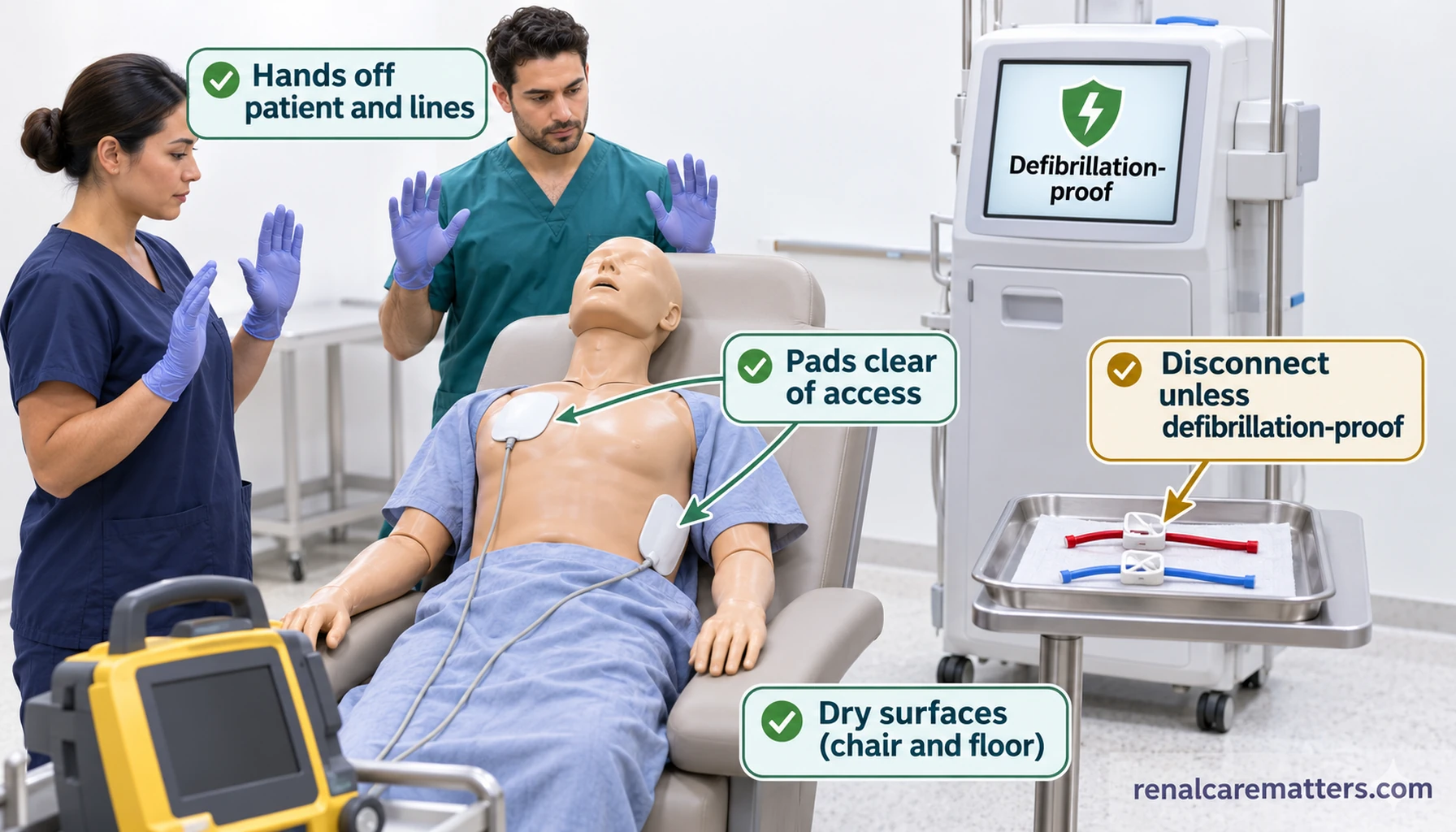
A shock passes current through the patient. Anything in contact with the patient during the shock, including a wet chair, a saline-soaked blanket, a person holding the blood lines, or metal connected to the patient, can carry current to staff or to equipment. The ERC advises disconnecting the patient from the machine unless the equipment is defibrillation-proof, and warns about wet surfaces.1
Figure 4. Defibrillating near a machine: dry surfaces, hands off the patient and the lines, and disconnect unless the machine is rated defibrillation-proof.
Before every shock
Why
Chair, blanket and floor around the patient dry; wipe or move wet drapes
Water conducts current to staff
Pads on dry skin, clear of the catheter exit site, dressings and the access arm
Current must go through the heart, not along wet skin
“Everyone clear: patient, chair, lines, machine”; the circuit nurse lets go of the lines
The blood lines are in contact with the patient
Machine status known: rated defibrillation-proof by the manufacturer, or disconnected
Protects the patient’s connection and the device
Oxygen mask or tubing moved away from the chest during the shock
Sparks near oxygen are a fire risk
Whether a particular dialysis machine is rated defibrillation-proof is written in the manufacturer’s instructions for use, not on a wall poster, and it may differ between models in the same unit. Ask your biomedical technician to put the answer for each model in writing beside the crash cart. When in doubt, the circuit nurse clamps and disconnects before the first shock, which takes seconds and does not require returning the blood. Disconnecting must never delay a shock for ventricular fibrillation (VF): if the device is ready and the patient is in VF, the leader decides, and everyone stands clear of the patient, chair, lines and machine.
RememberBefore every shock: dry surfaces, pads clear of the access, hands off the patient and the lines, and the machine either rated defibrillation-proof or disconnected.
Lesson · part 4
The access is a resuscitation line, used safely
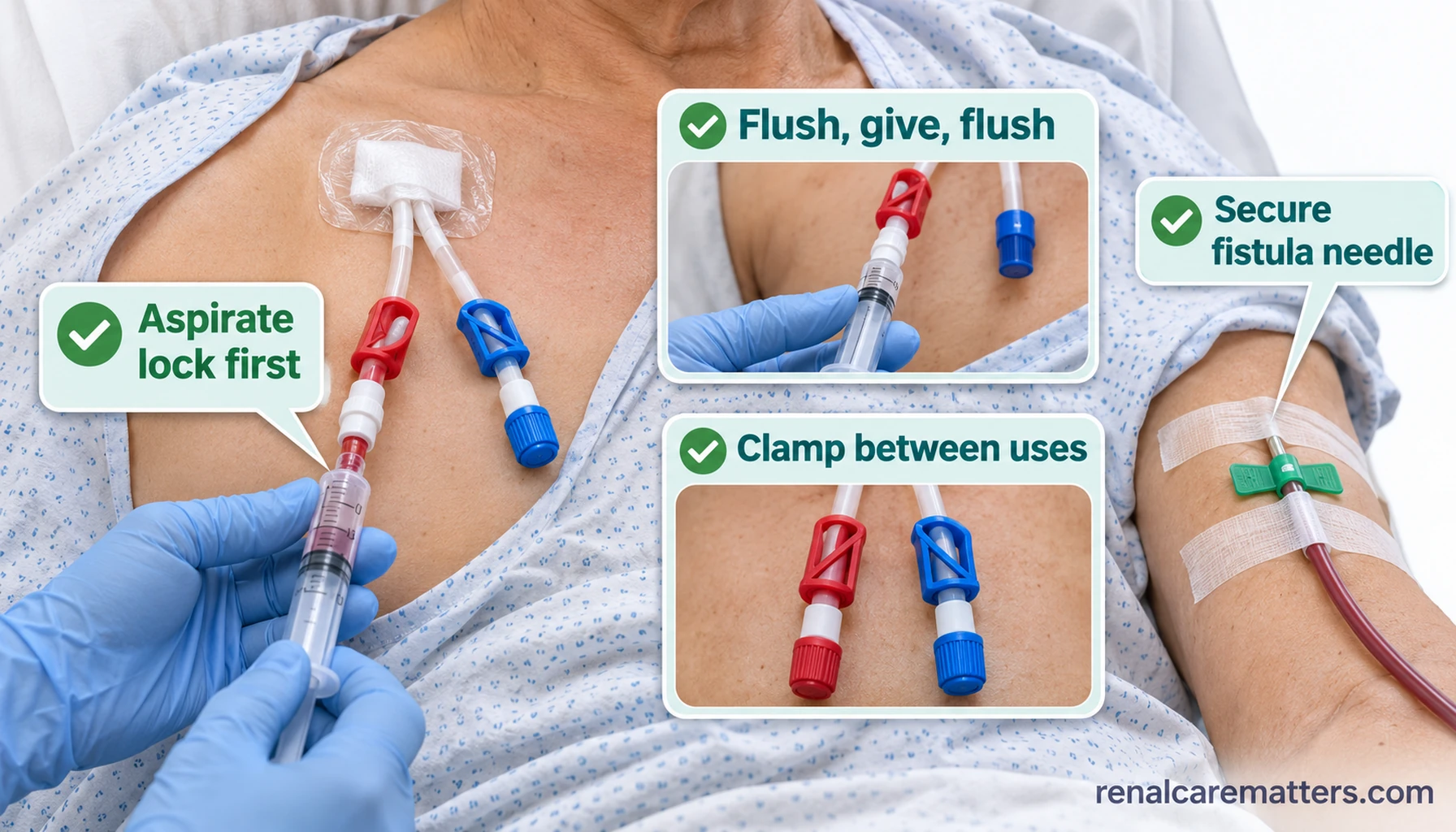
A dialysis patient in arrest usually has a large-bore needle in a fistula or a central catheter already in place. The ERC says to leave the access open and use it for drug administration.1 “Open” means available and working, never an uncapped needle or an unclamped catheter limb. An open central catheter limb can draw air into the heart, especially when chest pressure falls.
Figure 5. Using the access for drugs: aspirate the catheter lock first, flush, give, flush, and clamp between uses.
Access
How to use it for drugs
Hazard to avoid
Fistula or graft, needles in place, circuit returned or clamped
Keep the venous needle secured and taped; give drugs through a saline-primed line on the venous needle, flushing after each drug
A dislodged needle; giving drugs through the arterial needle into a clotted segment
Fistula or graft, circuit still running
Drugs may go into the venous line port per protocol, after the circuit nurse confirms flow
Drugs lost in a stopped or clotted circuit
Tunneled or non-tunneled catheter
Aspirate the lock solution from the limb first (at least the labeled limb volume), flush with saline, give the drug, flush, clamp
Pushing heparin or citrate lock into the patient; air entry through an open limb
The catheter lock is often concentrated heparin or citrate. Pushing it into a patient in arrest is a medication error, and aspirating it first is standard practice before any catheter use. Every catheter limb carries its fill volume printed on the clamp or hub; aspirate at least that much. Between drugs, the limb stays clamped with a syringe or a capped connector attached.
If the access is lost or unusable, the standard order applies: attempt a peripheral intravenous (IV) first (Class of Recommendation (COR) 1, Level of Evidence (LOE) A), and use intraosseous access if IV attempts fail or are not feasible (COR 2a, LOE A).2 Do not place a peripheral IV in the fistula arm, except as a last resort decided by the leader.
RememberUse the access for drugs, but safely: aspirate every catheter lock first, flush before and after, clamp between uses, and keep fistula needles secured.
On the floor · The citrate push
During a drill on a catheter patient, the drug nurse connected the epinephrine syringe straight to the venous limb. The circuit nurse stopped her: “Lock first. Aspirate 2 milliliters, then flush.” The drill paused for six seconds; compressions did not.
The circuit nurse protects the access while the team protects the circulation.
Illustrative scenario. Names and details are invented.
Lesson · part 5
Air embolism, and the twelve other patients
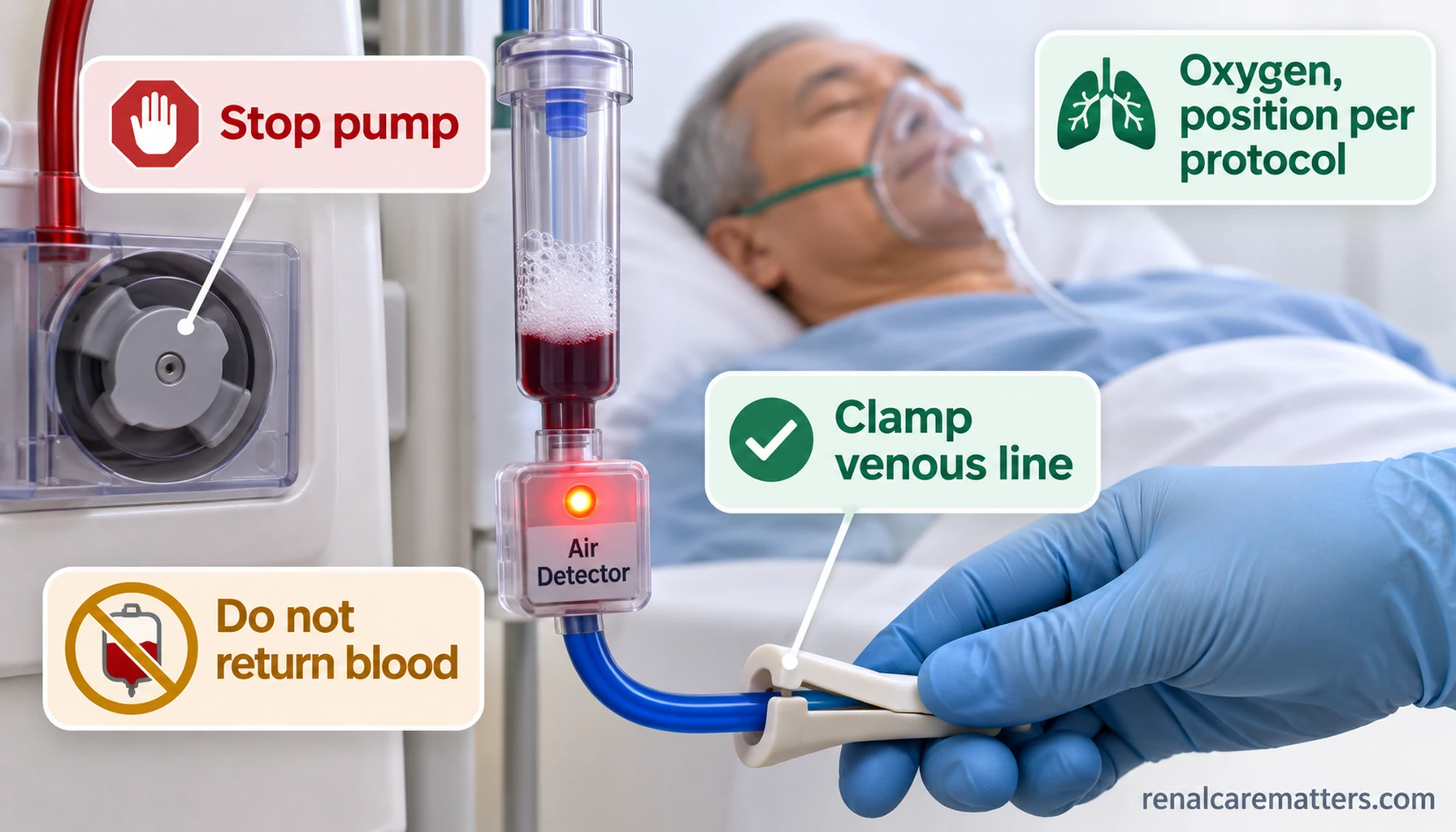
Air enters the circuit through a loose connection before the blood pump, an empty saline bag, a cracked line, or an open catheter limb. A large volume reaching the right heart can block outflow to the lungs; air that crosses to the arterial side through a hole in the heart can reach the brain. Signs are sudden cough, chest tightness, breathlessness, confusion, or collapse, often with foam in the venous line or an air detector alarm (Card 5).3,4
Figure 6. Air in the circuit: stop the pump, clamp the venous line, do not return the blood, give oxygen, and position per your protocol.
Step
Source
Stop the blood pump; clamp the venous line; never override the air detector
Card 5 (dialysis practice)
Do not return the blood
Card 5
100% oxygen
AHA 2025, COR 1, LOE C-EO
Position: AHA “supine or recovery position on a level surface”; dialysis teaching “left side, sometimes head down”; never sit the patient up
AHA 2025, COR 2a, LOE C-EO; dialysis reviews
Hyperbaric oxygen is reasonable for life-threatening gas embolism
AHA 2025, COR 2a, LOE B-NR (adults)
No pulse: cardiopulmonary resuscitation (CPR) flat on the back (Card 1)
All sources
The guidelines disagree on position. The 2025 AHA recommendation for life-threatening gas embolism is to position the patient supine or in the recovery position on a level surface (COR 2a, LOE C-EO), with 100% oxygen (COR 1, LOE C-EO).5 Dialysis texts and reviews have long taught the left side, sometimes with the head down, to keep air in the right heart.3 Both rest on expert opinion. Card 5 says “position per your unit’s protocol” and flags the difference for clinical review; this course does the same. What no source supports is sitting the patient up, and every source agrees that CPR, if needed, is done flat on the back.
The other patients
An arrest takes four to six staff to one chair. Every other circuit keeps running. Needles dislodge, pressures fall, and alarms sound unanswered. The watcher, named at the start of the shift, stays with the other patients and does not join the arrest. If the arrest goes on, the charge nurse decides whether to hold new connections.
RememberAir: clamp, do not return, oxygen, flat (position per protocol), never sit up. And someone always watches the other patients.
Stop and callAir below the venous chamber, an air alarm with symptoms, or any arrest on the machine: follow Card 1 or Card 5 now, call the physician-on-duty and the attending nephrologist, and arrange emergency transfer. Your unit protocol decides position and the blood decision; always ask the attending nephrologist for guidance before any restart.
On the floor
Real situations: problems and solutions
These are fictional but typical. For each one, cover the answer, decide what you would do, then compare. Where a step depends on local rules, your unit’s procedure and your supervisor’s direction come first.
The rinse-back that took four minutes
What you see
During an arrest, the circuit nurse stands at the machine for four minutes completing rinse-back while the team lacks a compressor.
What is likely going on
Rinse-back took priority over the team’s needs.
What to do
If rinse-back would take you away from something more urgent, clamp and disconnect instead, and announce it.
Why it matters
The blood decision should take seconds, not minutes.
The wet chair
What you see
A saline bag has leaked onto the chair beside the patient’s arm just before a shock.
What is likely going on
Water can carry current to staff and away from the heart.
What to do
Wipe or move the wet drapes, place the pads on dry skin away from the access arm, and call clear.
Why it matters
Dry surfaces are part of every shock in a dialysis unit.
The uncapped limb
What you see
After a drug is given through a catheter, the limb is left open with no syringe or cap.
What is likely going on
An open central catheter limb can draw in air.
What to do
Clamp the limb and cap it, or leave a syringe attached; check both limbs.
Why it matters
“Leave the access open” never means uncapped.
Field notes
Practice the circuit nurse role on a training circuit at least once a quarter.
Post each machine model’s defibrillation statement beside the crash cart.
Case review
Back to the case: Station 7, the circuit
The first 60 seconds, in order. Ms. Ortiz stops fluid removal at once. She looks for a circuit cause: no air in the venous line, no translucent blood, no sign of a reaction, no line apart. With none, she chooses the quick path: she returns the blood with saline per protocol (giving back volume after 2.1 L removed), or clamps and disconnects if rinse-back would take her away from anything more urgent. She announces, “Fluid removal off. Blood returned,” or “Clamped and disconnected.” She keeps the venous needle secured and flushed for drugs and tells the leader which port to use.
Would the answer change? Yes, if there were foam in the venous line, port-wine blood, a reaction in the first minutes of the session, or an open line end. Then she clamps and does not return the blood.
Before the first shock. The wet chair and blanket near the arm are wiped or moved; pads go on dry skin away from the fistula arm; the machine is disconnected unless it is rated defibrillation-proof; and Ms. Ortiz lets go of the lines when the leader calls “clear.” No one moves the patient off the chair unless the leader decides compressions cannot be done there.
Afterward. Dialysis is not restarted without the attending nephrologist. Ms. Ortiz hands over: time on the machine (two hours), fluid removed (2.1 L), whether the blood was returned, the last potassium, and the access.
Interactive case · fictional
Interactive cases
Work through a shift one decision at a time. The panel at the top changes with what you choose. After each choice you see why it is, or is not, the best move; after a weaker one you can try again or carry on and see where it leads. Your first choice at each step is scored. The score stays on this device and nothing is sent anywhere. In real practice, your unit’s protocol and the people responsible for each decision come first.
Skills checklist: Circuit nurse in a dialysis arrest
On a manikin in a recliner connected to a training circuit (no patient, no live water connection), act as the circuit nurse during a facilitated arrest. Your preceptor rates each step as satisfactory, needs practice, or not observed. Steps marked Critical must all be satisfactory before sign-off. This checklist supports supervised learning; your unit’s own procedure and competency form are the authority. A printable version of every checklist is on the trainer page.
CriticalStops fluid removal within the first seconds and announces it.
CriticalIdentifies whether air, hemolysis, a severe reaction or an open line end is present before deciding on the blood.
CriticalNever returns blood after air, hemolysis or a severe reaction.
Returns blood with saline or clamps and disconnects, and announces the decision aloud for the recorder.
CriticalNever interrupts compressions or crosses the compressor to reach the machine.
CriticalBefore a shock, ensures dry surfaces, releases the lines, and confirms the machine is defibrillation-proof or disconnected.
CriticalAspirates the catheter lock before using a catheter limb for drugs, flushes, and clamps between uses.
Hands over time on machine, fluid removed, blood decision, last potassium and access.
Placement activity. With your biomedical technician, find the manufacturer’s statement on defibrillation for each machine model in your unit and post it beside the crash cart.
Self-assessment
Check your understanding
Each visit draws 5 questions at random from this module’s 10-question bank. Choose the single best answer for each, then select Check answers; an explanation appears under the best answer. Select New set of questions for a different mix. A good target is 4 of 5 on two different sets. Nothing you select is sent anywhere; scoring happens in your browser.
Lott, C., Karageorgos, V., Abelairas-Gomez, C., Alfonzo, A., Bierens, J., Cantellow, S., Debaty, G., Einav, S., Fischer, M., González-Salvado, V., Greif, R., Metelmann, B., Metelmann, C., Meyer, T., Paal, P., Peran, D., Scapigliati, A., Spartinou, A., Thies, K., . . . Deakin, C. D. (2025). European Resuscitation Council guidelines 2025 special circumstances in resuscitation. Resuscitation, 215(Suppl. 1), Article 110753. https://doi.org/10.1016/j.resuscitation.2025.110753
Wigginton, J. G., Agarwal, S., Bartos, J. A., Coute, R. A., Drennan, I. R., Haamid, A., Kudenchuk, P. J., Link, M. S., Panchal, A. R., Pelter, M. M., Del Rios, M., Rodriguez, A. J., Perman, S. M., Sanko, S., Kotini-Shah, P., & Kurz, M. C. (2025). Part 9: Adult advanced life support: 2025 American Heart Association guidelines for cardiopulmonary resuscitation and emergency cardiovascular care. Circulation, 152(16_suppl_2), S538–S577. https://doi.org/10.1161/CIR.0000000000001376
McCarthy, C. J., Behravesh, S., Naidu, S. G., & Oklu, R. (2016). Air embolism: Practical tips for prevention and treatment. Journal of Clinical Medicine, 5(11), Article 93. https://doi.org/10.3390/jcm5110093
Greenberg, K. I., & Choi, M. J. (2021). Hemodialysis emergencies: Core curriculum 2021. American Journal of Kidney Diseases, 77(5), 796–809. https://doi.org/10.1053/j.ajkd.2020.11.024
Cao, D., Arens, A. M., Chow, S. L., Easter, S. R., Hoffman, R. S., Lagina, A. T., Lavonas, E. J., Patil, K. D., Sutherland, L. D., Tijssen, J. A., Wang, G. S., Zelop, C. M., Rodriguez, A. J., Drennan, I. R., & McBride, M. E. (2025). Part 10: Adult and pediatric special circumstances of resuscitation: 2025 American Heart Association guidelines for cardiopulmonary resuscitation and emergency cardiovascular care. Circulation, 152(16_suppl_2), S578–S672. https://doi.org/10.1161/CIR.0000000000001380
Educational reviewer and practice resource for dialysis teams. It is not an American Heart Association (AHA) course, it is not BLS, ACLS or PALS certification, and online completion does not establish hands-on competence. Staff certify through an authorized training center. Your unit’s approved protocol, crash-cart stock and machine manufacturer’s instructions govern every real event.