Roles and closed-loop orders, leadership handover, code status and families, the five-question debrief, performance reports, and drill cadence.
PublishedNailathalaGipatikPepalwal:ReferencesMga SanggunianMga TinubdanReng Reperensya:4Audience: Every member of the dialysis shift team: hemodialysis nurses, charge and head nurses, physicians-on-duty, attending nephrologists, dialysis and biomedical technicians, nurse assistants and support staff · pediatric dialysis teams for Part 4Read timeOras ng pagbasaOras sa pagbasaOras ning pamamasa:
This module is study material for dialysis teams. It explains the reasoning behind resuscitation decisions; it is not a unit protocol, an order set, or certification. Doses and energies are quoted from the 2025 American Heart Association (AHA) guidelines and the European Resuscitation Council (ERC) where named, so you can recognize them; give medicines only within your license and your unit’s approved protocol. Escalation always follows your unit protocol, and you always ask the attending nephrologist for guidance. Every case, name, and identifier is fictional.
Learning objectives
After this module you should be able to
Assign and combine resuscitation roles for a small, standard or large team, and transfer leadership cleanly when another team arrives.
Use closed-loop communication for every order, and keep the recorder’s timeline accurate.
Check code status before the emergency, respect a documented decision, and support families with presence and plain language.
Lead a five-question debrief after a drill or a real event, and turn findings into owned system changes.
Use three separate performance reports (clinical skills, team coordination, system readiness), state their data sources, and plan a practice cadence.
Classroom 1 hSkills lab 1 hSupervised placement 0 h
Pre-testBefore you read, answer the 5 self-assessment questions and note your score. After the module, select New set of questions and compare. The difference is what you learned; the questions you still miss are what to reread.
Start here
The big picture, in plain words
In plain wordsA resuscitation team is like a small orchestra without rehearsal time. Everyone knows how to play; the danger is that they play at different speeds, or two people play the same part while another part is silent. A conductor, a shared score and a habit of listening to each other turn skilled individuals into a team.
The picture has a limit. An orchestra rehearses the same piece many times; a dialysis team meets each arrest with a different patient, different staff on the roster, and a machine in the middle of the room. That is why the team skills (roles, closed-loop orders, leadership handover, debrief) must be practiced as deliberately as compressions, and why the debrief afterward is where most of the learning happens.
This module closes the course. It covers the team, the ethical questions that come before and after an arrest, and the practice system that keeps the whole unit ready.
Figure 1 · Key terms for this module
Closed-loop communicationAn order directed to a named person, repeated back, and confirmed when done.
Leadership handoverThe explicit transfer of the leader role to an arriving clinician.
Code statusA documented decision about whether to start cardiopulmonary resuscitation (CPR) if the heart stops.
Family presenceAllowing family members to be present during resuscitation, with a staff member supporting them.
DebriefA short structured review after a drill or event.
Psychological safetyA team climate where anyone can speak up about a problem without fear.
Opening case · fictional
Case: The debrief nobody wanted
At 11:05 a.m., after a 25-minute resuscitation that ended with transfer of a patient with return of spontaneous circulation (ROSC), the team at a unit in Pampanga is exhausted. The patient’s daughter arrived during the arrest and was kept in the waiting area alone. During the event, two physicians gave conflicting orders for a minute after the attending arrived; one dose of epinephrine was given twice; and the watcher was pulled into compressions, during which another patient’s blood pressure fell unnoticed for ten minutes.
The charge nurse, Ms. Maricel Bernardo, says, “Let us have a quick debrief.” A senior nurse replies, “We did our best. Nobody wants to be blamed. Let us just go back to work.”
Before reading on, decide:
Should the team debrief now, and how can it avoid blame?
Which problems were system problems, and who owns each fix?
What should have happened for the daughter?
Keep your answers in mind. The lesson gives you what you need, and the case review near the end shows one sound response.
Lesson · part 1
Roles, combined roles, and the arriving team
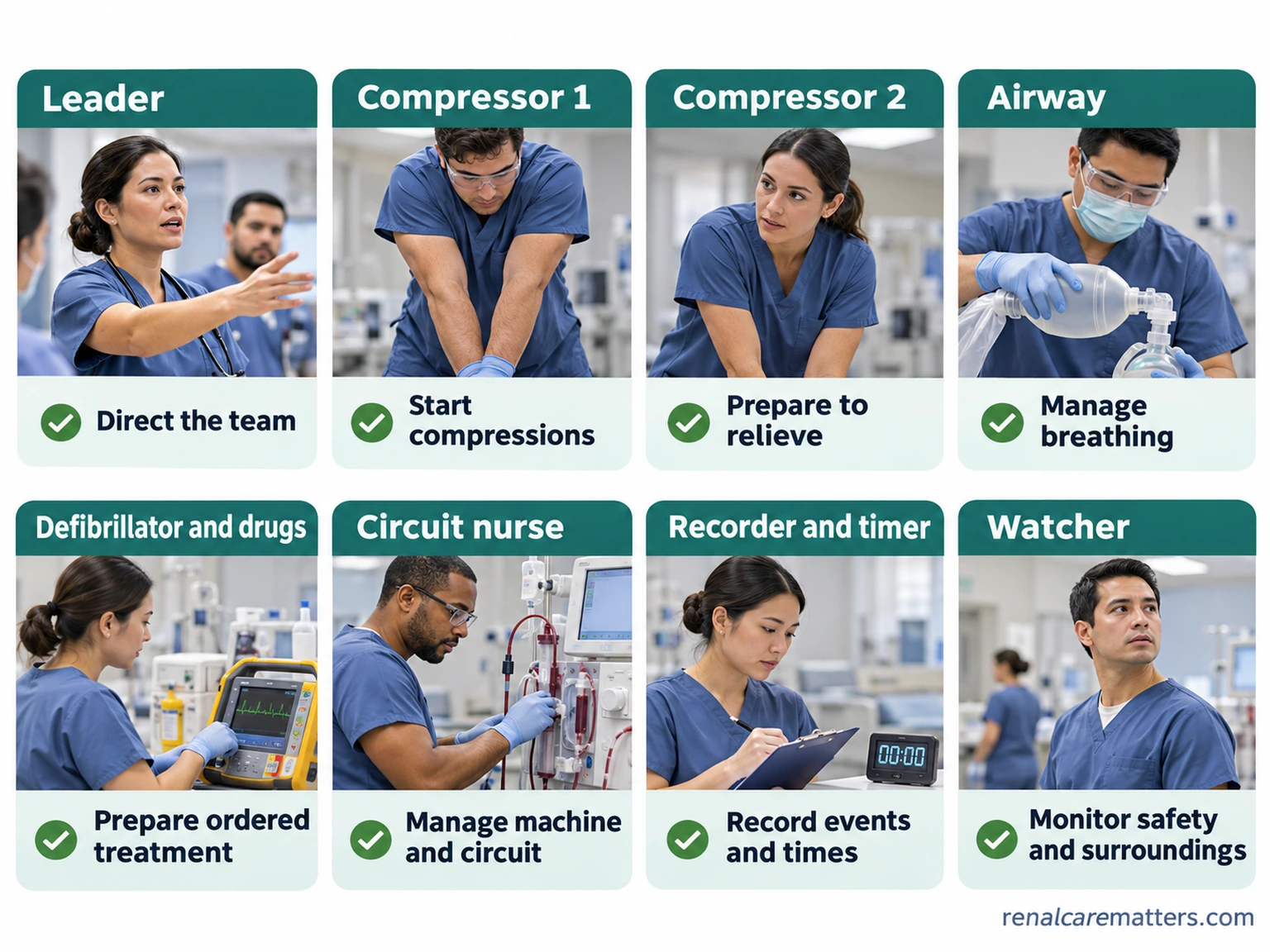
Roles named at the start of the shift (Module 1) are confirmed at the start of the arrest: the leader says them aloud. Small teams combine roles; large teams risk crowding. The leader stays hands-off whenever staffing allows.
Figure 2. Role cards. Small teams combine roles; the leader stays hands-off when there are enough people.
Team size
Roles
3 staff
Leader + defibrillator and drugs; compressor + airway (swapping every 2 minutes); circuit nurse + recorder. Watcher: called from another area
5 to 6 staff
Leader; two compressors (one also airway); defibrillator and drugs; circuit nurse then recorder; watcher
8 or more
Every role separate; extra staff wait outside the circle until called; the watcher never joins
Leadership handover
When the physician-on-duty, the attending nephrologist or a hospital code team arrives, two leaders giving orders at once is a known source of error. The arriving clinician asks for a 15-second summary (time down, rhythms, shocks, drugs and times, circuit status, suspected cause), then says aloud: “I am taking the lead.” The previous leader confirms: “You have the lead,” and takes a named role.
RememberThe leader names roles aloud. When a new leader arrives: summary, “I am taking the lead,” “You have the lead.” One voice gives orders.
Lesson · part 2
Closed-loop orders and the recorder’s timeline
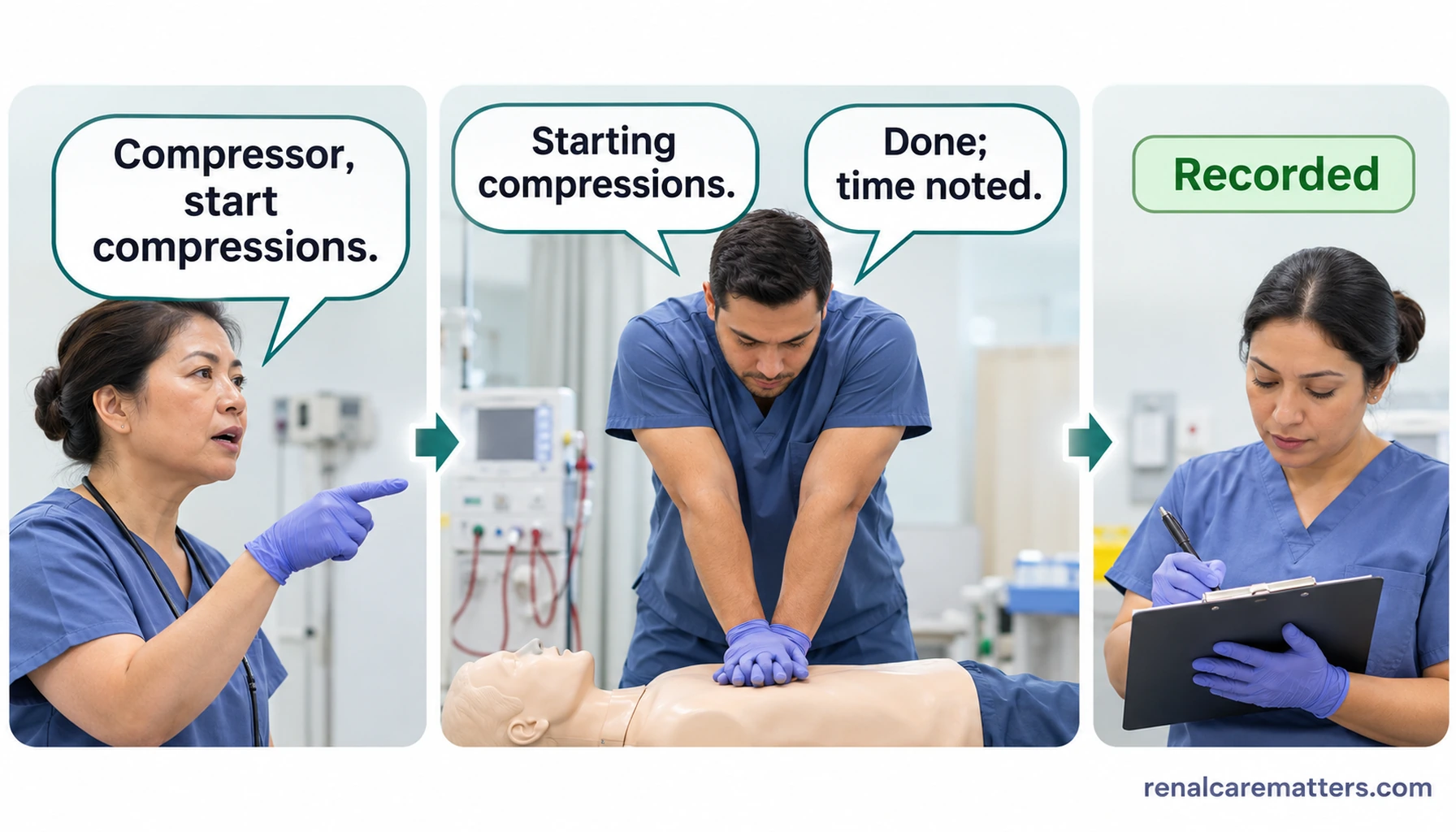
Most medication errors in resuscitation come from orders that nobody owned: said to the room, heard by two people, or by nobody. Closed-loop communication fixes this with three parts: an order to a named person, a read-back, and a report when done.
Recorder writes the time and calls the next dose due: “Next epinephrine due 10:47.”
The recorder is not a passive scribe. The recorder keeps the clock, calls the two-minute checks and drug intervals, and keeps the timeline that the debrief and the handover depend on. In the case, the doubled epinephrine dose is the predictable result of orders given to the room, without a recorder calling the last dose. The facilitator recorder in the Megacode Practice Lab produces a timestamped timeline in drills.
RememberEvery order: a name, a read-back, a “done” with the time. The recorder keeps the clock and calls what is due next.
Lesson · part 3
Code status, families, and dignity
The 2025 American Heart Association (AHA) ethics chapter discusses advance directives and shared decision-making, decisions to start, withhold or stop resuscitation, cultural and religious considerations, family presence, and the effect of resuscitation on families and staff.1 For a dialysis unit, the practical work happens before the emergency.
Before
During
After
Ask about goals of care at admission and at changes; document code status where the night shift and the charge nurse can see it
Follow a documented decision; if none exists, start CPR
Tell the family in plain words, early, in a private space
Involve the attending nephrologist and the family in decisions about CPR for patients with very poor prognosis
Offer the family a supported chance to be present, if your unit allows it, with one staff member beside them
Offer the family time with the patient and the social worker
Check advance directives and the Philippine legal context with your facility’s policy
Never debate code status at the chair while CPR is needed
Document what was said and who said it
In the Philippines, the legal standing of advance directives and do-not-resuscitate orders is set by facility policy and evolving law; this course does not give legal advice. What it does say is practical: a code status decision made calmly, with the patient and family and the attending nephrologist, protects everyone from an impossible decision at the worst moment. In the case, the daughter waited alone; a staff member could have stayed with her, told her what was happening, and, if unit policy allowed, offered her a supported place in the room.
RememberSettle code status before the emergency, follow a documented decision, and never leave a family alone during a resuscitation.
Lesson · part 4
The debrief, the three reports, and the practice system
A debrief is not a search for someone to blame. It is the cheapest system fix available: ten minutes, while memories are fresh, to find what delayed care and who will change it. Structured debriefing after simulation is associated with better learning outcomes than no debriefing, in a meta-analysis of simulation studies.2
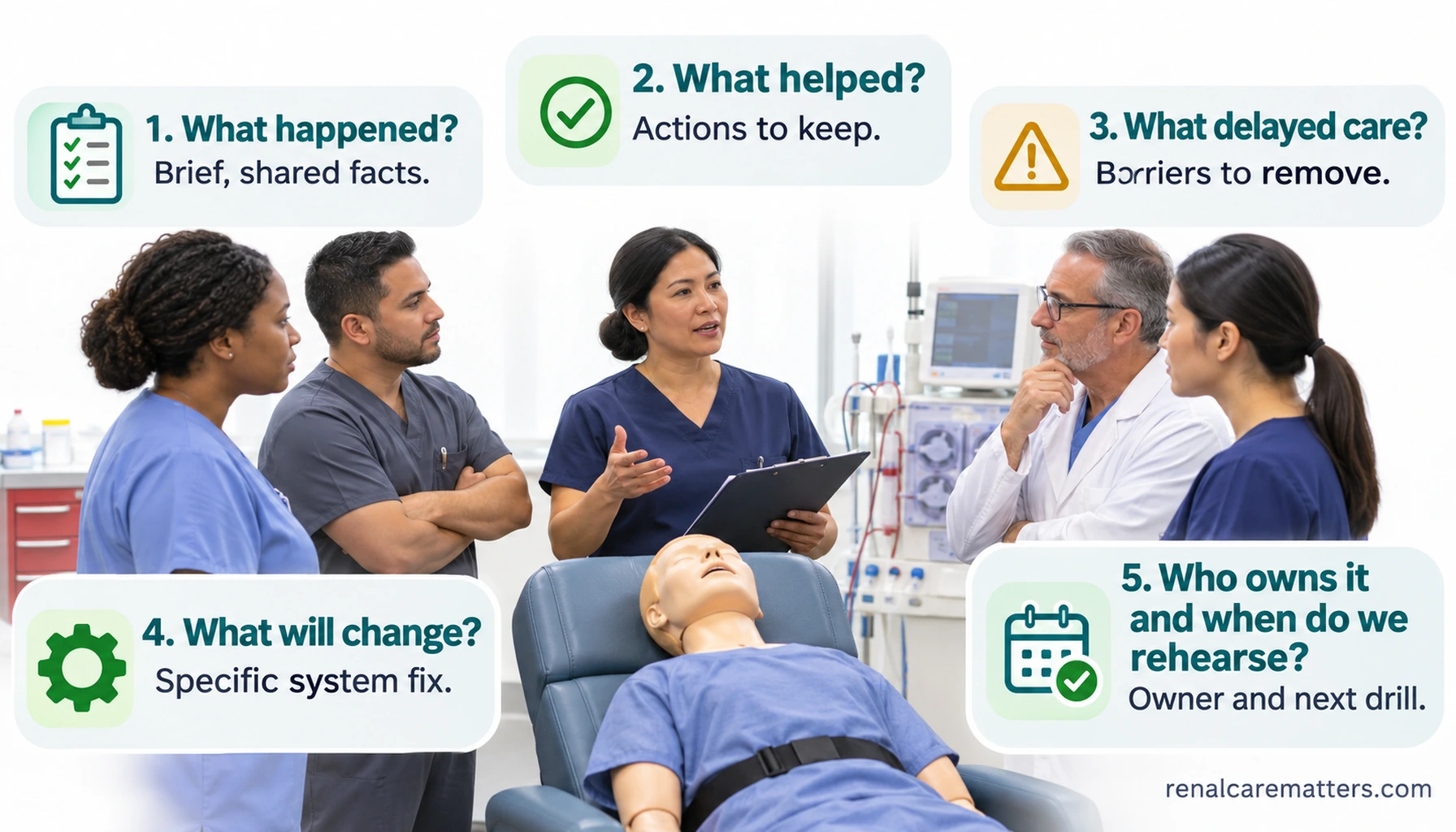
Figure 4. The five-question debrief turns a drill or a real event into a system fix.
Figure 5 · The five-question debrief
What happened?A short factual timeline from the recorder’s sheet.
What helped?Name the actions that worked, so they are repeated.
What delayed care?Equipment, communication, roles, information. Systems, not personalities.
What will change?One to three concrete changes.
Who owns it, and when do we rehearse?A name and a date for each change, and the next drill.
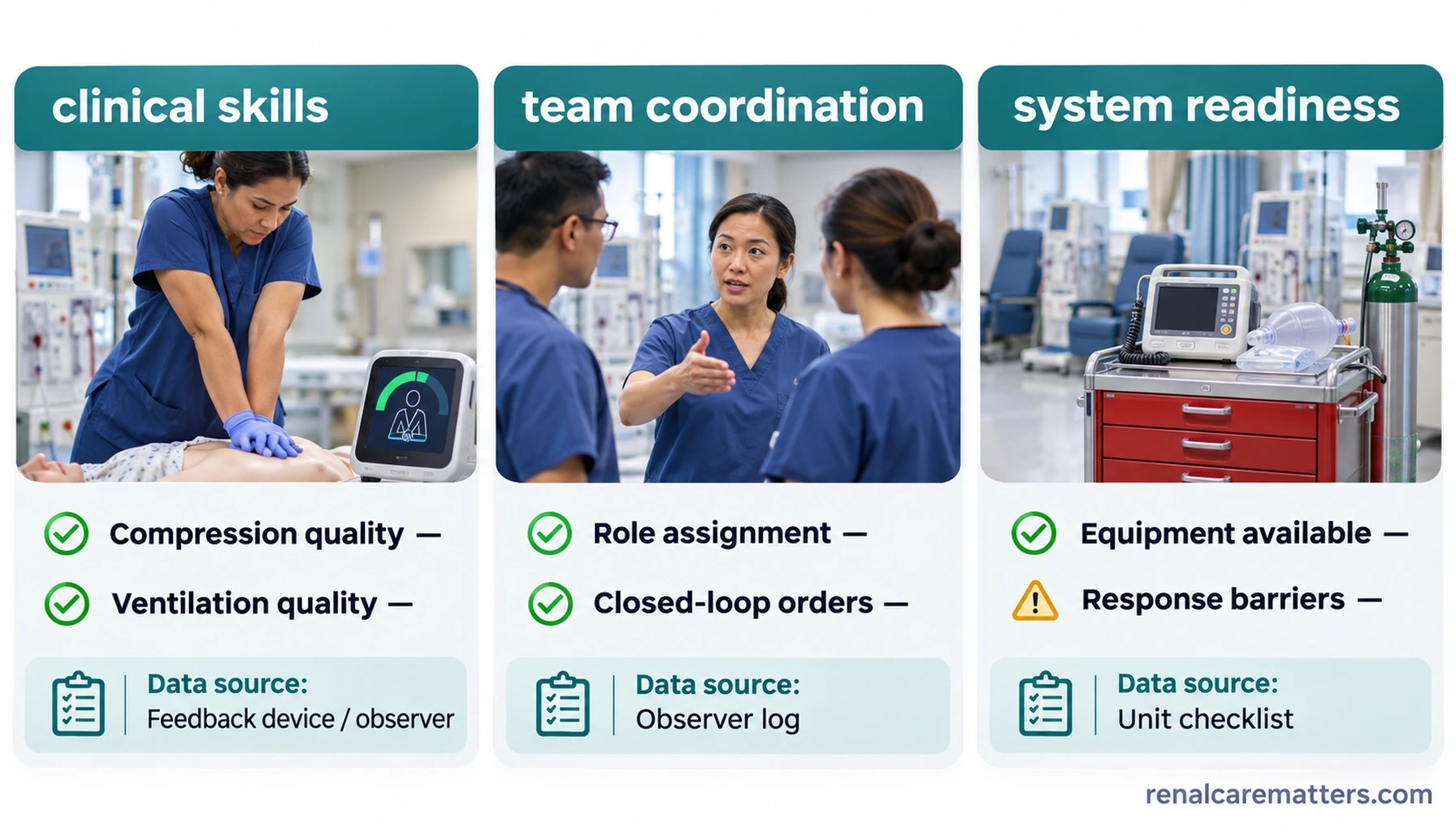
Three reports, never one score
Performance after a drill is reported in three parts: clinical skills (recognition, time to first compression, pads, first shock, drug timing, ROSC check), team coordination (roles named, closed-loop orders, leadership handover, watcher kept, handover complete), and system readiness (cart in place, defibrillator charged, oxygen full, numbers posted, ambulance called on time). Each report states its data source: a feedback device, a defibrillator download, observer timestamps, or participant entry. Browser buttons cannot measure compression depth or ventilation quality. The megacode timeline analyzer computes the times from a recorder log.
Figure 6. Three reports, never one blended score. Each states where its numbers came from.
Safety-critical errors (compressions not started, a shock while someone touches the patient, contaminated blood returned, an adult dose given to a child, an access left open) require coached repeat practice even when the overall score is high. Pass marks the unit sets for itself are educational standards, not validated measures of competence. There are no public individual rankings.
How often to practice
Spaced practice is at least as effective as one long session: a 2026 systematic review of 15 comparative studies found spaced simulation training generally as effective as massed training, with some advantage for retention, and no study of patient outcomes.3 A 2024 International Liaison Committee on Resuscitation (ILCOR) review of nine simulation studies found that rapid cycle deliberate practice shortened simulated time to defibrillation and epinephrine, at very low certainty and with no patient outcomes.4 Neither defines the best interval for a dialysis unit. This course proposes onboarding, a weekly five-minute refresher, a monthly short drill, a quarterly integrated megacode and a targeted rehearsal after any real event; that cadence is an Academy teaching choice.
RememberDebrief every drill and every real event in five questions, report skills, teamwork and systems separately, and practice little and often.
Stop and callAfter any real resuscitation, the charge nurse arranges a debrief the same day and reports system findings to the head nurse and the Dialysis Clinical Head. Follow your unit protocol for incident reporting, and always inform the attending nephrologist.
On the floor
Real situations: problems and solutions
These are fictional but typical. For each one, cover the answer, decide what you would do, then compare. Where a step depends on local rules, your unit’s procedure and your supervisor’s direction come first.
“We did our best”
What you see
After a long arrest, staff want to skip the debrief to avoid blame.
What is likely going on
Fear of blame is blocking learning.
What to do
Run a ten-minute, systems-only debrief with the five questions; state the no-blame rule aloud.
Why it matters
Most fixable problems are system problems.
The code status nobody could find
What you see
During an arrest, a nurse remembers the family once said “no machines,” but nothing is documented.
What is likely going on
Code status was discussed but not recorded.
What to do
Start CPR (no documented decision), inform the attending, and make code-status documentation part of admission review.
Why it matters
Decisions must be findable at 3 a.m.
Too many helpers
What you see
Ten staff crowd one chair during an arrest; the leader cannot see the monitor.
What is likely going on
Crowding hides the team’s view and blocks the circuit nurse.
What to do
The leader names roles and sends extra staff outside the circle until called.
Why it matters
More hands are not always more help.
Field notes
Laminate the five debrief questions on the back of the code record sheet.
Put each drill’s action list, owners and dates on the staff notice board.
Case review
Back to the case: The debrief nobody wanted
Debrief now, without blame. Yes, briefly, the same day. Ms. Bernardo sets the rule aloud: “We are looking at our system, not at people.” She uses the five questions and the recorder’s sheet. Ten minutes is enough. The senior nurse’s fear of blame is the reason to structure the debrief, not a reason to skip it.
System problems and owners. Conflicting orders: no leadership handover script; owner, the Dialysis Clinical Head, who adds the “I am taking the lead” script to the unit protocol and the next drill. The doubled epinephrine: orders given to the room and no recorder calling doses; owner, the head nurse, who makes the recorder role and closed-loop orders part of every drill. The watcher pulled into compressions: owner, the charge nurse, who adds “the watcher never joins” to the shift huddle. Each change gets a date and a rehearsal.
The daughter. A staff member, or the social worker, should have stayed with her, told her what was happening in plain words, and offered her a supported chance to be present if unit policy allowed. Afterward she should hear from the leader or the attending nephrologist, privately, before she hears it from anyone else.
Interactive case · fictional
Interactive case: The debrief nobody wanted
Work through a shift one decision at a time. The panel at the top changes with what you choose. After each choice you see why it is, or is not, the best move; after a weaker one you can try again or carry on and see where it leads. Your first choice at each step is scored. The score stays on this device and nothing is sent anywhere. In real practice, your unit’s protocol and the people responsible for each decision come first.
Skills lab · with your preceptor
Skills checklist: Team leadership and debrief
Lead a facilitated megacode with role assignment and a leadership handover, then lead the debrief while a supervisor observes. Your preceptor rates each step as satisfactory, needs practice, or not observed. Steps marked Critical must all be satisfactory before sign-off. This checklist supports supervised learning; your unit’s own procedure and competency form are the authority. A printable version of every checklist is on the trainer page.
CriticalNames every role aloud at the start of the arrest, combining roles safely for the team size.
CriticalUses closed-loop orders for every drug and shock.
Performs a leadership handover with a summary and the explicit words.
CriticalKeeps the watcher out of the arrest.
Checks code status before or during the event per protocol and assigns a staff member to the family.
CriticalLeads a five-question debrief focused on systems, ending with owners and dates.
Reports clinical, team and system findings separately, with data sources.
Placement activity. Facilitate one monthly drill in your unit using the facilitator recorder, and present the three reports and the action list at the staff meeting.
Self-assessment
Check your understanding
Each visit draws 5 questions at random from this module’s 10-question bank. Choose the single best answer for each, then select Check answers; an explanation appears under the best answer. Select New set of questions for a different mix. A good target is 4 of 5 on two different sets. Nothing you select is sent anywhere; scoring happens in your browser.
Elmer, J., Atkins, D. L., Daya, M. R., Del Rios, M., Fry, J. T., Henderson, C. M., Lewis-Newby, M., Madrigal, V. N., Marco, C. A., Ornato, J. P., Paquette, E. T., Parnia, S., Rodriguez, A. J., Shapiro, J. P., Schexnayder, S. M., Weiss, E. M., Zientek, D. M., & Idris, A. H. (2025). Part 3: Ethics: 2025 American Heart Association guidelines for cardiopulmonary resuscitation and emergency cardiovascular care. Circulation, 152(16_suppl_2), S323–S352. https://doi.org/10.1161/CIR.0000000000001371
Cheng, A., Eppich, W., Grant, V., Sherbino, J., Zendejas, B., & Cook, D. A. (2014). Debriefing for technology-enhanced simulation: A systematic review and meta-analysis. Medical Education, 48(7), 657–666. https://doi.org/10.1111/medu.12432
Patocka, C., Anderson, I., Brennan, E., Lacroix, L., Pandya, A., Ganshorn, H., & Hall, A. K. (2026). The impact of simulation-based spaced training for skills acquisition on learning and performance outcomes among healthcare professionals: A systematic review. Simulation in Healthcare, 21(4), 241–246. https://doi.org/10.1097/SIH.0000000000000898
Abelairas-Gómez, C., Cortegiani, A., Sawyer, T., Greif, R., Donoghue, A., & International Liaison Committee on Resuscitation (ILCOR) Education, Implementation and Teams (EIT) Task Force. (2024). Rapid cycle deliberate practice approach on resuscitation training: A systematic review. Resuscitation Plus, 18, Article 100648. https://doi.org/10.1016/j.resplu.2024.100648
Educational reviewer and practice resource for dialysis teams. It is not an American Heart Association (AHA) course, it is not BLS, ACLS or PALS certification, and online completion does not establish hands-on competence. Staff certify through an authorized training center. Your unit’s approved protocol, crash-cart stock and machine manufacturer’s instructions govern every real event.