After this module you should be able to
- Explain how oxidizing and aldehyde germicides and heat kill microorganisms in a dialyzer.
- Explain why a germicide must be mixed evenly and tested for potency, using the Centers for Disease Control and Prevention (CDC) outbreak of 1988 as the example.
- Calculate a dilution with C1V1 = C2V2 and state why the result must still be verified.
- Read a safety data sheet (SDS) for hazards, protective equipment and first aid.
- Describe the respiratory and skin risks to staff and the controls that reduce them.
The big picture, in plain words
The picture has a limit. A weak glass of juice is only disappointing. A weak dose of germicide leaves bacteria alive inside the fibers, where they multiply and release endotoxin into the next patient’s blood. A strong dose that is not rinsed away reaches the patient as a chemical. The strength must be right, the same everywhere in the batch, proven by a test, and then removed.
Figure 1 · Key terms for this module
You will never choose the germicide or set its strength; the program and the instructions for use (IFU) do that. Your work is to prepare it exactly, prove it, use it safely, and remove it completely.
Case: The bottom of the container
This case is retold from a CDC investigation.1 In April 1988, a United States hemodialysis center saw nine pyrogenic reactions and five gram-negative bacteremias in 11 patients over about two weeks. Every affected session used a reprocessed dialyzer; none occurred with new dialyzers.
The center reprocessed manually with a 2.5% peracetic acid mixture. Investigators measured germicide strength in stored dialyzers and found it ranged from 0.9% to 4.2%. Dialyzers with strength at or below 1.0% had higher endotoxin. When investigators repeated the technician’s own dilution method, the solution measured 1.4% at the surface of the mixing container and 3.5% at the bottom.
Before reading on, decide:
- Why did some dialyzers hold less than half the intended strength?
- Which single check would have caught the problem before patients were affected?
- What would you change in the mixing procedure?
Keep your answers in mind. The lesson gives you what you need, and the case review near the end shows one sound response.
How germicides kill
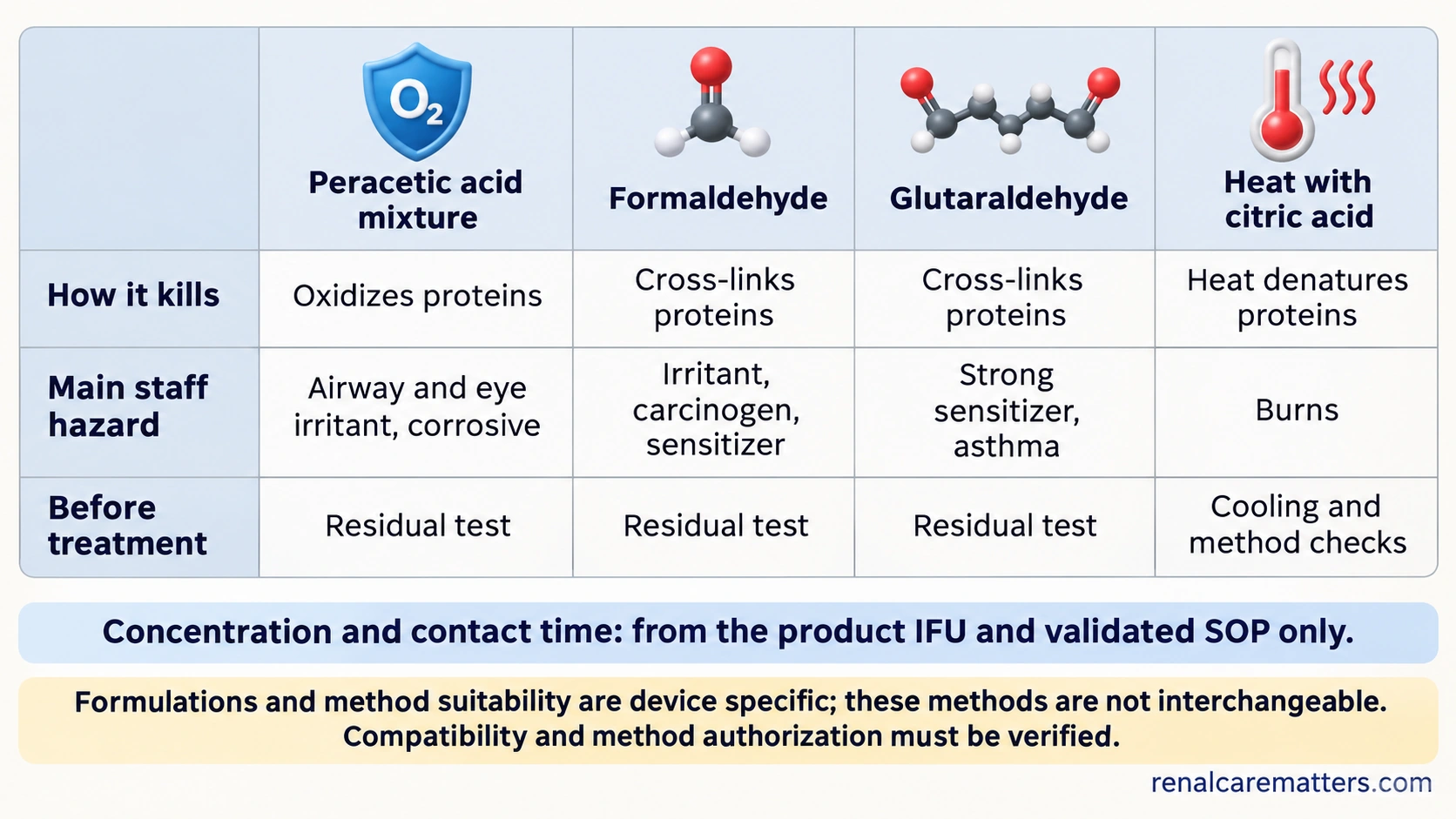
| Method | How it kills | Main hazard to staff | Before the next treatment |
|---|---|---|---|
| Peracetic acid mixture | Oxidizes proteins and cell membranes of microorganisms | Irritates eyes, nose and airways; corrosive to skin | Residual test for the peroxide or acid after rinsing |
| Formaldehyde | Binds and cross-links proteins | Irritant; classified as a human carcinogen; skin sensitizer | Residual formaldehyde test after rinsing |
| Glutaraldehyde | Cross-links proteins | Strong sensitizer; occupational asthma and dermatitis | Residual test after rinsing |
| Heat with citric acid | Heat denatures proteins; citric acid assists | Burns from hot equipment | Cooling and checks set by the method |
The Hemodialysis (HEMO) Study (HEMO) Study used several of these methods, including heated citric acid, and found that the method changed how well middle molecules were cleared.2 The 2012 systematic review found that outcome differences, where seen, varied by germicide.3 So the germicide is a clinical choice, made by the program. Concentrations and contact times differ between products and are taken only from the product IFU and the validated procedure.
Mixing, potency and the 1988 outbreak
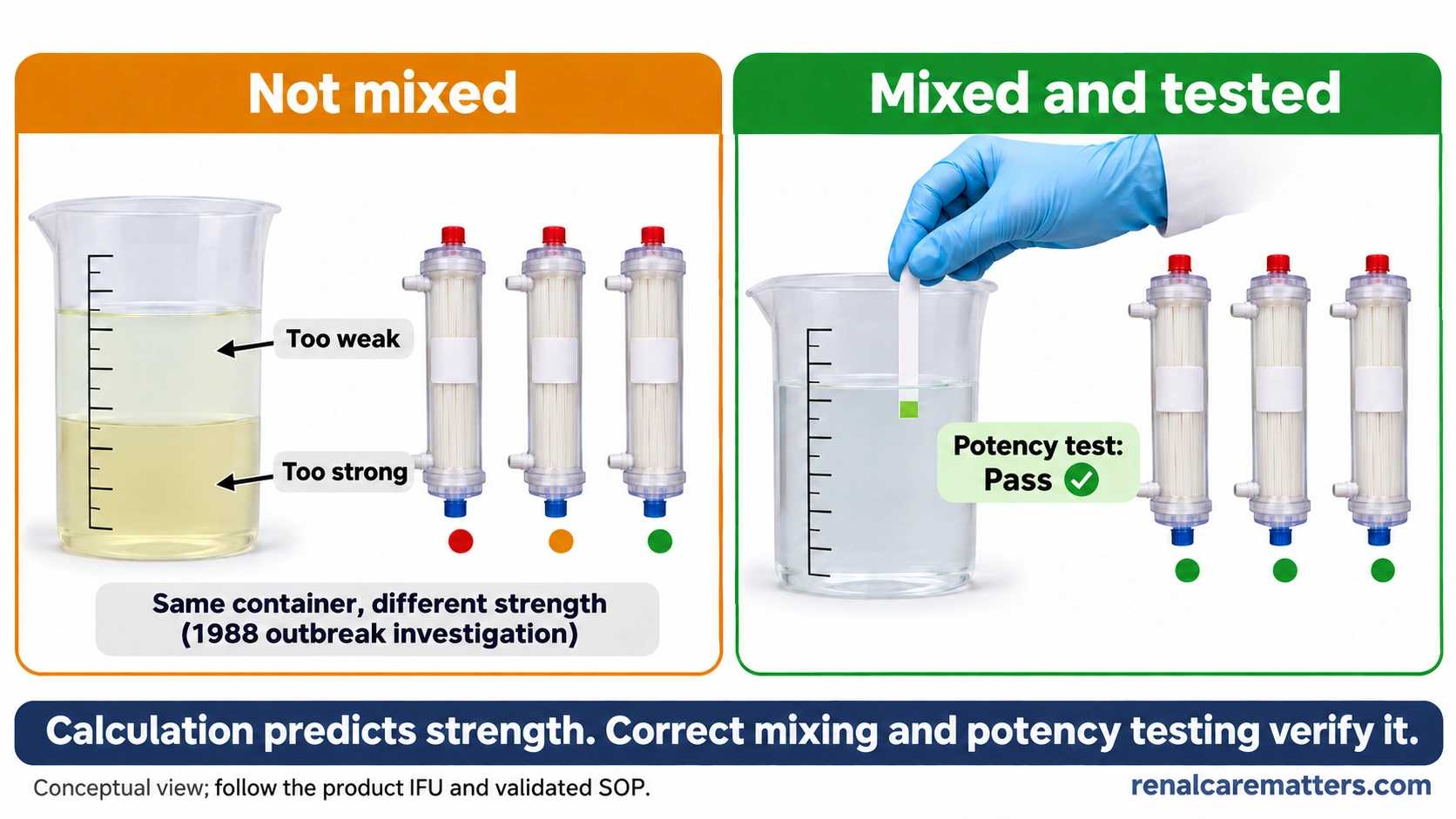
A concentrated germicide is often denser than water. Poured in without enough mixing, it sinks. The top of the container is weak and the bottom is strong. Dialyzers filled from different parts of the batch get different doses. That is what the 1988 investigators found, and weak germicide allowed bacteria and endotoxin to persist in stored dialyzers.1
Automated reprocessors dilute germicide in-line, which reduces but does not remove the risk: a kinked line, an empty concentrate container or a failing pump gives weak germicide too. The defense in every system is the same.
Figure 4 · Preparing and proving the germicide
- Check the productCorrect product, within its expiry date, container intact.
- PrepareExactly as the IFU and standard operating procedure (SOP) direct, including the order of adding concentrate and water and the mixing method.
- Prove the batchPotency test on the prepared solution before use, recorded.
- Prove each dialyzerPresence or potency test on each filled dialyzer as the program directs, recorded.
- LabelBatch preparation time and expiry, if the solution is stored.
The formula tells you how much to measure. It cannot tell you whether the batch is mixed or whether the stock has lost strength in storage. Only the potency test does.
Reading a safety data sheet
Every chemical in the room has an SDS. You do not need to read all of it every day. You need to know where it is and four sections by heart.
| SDS section | What to look for |
|---|---|
| Hazards identification | Pictograms and warnings: corrosive, toxic, sensitizer, carcinogen |
| First-aid measures | What to do for eyes, skin, inhalation and swallowing |
| Exposure controls and personal protection | Ventilation, glove material, eye and face protection, respirator if any |
| Handling and storage; stability and reactivity | Temperature, light, incompatible chemicals |
Protecting your lungs, eyes and skin
Germicide vapor is a staff health problem. The best data come from hospitals using products that contain hydrogen peroxide, peracetic acid and acetic acid for cleaning. In a study of 163 staff, users reported more work-related wheeze and watery eyes than non-users, and workers in the department with the highest air levels had a higher prevalence of watery eyes and more than three times the expected rate of current asthma.4 In a companion study of cleaning staff, eye and airway symptoms were associated with exposure even though measured air levels were below established limits; no full-shift limit for peracetic acid had been set in the United States, and a limit of 0.2 ppm had been proposed by researchers.5 Both were observational studies of cleaning staff, not reuse rooms, but the chemicals are the same.
| Control | How it protects you |
|---|---|
| Closed systems and automated filling | Less open liquid, less vapor |
| Local exhaust ventilation at the work point | Removes vapor before you breathe it |
| Capped containers; spills cleaned promptly with the spill kit | Less evaporation |
| Chemical-compatible gloves, goggles or face shield, gown | Prevents skin and eye contact |
| Reporting symptoms early | Wheeze, cough, eye or skin irritation at work are signals, not inconveniences |
Spills and splashes
Figure 5 · Germicide spill
- ProtectWarn others; keep people away; open ventilation if safe.
- Protective equipmentGloves, goggles and gown before you approach; respirator only if the SDS calls for it and you are fitted.
- ContainUse the spill kit absorbent; never wipe concentrate with a bare cloth.
- DisposeAs the SDS and the waste procedure direct.
- ReportRecord the spill and any exposure.
A splash to the eye is flushed at once at the eye wash, as in Module 4, and followed by the first-aid section of the SDS and a report to occupational health.
Back to the case: The bottom of the container
Why was the strength uneven? The concentrate was not mixed thoroughly into the water. It layered: 1.4% at the surface and 3.5% at the bottom of the same container.1 Dialyzers filled from the weak layer held as little as 0.9%, not enough to stop bacteria growing during storage.
Which check would have caught it? A potency test on the prepared batch, and a presence or potency check on each filled dialyzer. Either would have shown the weak solution before the dialyzers were stored.
What would you change? Follow the IFU’s mixing method exactly, including the order of adding concentrate and water and the mixing time; test the batch every time it is prepared; test each dialyzer as the program directs; and record both. Better still, use a validated automated system and keep the same tests, because machines can dilute badly too.
Skills checklist: Germicide preparation and spill drill
Practice with water and a dye in place of germicide, then with the real product under supervision. Your preceptor rates each step as satisfactory, needs practice, or not observed. Steps marked Critical must all be satisfactory before sign-off. This checklist supports supervised learning; your unit’s own procedure and competency form are the authority. A printable version of every checklist is on the trainer page.
- CriticalChecks product name, expiry and container integrity before use.
- Calculates the volume of concentrate with C1V1 = C2V2 and has the arithmetic checked.
- CriticalPrepares the solution in the order and with the mixing method the IFU sets.
- CriticalPerforms and records a potency test on the batch before use.
- CriticalWears chemical-compatible gloves, eye and face protection and a gown.
- Locates the SDS and reads the first-aid and protection sections aloud.
- CriticalContains and cleans a simulated spill with the spill kit.
- CriticalStates why bleach must never be mixed with acid germicides.
Check your understanding
Each visit draws 5 questions at random from this module’s 12-question bank. Choose the single best answer for each, then select Check answers; an explanation appears under the best answer. Select New set of questions for a different mix. A good target is 4 of 5 on two different sets. Nothing you select is sent anywhere; scoring happens in your browser.
Read next on this site
- Dialyzer Reprocessing and ReuseGermicides used in reprocessing and their risks.