
After this module you should be able to
- Explain why reprocessing water touches the blood side of the dialyzer and must meet dialysis water quality.
- Trace water from the treatment plant to the reprocessing outlet and name the sampling points.
- State the Department of Health (DOH) monitoring schedule and the meaning of a limit and an action level.
- Collect a water sample without contaminating it, and record it correctly.
- Escalate an abnormal result and hold reprocessing when the program requires it.
The big picture, in plain words
The picture has a limit. A bottle’s rinse water touches the outside of what the baby swallows. Reprocessing water fills the blood compartment of the dialyzer, the inside of the fibers where the patient’s blood will flow next treatment. Bacteria and their toxins left there meet the blood directly. So the reuse outlet is treated as a point of use, sampled and protected like a dialysis station.
Figure 1 · Key terms for this module
Your role is not to run the water plant. It is to know where the reuse outlet sits in the system, to sample and record correctly when assigned, to read the logs before you start, and to stop when the evidence says the water is not fit.
Case: Monday morning
At 6:00 on a Monday, Mr. Arnold Mendoza opens the reuse room at a unit in Laguna. Before starting the reprocessor, he checks the water log. The weekly product-water TDS reading taken on Saturday is 14 mg/L. The action limit written on the log is 10 mg/L. Nobody has signed the corrective-action box.
Twenty used dialyzers from Saturday’s last shift are in the refrigerator waiting to be processed. The water technician starts work at 8:00.
Before reading on, decide:
- What does a TDS of 14 mg/L tell you, and what does it not tell you?
- May Mr. Mendoza start processing the twenty dialyzers?
- Who must know, and what record should he make?
Keep your answers in mind. The lesson gives you what you need, and the case review near the end shows one sound response.
Why reprocessing water matters
Water is used to rinse the blood compartment, to clean by reverse ultrafiltration, to dilute germicide, and to rinse germicide out before treatment. Each time, it fills the inside of the fibers. The reprocessing standard of the Association for the Advancement of Medical Instrumentation (AAMI) expects reprocessing water to meet the quality required for dialysis water.1
Outbreak investigations show what happens when it does not. In a Centers for Disease Control and Prevention (CDC) investigation of one United States center, water used to prepare dialysis fluid and to reprocess dialyzers exceeded the allowed bacteria and endotoxin levels; 13 episodes of bacteremia or pyrogenic reaction followed. They were traced to the water and to one machine type that was not heat-disinfected as its maker advised, not to reuse itself, but the same water was filling reprocessed dialyzers.2 In Hanoi, 303 dialysis patients had pyrogenic reactions over nine months; the bacteria found were largely waterborne, and investigators named suboptimal water or reprocessing as the likely cause.3 Most dialysis outbreaks in a CDC review were preventable by adequate water treatment, disinfection and adherence to reprocessing protocols.4
The most severe case was in Caruaru, Brazil, in 1996. Water from a reservoir reached a dialysis center without proper treatment. It carried microcystins, toxins made by blue-green algae. Of 130 patients, 101 developed acute liver failure, and 50 died.5 That center did not reuse dialyzers; the lesson is that water reaches the blood, and anything in it reaches the patient.
From the plant to the reuse outlet
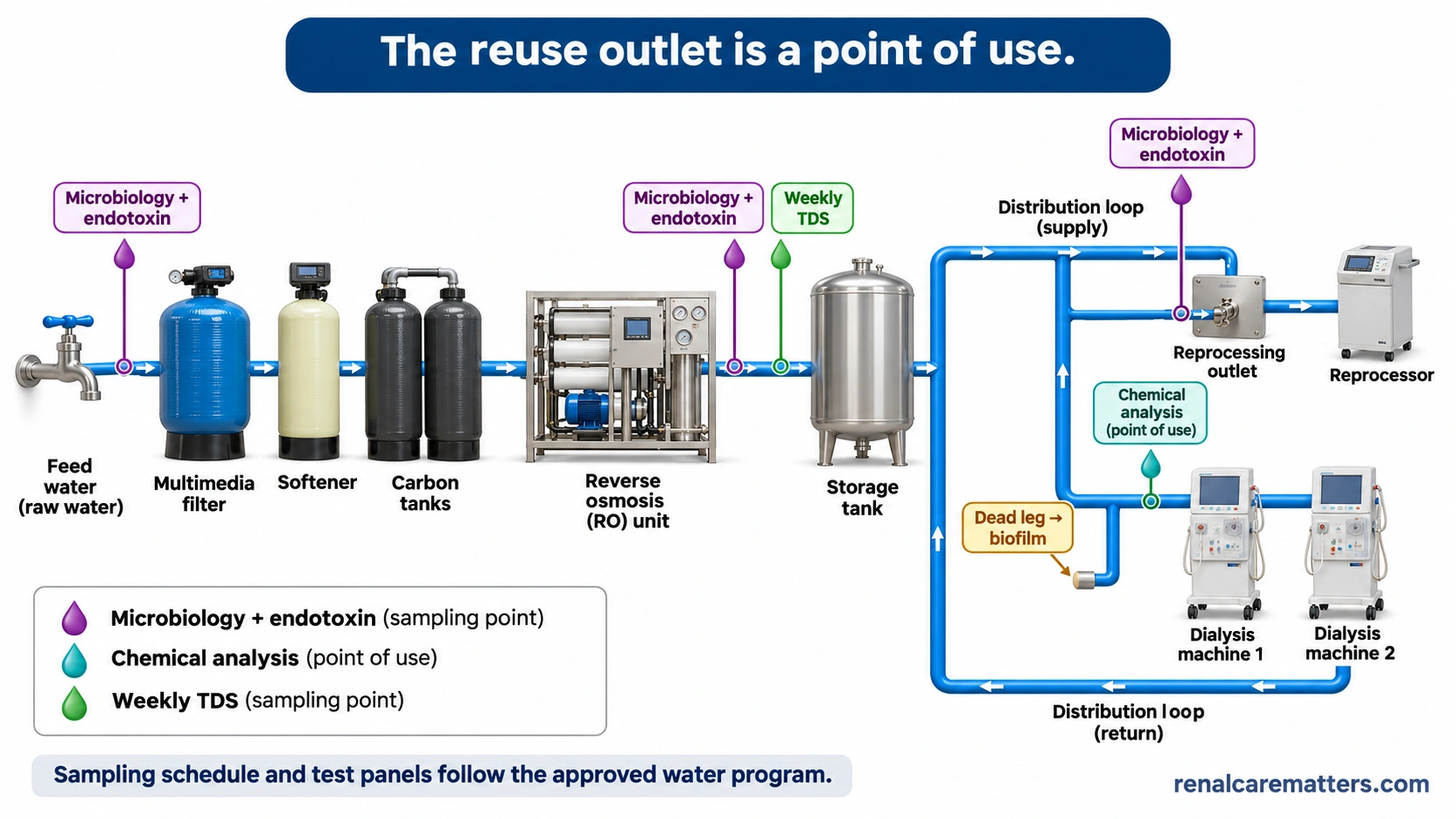
| Stage | What it does | What can go wrong for the reuse room |
|---|---|---|
| Pretreatment (filters, softener, carbon) | Removes particles, hardness and chlorine or chloramine | Exhausted carbon lets chlorine through, which can damage membranes and patients |
| Reverse osmosis | Removes most dissolved solids and bacteria | A failing membrane raises TDS and conductivity |
| Storage and distribution loop | Delivers product water to points of use | Biofilm grows in dead legs and stagnant pipes |
| Reprocessing outlet and hose | Feeds the reprocessor or the manual rinse | Unlabeled outlet, old hose, outlet left running into a sink, contamination at the tip |
The Malaysian 2026 standards, a current regional comparison, require labeled water outlets in the reprocessing area.6 Biofilm, a slimy layer of bacteria on pipe walls, is the usual source of persistent contamination. It shelters bacteria from disinfectant and sheds endotoxin into the water.
The monitoring schedule, limits and action levels
The DOH water order sets the minimum monitoring for licensed facilities.7
| Test | Where | How often (DOH minimum) |
|---|---|---|
| Microbiology | Raw water, product water and point of use | Before operation, then at least monthly |
| Chemical analysis | Point of use | Before operation, then at least every six months |
| Total dissolved solids | Product water | Weekly; corrective action above 10 mg/L |
The order requires stopping and compliant repeat testing when water fails, and makes the medical director accountable for water quality.7 Sampling and transport follow the accredited laboratory’s instructions.
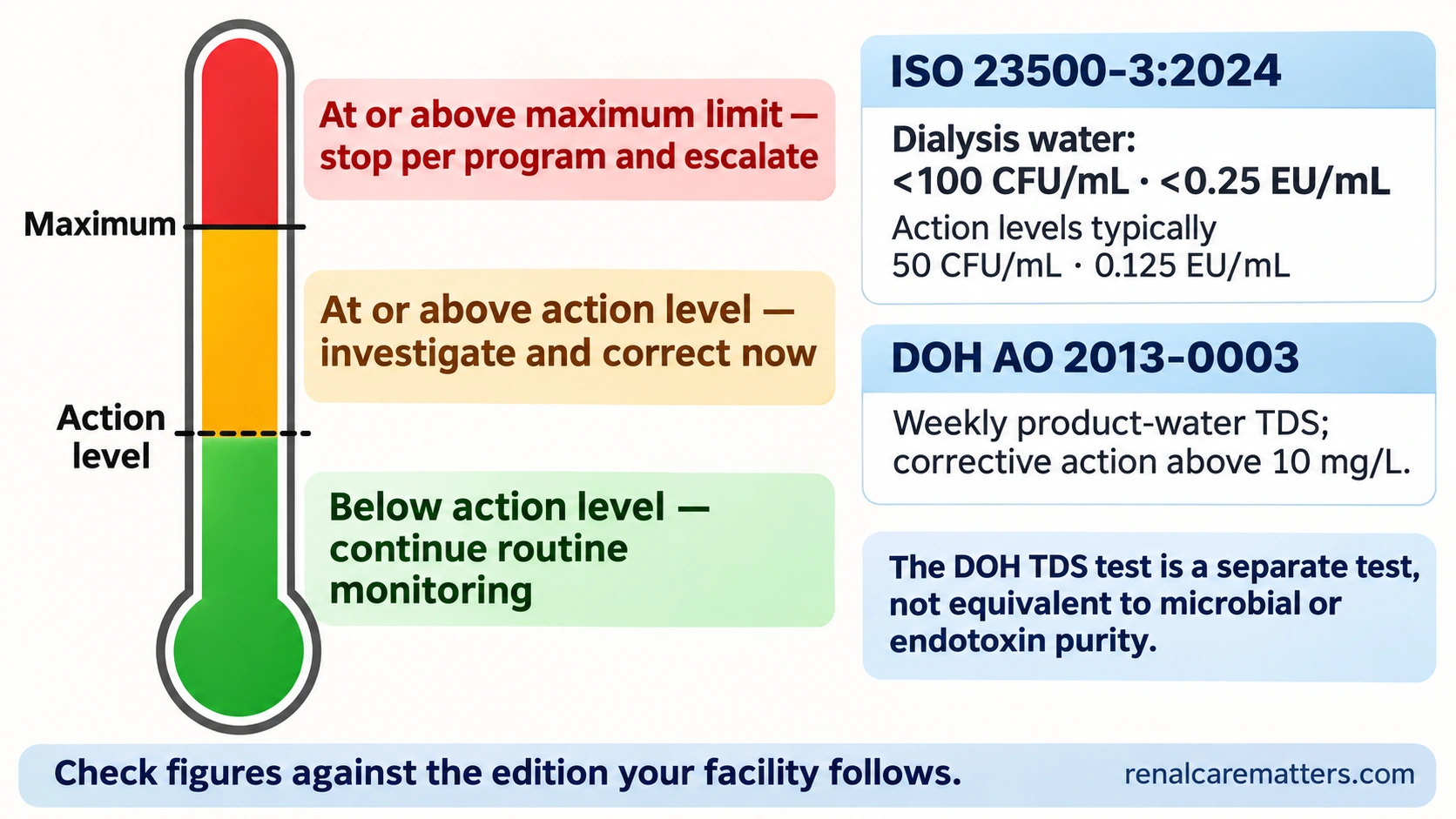
The international standard for dialysis water, International Organization for Standardization (ISO) 23500-3, sets a maximum total viable microbial count of 100 CFU/mL and endotoxin of 0.25 endotoxin units (EU) per mL, with action levels usually set at half those values.8 Check these figures against the edition your facility follows. An action level is a warning: the water still meets the limit, but something is changing, and the time to find it is now.
Collecting a sample that tells the truth
A sample is only as good as its collection. A contaminated bottle reports a false failure; a sample taken after flushing a heavily used outlet for a long time may report a false pass. Follow the laboratory’s instructions for flushing, disinfecting the outlet and bottle handling, because they differ between laboratories and the DOH order allows some local variation.7
Figure 4 · Sampling the reuse outlet
- PrepareSterile bottle from the laboratory, label filled in before sampling, hand hygiene, clean gloves.
- OutletFollow the laboratory’s instructions for disinfecting and flushing the outlet.
- CollectOpen the bottle only at the moment of filling. Do not touch the inside of the cap or the outlet tip.
- Close and labelOutlet name, date, time, collector.
- SendCold chain and timing as the laboratory requires.
- RecordLog the sample and later the result, and who reviewed it.
When a result fails
Figure 5 · What you do with an abnormal water result
Back to the case: Monday morning
What does 14 mg/L tell you? The reverse osmosis system is passing more dissolved solids than it should. A membrane may be failing, or pretreatment may be exhausted. It does not tell you whether bacteria or endotoxin have risen, and it does not by itself say the water is dangerous today. It does say that the corrective action required above 10 mg/L has not been documented.7
May he start? Not until the person responsible for water confirms what was done and whether the water is fit for use. The twenty dialyzers can stay refrigerated within the time your procedure allows; if that time will run out, they follow the procedure for overdue dialyzers (Module 8), and patients receive new dialyzers.
Who must know? The water technician, the head nurse, and the medical director’s designate. He records the time he found the unsigned result, who he told, and the decision. That record protects the patients and him.
Skills checklist: Water sampling and log review
Practice with a sterile bottle on a training outlet, then review a set of synthetic water logs. Your preceptor rates each step as satisfactory, needs practice, or not observed. Steps marked Critical must all be satisfactory before sign-off. This checklist supports supervised learning; your unit’s own procedure and competency form are the authority. A printable version of every checklist is on the trainer page.
- CriticalLabels the bottle with outlet, date, time and collector before opening it.
- Follows the laboratory’s outlet preparation steps.
- CriticalFills the bottle without touching the inside of the cap or the outlet tip.
- CriticalReviews the water log before starting the reprocessor.
- CriticalIdentifies a result at an action level and one above a limit.
- CriticalStops and asks when the log shows an unsigned failure.
- Records who was told and when.
Check your understanding
Each visit draws 5 questions at random from this module’s 12-question bank. Choose the single best answer for each, then select Check answers; an explanation appears under the best answer. Select New set of questions for a different mix. A good target is 4 of 5 on two different sets. Nothing you select is sent anywhere; scoring happens in your browser.
Read next on this site
- Hemodialysis Water Treatment SystemsHow dialysis water is made and monitored.


