After this module you should be able to
- Explain how a dialyzer removes waste and water by diffusion and ultrafiltration across thousands of hollow fibers.
- Explain why clotted or protein-coated fibers reduce the dose of dialysis, and how total cell volume (TCV) estimates open fibers.
- Describe what the Hemodialysis (HEMO) Study showed about clearance as dialyzers are reused.
- Summarize the outcome evidence on reuse and state how strong it is.
- Name the reasons units reuse dialyzers and the limits of each reason.
The big picture, in plain words
The picture has a limit. The straw walls are not just holes. They are a membrane with pores of a designed size, and the blood leaves a thin protein layer on them during every treatment. Germicides and cleaning agents can change that layer and the pores themselves. So a reused dialyzer is not the same dialyzer it was on day one, and the patient’s dose can drift without anyone seeing it.
Figure 1 · Key terms for this module
Your work is not to calculate the dose; that belongs to the nurse and the nephrologist. Your work is to return a dialyzer whose fibers are open, whose membrane is intact, and whose history is complete, so that the dose the nephrologist prescribes is the dose the patient receives.
Case: The fourth use
Mrs. Corazon Villaflor, 58, dialyzes three times a week at a unit in Pampanga. Her dialyzer is reused under the unit’s program. Over two months, the nurse notices that her monthly adequacy result has drifted down, although her blood flow, session time and dialyzer type have not changed.
The reprocessing technician, Mr. Rommel Pangilinan, pulls the records. Her dialyzers have tended to come back with partly clotted headers. Their volume results have been passing, but each one lower than the last: 92%, 88%, 84%, 81% of baseline by the fourth use.
Before reading on, decide:
- How can a dialyzer that passes every test still deliver less dialysis?
- What does the research say about clearance as dialyzers are reused?
- What should Mr. Pangilinan report, and to whom?
Keep your answers in mind. The lesson gives you what you need, and the case review near the end shows one sound response.
How a dialyzer cleans blood

A dialyzer is a plastic cylinder packed with thousands of hollow fibers. Blood enters one end, flows through the inside of the fibers, and leaves the other end. Dialysis fluid flows around the outside of the fibers in the opposite direction, which keeps the concentration difference high along the whole length.
Two processes do the work. In diffusion, small waste molecules such as urea move from the blood, where they are concentrated, into the dialysis fluid, where they are not. In ultrafiltration, pressure pushes water out of the blood, and some solutes are carried with it. Both depend on surface: the more open fiber wall the blood touches, the more waste crosses.
| What happens to the fibers | Effect on the dialyzer | What you may see in the room |
|---|---|---|
| Clot blocks some fibers | Less surface; small-molecule clearance falls | Dark streaks in the bundle; clot in the header; lower TCV |
| Protein coats the inner wall | Larger molecules pass less easily | Usually nothing visible |
| Germicide or bleach alters the membrane | Pores may tighten or widen, depending on membrane and method | Nothing visible; only measured clearance shows it |
| A fiber breaks | Blood and dialysis fluid can mix | A failed integrity test |
What reuse does to the dose
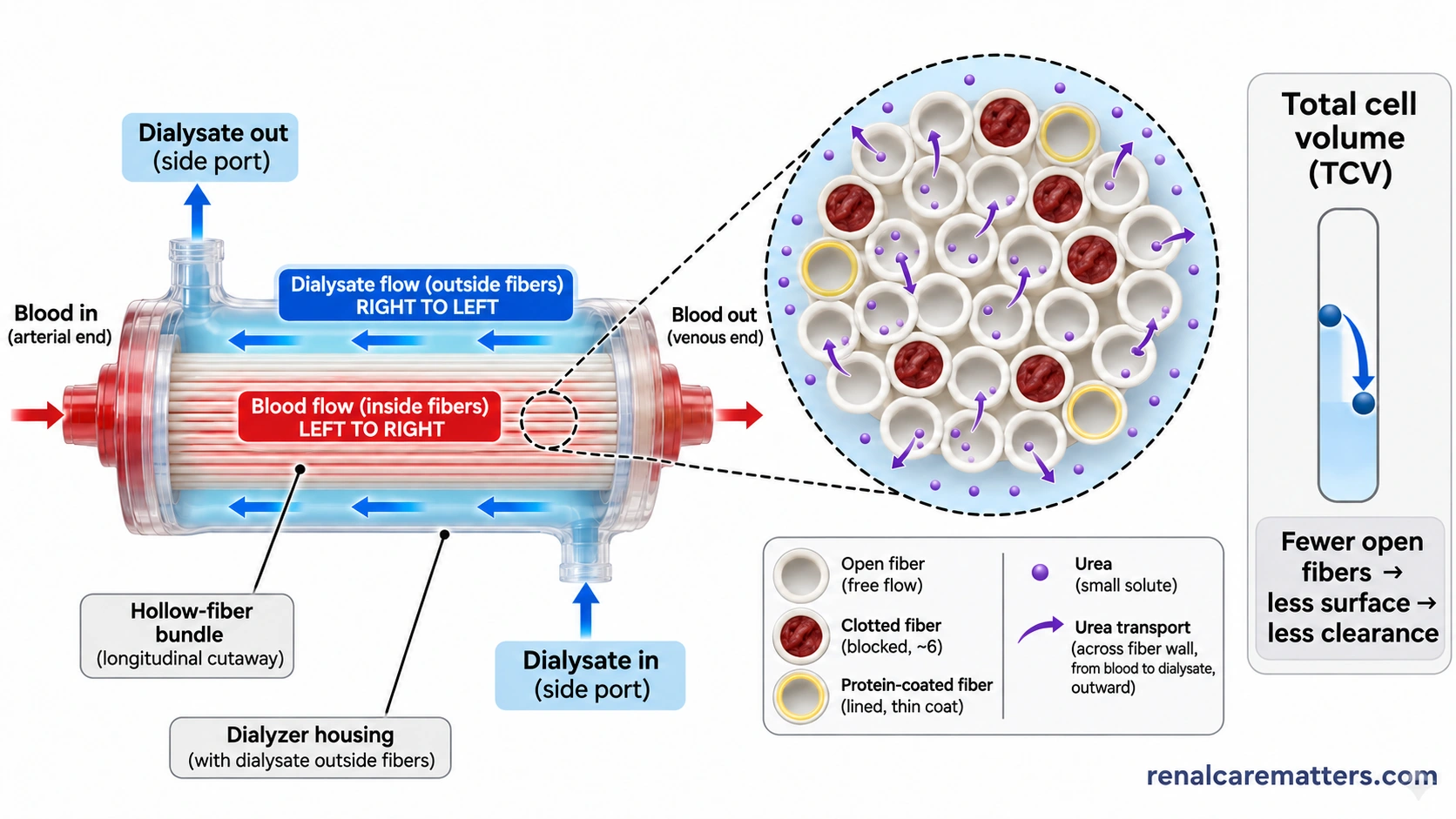
The best measurement study comes from the HEMO Study, a large United States trial. Cheung and colleagues measured clearance in dialyzers reprocessed with several germicides and methods. Urea clearance fell by about 1% to 2% for every ten reuses, whatever the membrane or method. Clearance of beta-2-microglobulin, a middle molecule, fell, stayed the same, or rose substantially, depending on the membrane material and the reprocessing technique.1 The study measured clearance, a surrogate; it did not measure how patients felt or lived.
Smaller studies show why the floor matters. In one crossover study, the blood-compartment volume of dialyzers fell between the first and second use with standard heparin.2 In another, adjusting heparin doses improved measured urea clearance without changing the measured blood-compartment volume.3 Clotting during treatment closes fibers; the reuse room only measures what the floor sends.
New membranes are still being studied. A 2025 study from Thailand reused super high-flux dialyzers with peracetic acid up to 15 times in five patients. Beta-2-microglobulin clearance was similar at the first and fifteenth use, but removal of two larger or protein-bound toxins fell, and albumin leakage into the dialysis fluid dropped sharply after the first use.4 The study was very small; it suggests that reuse affects different toxins differently, not that 15 reuses are safe.
Does reuse change how patients do?
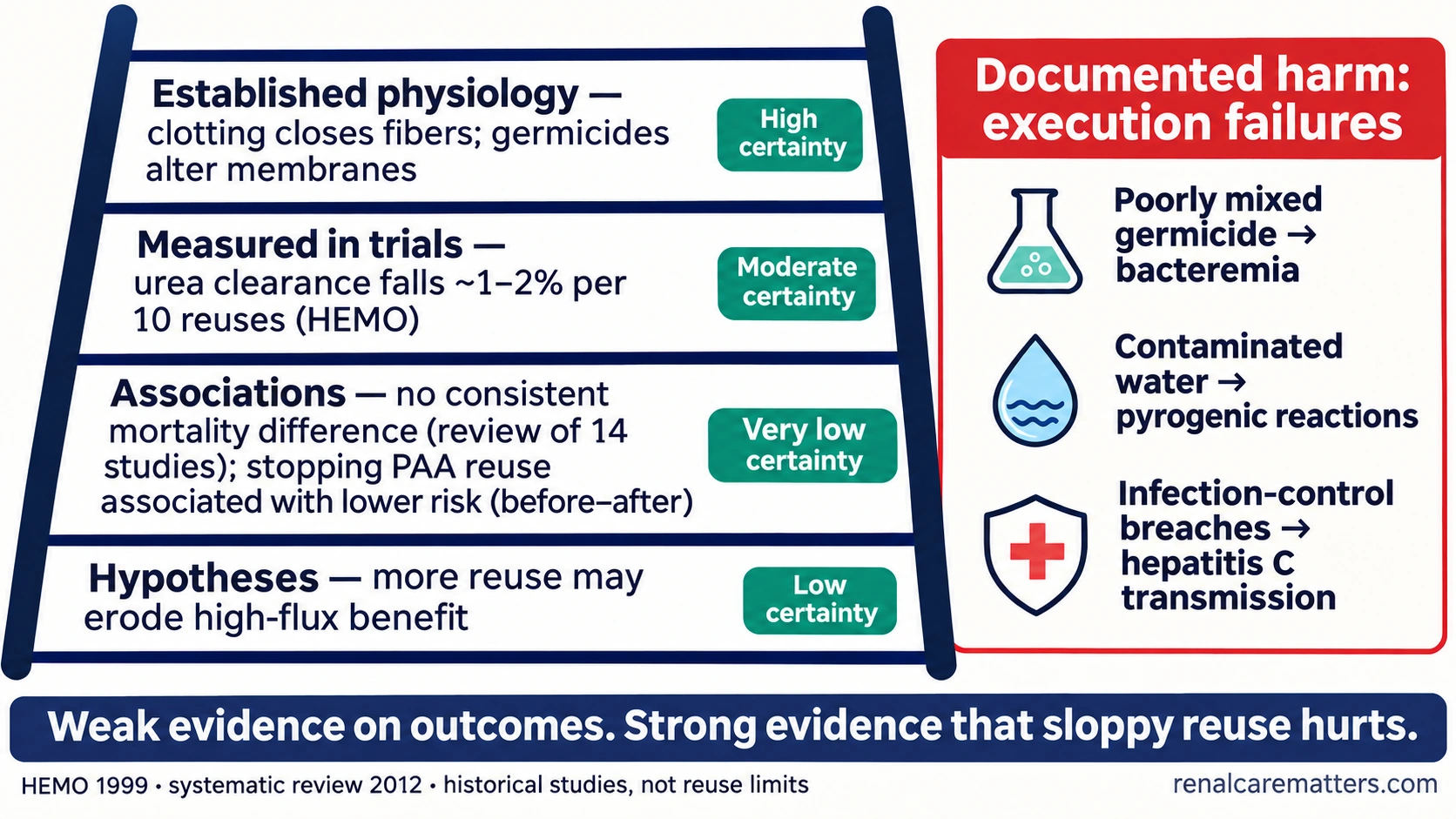
No randomized trial has compared reuse with single use on outcomes that patients feel. What exists is observational, and it points in different directions.
| Study | Design and size | Finding | What it cannot show |
|---|---|---|---|
| Galvao and colleagues, 2012 | Systematic review of 14 studies, 956,807 patients; evidence graded very low quality | No consistent difference in death between reuse and single use; differences varied by germicide, period and unit5 | That reuse is safe, or unsafe |
| Lacson and colleagues, 2011 | 23 facilities that stopped peracetic acid reuse, before and after | Single use was associated with lower death risk (adjusted hazard ratio 0.74) and lower C-reactive protein (CRP), an inflammation marker6 | Cause and effect; other changes over time may explain it |
| Bond and colleagues, 2011 | Large provider; instrumental-variable and propensity analyses | No difference in death; 13.8 million dialyzers and about 10,000 metric tons of waste avoided7 | Safety of a poorly run program |
| Argyropoulos and colleagues, 2015 | Secondary analysis of HEMO | The survival advantage of high-flux dialyzers seen with little reuse reversed with extensive reuse8 | A safe maximum number of reuses |
Reviewers disagree on what to make of this. One editorial argued that cheap biocompatible membranes weaken the case for reuse;9 another weighed safety against cost and waste in settings where cost still decides access.10 The honest summary: outcome evidence is weak in both directions. The harms that are well documented, covered in Modules 4 to 6, came from failures of execution.
Why units reuse, and the limits of each reason
| Reason | What is true | The limit |
|---|---|---|
| Cost | A reused dialyzer spreads its price over several treatments. Philippine Health Insurance Corporation (PhilHealth)’s package allows up to five uses per dialyzer.11 | Savings never justify keeping a dialyzer that fails a gate. |
| Waste | Reuse cuts plastic waste; one provider avoided about 10,000 metric tons.7 Dialysis is among the most resource-intensive therapies.12 | Reprocessing uses water and chemicals; the net environmental effect has not been measured well. |
| First-use reactions | Older cellulose membranes caused reactions on first use that reuse reduced. | Modern synthetic membranes rarely cause them, so this reason has largely faded.9 |
Back to the case: The fourth use
How can a passing dialyzer deliver less? A volume result of 81% still meets the 80% floor, but it means about a fifth of the blood compartment is gone, mostly from closed fibers. Less open surface means less urea crosses. The HEMO data also show that clearance falls a little with reuse even when volume is kept.1
What does the research say? Urea clearance falls slightly with reuse; middle-molecule clearance depends on membrane and method. Outcome studies are observational and inconsistent.
What should Mr. Pangilinan report? The trend, with the dialyzer numbers and dates: falling volumes and repeated header clots. He reports to the head nurse and the nurse caring for Mrs. Villaflor, who will tell the nephrologist. The fix may be on the floor, in heparin or end-of-treatment rinsing, not in the room. Whether to change her dialyzer or limit its uses is the nephrologist’s decision.
Skills checklist: Reading a dialyzer and its history
Use a cut-open training dialyzer and a set of synthetic processing records. Your preceptor rates each step as satisfactory, needs practice, or not observed. Steps marked Critical must all be satisfactory before sign-off. This checklist supports supervised learning; your unit’s own procedure and competency form are the authority. A printable version of every checklist is on the trainer page.
- CriticalIdentifies the blood ports, the dialysate ports, the headers and the fiber bundle.
- Explains diffusion and ultrafiltration in one sentence each.
- CriticalRecognizes clot in a header and dark streaks in a fiber bundle.
- CriticalCalculates retained volume for three records and identifies a falling trend that still passes.
- States what the outcome evidence on reuse does and does not show.
- Names the people who receive a trend report and what they may decide.
Check your understanding
Each visit draws 5 questions at random from this module’s 12-question bank. Choose the single best answer for each, then select Check answers; an explanation appears under the best answer. Select New set of questions for a different mix. A good target is 4 of 5 on two different sets. Nothing you select is sent anywhere; scoring happens in your browser.
Read next on this site
- Dialysis AdequacyHow the dose of dialysis is measured.
- Green Nephrology 2026 — How Sustainable Kidney Care Begins Before DialysisThe environmental footprint of dialysis.