After this module you should be able to
- Calculate retained total cell volume (TCV) against the dialyzer’s own baseline, and hold when the baseline is missing or implausible.
- Explain what the integrity (pressure-hold) test detects, and why a passing volume cannot compensate for a failed integrity test.
- Inspect a processed dialyzer and name the findings that reject it.
- Apply every acceptance gate independently: identity, eligibility, uses left, inspection, volume, integrity, processing record.
- Repeat a test only as the validated procedure allows, keep every result, and escalate inconsistent results.
The big picture, in plain words
The picture has a limit. A buyer can choose to accept a small fault. A technician cannot trade one result against another, because each test looks at a different danger. The volume test asks whether enough fibers are open to deliver the dose. The integrity test asks whether any fiber is broken, which would let blood and dialysis fluid mix. A dialyzer with perfect volume and a broken fiber is a dangerous dialyzer.
Figure 1 · Key terms for this module
Your job is to measure honestly, apply every gate independently, and let one failure stop the dialyzer.
Case: Seventy-nine and eighty
It is 4:40 on a Friday afternoon at a unit in Davao. Ms. Grace Alcantara is finishing the day’s run. The unit floor for retained TCV is 80%, from the Philippine Health Insurance Corporation (PhilHealth) quality circular and the program.1
Dialyzer RU-0731 has a baseline of 100 mL and a measured volume of 79 mL. Dialyzer RU-0732 has a baseline of 100 mL and a measured volume of 86 mL, but its pressure-hold test failed. Dialyzer RU-0733 shows a measured volume of 104 mL against a baseline of 98 mL. A colleague suggests running RU-0731 again “until it passes,” and says RU-0732 is “fine, the volume is great.”
Before reading on, decide:
- What is the retained TCV of each dialyzer, and what does each result mean?
- Can the good volume of RU-0732 make up for its failed pressure test?
- When is a repeat test legitimate?
Keep your answers in mind. The lesson gives you what you need, and the case review near the end shows one sound response.
Measuring against a defensible baseline
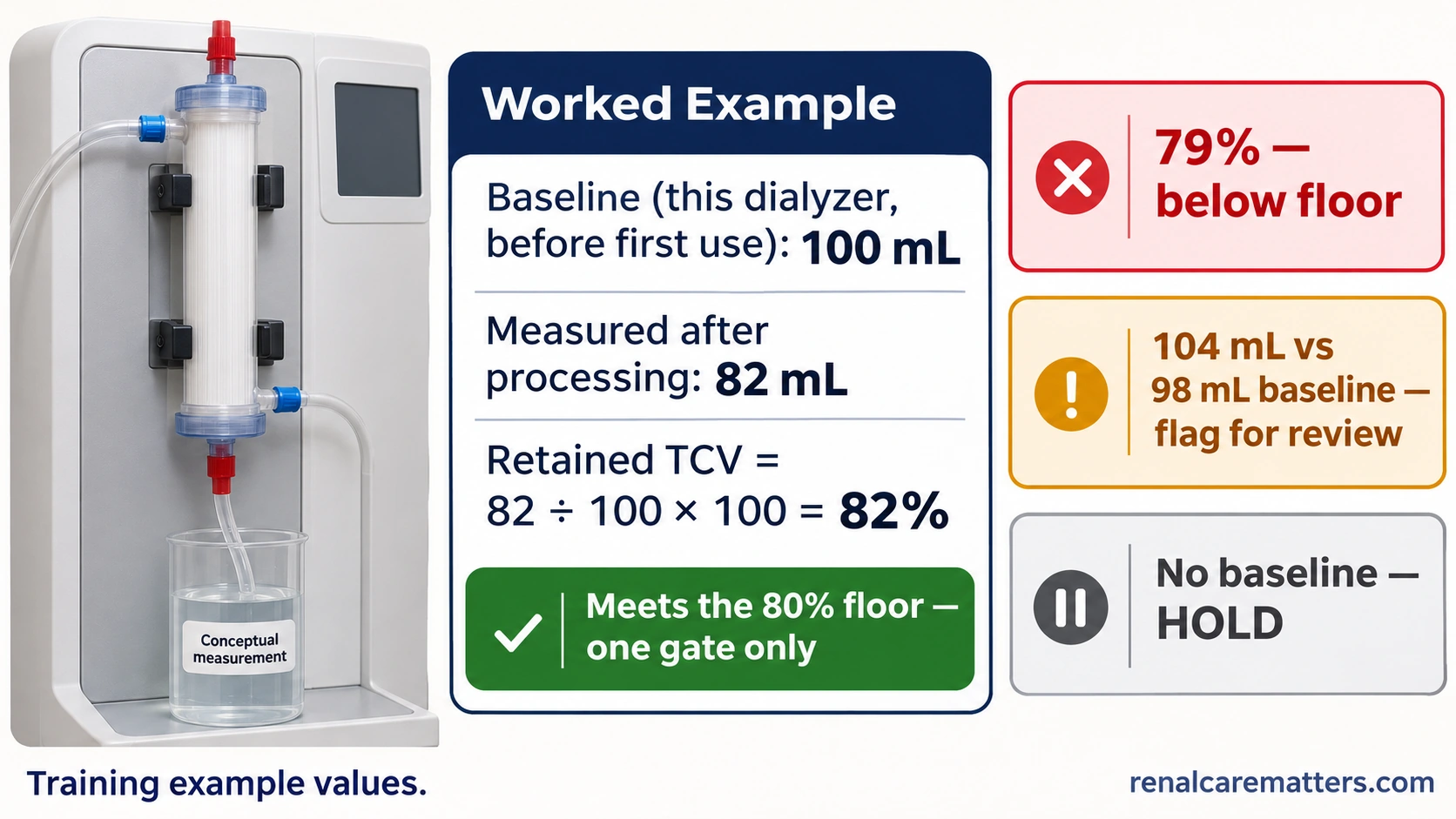
TCV is measured by displacing the fluid in the blood compartment and measuring its volume. Each dialyzer’s first measurement, before first use, is its baseline. Every later result is compared with that baseline, never with a catalog value, because individual dialyzers of the same model differ.
The PhilHealth quality circular and the Association for the Advancement of Medical Instrumentation (AAMI) standard use a floor of at least 80% retained.1,2 A dialyzer at 80% has lost a fifth of its blood compartment. It meets the floor, and it may still clean less than it did when new (Module 2).
| Situation | What it means | Action |
|---|---|---|
| Baseline missing | No denominator; the result means nothing | Hold; never substitute a catalog value |
| Baseline implausible for the model | Possible measurement or recording error | Hold and investigate |
| Measured above baseline | Possible measurement error, air, or record mismatch | Flag for review; do not cap or accept automatically |
| Measured below the floor | Too many fibers closed | Fails this gate; follow the procedure for discard |
The integrity test
In a pressure-hold test, the reprocessor pressurizes the blood compartment, usually with air, and watches the pressure. An intact membrane holds it. A broken fiber lets gas escape to the other side, and the pressure falls faster than the allowed rate. The pass criterion comes from the reprocessor and the dialyzer model, as validated in your procedure.
A broken fiber is dangerous in both directions. Dialysis fluid and anything in it can enter the blood, and blood can leak into the dialysis fluid. Volume and integrity measure different things, so one can be perfect while the other fails. In a Centers for Disease Control and Prevention (CDC) study of three centers whose reprocessed dialyzers were all integrity-tested before use, the rate of pyrogenic reactions was 0.7 per 1,000 treatments despite high bacterial counts in the dialysis fluid.3 The study did not test the integrity check itself, but it shows the setting in which membrane integrity protects patients.
Inspecting the processed dialyzer
| Look for | Why it rejects the dialyzer |
|---|---|
| Cracks or leaks in the housing or ports | Loss of containment; contamination |
| Visible clot, dark streaks or discolored fibers more than the procedure allows | Blocked surface; trapped residue |
| Blood or protein in the headers after cleaning | Cleaning incomplete |
| Missing or damaged caps; damaged O-rings | Germicide can leak out and contaminants can enter |
| Label damaged or unreadable | Identity lost (Module 7) |
Inspect in good light, at a set point in the procedure, and record what you saw. “Looked fine” written at the end of the day is not an inspection.
Every gate must pass
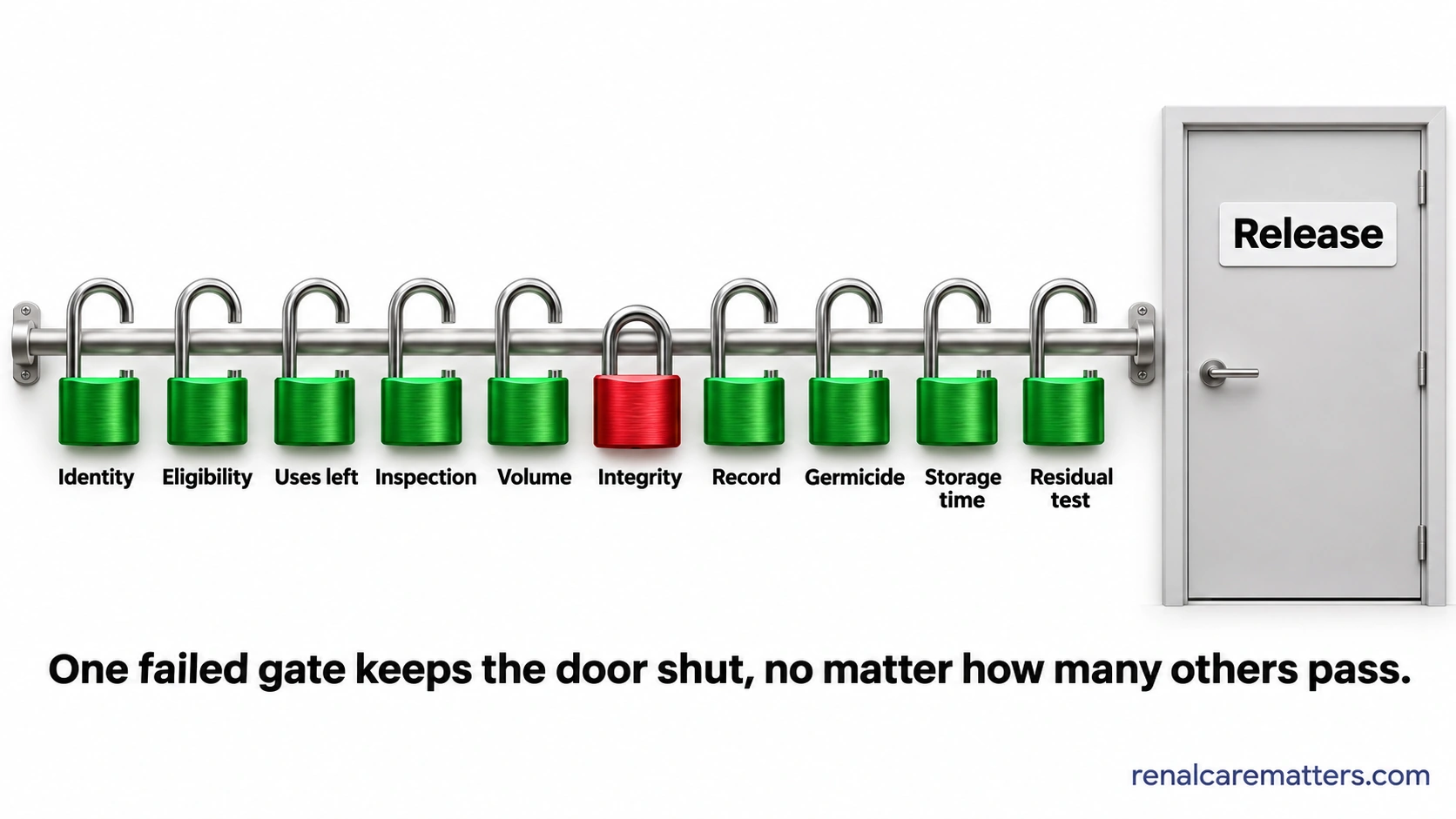
Before a processed dialyzer can be stored for release, every acceptance gate must pass. Each is independent. A favorable result on one cannot compensate for a failure on another.
| Gate | Question | If it fails or is missing |
|---|---|---|
| Identity | Is this the labeled patient’s dialyzer, with a matching record? | Quarantine |
| Eligibility | Is the patient currently eligible? | Hold |
| Uses left | Is the next use within the limit? | Discard at the limit |
| Inspection | Any rejecting finding? | Discard or reprocess per procedure |
| Volume | Retained TCV at or above the floor, against a valid baseline? | Discard below the floor; hold if baseline invalid |
| Integrity | Pressure held within the criterion? | Discard or follow procedure; never override |
| Processing record | Every step and test recorded, with the run linked to its water, germicide and reprocessor checks? | Hold until resolved, or discard |
After this, the germicide, contact time, storage and residual-test gates follow (Module 10).
Repeating a test without gaming it
Measurements can go wrong for innocent reasons: air in the line, a loose connection, a sensor fault. Your procedure may allow one repeat for a defined reason. What it never allows is repeating a test until a passing number appears and keeping only that one.
Figure 4 · Legitimate repeats
A failed dialyzer stays unavailable until its disposition follows the program. A later finding that the reprocessor was faulty does not erase the dialyzer’s recorded failure; it adds a question about every dialyzer processed on that reprocessor (Module 11).
Back to the case: Seventy-nine and eighty
The three results. RU-0731: 79 ÷ 100 × 100 = 79%, below the 80% floor. It fails the volume gate. RU-0732: 86%, which meets the floor, but its integrity test failed. RU-0733: 104 ÷ 98 × 100 = 106%, above baseline. That is not a super-dialyzer; it suggests a measurement or record error and must be flagged for review, not accepted.
Can RU-0732’s volume make up for the failed pressure test? No. The two tests look at different dangers. A broken fiber can mix blood and dialysis fluid regardless of how many fibers are open. RU-0732 follows the procedure for an integrity failure.
When is a repeat legitimate? Only for a defined, recorded reason the procedure allows, with the first result kept. Running RU-0731 “until it passes” is gaming. If several dialyzers that day gave odd readings, Ms. Alcantara reports a possible equipment fault before more dialyzers are processed.
Skills checklist: Acceptance decisions on ten records
Use ten synthetic processing records and the Reprocessing Technician Toolkit, then observe acceptance testing on the unit’s reprocessor. Your preceptor rates each step as satisfactory, needs practice, or not observed. Steps marked Critical must all be satisfactory before sign-off. This checklist supports supervised learning; your unit’s own procedure and competency form are the authority. A printable version of every checklist is on the trainer page.
- CriticalCalculates retained TCV correctly for every record.
- CriticalHolds a record with a missing or implausible baseline.
- CriticalFlags a measured volume above baseline for review.
- CriticalRejects a dialyzer with a failed integrity test regardless of volume.
- CriticalIdentifies the record that would reach a sixth use.
- Inspects a processed training dialyzer and records findings.
- CriticalStates when a repeat test is legitimate and keeps every result.
- Writes a disposition (release to storage, reprocess, discard, hold) for each record.
Check your understanding
Each visit draws 5 questions at random from this module’s 12-question bank. Choose the single best answer for each, then select Check answers; an explanation appears under the best answer. Select New set of questions for a different mix. A good target is 4 of 5 on two different sets. Nothing you select is sent anywhere; scoring happens in your browser.
Read next on this site
- Dialyzer Reprocessing and ReusePerformance tests in reprocessing.