After this module you should be able to
- Explain why a wrong-patient dialyzer is a serious event, even when the dialyzer is clean.
- Label a dialyzer with two identifiers and the fields the program requires, before its first use.
- Use two identifiers and read-back at every hand-over.
- Recognize the risk of similar names and use the unit’s alert system.
- Keep the use count and history continuous: never reset, never transfer a label.
The big picture, in plain words
The picture has a limit. Shoes that are not yours are a nuisance. A dialyzer that is not yours carries traces of another person’s blood and has been tested against another person’s baseline. The United States federal rule restricts reuse to the same patient;1 every program does. So identity is not one check. It is a chain of checks, and a break anywhere makes every later check meaningless.
Figure 1 · Key terms for this module
Your job is to make it impossible for a dialyzer to reach the wrong patient without someone noticing, and to keep its history whole from first use to discard.
Case: Two Santoses
At 11:40 on a Thursday, the reuse room at a unit in Batangas holds two processed dialyzers on the same shelf. One belongs to Mr. Ramon Santos, 61, on the 1 p.m. shift. The other belongs to Mr. Ramil Santos, 45, on the 5 p.m. shift. Both are the same model. Their labels are handwritten.
The relief technician, Mr. Paolo Garcia, is asked by a nurse to bring “Santos’s dialyzer” for the 1 p.m. shift. He picks the one at the front of the shelf. The nurse is in a hurry and says she will check it at the chair.
Before reading on, decide:
- Where can this chain break?
- What should Mr. Garcia do before the dialyzer leaves the room?
- What could the unit change permanently?
Keep your answers in mind. The lesson gives you what you need, and the case review near the end shows one sound response.
Why identity is the first gate
A dialyzer used on the wrong patient exposes that patient to another person’s blood residue and to any bloodborne virus that person carries. It also breaks every test result, because the volume test compares this dialyzer with its own baseline and the history belongs to someone else. Programs therefore treat a wrong-patient dialyzer as a serious event, report it, and assess the exposed patient for bloodborne infection.
Wrong-patient errors usually come from ordinary moments: similar names, a rushed hand-over, a label that is smudged, a dialyzer picked by position on a shelf. Each is preventable by a habit.
The label and what it carries
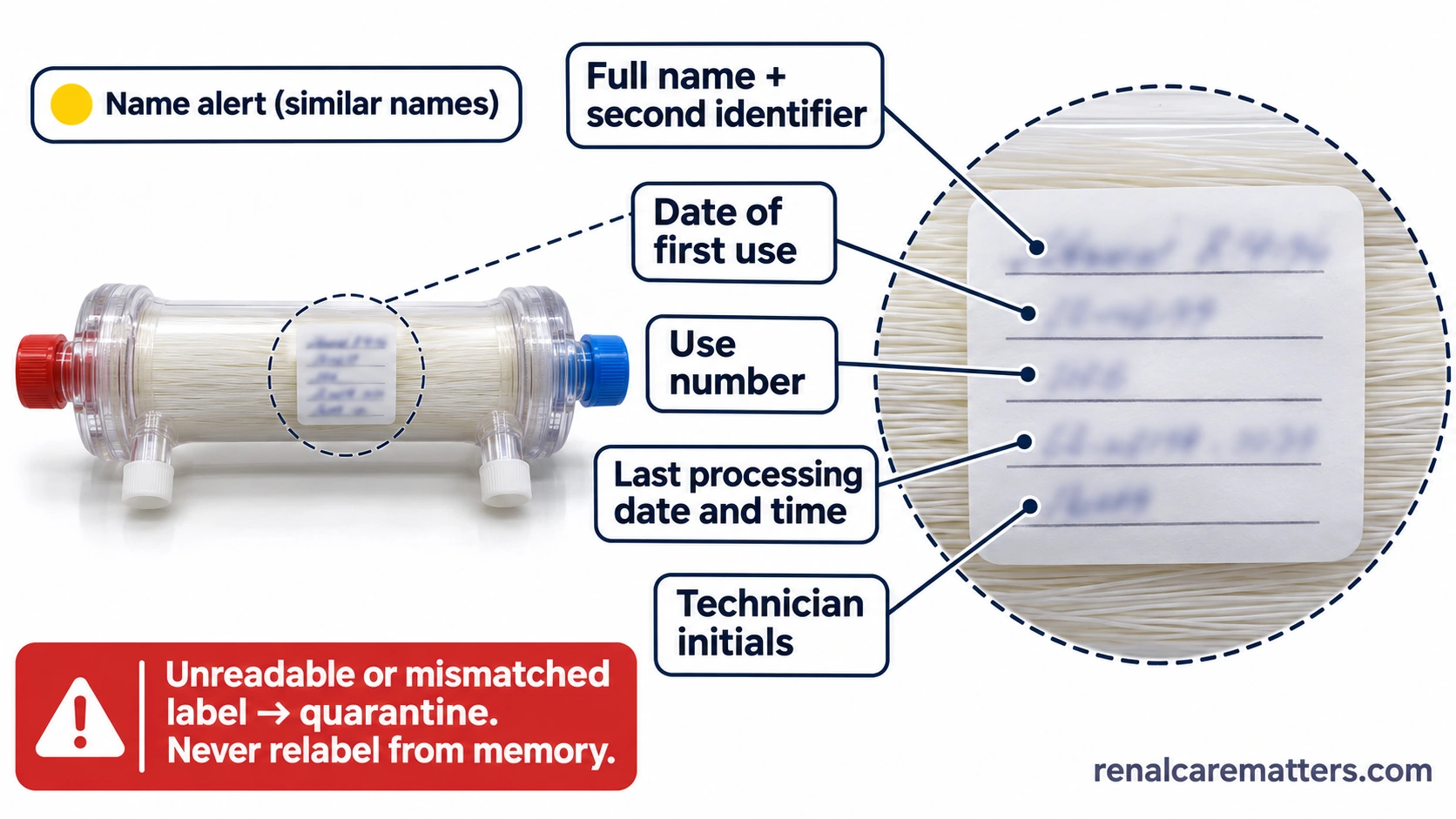
The label is applied before the first use, while the dialyzer is still sealed and the patient is present. It stays on the dialyzer until discard. The program decides the exact fields; most include these.
| Field | Why |
|---|---|
| Patient full name and a second identifier | Two identifiers prevent confusion between similar names |
| Date of first use | Anchors the history and any time limit |
| Use number, updated each cycle | Prevents a sixth use |
| Date and time of the last processing | Links to storage time and expiry |
| Initials of the person who processed it | Accountability and traceability |
The federal rule in the United States requires labeling suitable for multiple reuse, and its surveyors check it.1,2 Labels must survive water and germicide; a label that fades is a label that fails. Do not write infection status on a label that other patients can read.
The chain of custody
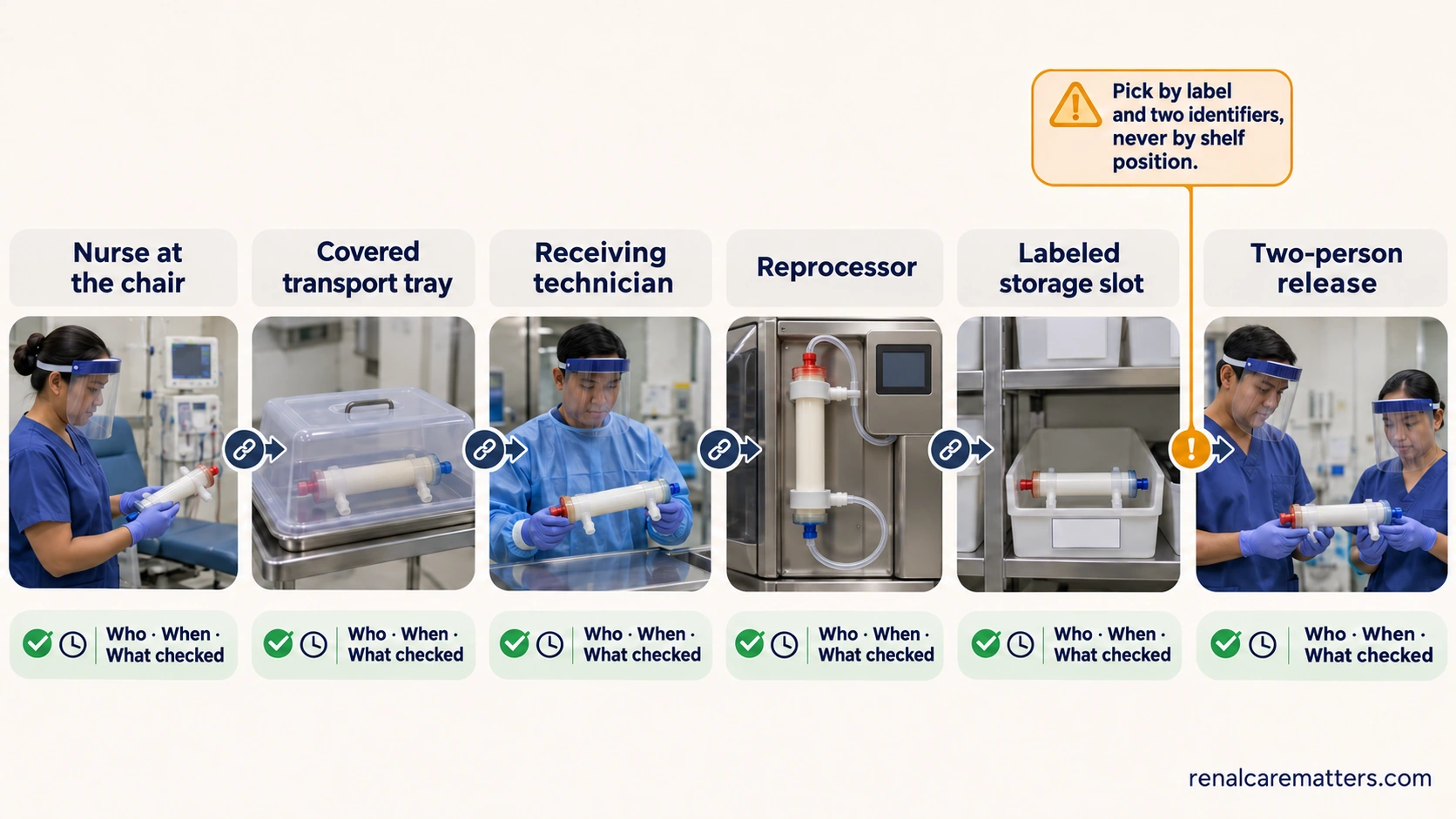
Every time the dialyzer changes hands, the person giving and the person receiving check identity together. The record shows who, when and what was checked.
Figure 4 · One dialyzer, one day
- At the chair, end of treatmentNurse confirms the label against the patient and closes the dialyzer for transport as the procedure directs.
- TransportIn a covered, leak-proof tray to the dirty receiving area, never with clean items.
- ReceivingTechnician checks label against the receiving log and the eligibility list; notes time received.
- ProcessingReprocessor record links to the dialyzer’s identifier.
- StoragePlaced in the patient’s labeled slot, not by position or color alone.
- Release to the nurseTwo people read the label against the patient record and, at the chair, the wristband (Module 10).
Similar names and other traps
| Trap | Habit that prevents it |
|---|---|
| Same or similar surnames, especially common Filipino surnames | Name alert marker on labels and records; separate storage positions; always two identifiers |
| Same model of dialyzer | Never rely on model or color to identify |
| Verbal requests such as “Santos’s dialyzer” | Ask for the full name and second identifier; read back |
| Handwritten, smudged labels | Printed or water-resistant labels; quarantine any unreadable label |
| Patients who change shift | Update the storage map the same day |
One continuous history
The dialyzer’s use count and history follow it from first use to discard. They are never reset, not after a failed cycle that was later passed, not after a repair of the record, and not after a transfer. A label is never moved from one dialyzer to another.
If the history is broken, for example a missing processing record or two labels that disagree, the dialyzer cannot be traced. An untraceable dialyzer is discarded under the program’s procedure, and the break is reported so the cause can be found.
Back to the case: Two Santoses
Where can the chain break? At the verbal request (“Santos” without a first name or second identifier), at the pick (front of the shelf rather than by label), at the hand-over (the nurse defers checking to the chair), and at the chair if the check there is rushed too. Each break alone could deliver the wrong dialyzer.
What should Mr. Garcia do? Ask for the patient’s full name and second identifier, find the dialyzer by its label, read the label aloud with the nurse against the patient record, and log the release time. If the labels are hard to read, he quarantines the doubtful dialyzer rather than guessing.
What could the unit change? A name alert for the two Santoses, separate storage positions on different shelves, printed water-resistant labels, and a rule that no dialyzer leaves the room without a two-person read-back. Changing one patient’s shift would also separate them in time.
Skills checklist: Labeling and hand-over drill
Use synthetic patients with similar names and training dialyzers. Your preceptor rates each step as satisfactory, needs practice, or not observed. Steps marked Critical must all be satisfactory before sign-off. This checklist supports supervised learning; your unit’s own procedure and competency form are the authority. A printable version of every checklist is on the trainer page.
- CriticalLabels a new dialyzer with two identifiers and the required fields before first use.
- CriticalChecks a received dialyzer against the receiving log and eligibility list.
- CriticalPicks a dialyzer from storage by label and two identifiers, not by position.
- CriticalAsks for the full name and second identifier when given a surname only.
- CriticalPerforms a two-person read-back at release.
- CriticalQuarantines a dialyzer with an unreadable label.
- States why a use count is never reset.
Check your understanding
Each visit draws 5 questions at random from this module’s 12-question bank. Choose the single best answer for each, then select Check answers; an explanation appears under the best answer. Select New set of questions for a different mix. A good target is 4 of 5 on two different sets. Nothing you select is sent anywhere; scoring happens in your browser.
Read next on this site
- Dialyzer Reprocessing and ReuseLabeling and records in a reuse program.