After this module you should be able to
- Receive a used dialyzer: check identity and eligibility, record the time, and decide whether it can be processed.
- Explain why time and temperature before processing matter, and follow the procedure for a dialyzer that waited too long.
- Explain rinsing, reverse ultrafiltration and header cleaning in terms of what they remove from the fibers.
- Describe what cleaning agents do to the membrane, and why only the approved agent and sequence are used.
- Follow the approved procedure step by step and document each step.
The big picture, in plain words
The picture has a limit. Food on a pot is visible, and you can scrub it. Blood and protein left inside ten thousand fibers cannot be seen or scrubbed; they can only be rinsed and lifted out by water and cleaning agents moving through the right paths. Bacteria in that residue multiply with time and warmth. So the clock starts at the end of treatment, and the cleaning follows a method that has been shown to work on this dialyzer model.
Figure 1 · Key terms for this module
Your work is to start the cleaning in time, follow the validated steps exactly, and stop when a dialyzer cannot be cleaned within what the procedure allows.
Case: Three hours in the hallway
At 3:15 on a Wednesday afternoon, Ms. Nina Aquino finds a used dialyzer in a tray on a cart in the hallway outside the reuse room. Its label is clear, and the patient is eligible. The run sheet shows the treatment ended at 12:05. The hallway is warm. The refrigerator in the reuse room has space, and its temperature log was last signed at 7:00.
The dialyzer is on its third use. The patient is a 70-year-old woman whose new dialyzer would cost the unit another one from its yearly allowance.
Before reading on, decide:
- What is the problem with this dialyzer?
- What does the procedure probably require, and who decides?
- How can the unit stop it happening again?
Keep your answers in mind. The lesson gives you what you need, and the case review near the end shows one sound response.
Receiving a used dialyzer

Receiving is the first gate inside the room. A dialyzer that fails it is not processed.
| Check | Pass | Hold or reject |
|---|---|---|
| Identity | Label readable, matches the receiving log | Missing, unreadable or mismatched label |
| Eligibility | Patient on the current eligibility list | Not listed, status changed, or unknown |
| Use count | Next use within the limit | Limit reached |
| Time since end of treatment | Within the limit your procedure sets, or refrigerated within it | Over the limit without refrigeration |
| Condition | Housing intact, ports capped | Cracks, leaks, gross clot, unusual color |
Time and temperature before processing
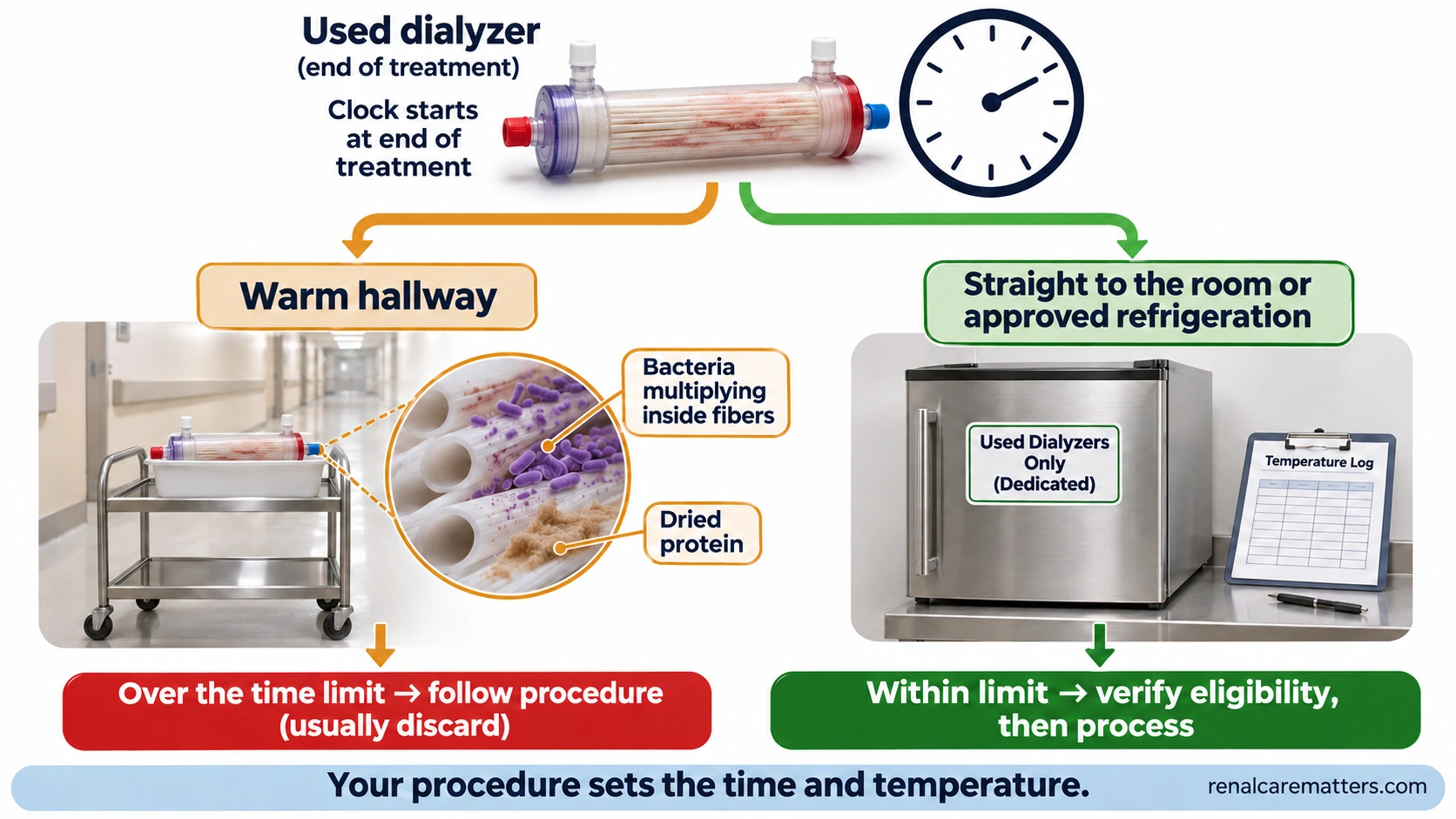
After treatment, the fibers hold blood, protein and whatever bacteria entered the circuit. At room temperature, bacteria multiply; dried protein sticks to the membrane. Both make cleaning less effective and raise endotoxin. That is why programs set a maximum time to processing and require refrigeration for dialyzers that will wait longer. The exact time and temperature come from your procedure, which follows the Association for the Advancement of Medical Instrumentation (AAMI) standard and the reprocessor maker.1
The refrigerator is part of the system. A refrigerator for used dialyzers holds only used dialyzers, never food or medicines, and its temperature is logged. The United States Food and Drug Administration (FDA) advises that dialyzers should not be reused when reprocessing or required refrigeration facilities are not working.2
Rinsing, reverse ultrafiltration and the headers
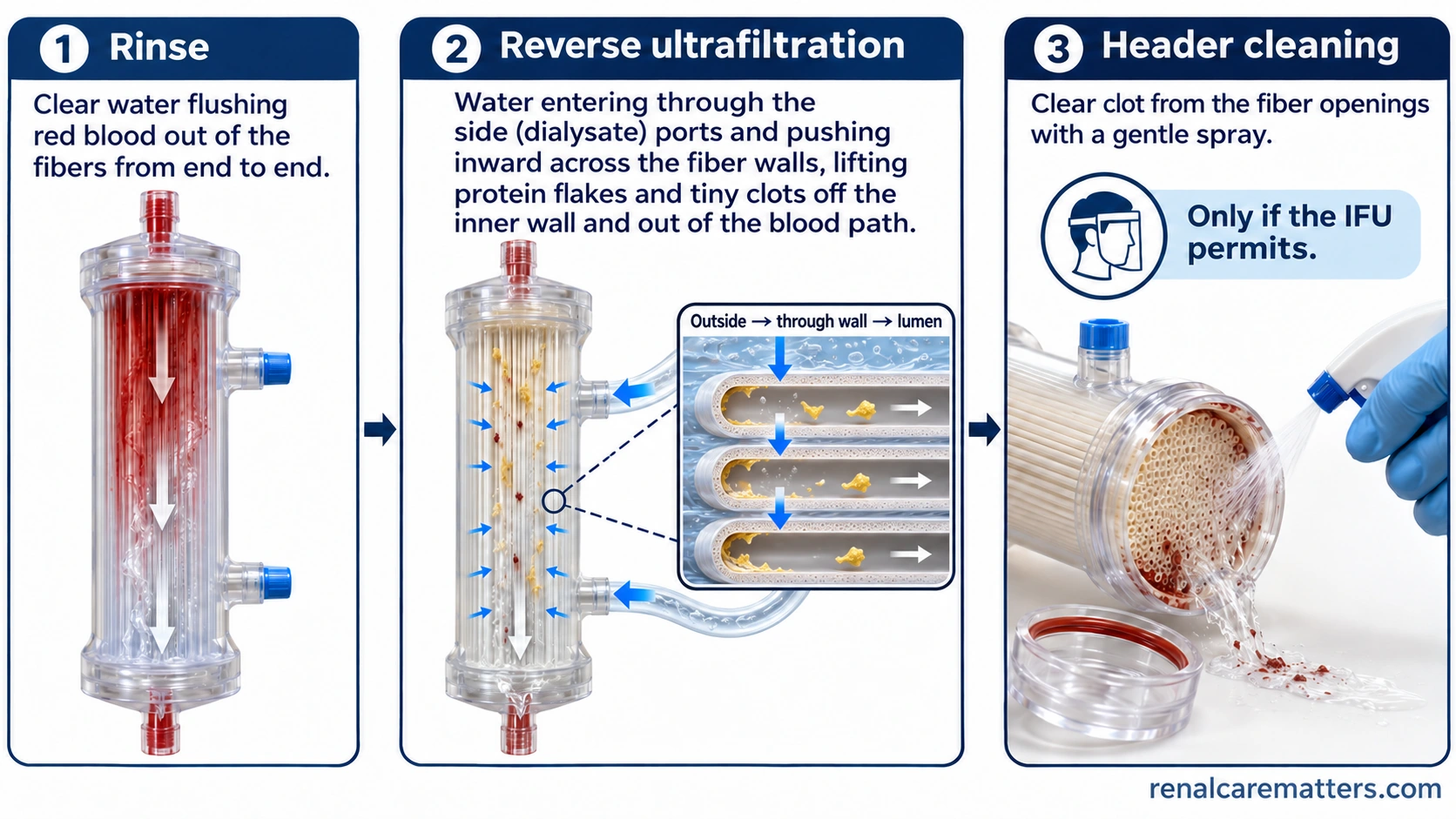
Cleaning works from the outside in. First, water flushes the blood out of the blood compartment. Then reverse ultrafiltration pushes water backward through the membrane, from the dialysate side into the fibers, lifting protein and small clots off the inner wall. A cleaning agent, if the program uses one, dissolves what remains. Last, the headers are cleaned, because clot often collects there where blood enters the fibers.
| Step | What it removes | Common error |
|---|---|---|
| Initial rinse | Loose blood | Starting with a warm, dried dialyzer |
| Reverse ultrafiltration | Protein and small clots on the inner fiber wall | Pressure outside the reprocessor’s set range |
| Cleaning agent | Remaining protein | Wrong agent, wrong strength, or skipped rinse afterward |
| Header cleaning | Clot at the fiber openings | Removing the header without authorization or damaging the O-ring; splash to the face |
Header removal and cleaning carry a splash risk, so the face shield stays down (Module 4). Some dialyzer models must not have their headers removed; the instructions for use (IFU) says which.
What cleaning agents do to the membrane
Cleaning agents are chosen for a dialyzer model by the program. They can change the membrane itself. In the Hemodialysis (HEMO) Study (HEMO) analysis, the clearance of beta-2-microglobulin with reuse depended on both the membrane material and the reprocessing technique; with some combinations it fell, and with others it rose substantially.3 A membrane that becomes more open can lose more albumin into the dialysis fluid. This is why a program cannot swap one agent for another, or add an extra cleaning step, without validation and the medical director’s approval.
Agents must also be compatible with the germicide that follows. Some combinations react dangerously; Module 6 explains why bleach must never meet acid germicides outside a validated sequence.
Following the approved procedure
This module describes the logic of cleaning. The steps you perform come from your unit’s approved procedure, written for its own reprocessor, dialyzer models and agents. This track does not publish a recipe, because a recipe that works for one system can fail on another.
Figure 5 · Before you start a processing run
Back to the case: Three hours in the hallway
What is the problem? The dialyzer has waited more than three hours at warm room temperature since the end of treatment. Bacteria may have multiplied and protein may have dried onto the membrane. Unless your procedure allows that time without refrigeration, it is outside the limit.
What does the procedure require? Usually that such a dialyzer is not processed and is discarded, with a record. The decision follows the written procedure; if it is unclear, the head nurse or medical director’s designate decides. The cost of one dialyzer and the yearly allowance do not change the safety decision; Module 3 explained that a payer allowance never justifies using a doubtful dialyzer.
How can the unit prevent it? A rule that used dialyzers go straight to the reuse room or its refrigerator, a log of time received, a hallway cart that is never a parking place, and a shift hand-over that includes the reuse room. Ms. Aquino reports the event so the cause can be fixed without blame.
Skills checklist: Receiving and cleaning on a training dialyzer
Practice receiving and the cleaning steps on training dialyzers and the unit’s reprocessor under supervision. Your preceptor rates each step as satisfactory, needs practice, or not observed. Steps marked Critical must all be satisfactory before sign-off. This checklist supports supervised learning; your unit’s own procedure and competency form are the authority. A printable version of every checklist is on the trainer page.
- CriticalChecks identity, eligibility, use count, time since treatment and condition at receiving, and records the time.
- CriticalRejects a dialyzer outside the time limit and follows the procedure.
- CriticalConfirms the start-of-run checks before starting the reprocessor.
- CriticalPerforms the rinse and reverse ultrafiltration steps as the procedure sets.
- CriticalCleans the header with the face shield down and without damaging seals, only if the IFU permits.
- CriticalUses only the approved cleaning agent at the approved strength.
- Records each step as it is done, not afterward.
- Checks and records the used-dialyzer refrigerator temperature.
Check your understanding
Each visit draws 5 questions at random from this module’s 12-question bank. Choose the single best answer for each, then select Check answers; an explanation appears under the best answer. Select New set of questions for a different mix. A good target is 4 of 5 on two different sets. Nothing you select is sent anywhere; scoring happens in your browser.
Read next on this site
- Dialyzer Reprocessing and ReuseThe reprocessing steps in more detail.