Why dialysis patients have a deadline in days, dependencies that fail together, the patient tracker, and a signed restart.
PublishedNailathalaGipatikPepalwal:ReferencesMga SanggunianMga TinubdanReng Reperensya:8Audience: Physician heads of adult maintenance hemodialysis units · nephrologists preparing to take an appointment · head nurses, operations managers, and quality leads who share the leadership tableRead timeOras ng pagbasaOras sa pagbasaOras ning pamamasa:
Training track for physician heads of hemodialysis services
This module is study material for physician heads of adult maintenance hemodialysis services. It explains the reasoning behind common decisions; it is not a protocol and not legal advice. Regulations change: confirm every rule against the current text and your regional office before you rely on it. Clinical limits are set by your unit’s approved protocols and the attending nephrologist. Every case and record is fictional.
Learning objectives
After this module you should be able to
Explain why a patient on hemodialysis has a deadline measured in days, and why dialyzing early before a storm helps.
Map the hazards and the dependencies that can fail together, including a backup site that shares your road or power line.
Write an agreement with a receiving unit that names real capacity, contacts, records, transport, and billing.
Activate a continuity plan and run a patient tracker until every displaced patient has an outcome or a named owner.
Restart only when facility, water, machines, staff, supplies, and records are verified and signed.
Lead an after-action review that produces owners, dates, and a repeat drill.
Pre-testBefore you read, answer the 8 self-assessment questions and note your score. After the module, select New set of questions and compare. The difference is what you learned; the questions you still miss are what to reread.
Start here
The big picture, in plain words
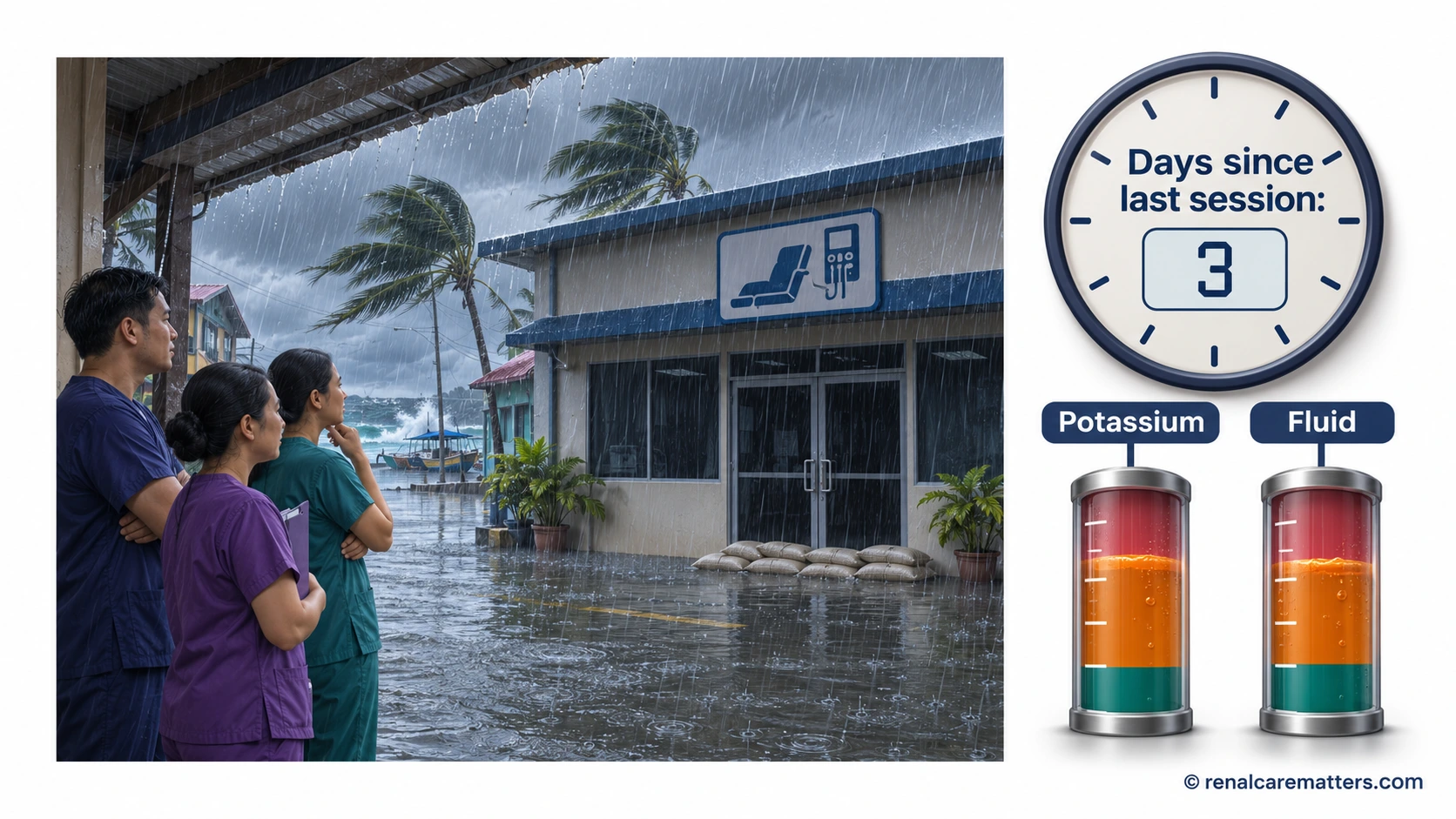
In plain wordsEvery patient on hemodialysis carries a clock that starts at the end of each session. Without kidneys, potassium and water rise every hour the clock runs. A disaster does not stop the clock; it only removes the place where it gets reset.
Figure 1. The dialysis clock. Every day without treatment adds potassium and fluid. Risk is already highest after the usual two-day weekend gap.
The picture has a limit. The clock does not run at the same speed for everyone. A patient with some remaining urine, a careful diet, and a low potassium can wait longer than a patient who gains three kilograms over a weekend. Who can wait, and for how long, is a physician’s decision for each patient, which is why the tracker needs a clinician’s priority on every row.
Figure 2 · Key terms for this module
Continuity planThe written plan that keeps dialysis going, or moves it, when the unit cannot operate normally.
DependencyAnything the unit needs to run: power, water pressure, roads, staff, supplies, records, communications.
Incident commandA temporary structure that assigns roles such as commander, clinical lead, logistics, communications, and patient tracking.
Receiving unitA dialysis facility that has agreed to treat your patients when you cannot.
Patient trackerA list of every affected patient and their status until each has a confirmed outcome.
Stand-downThe decision to end the emergency response and return to normal operations.
LDRRMOLocal Disaster Risk Reduction and Management Office.
Opening case · fictional
Case: The road is flooded
Typhoon signal number 3 is raised over Bulacan on a Thursday afternoon. At 14:20, the access road to your twelve-station unit in Marilao floods knee-deep. Utility power fails and water pressure drops. The generator starts, but the reverse osmosis pump alarms. Four patients are mid-session. Eight more are due on the next shift, and one of them, Mrs. Norma Garcia, already missed Tuesday because of an earlier flood and is now breathless.
Your backup unit in Meycauayan confirms four slots for tonight. It is on the same main road. Mobile signal comes and goes.
Before reading on, decide:
What do you do for the four patients already connected?
How do you decide who goes to the four slots, and what happens to the others?
When can the unit restart, and who signs?
Keep your answers in mind. The lesson gives you what you need, and the case review near the end shows one sound response.
Lesson · part 1
What disasters do to dialysis patients
The risk of a dialysis patient is highest on the day after the usual two-day weekend gap, even in ordinary times.1 A disaster stretches that gap. The evidence from hurricanes in the United States shows both the harm and what reduces it.
Event
Finding
Strength and limits
Hurricane Sandy, 2012
Of 13,836 patients in the affected area, 60% were dialyzed early before landfall. Early dialysis was associated with fewer emergency visits (adjusted odds ratio 0.80), fewer hospitalizations (0.79), and lower 30-day mortality (0.72)2
Observational; patients who declined early dialysis may have differed
Hurricane Sandy, 2012, lower Manhattan
26% of surveyed patients missed dialysis, a median of two sessions; 66% were treated at a unit other than their own. Only 44% carried a detailed medication list3
Cross-sectional survey
Hurricane Katrina, 2005
Among patients from 94 affected clinics, the hurricane was not associated with significantly increased mortality in adjusted analyses4
Cohort; widespread relocation may have protected patients
After Katrina
About 24% of hemodialysis patients had symptoms of post-traumatic stress a year later, more often if they missed three or more sessions5; depression was associated with higher mortality and hospitalization6
Cohort and cross-sectional
Philippine dialysis data from typhoons were not found in the literature searched. The United States evidence supports two practical steps: dialyze patients early when a storm is forecast, if the attending nephrologists agree, and plan for patients to be treated at other units with records in hand.
RememberThe most effective disaster intervention may happen two days before landfall: an extra session, a full patient card, and a phone tree that works.
Lesson · part 2
Map hazards and the dependencies that fail together
List the hazards your unit actually faces: typhoon and flood, earthquake, fire, extended power or water loss, equipment or information system failure, outbreak, and supply or staff disruption. For each, map the effect on three groups: patients connected now, patients due today, and patients already overdue.
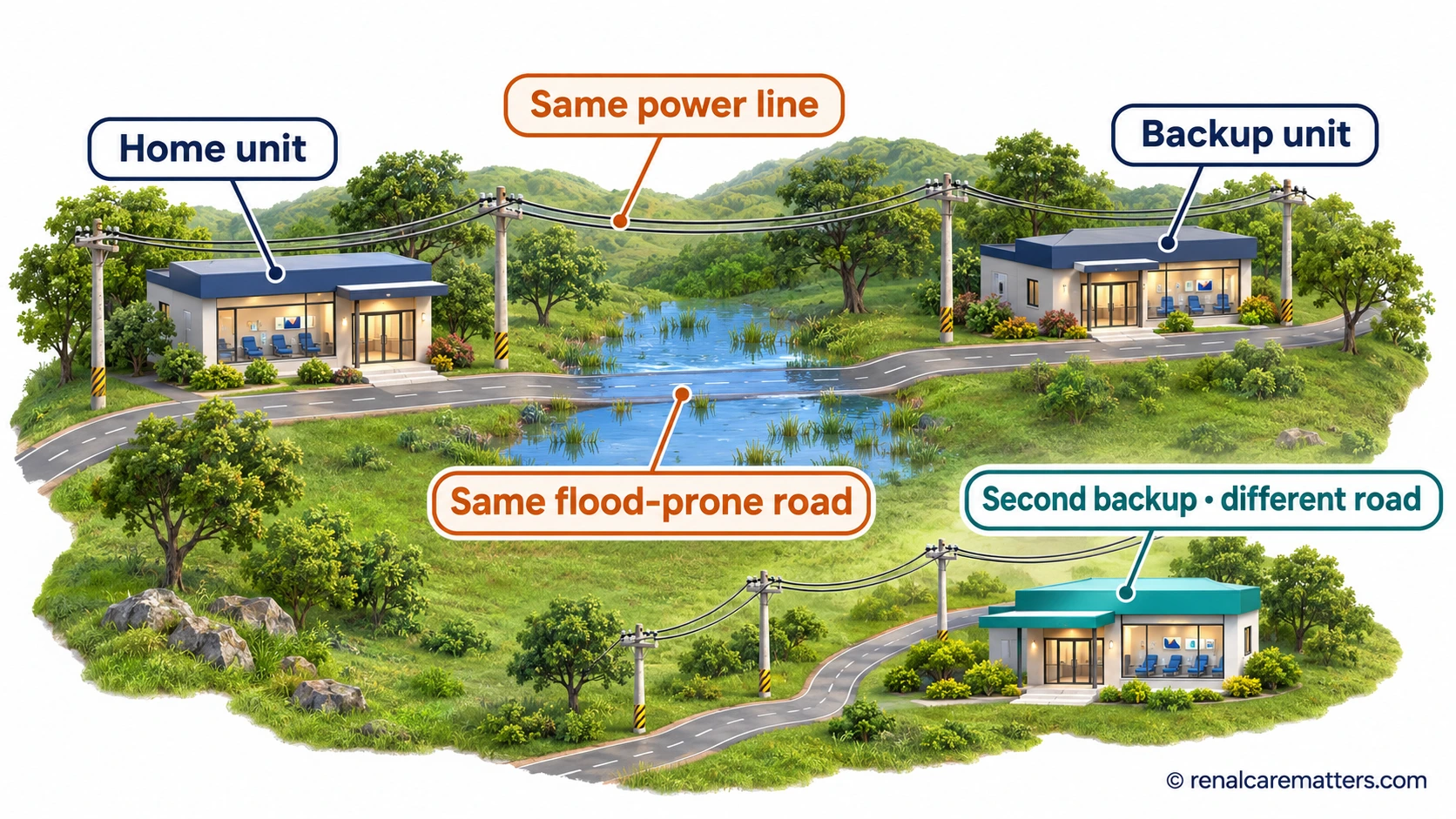
Figure 3. A backup that shares your power line or your road fails when you do. Map the dependencies before the season.
Then look for shared dependencies. A backup unit that uses the same power feeder, the same water main, or the same flood-prone road will fail when you do. Find at least one receiving unit in a different direction.
A receiving agreement should name
Why
Activation contacts, with two ways to reach each
Mobile networks fail first
Real capacity: staffed, released stations and time slots
An available chair is not an accepted patient
Acceptance process and the records that travel
The receiving physician needs the order, access, infection status, and last results
Transport responsibility
Patients may not be able to get there
Billing and benefit handling, confirmed with the claims lead and Philippine Health Insurance Corporation (PhilHealth)
Prevents duplicate claims and protects access when payment is uncertain
Supplies, mutual obligations, and testing schedule
An agreement never tested is a hope
Coordinate with the LDRRMO, emergency medical services, and, for hospital-based units, the hospital incident command, as the national disaster law expects.7 Keep an offline, access-controlled patient roster and contact list, and give every patient an emergency card with their diagnosis, access, dry weight, medicines, last results, and unit contacts.8
Lesson · part 3
Activate, account, and track
At activation, open the command log, confirm the hazards, control affected operations, and account for every patient and staff member in the building. Use your chairside emergency procedures for patients on the machine. Then turn to the patients who are not in the building.
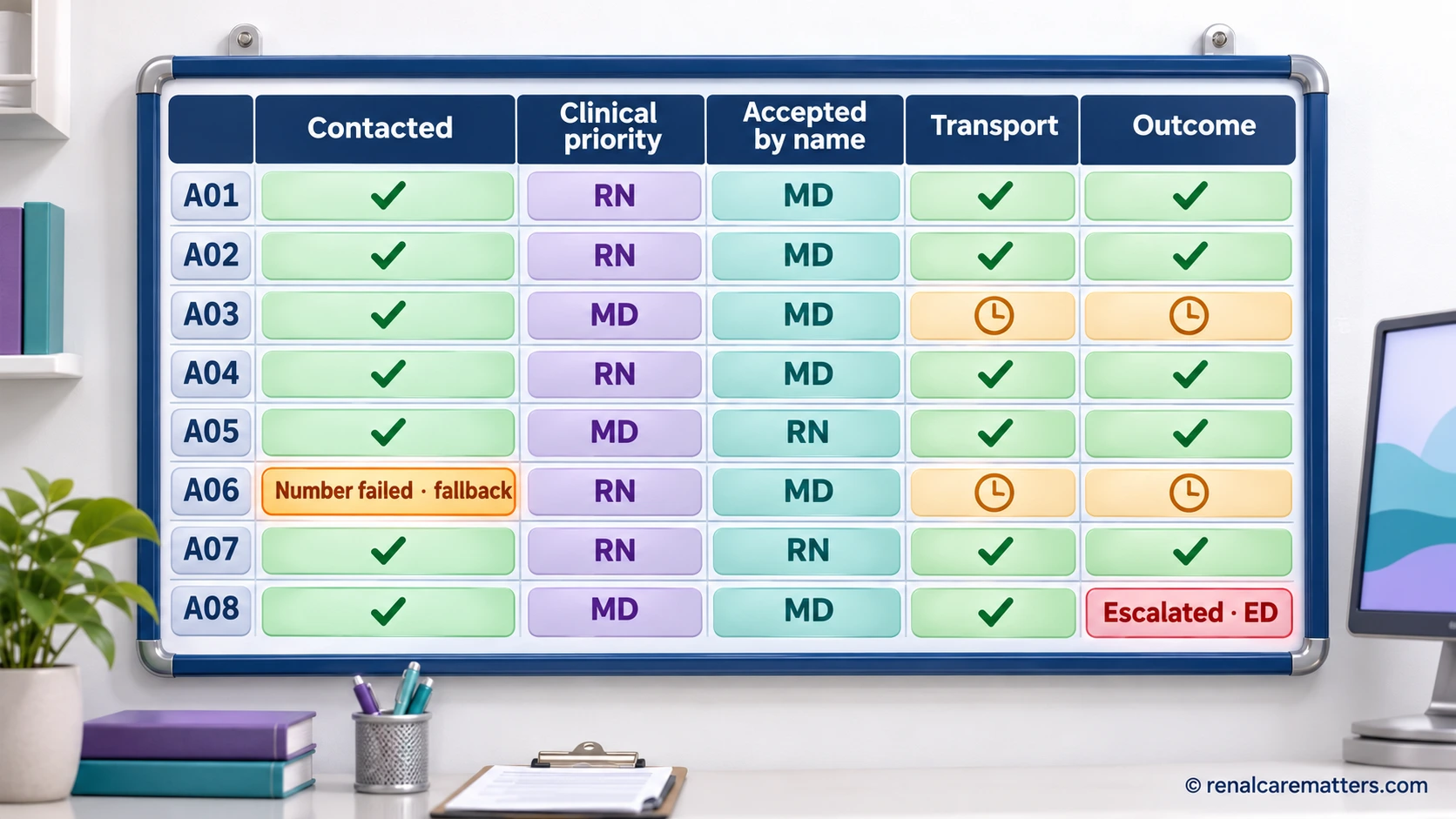
Figure 4. The patient tracker. Stand down only when every row has an outcome or a named owner.
Figure 5 · One row of the tracker, one patient
ContactReached, by which route, at what time. If not, the fallback contact.
Clinical prioritySet by the attending nephrologist or physician on duty, not by the order of the list.
PlacementAccepted by name at a receiving unit, or referred for urgent assessment.
TransportArranged and confirmed.
OutcomeTreated, admitted, or still pending with a named owner and a next check time.
Stop and callStop and escalate to the LDRRMO, the receiving hospital, or emergency medical services any patient with urgent symptoms who cannot be placed. Do not stand down while any row on the tracker lacks an outcome or a named owner.
Calculator 6 shows, for each patient, the hours since the last session and flags those past the usual long gap. It supports, and never replaces, the physician’s priority.
Lesson · part 4
Restart is a signed decision
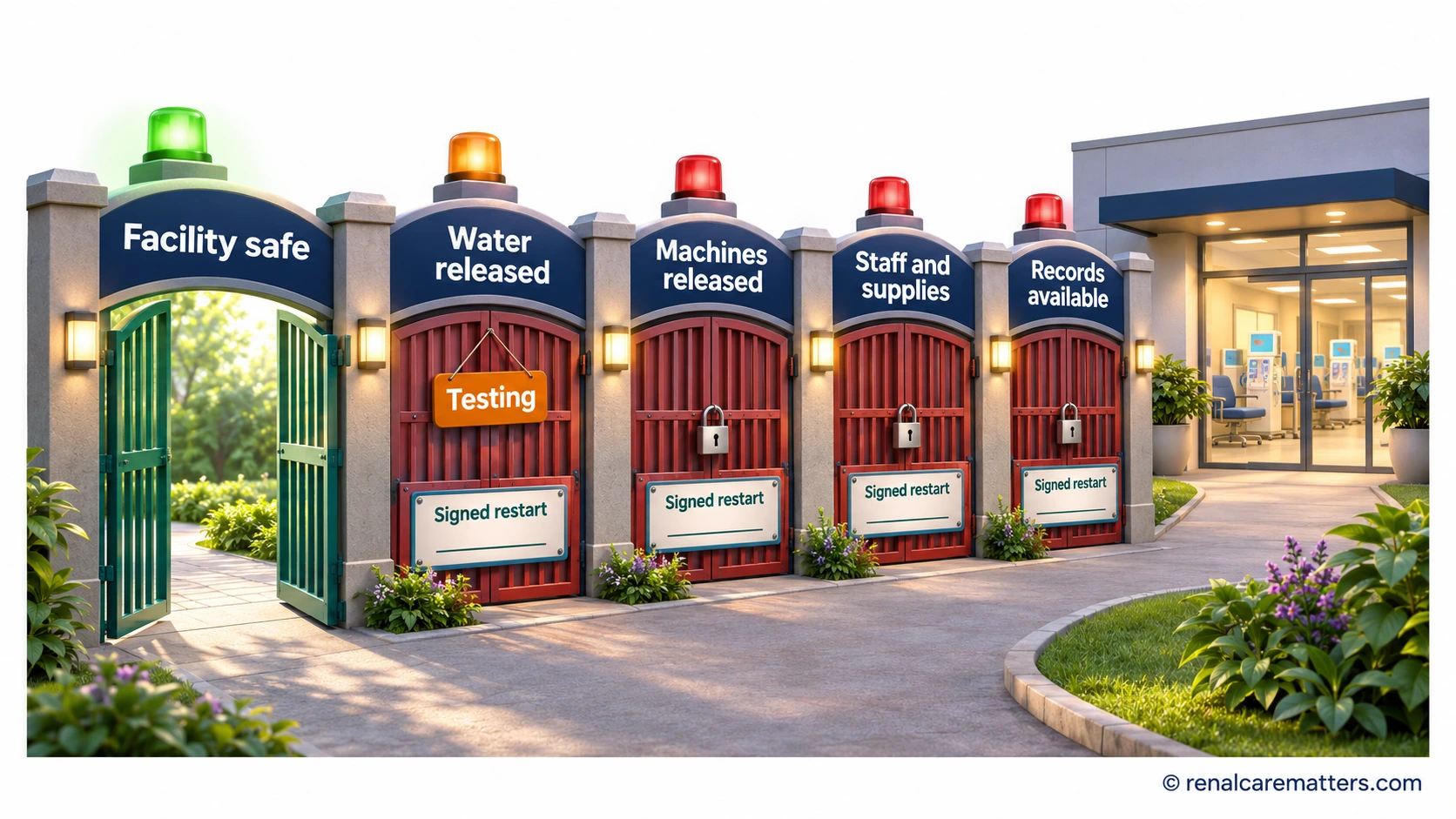
Figure 6. Power is one gate. Restart is a signed decision after all five.
Power returning restores one dependency. Before treating patients again, verify the facility is safe, the water system is within limits after the disruption, each machine is released, staffing and supplies are adequate, and records are available. The technical leads sign the technical release; you sign the clinical restart. Then review outstanding transfers, reconcile any downtime records (Module 12), and hold an after-action review within a week.
Walk the fire and evacuation plan with the facility safety officer at least once a year: who raises the alarm, who leads chairside emergency disconnection under the approved procedure, who accounts for everyone at the assembly point, and who helps patients who cannot walk. Assign fire-fighting only to those trained, and only with a clear escape route behind them.
RememberAsk what failed, what worked, who owns each fix, and how the next drill will show it changed.
On the floor
Real situations: problems and solutions
These are fictional but typical. For each one, cover the answer, decide what you would do, then compare. Where a step depends on local rules, your unit’s procedure and your supervisor’s direction come first.
The backup on the same road
What you see
Your backup unit is twenty minutes away, on the same road that flooded last year.
What is likely going on
A shared dependency.
What to do
Find a second backup in a different direction and put it in writing.
Why it matters
Two units that fail together are one unit.
Four slots for eight
What you see
The receiving unit can take four of your eight displaced patients today.
What is likely going on
A capacity gap that needs clinical prioritization.
What to do
Ask the attending nephrologists to prioritize, confirm a second site, and escalate anyone unplaced.
Why it matters
No patient leaves the tracker without an outcome or an owner.
The generator is on
What you see
Power returns by generator and staff want to restart immediately.
What is likely going on
One dependency restored.
What to do
Restart only after water, machines, staffing, and supplies are verified and signed.
Why it matters
Power is one gate of several.
Field notes
Ask the attending nephrologists about dialyzing early when a typhoon warning is issued.
Test the call list before the season, not during it.
Give every patient an emergency card.
Case review
Back to the case: The road is flooded
The four connected patients. With the reverse osmosis pump alarming, treat the water supply as unverified. Follow your emergency procedure to end treatment safely; whether to return blood is a physician’s call for each patient, depending on the circuit and the patient. Record the time and the delivered treatment for each, and make sure each has a plan for the next session.
The four slots. Ask the attending nephrologists to rank the eight by clinical urgency. Mrs. Garcia, breathless after a missed session, needs urgent physician assessment now and may need the emergency department rather than a slot. Confirm acceptance by name at Meycauayan, then look for a second site in a different direction because Meycauayan shares your road. Escalate anyone you cannot place to the LDRRMO and the receiving hospital. Keep every row open until each has an outcome or a named owner.
Restart. Not when the power returns. Only when the water system has been tested and released by the technical lead, the machines have been checked, staff and supplies are in place, and you have signed clinical restart. Then reconcile records, close the tracker, and schedule an after-action review and a repeat drill.
Skills lab · with your preceptor
Skills checklist: Continuity activation and patient tracker
Take part in the typhoon tabletop in the trainer guide as clinical lead, with role players for the receiving unit, transport, and a family member. Your preceptor rates each step as satisfactory, needs practice, or not observed. Steps marked Critical must all be satisfactory before sign-off. This checklist supports supervised learning; your unit’s own procedure and competency form are the authority. A printable version of every checklist is on the trainer page.
Activates command and assigns clinical, logistics, communication, and tracking roles.
CriticalDirects chairside procedures for connected patients according to the approved protocol.
CriticalObtains a physician’s clinical priority for every displaced patient.
CriticalConfirms receiving acceptance by patient name, not by number of slots.
Identifies a shared dependency with the backup site and seeks a second site.
CriticalEscalates any urgent patient who cannot be placed, with the escalation recorded.
CriticalAccounts for every patient before stand-down.
CriticalHolds restart until technical release and clinical authorization are both signed.
Leads an after-action review that names owners, dates, and a repeat drill.
Placement activity. Before the next typhoon season, test your call list, confirm two receiving agreements in different directions, and give every patient an emergency card. Record the percentage of numbers that connected.
Self-assessment
Check your understanding
Each visit draws 8 questions at random from this module’s 15-question bank. Choose the single best answer for each, then select Check answers; an explanation appears under the best answer. Select New set of questions for a different mix. A good target is 7 of 8 on two different sets. Nothing you select is sent anywhere; scoring happens in your browser.
Foley, R. N., Gilbertson, D. T., Murray, T., & Collins, A. J. (2011). Long interdialytic interval and mortality among patients receiving hemodialysis. New England Journal of Medicine, 365(12), 1099–1107. https://doi.org/10.1056/NEJMoa1103313
Lurie, N., Finne, K., Worrall, C., Jauregui, M., Thaweethai, T., Margolis, G., & Kelman, J. (2015). Early dialysis and adverse outcomes after Hurricane Sandy. American Journal of Kidney Diseases, 66(3), 507–512. https://doi.org/10.1053/j.ajkd.2015.04.050
Murakami, N., Siktel, H. B., Lucido, D., Winchester, J. F., & Harbord, N. B. (2015). Disaster preparedness and awareness of patients on hemodialysis after Hurricane Sandy. Clinical Journal of the American Society of Nephrology, 10(8), 1389–1396. https://doi.org/10.2215/CJN.10181014
Kutner, N. G., Muntner, P., Huang, Y., Zhang, R., Cohen, A. J., Anderson, A. H., & Eggers, P. W. (2009). Effect of Hurricane Katrina on the mortality of dialysis patients. Kidney International, 76(7), 760–766. https://doi.org/10.1038/ki.2009.268
Hyre, A. D., Cohen, A. J., Kutner, N., Alper, A. B., & Muntner, P. (2007). Prevalence and predictors of posttraumatic stress disorder among hemodialysis patients following Hurricane Katrina. American Journal of Kidney Diseases, 50(4), 585–593. https://doi.org/10.1053/j.ajkd.2007.07.013
Edmondson, D., Gamboa, C., Cohen, A., Anderson, A. H., Kutner, N., Kronish, I., Mills, M. A., & Muntner, P. (2013). Association of posttraumatic stress disorder and depression with all-cause and cardiovascular disease mortality and hospitalization among Hurricane Katrina survivors with end-stage renal disease. American Journal of Public Health, 103(4), e130-7. https://doi.org/10.2105/AJPH.2012.301146
Republic Act No. 10121: Philippine Disaster Risk Reduction and Management Act of 2010. (2010). Congress of the Philippines.
Centers for Disease Control and Prevention. (n.d.). Caring for your kidneys: Emergency preparedness for people on dialysis. Retrieved November 23, 2026, from https://www.cdc.gov/kidney-disease/caring/
Educational material for physicians and unit leaders. Completing it is an Academy learning record only. It does not confer CPD units, PSN attestation, DOH eligibility, PhilHealth accreditation, or appointment authority, and it does not replace current regulations, your facility’s bylaws and protocols, or legal advice.