Reading the finances, the cost of a shortage, qualifying a substitute, disclosure and recusal, and disputes between clinicians.
PublishedNailathalaGipatikPepalwal:Audience: Physician heads of adult maintenance hemodialysis units · nephrologists preparing to take an appointment · head nurses, operations managers, and quality leads who share the leadership tableRead timeOras ng pagbasaOras sa pagbasaOras ning pamamasa:
Training track for physician heads of hemodialysis services
This module is study material for physician heads of adult maintenance hemodialysis services. It explains the reasoning behind common decisions; it is not a protocol and not legal advice. Regulations change: confirm every rule against the current text and your regional office before you rely on it. Clinical limits are set by your unit’s approved protocols and the attending nephrologist. Every case and record is fictional.
Learning objectives
After this module you should be able to
Read the finances that affect safety: volume, collections, fixed and variable costs, and commitments.
Calculate the runway of a critical supply and decide early when a shortage becomes a clinical decision.
Compare the full cost of options, including cancellations, transfers, and harm, not only purchase price.
Qualify a substitute product through its regulatory, technical, clinical, training, and traceability gates.
Disclose and recuse when you, or the people deciding, have a tie to a vendor.
Stabilize coverage first, then mediate, when two clinicians dispute patients or services.
Pre-testBefore you read, answer the 8 self-assessment questions and note your score. After the module, select New set of questions and compare. The difference is what you learned; the questions you still miss are what to reread.
Start here
The big picture, in plain words
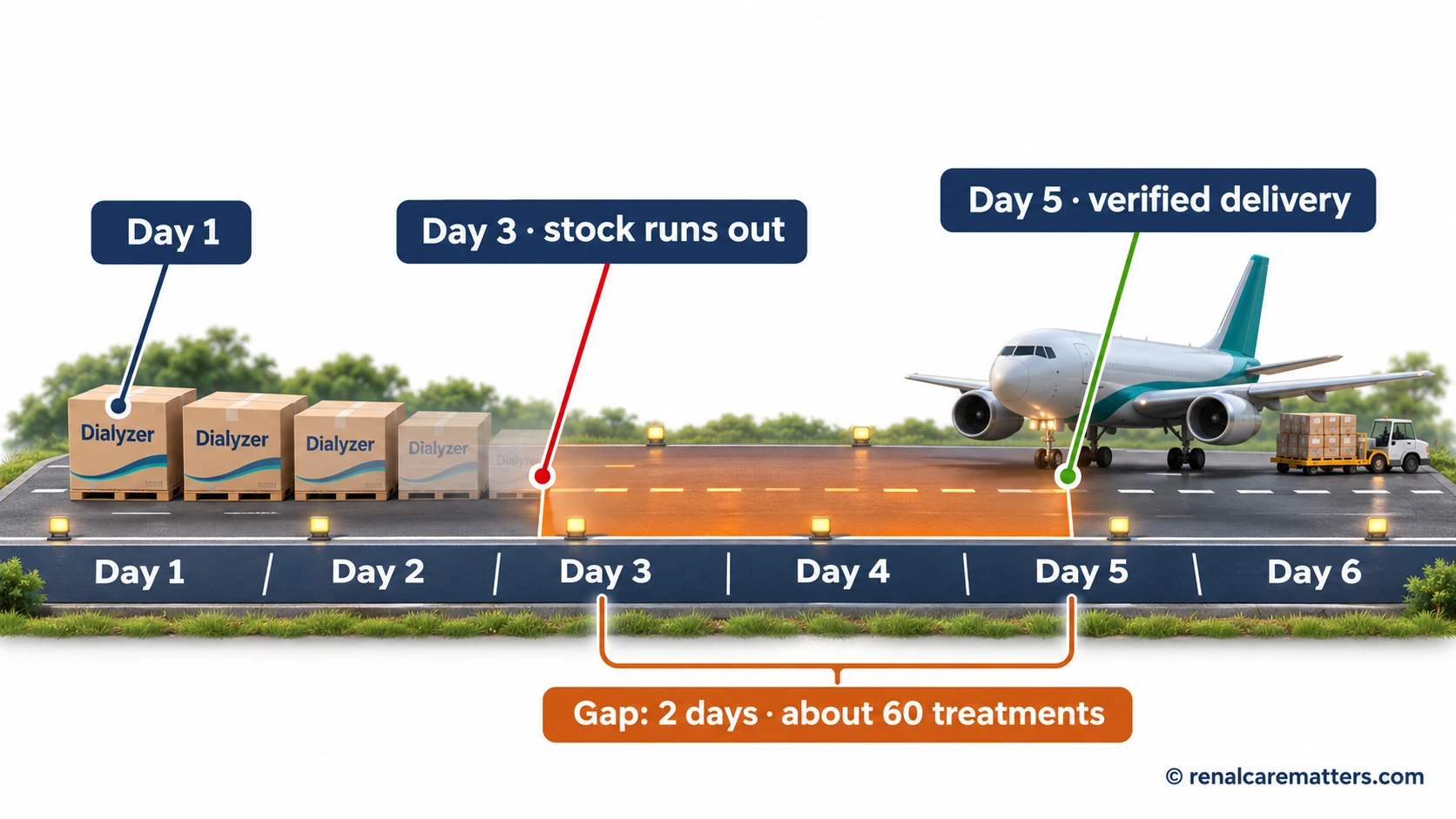
In plain wordsA shortage is a runway. You know how many days of stock you have, and you know when the next verified delivery lands. The distance between them is the time you have to choose.
Figure 1. The runway. If the next verified delivery lands after the stock runs out, the gap is a clinical decision, not a purchasing one.
The picture has a limit. A runway has a fixed length, but stock does not: a change in demand, a damaged box, or a recall can shorten it overnight. Check the runway every day once it is short, and decide early, while you still have options.
Figure 2 · Key terms for this module
Fixed costA cost that does not change with the number of sessions, such as rent or salaries.
Variable costA cost that rises with each session, such as dialyzers and lines.
CollectionsCash actually received, which may lag behind claims submitted.
QualificationThe checks a new product passes before it is used on patients.
Conflict of interestA financial or personal tie that could influence, or appear to influence, a decision.
RecusalStepping back from a decision in which you have a conflict.
Opening case · fictional
Case: Three days of stock
Philippine Health Insurance Corporation (PhilHealth) collections at your Bulacan unit are six weeks behind. The stockroom forecasts that the unit’s current dialyzer model will run out in three days. The usual supplier can deliver in five days, at 120 pesos more per unit than last quarter, enough for 80 treatments.
Mr. Jerome Uy, a supplier and the owner’s nephew, offers delivery tomorrow of a dialyzer model the unit has never used, at the old price. “It is the same thing,” he says. “Just a different brand.”
Before reading on, decide:
What evidence would make the substitute usable, and who signs each part?
What do you do if that evidence arrives after the current stock runs out?
How do you handle the family tie?
Keep your answers in mind. The lesson gives you what you need, and the case review near the end shows one sound response.
Lesson · part 1
The finances that touch safety
You do not run the books, but you need to read them well enough to see when money is about to become a safety problem. Ask finance for treatment volume, collections timing, operating expenses, upcoming contractual commitments, and the cost of downtime. Separate a fall in demand from a delay in collections; they need different responses.
Some costs are the price of operating at all. A second carbon tank, a validated relief nurse, or a water culture are not savings opportunities. When the owner proposes a cut, ask which control it removes and show the consequence in plain terms.
Stop and callStop and escalate in writing any proposed cost cut that removes a safety control. State the control, the risk it covers, and the alternative savings you would accept.
Lesson · part 2
The full cost of a shortage
Compare options on their full cost. The incremental cost of the verified product is the price difference times the units needed. The cost of not having it includes canceled or transferred sessions, transport, staff time, and the clinical risk of a longer gap between treatments.
Option
Direct cost
Hidden cost
Pay more for the verified product
120 pesos × 80 = 9,600 pesos
Two days of gap if the delivery lands on day 5 and stock ends on day 3
Transfer sessions during the gap
Partner unit fees, transport
Patient travel, missed sessions, disruption
Use the unfamiliar substitute
Lower price
Qualification time, training, unknown performance, recall traceability
Ask for partial early delivery or borrow from a partner unit
Negotiation, freight
Depends on partner’s stock
Runway. Stock lasts 3 days; verified delivery lands on day 5. Gap = 2 days. With 30 treatments a day, about 60 treatments fall in the gap. Calculator 7 compares the incremental cost with the cost of canceling or transferring them.
Use ranges when assumptions are uncertain. A brief that says “between 40 and 60 sessions, depending on whether the courier delivers on day 4 or day 5” is more honest, and more useful, than a single number.
Lesson · part 3
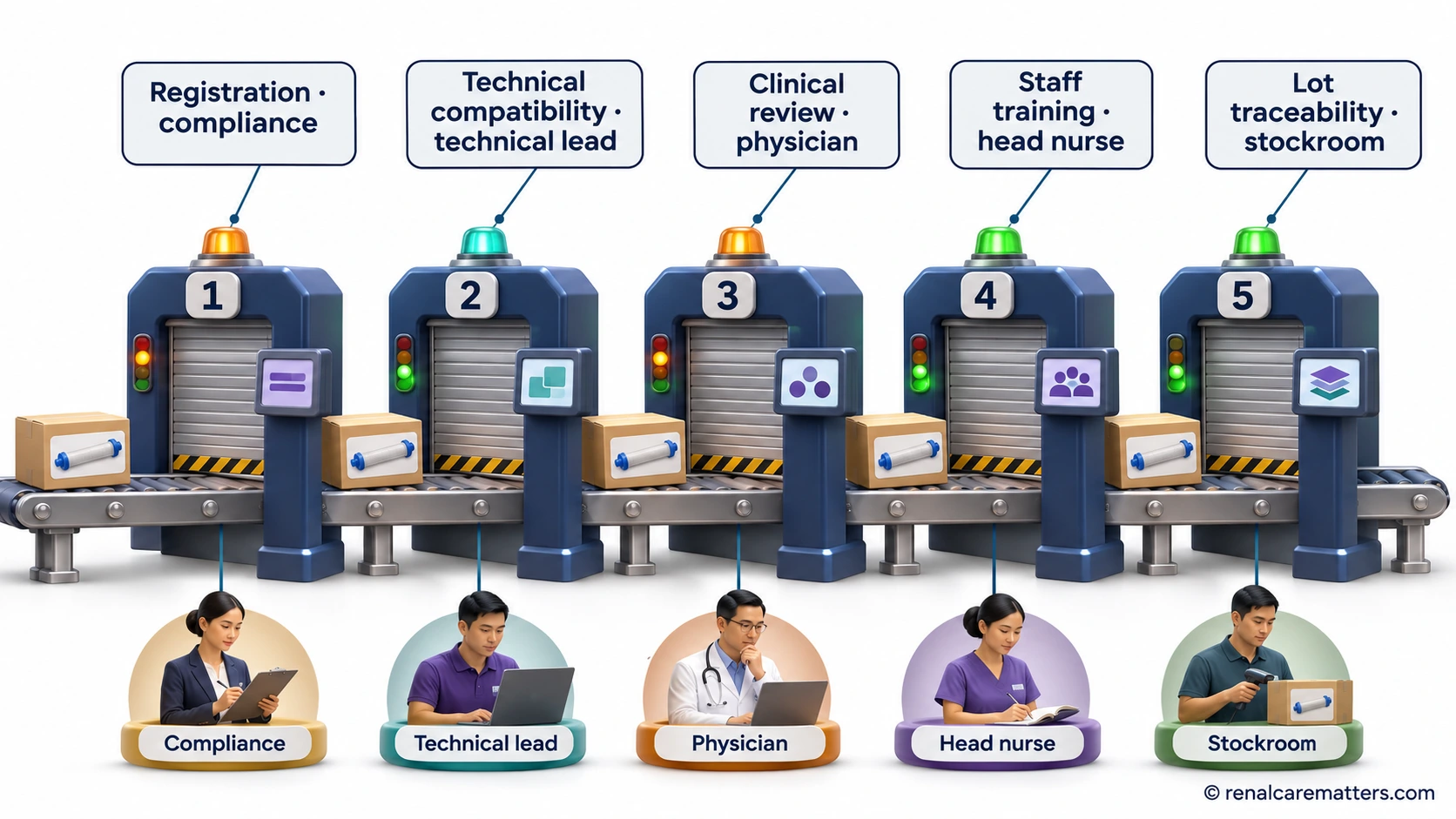
Paying for it does not make it safe
Figure 3. Paying for a substitute does not make it safe to use. Each gate has its own owner.
Figure 4 · Gates for a substitute
1. RegulatoryRegistered for sale in the Philippines for this use.
2. TechnicalCompatible with your machines, lines, and reprocessing method if you reuse.
3. ClinicalMembrane, surface area, and clearance reviewed against your patients’ prescriptions by a physician.
4. TrainingStaff shown any differences in priming, handling, or alarms.
5. TraceabilityLot numbers recorded so a recall can find every patient.
Each gate has its own owner: compliance, the technical lead, the clinical head or a designated nephrologist, the head nurse, and the stockroom. An owner who approves payment has not approved suitability.
Lesson · part 4
Disclose, then step back
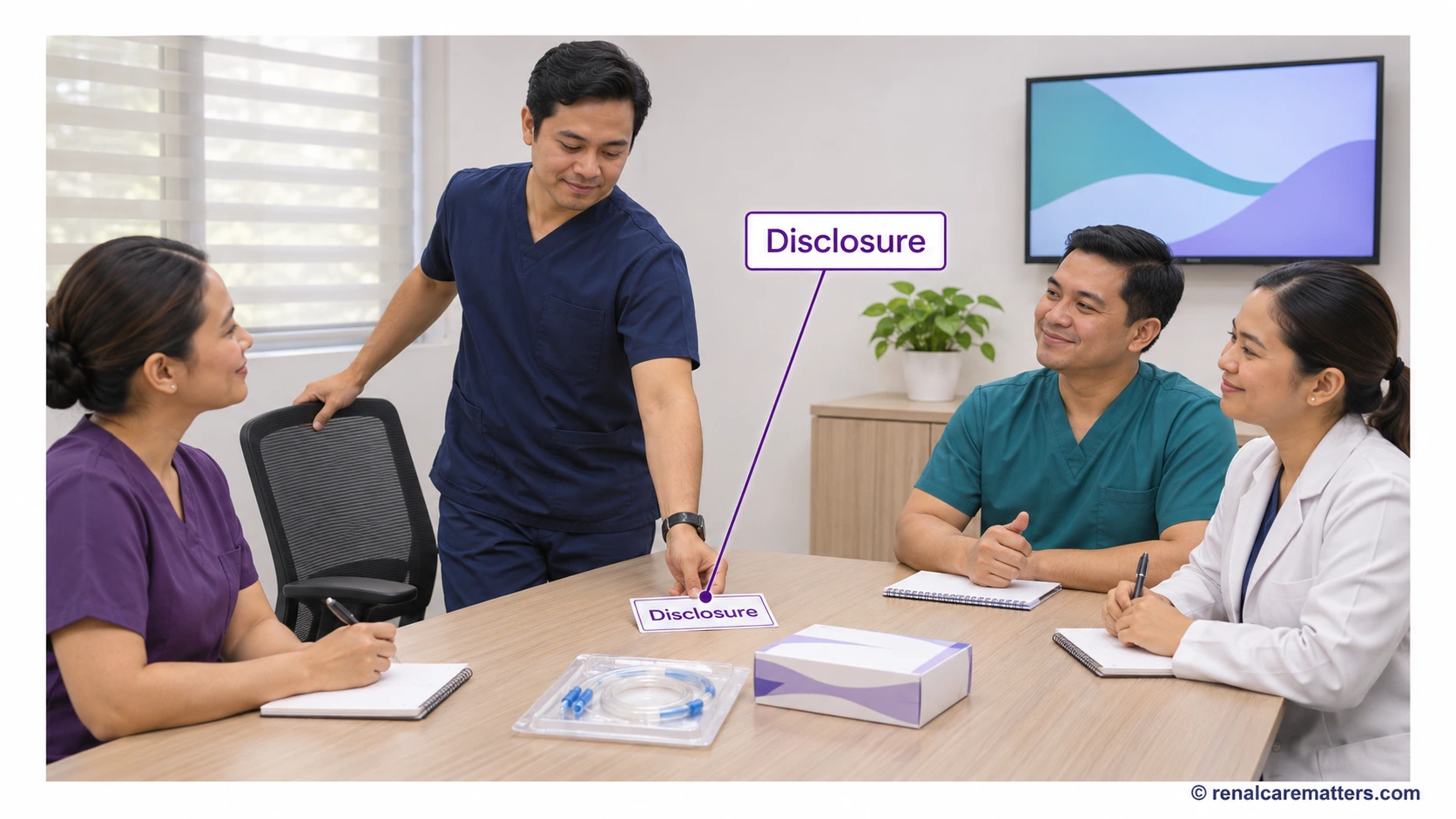
Figure 5. Disclose, then step back. A tie to a vendor is not a scandal; hiding it is.
A family tie to a vendor is not a scandal. Hiding it is. Before any evaluation, the person with the tie discloses it in writing and steps back from the decision, following your facility’s purchasing and recusal process. Compliance should review inducements, bundled charges, and anything that looks like a payment for referrals.
The same discipline applies to clinicians. When two nephrologists dispute referrals, coverage, or use of a service, first make sure no patient is left without a physician. Then document the competing interests, ask a neutral medical staff leader or governance designee to mediate under your bylaws, and recuse anyone with a material conflict. Agree who tells patients, who resolves open orders, and who fixes any process defect the dispute exposed. Credentialing or conduct issues go through the authorized medical staff pathway.
RememberPatients should never feel a dispute between the people responsible for them.
On the floor
Real situations: problems and solutions
These are fictional but typical. For each one, cover the answer, decide what you would do, then compare. Where a step depends on local rules, your unit’s procedure and your supervisor’s direction come first.
The relative’s offer
What you see
A vendor tied to an owner’s relative offers immediate delivery of an unfamiliar dialyzer.
What is likely going on
A conflict of interest and an unqualified product.
What to do
Disclose, recuse, and qualify the product through the usual gates.
Why it matters
Speed does not replace qualification.
Collections are late
What you see
PhilHealth payments are delayed and the owner proposes cutting the second carbon tank.
What is likely going on
A cost cut that removes a safety barrier.
What to do
Show the risk and the cost of the alternatives. Escalate in writing.
Why it matters
Some costs are the price of operating at all.
Two nephrologists, one unit
What you see
Two nephrologists dispute who covers which patients.
What is likely going on
A conflict that leaves patients in between.
What to do
Secure coverage first, then ask a neutral leader to mediate under the bylaws.
Why it matters
Patients should never feel the dispute.
Field notes
Use ranges when assumptions are uncertain.
Count the cost of canceling sessions, not only the cost of buying.
Keep disclosure forms current for everyone on the purchasing committee.
Case review
Back to the case: Three days of stock
What would make the substitute usable? Evidence that it passes each gate: registration for this use, technical compatibility confirmed by the technical lead, clinical review of its specifications against your patients’ prescriptions, staff training, and lot traceability. That cannot happen by tomorrow without cutting corners.
If the evidence arrives late. Restrict operations to verified supply. Ask the attending nephrologists to prioritize the roughly 60 treatments that fall in the two-day gap, try for partial early delivery or a loan from a partner unit, and transfer sessions where needed with confirmed acceptance. Present the owner with the incremental 9,600 pesos against the cost of transfers and the clinical risk of gaps. On these numbers, paying for verified stock is likely the cheaper option.
The family tie. The owner discloses the relationship in writing and steps back from the decision. The substitute is evaluated through the usual gates by people without the tie, and compliance reviews the offer. If it qualifies later, it can be considered on its merits for the next order.
Skills lab · with your preceptor
Skills checklist: Resource decision and conflict of interest
Prepare and present a supply decision to a mock board, including a disclosed conflict. Your preceptor rates each step as satisfactory, needs practice, or not observed. Steps marked Critical must all be satisfactory before sign-off. This checklist supports supervised learning; your unit’s own procedure and competency form are the authority. A printable version of every checklist is on the trainer page.
Calculates the runway and the number of treatments in the gap.
Compares full costs, including cancellations, transfers, and clinical risk.
Uses ranges where assumptions are uncertain.
CriticalPrevents use of an unqualified supply.
Names the owner of each qualification gate.
CriticalRequires written disclosure and recusal before vendor evaluation.
CriticalEscalates a cost cut that removes a safety control, in writing.
CriticalGives a time-bound fallback plan with physician prioritization.
Placement activity. List your unit’s ten critical supplies with their lead times, approved substitutes, and qualification owners. Fill any gap before the next shortage.
Self-assessment
Check your understanding
Each visit draws 8 questions at random from this module’s 15-question bank. Choose the single best answer for each, then select Check answers; an explanation appears under the best answer. Select New set of questions for a different mix. A good target is 7 of 8 on two different sets. Nothing you select is sent anywhere; scoring happens in your browser.
Educational material for physicians and unit leaders. Completing it is an Academy learning record only. It does not confer CPD units, PSN attestation, DOH eligibility, PhilHealth accreditation, or appointment authority, and it does not replace current regulations, your facility’s bylaws and protocols, or legal advice.