Judging a new technology such as hemodiafiltration on evidence, staged launches with stop rules, handover, and a 30-60-90 plan.
PublishedNailathalaGipatikPepalwal:ReferencesMga SanggunianMga TinubdanReng Reperensya:6Audience: Physician heads of adult maintenance hemodialysis units · nephrologists preparing to take an appointment · head nurses, operations managers, and quality leads who share the leadership tableRead timeOras ng pagbasaOras sa pagbasaOras ning pamamasa:
Training track for physician heads of hemodialysis services
This module is study material for physician heads of adult maintenance hemodialysis services. It explains the reasoning behind common decisions; it is not a protocol and not legal advice. Regulations change: confirm every rule against the current text and your regional office before you rely on it. Clinical limits are set by your unit’s approved protocols and the attending nephrologist. Every case and record is fictional.
Learning objectives
After this module you should be able to
Frame a new technology as a question: population, intervention, comparison, and outcome.
Appraise the evidence for hemodiafiltration, converting relative effects into absolute effects and numbers needed to treat.
Check infrastructure, water, monitoring, staffing, and cost before committing to a new service.
Plan a staged launch with stop criteria agreed in advance, and a review date for continuing, extending, or stopping.
Give and receive a handover that lists every open item with an owner and a deadline.
Build a 30-60-90 day plan that starts with the work people are already waiting for.
Pre-testBefore you read, answer the 8 self-assessment questions and note your score. After the module, select New set of questions and compare. The difference is what you learned; the questions you still miss are what to reread.
Start here
The big picture, in plain words
In plain wordsA new service is like adding a floor to a house. Before you build up, you check the foundations: the water supply, the wiring, the people who will live there, and whether the floor below is already cracked.
The picture has a limit. A house does not change while you build. A dialysis unit does: patients arrive, staff leave, and the evidence for a technology can change between the day you decide and the day you open. Build a review date into every decision.
Figure 1 · Key terms for this module
Hemodiafiltration (HDF)Hemodialysis combined with convection: large volumes of fluid are filtered from the blood and replaced with ultrapure fluid, removing larger molecules more effectively.
Convection volumeThe total volume filtered by convection in one session, usually in liters.
Relative risk reductionThe proportional fall in risk with a treatment.
Absolute risk reductionThe difference in risk between groups, in percentage points.
Number needed to treat (NNT)How many patients must be treated for a given time to prevent one event.
Stop criterionA condition agreed in advance that pauses or ends a pilot.
Opening case · fictional
Case: The night shift already announced
You start as clinical head of a twelve-station unit in Angeles City. In your first week you find a two-week backlog of new referrals, a disaster drill overdue by eight months, and two machines whose maintenance records stop in June. Your predecessor offers a ten-minute handover in the hallway.
The owner, Mr. Benjamin Lacson, has already announced a night shift starting next week. He also shows you a vendor brochure: “Hemodiafiltration lowers mortality by 23%. Our competitor has it. I want it by March.”
Before reading on, decide:
What needs your attention this week?
What would you need to see before agreeing to the night shift?
How do you respond to the brochure’s claim and the March deadline?
Keep your answers in mind. The lesson gives you what you need, and the case review near the end shows one sound response.
Lesson · part 1
Write the question before you buy the answer
Figure 2. Before buying a technology, write the question it is supposed to answer.
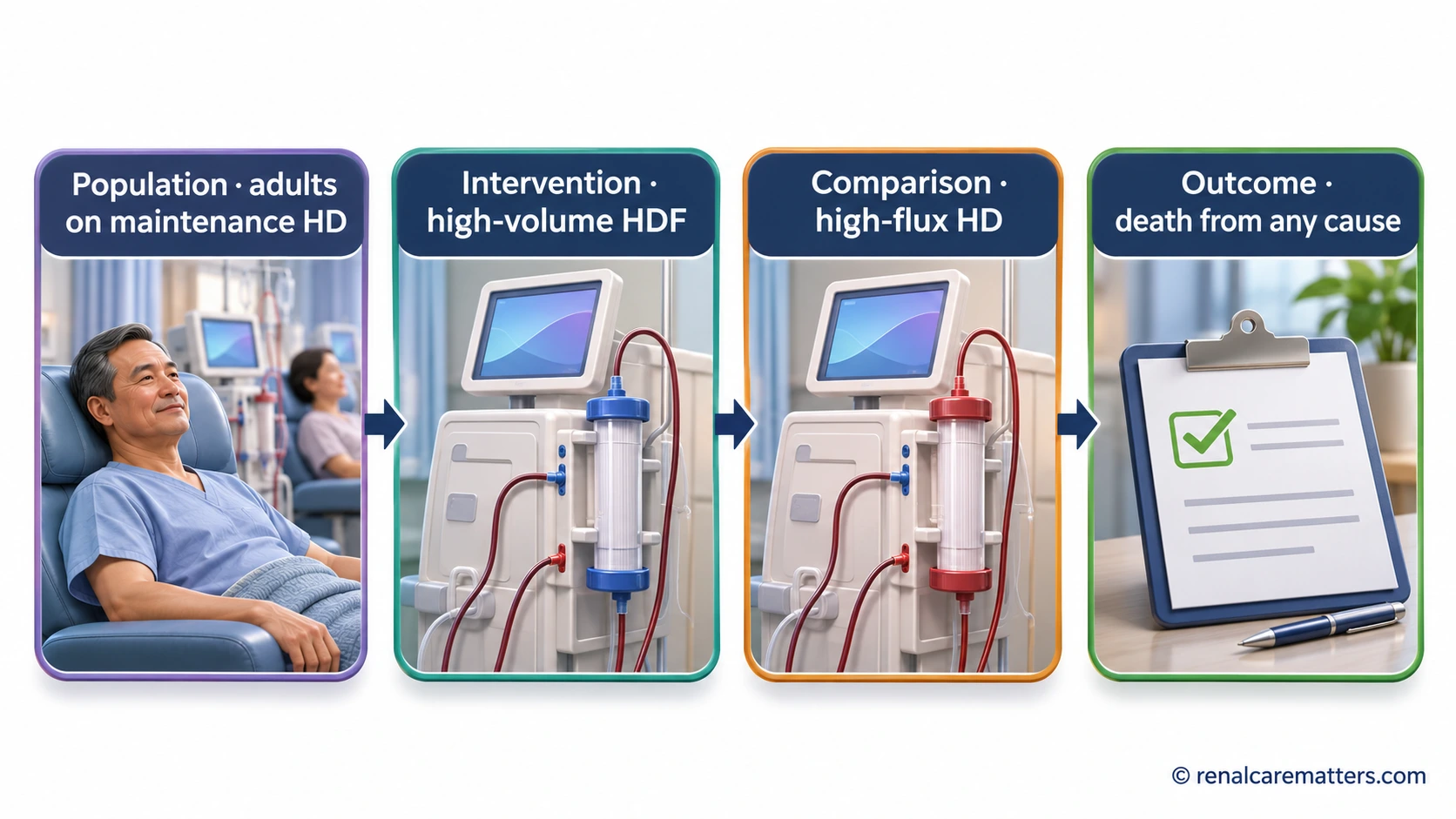
Every technology is an answer to a question. Write the question first: in which patients, compared with what, to improve which outcome? For hemodiafiltration: in adults on maintenance hemodialysis who can achieve high convection volumes, does high-volume hemodiafiltration, compared with high-flux hemodialysis, reduce death from any cause?
Then ask what alternatives would answer the same need, such as making the existing service more reliable: fewer catheters, fewer missed sessions, better delivered dose. A new machine does not fix a unit that cannot keep its current patients on schedule.
Lesson · part 2
What the hemodiafiltration evidence shows
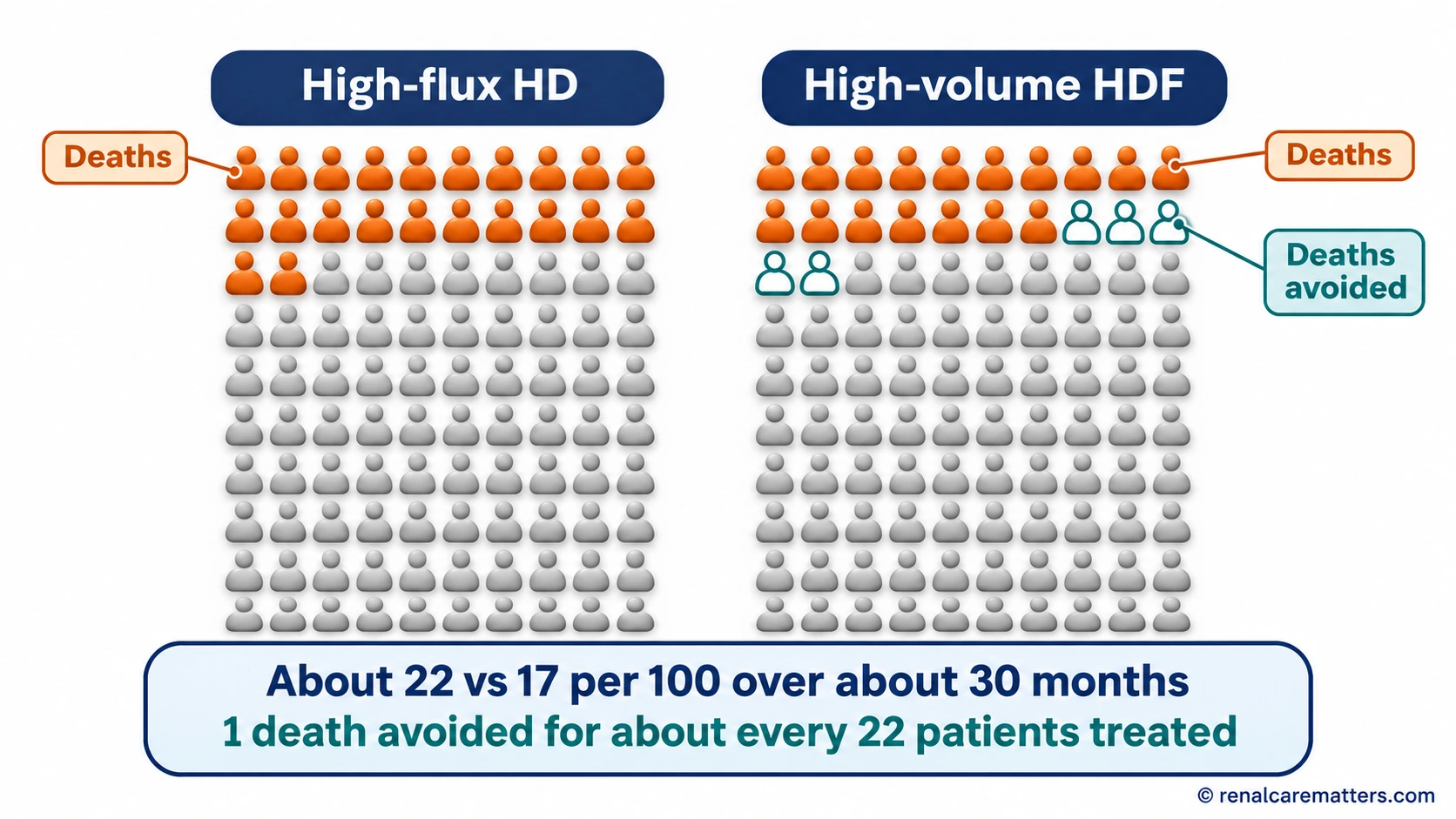
The CONVINCE trial randomized 1,360 adults across European centers to high-dose hemodiafiltration or continued high-flux hemodialysis. Over a median of 30 months, with a mean convection volume of 25.3 liters per session, death from any cause occurred in 17.3% of the hemodiafiltration group and 21.9% of the hemodialysis group (hazard ratio 0.77, 95% confidence interval 0.65 to 0.93).1
From relative to absolute. A hazard ratio of 0.77 is the brochure’s “23% lower mortality.” The absolute difference was 21.9% − 17.3% = 4.6 percentage points over about 30 months. Number needed to treat = 1 ÷ 0.046 ≈ 22 patients treated for about two and a half years to prevent one death. Calculator 9 does this for any trial.
Figure 3. About 22 versus 17 per 100 over about 30 months: one death avoided for about every 22 patients treated.
Strong for patients who can achieve high convection volume; not blinded; European centers with ultrapure water
EuDial consensus of the European Renal Association, 20252
HDF appears associated with improved overall and cardiovascular survival, provided high convection volumes are achieved; generalizability depends on patients’ overall health
Consensus from meta-analyses and expert opinion; not a standard of care
International retrospective cohort, 71,669 patients3
HDF associated with about 20% fewer hospital admissions and hospital days
Compares high-volume HDF with high-flux hemodialysis (HD) on non-cancer mortality or hospitalization with cardiovascular events or infection
Follow-up ended in May 2025; results were not found in the literature searched on November 24, 2026
The benefit depends on dose. Patients who cannot achieve high convection volumes, often because of poor vascular access or low blood flow, may not gain it. The evidence supports offering high-volume HDF where the unit can deliver it reliably; it does not yet tell you that every patient must have it. Check whether H4RT has reported before you decide.
Modality and schedule can also be combined. In a Spanish randomized trial in patients starting dialysis with residual kidney function, twice-weekly incremental HDF gave clinical outcomes similar to thrice-weekly HDF with about 70 rather than 123 sessions a year; it was a small trial and needs confirmation.5
Lesson · part 3
What a new service needs before day one
Domain
Question
Owner
Permission
Does the change need a Department of Health (DOH) or Philippine Health Insurance Corporation (PhilHealth) decision first? (Modules 2 and 3)
Compliance lead
Water
Can the system deliver ultrapure water and the larger volumes HDF needs, with monitoring?6
Technical lead
Equipment
Are machines commissioned, released, and maintained under contract?
Biomedical lead
People
Are nurses trained and validated, and is the night shift staffed with the same competencies as the day?
Head nurse
Patients
Who is eligible, how will convection volume be measured, and how will patients consent?
Clinical head
Money
What do utilization and total cost look like under low and high uptake?
Finance
Continuity
Can the unit still meet its disaster and transfer obligations with the added service?
Operations
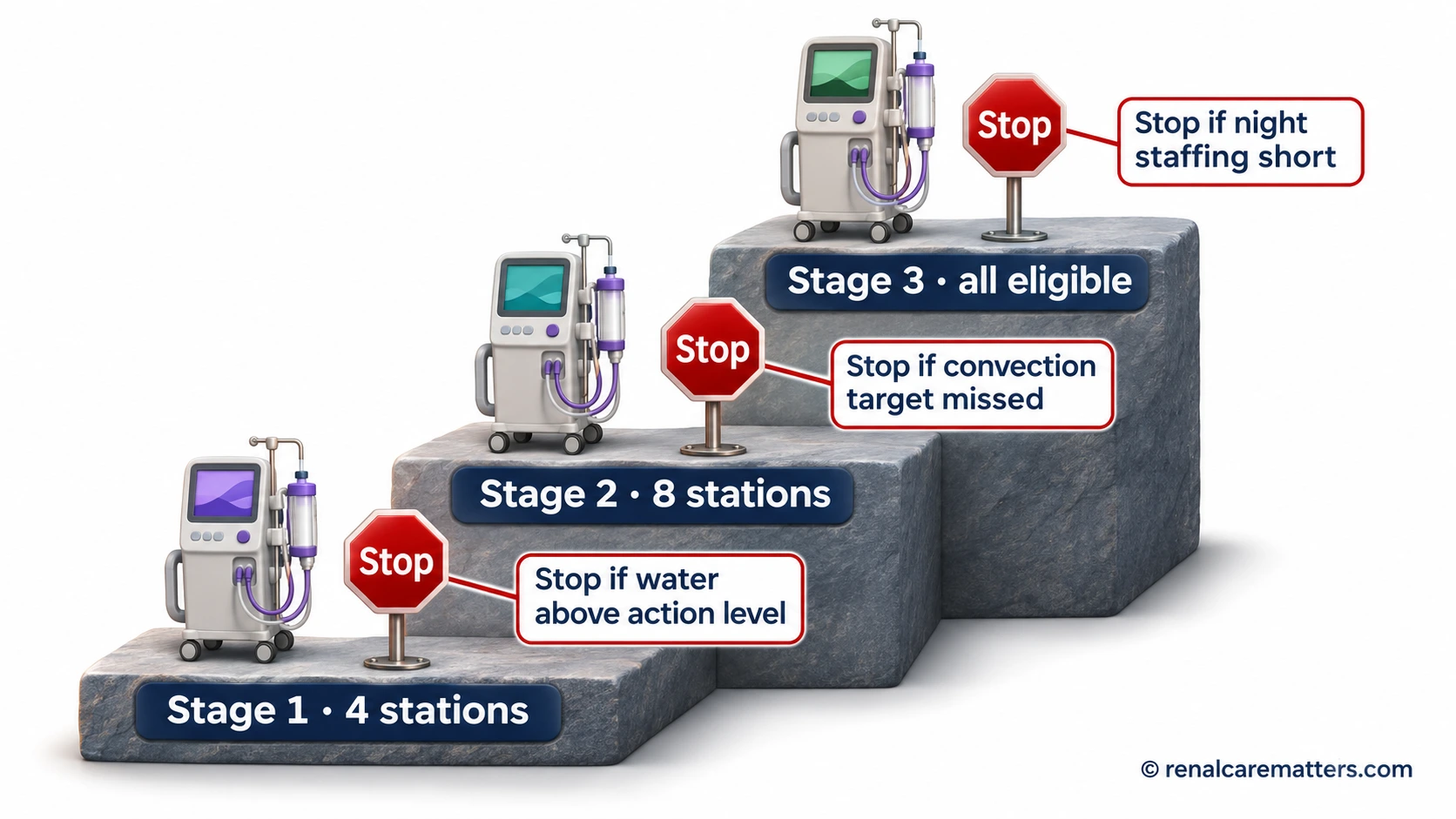
Figure 4. A staged launch with stop rules. Agree in advance what would make you pause.
Launch in stages, with stop criteria agreed before the first patient: for example, a water result above an action level, a convection volume target missed in most sessions, or a staffing shortfall on any night. Set a review date for continuing, extending, or stopping. If the decision is deferred, keep the original scope and model how demand will be met safely meanwhile.
Stop and callStop any new service or shift that lacks required permissions, validated staff, released equipment, or verified water capacity, whatever date has been announced. Escalate the gap and the options to the owner in writing.
Lesson · part 4
Handover and the first 90 days
A handover is complete when the incoming lead has acknowledged, in writing, every open item: pending results, transfers in progress, complaints, corrective actions, workforce gaps, maintenance, and regulatory deadlines, each with an owner and a due date. What is not written is not handed over.
Figure 5. Your first 90 days. Find the work people are already waiting for before you plan the future.
Figure 6 · 30-60-90
First 30 daysReconcile your appointment, scope, and policy versions. Walk a shift. Trace a referral and a claim. Inspect water and machine evidence with the technical leads. Meet nursing, operations, and patient representatives.
Days 31 to 60Complete a focused risk review and a continuity test.
Days 61 to 90Present a small number of measurable improvements, budget decisions, and open issues to the owner.
RememberSpend your first week finding the work people are already waiting for. A referral, a result, a repair, or a staffing decision each needs an owner before you plan the future.
Distinguish containment from improvement. A machine with no maintenance record is a hold this week. A new quality dashboard can wait for day 60.
On the floor
Real situations: problems and solutions
These are fictional but typical. For each one, cover the answer, decide what you would do, then compare. Where a step depends on local rules, your unit’s procedure and your supervisor’s direction come first.
The night shift already announced
What you see
The owner announced a night shift before staffing and water capacity were checked.
What is likely going on
A launch without readiness.
What to do
Publish the readiness criteria and a date to review them.
Why it matters
A launch that has to be pulled back hurts more than a delay.
The brochure’s survival claim
What you see
A vendor brochure says hemodiafiltration lowers mortality by 23%.
What is likely going on
A relative effect without context.
What to do
Ask for the absolute effect, the population, and the convection volume achieved.
Why it matters
A relative risk reduction alone overstates benefit.
The handover in a hallway
What you see
Your predecessor offers a ten-minute verbal handover.
What is likely going on
A handover without a list.
What to do
Ask for the open items in writing, each with an owner and a deadline.
Why it matters
What is not written is not handed over.
Field notes
Spend your first week finding work that people are waiting for.
Agree stop criteria before you start a pilot.
Present a few measurable improvements at 90 days, not many promises.
Case review
Back to the case: The night shift already announced
This week. Ask for the handover in writing, with every open item, owner, and deadline. Hold the two machines without maintenance records until the biomedical lead releases them. Clear the referral backlog by giving each referral an owner and a date. Schedule the overdue disaster drill.
Before the night shift. Written readiness criteria: any required permission, validated nurses and physician coverage at night equal to the day, released machines, verified water capacity for the extra hours, and transport for patients leaving late at night. Publish the criteria and a date to review them with Mr. Lacson. If they are not met, the start date moves.
The brochure and March. The 23% is a relative reduction from CONVINCE. Explain the absolute difference, about 4.6 percentage points over two and a half years, or one death prevented for about every 22 patients treated, in patients who achieved high convection volumes. Offer to appraise HDF properly: eligible patients, water and machine requirements, staff training, cost under low and high uptake, and whether H4RT has reported. A staged pilot with stop criteria may be reasonable later in the year; a March deadline set before the water system has been assessed is not.
Skills lab · with your preceptor
Skills checklist: Technology appraisal, go/no-go brief, and handover
Prepare a go/no-go brief for a new service and a written handover, and defend them at a mock review where the board asks for immediate extra capacity. Your preceptor rates each step as satisfactory, needs practice, or not observed. Steps marked Critical must all be satisfactory before sign-off. This checklist supports supervised learning; your unit’s own procedure and competency form are the authority. A printable version of every checklist is on the trainer page.
Writes the question as population, intervention, comparison, and outcome.
Converts a relative effect into an absolute difference and number needed to treat.
Identifies whether newer evidence, such as H4RT, has reported before deciding.
CriticalChecks permissions, water, equipment, staff, patients, money, and continuity.
CriticalAgrees stop criteria and a review date before launch.
CriticalHolds a launch that lacks permission, validated staff, released equipment, or water capacity.
Obtains a written handover with owners and deadlines for every open item.
Separates this week’s containment from improvements that can be sequenced.
Placement activity. Write your own 30-60-90 day plan, or review the one you are living. Present it to your owner and ask for one decision you need to begin.
Self-assessment
Check your understanding
Each visit draws 8 questions at random from this module’s 15-question bank. Choose the single best answer for each, then select Check answers; an explanation appears under the best answer. Select New set of questions for a different mix. A good target is 7 of 8 on two different sets. Nothing you select is sent anywhere; scoring happens in your browser.
Blankestijn, P. J., Vernooij, R. W. M., Hockham, C., Strippoli, G. F. M., Canaud, B., Hegbrant, J., Barth, C., Covic, A., Cromm, K., Cucui, A., Davenport, A., Rose, M., Török, M., Woodward, M., Bots, M. L., & CONVINCE Scientific Committee Investigators. (2023). Effect of hemodiafiltration or hemodialysis on mortality in kidney failure. New England Journal of Medicine, 389(8), 700–709. https://doi.org/10.1056/NEJMoa2304820
Battaglia, Y., Shroff, R., Meijers, B., Nistor, I., Alfano, G., Franssen, C., Luyckx, V., Liakopoulos, V., Mantovani, A., Baciga, F., Caccia, F., Momentè, C., Davenport, A., Blankestijn, P. J., Covic, A., Combe, C., & Basile, C. (2025). Haemodiafiltration versus high-flux haemodialysis: A consensus statement from the EuDial working group of the ERA. Nephrology, Dialysis, Transplantation, 40(8), 1590–1614. https://doi.org/10.1093/ndt/gfaf024
Zhang, Y., Winter, A., Ficociello, L. H., Ferrera, B. A., Carioni, P., Apel, C., Arkossy, O., Anger, M., Kossmann, R., Usvyat, L. A., & Stuard, S. (2025). Real-world hospitalization outcomes with on-line hemodiafiltration versus high-flux hemodialysis: A retrospective, international cohort study. Clinical Journal of the American Society of Nephrology, 21(5), 852–859. https://doi.org/10.2215/CJN.0000000955
Caskey, F. J., Procter, S., MacNeill, S. J., Wade, J., Taylor, J., Rooshenas, L., Liu, Y., Annaw, A., Alloway, K., Davenport, A., Power, A., Farrington, K., Mitra, S., Wheeler, D. C., Law, K., Lewis-White, H., Ben-Shlomo, Y., Hollingworth, W., Donovan, J., & Lane, J. A. (2022). The high-volume haemodiafiltration vs high-flux haemodialysis registry trial (H4RT): a multi-centre, unblinded, randomised, parallel-group, superiority study to compare the effectiveness and cost-effectiveness of high-volume haemodiafiltration and high-flux haemodialysis in people with kidney failure on maintenance dialysis using linkage to routine healthcare databases for outcomes. Trials, 23(1), 532. https://doi.org/10.1186/s13063-022-06357-y
Fernández Lucas, M., Muriel, A., Mendiola, N. R., Merino, J. L., Collado, A., Díaz Domínguez, M. E., Ruíz-Roso, G., Sánchez, R., Herrero, J. A., Bouarich, H., López de la Manzanara, V., & Zamora, J. (2025). Randomized trial of twice-Weekly versus thrice-Weekly hemodiafiltration for initiation of renal replacement therapy. Kidney International Reports, 10(12), 4188–4198. https://doi.org/10.1016/j.ekir.2025.09.048
International Organization for Standardization. (2024). Preparation and quality management of fluids for haemodialysis and related therapies: Part 3. Water for haemodialysis and related therapies (ISO Standard No. 23500-3:2024, 2nd ed.). ISO.
Educational material for physicians and unit leaders. Completing it is an Academy learning record only. It does not confer CPD units, PSN attestation, DOH eligibility, PhilHealth accreditation, or appointment authority, and it does not replace current regulations, your facility’s bylaws and protocols, or legal advice.