Writing a risk, scoring it honestly, the hierarchy of fixes, rates with denominators, and telling improvement from research.
PublishedNailathalaGipatikPepalwal:ReferencesMga SanggunianMga TinubdanReng Reperensya:2Audience: Physician heads of adult maintenance hemodialysis units · nephrologists preparing to take an appointment · head nurses, operations managers, and quality leads who share the leadership tableRead timeOras ng pagbasaOras sa pagbasaOras ning pamamasa:
Training track for physician heads of hemodialysis services
This module is study material for physician heads of adult maintenance hemodialysis services. It explains the reasoning behind common decisions; it is not a protocol and not legal advice. Regulations change: confirm every rule against the current text and your regional office before you rely on it. Clinical limits are set by your unit’s approved protocols and the attending nephrologist. Every case and record is fictional.
Learning objectives
After this module you should be able to
Write a risk as cause, failure, and consequence, score it, and name its owner and escalation threshold.
Use failure mode and effects analysis to test a process before you change it.
Investigate an event from work as it was actually done, looking for latent conditions rather than a person to blame.
Choose a fix from the stronger end of the hierarchy, and measure whether it worked.
Calculate a rate with its denominator and confidence interval, and pair every measure with a balancing measure.
Tell audit, improvement, and research apart, and send research questions to the ethics pathway.
Pre-testBefore you read, answer the 8 self-assessment questions and note your score. After the module, select New set of questions and compare. The difference is what you learned; the questions you still miss are what to reread.
Start here
The big picture, in plain words
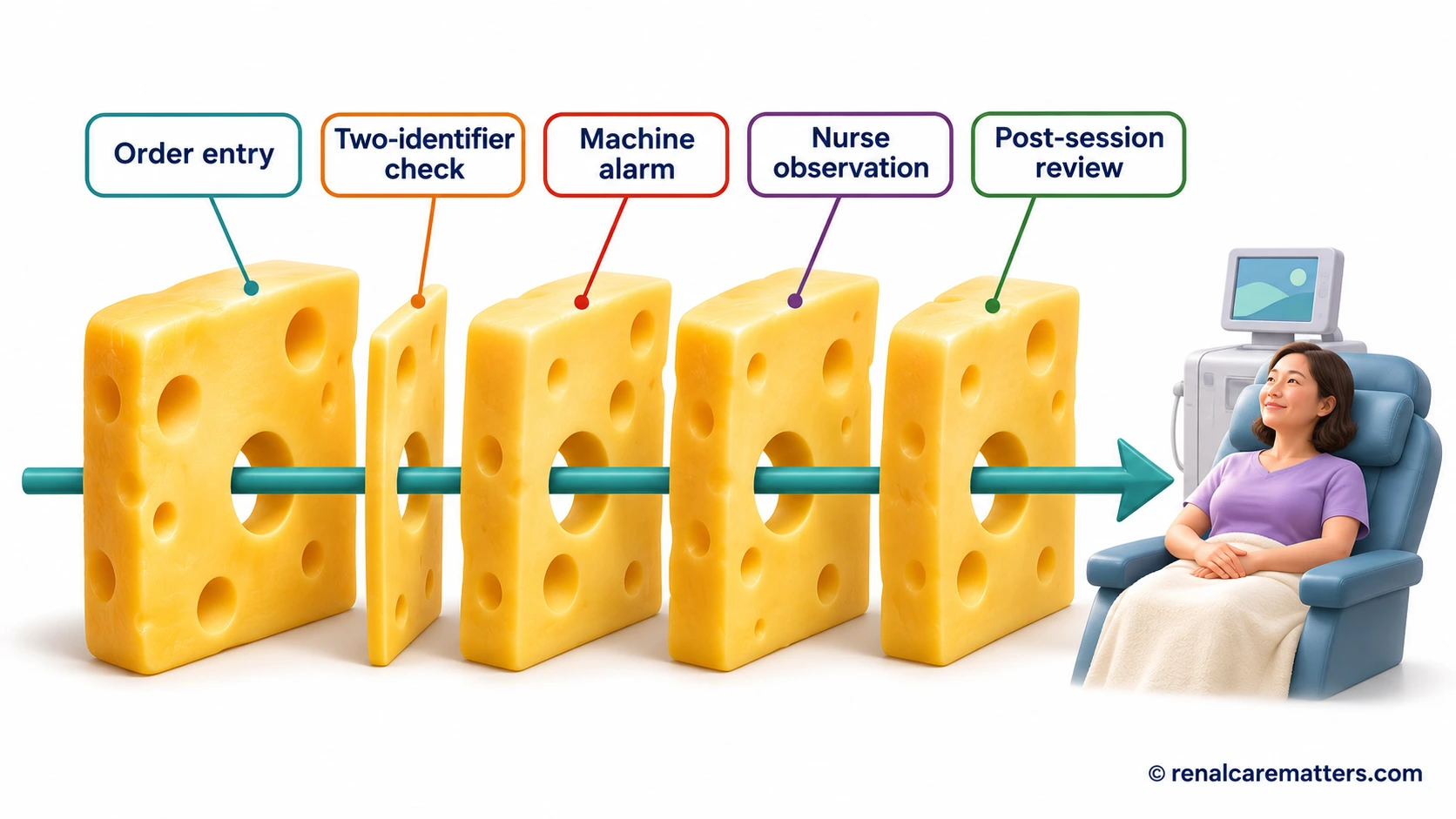
In plain wordsSafety layers are like slices of Swiss cheese. Each slice has holes, and most of the time the holes do not line up. Harm happens on the day they do.
Figure 1. Harm passes when the holes line up. The fix is a thicker slice where the holes keep recurring.
The picture has a limit. Real holes move. A layer that held yesterday can open today because a nurse is new, the unit is running late, or an override has become habit. Risk management is the work of finding where the holes keep lining up, and making that slice thicker.
Figure 2 · Key terms for this module
RiskA possible event described as cause, failure, and consequence.
Residual riskThe risk that remains after existing controls.
FMEAFailure mode and effects analysis, a structured way to ask how each step of a process could fail and what would follow.
Latent conditionA weakness built into the system, such as a sort order or a staffing pattern, that waits for an active error.
QAPIQuality assessment and performance improvement, the unit’s ongoing program to measure and improve care.
Balancing measureA measure that checks whether an improvement caused harm somewhere else.
Run chartData plotted over time with a median line, used to tell a real change from noise.
Opening case · fictional
Case: The order caught in time
At a twelve-station unit in Valenzuela, nurse Ms. Aileen Santos is about to program a dialysate potassium of 1.0 mmol/L for Mr. Ricardo Cruz. She stops. The order was written for Mr. Ricardo de la Cruz, who sits two stations away. The patient list sorts by station, not by name, and both men are on the afternoon shift. The electronic record has a patient-confirmation pop-up, but staff say they click through it because it appears on every screen. Nobody was harmed.
Your quality lead, Mr. Joel Ramos, asks what to put in the report. “Should I just remind everyone to be careful?”
Before reading on, decide:
What allowed the order to reach the wrong chart?
What change would you test next week, and how would you know it helped?
What would make you escalate this beyond the unit?
Keep your answers in mind. The lesson gives you what you need, and the case review near the end shows one sound response.
Lesson · part 1
Write it so it can be fixed
“Patient identification” is a topic, not a risk. A useful risk statement has three parts: the cause, the failure, and the consequence. “Because two patients with similar names share a shift and the list sorts by station (cause), an order may be entered in the wrong chart (failure), and a patient may receive the wrong dialysate potassium (consequence).”
Score likelihood and severity on a scale your facility has approved, name the existing controls and how you know they work, and estimate the residual risk. Assign an owner for the residual risk and a threshold above which it goes to leadership. A rare risk with a catastrophic consequence still deserves leadership review, even if its score looks modest.
Teaching scale. Likelihood 1 to 5 × severity 1 to 5. In this course’s exercises, a score of 15 or more, or any catastrophic consequence, triggers leadership review. Your facility’s approved thresholds apply in practice. Calculator 4 scores and flags a risk.
Before you change a process, test it on paper. In failure mode and effects analysis, a team walks each step and asks how it could fail, what would follow, and how likely and detectable that failure is. One Taiwanese unit used it to redesign deterioration alerts during hemodialysis and reported that its hazard scores fell by 71%.1 That is a single-center before-and-after report, but the method is cheap and often finds the hole before a patient does.
Lesson · part 2
After an event: work as done, not work as imagined
After a serious event, stabilize care first, preserve records and equipment, notify leadership and the required parties, and support the patient and the staff involved (Module 13). Then build the timeline from how the work was actually done that day. The goal is to find the latent conditions, not to find the person who touched it last.
Ask what made the error easy and what made catching it hard. In the case, the latent conditions are the station sort order, two similar names on one shift, and an alert that fires so often that staff no longer read it. Each of those will be there tomorrow, whoever is on duty.
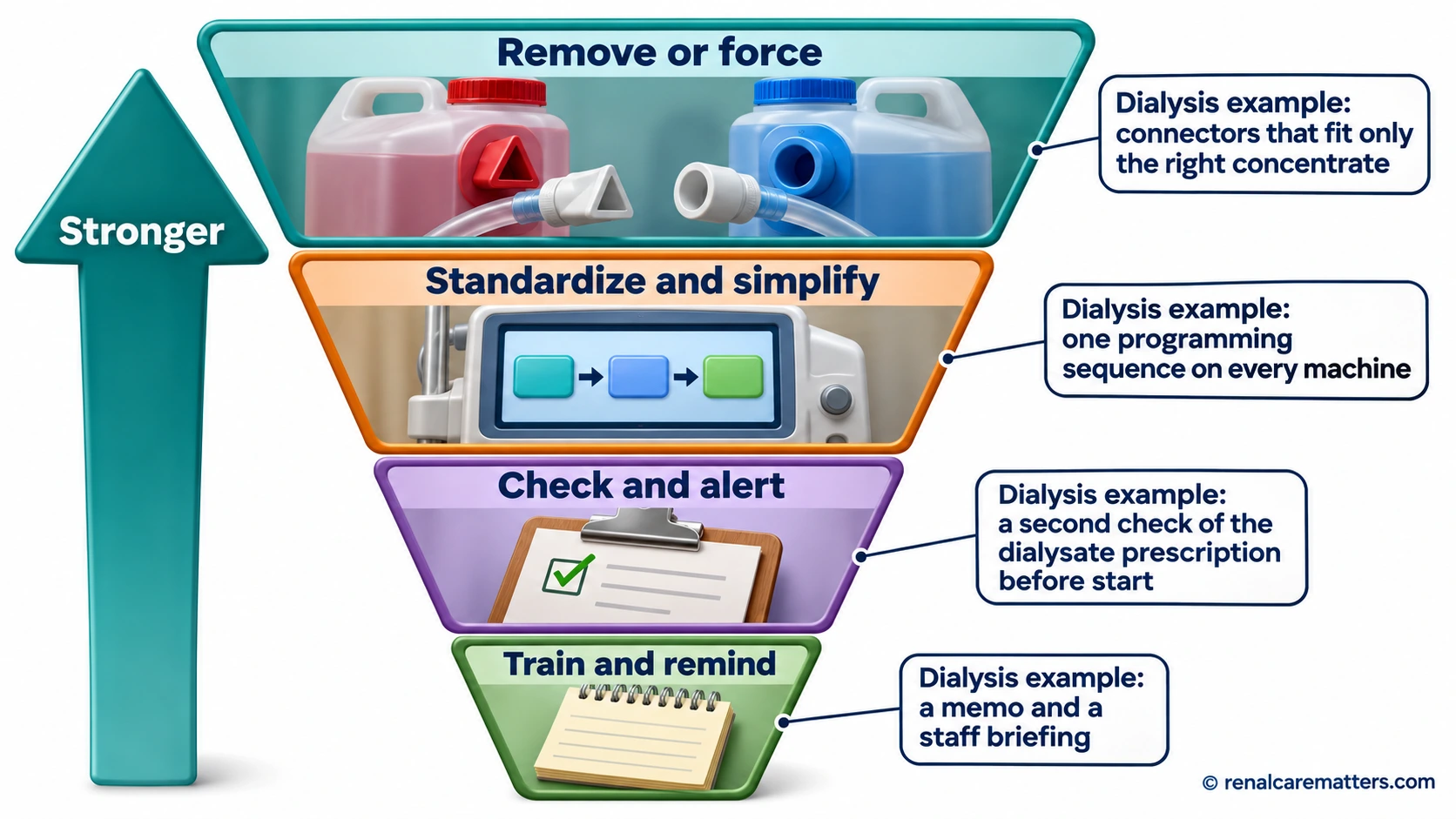
Figure 3. The hierarchy of fixes. Training supports a stronger fix; on its own it fades.
Figure 4 · The hierarchy of fixes, strongest first
Remove or forceMake the error impossible: separate similar names across shifts, require a barcode or second identifier before programming.
Standardize and simplifyOne way to do the step, on every shift.
Check and alertA second person or a targeted alert, used sparingly so it stays meaningful.
Train and remindNecessary, but on its own it fades within weeks.
RememberA reminder to be careful is the weakest fix there is. Choose one from higher up the list, then measure it.
Lesson · part 3
A rate needs a denominator
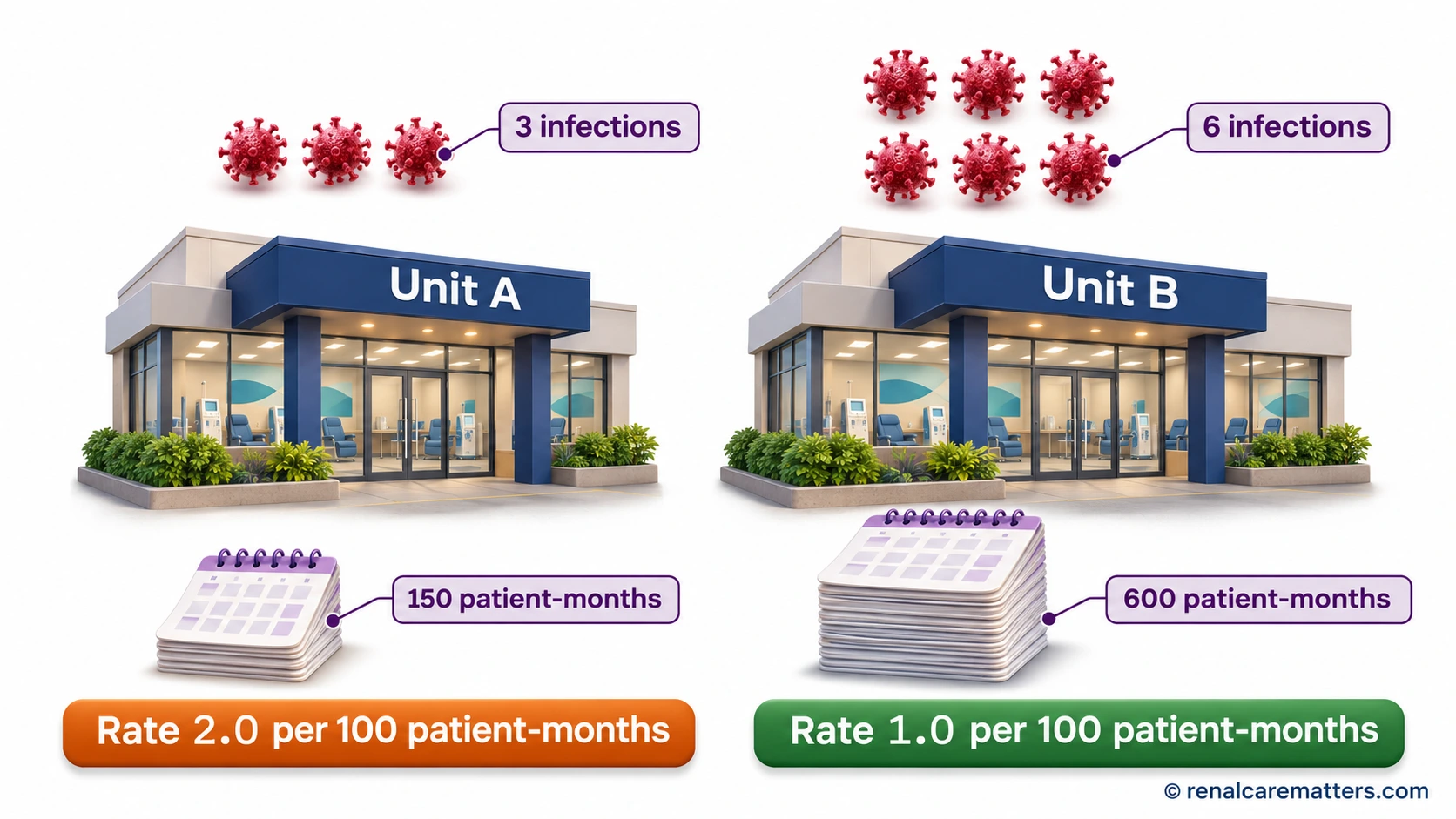
Figure 5. A count is not a rate. Every comparison needs a denominator, a time window, and the same definition.
A count tells you how many. A rate tells you how often, and only a rate can be compared across months or units. Every rate needs a definition of the event, a denominator, a time window, and a statement of what data are missing.
Measure
Numerator
Denominator
Example
Bloodstream infection rate
Events meeting the definition
Patient-months
3 in 150 = 2.0 per 100 patient-months
Catheter-related infection rate
Events in catheter patients
Catheter-days
2 in 900 = 2.2 per 1,000 catheter-days
Missed treatments
Sessions missed
Sessions scheduled
12 in 600 = 2.0 per 100
Identification check done
Correct checks observed
Opportunities observed
45 of 50 = 90%
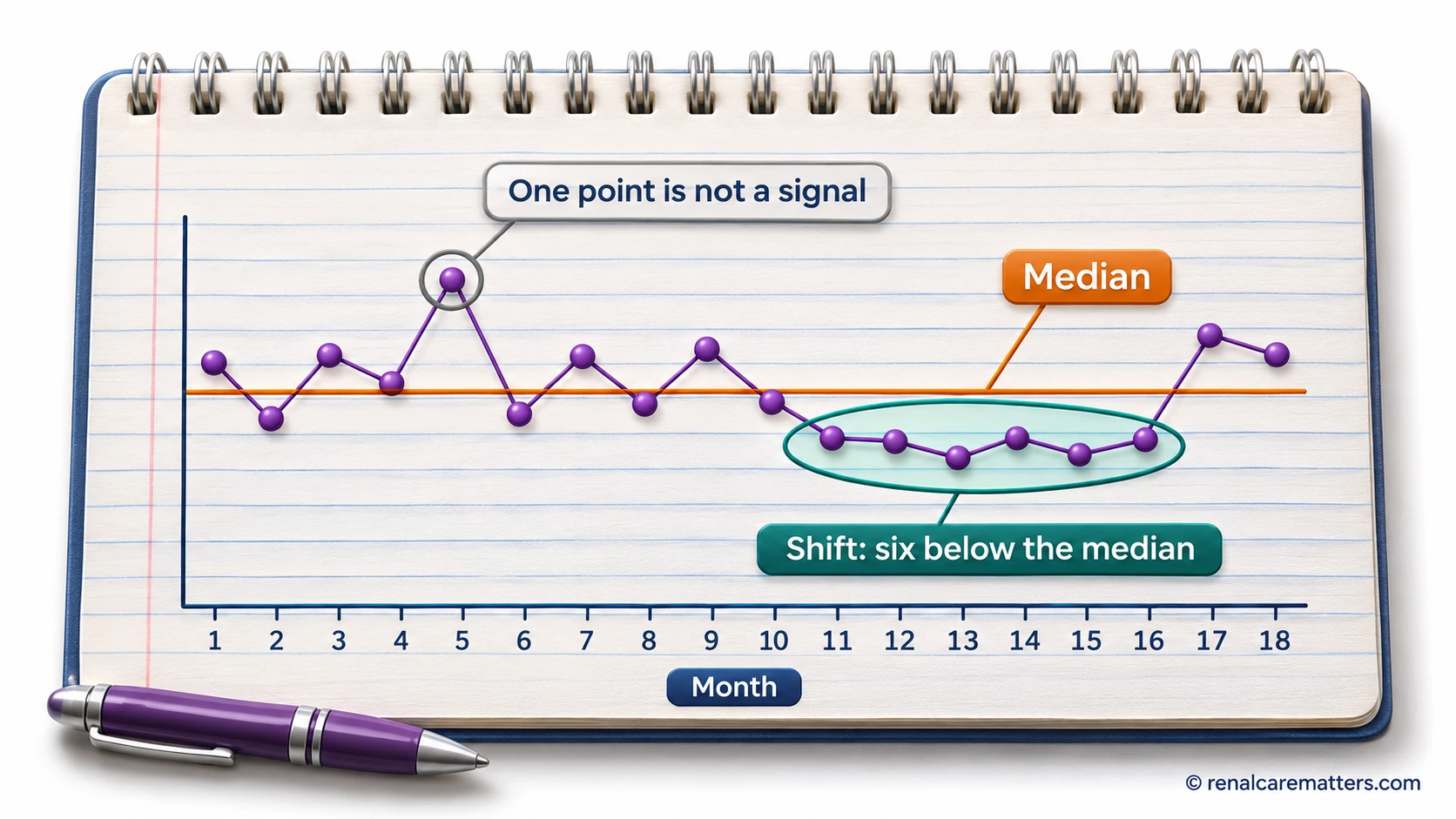
The first and third rates are both 2 per 100, but they measure different risks with different denominators. Small numbers swing widely by chance; a month with two infections instead of one is not a trend. Calculator 3 gives the rate with a 95% confidence interval and compares two periods. Plot rates on a run chart and react to a signal, such as six points in a row on one side of the median, rather than to a single point.
Figure 6. React to a signal, not to a single point.
Pair every improvement measure with a balancing measure. If a second identifier check cuts wrong-chart entries but adds fifteen minutes to afternoon starts, the delay is a harm too, and you need to see it.
Lesson · part 4
Improvement or research?
An audit asks whether you do what you said you would. Improvement asks whether a change made your own care better. Research asks a question meant to produce knowledge for others, usually by comparing groups, changing care for the purpose of the study, or sharing data beyond the unit. The line matters because research needs ethical review and, usually, consent.2
Activity
Example
Who decides how it proceeds
Audit
Percentage of sessions with a correct two-identifier check
Quality program
Improvement
Testing a new check for four weeks with run charts
Quality program, with governance
Research
Comparing outcomes before and after a vendor’s device and publishing them, or sharing treatment-level data with a sponsor
Research ethics committee, privacy lead, and governance, before any data leave or care changes
Stop and callStop any data release or study-related change in care until the research ethics pathway and the privacy lead have made a written determination.
Readiness for good research looks like good quality work: clear data definitions, complete records, trained staff, and a named data custodian. A retrospective analysis must reckon with selection bias, confounding, and missing data before anyone draws conclusions.
On the floor
Real situations: problems and solutions
These are fictional but typical. For each one, cover the answer, decide what you would do, then compare. Where a step depends on local rules, your unit’s procedure and your supervisor’s direction come first.
The near miss nobody reported
What you see
A nurse mentions in passing that she caught a wrong dialyzer at the chair last week.
What is likely going on
A near miss outside the reporting system.
What to do
Thank her, record it, and ask what caught it and whether it would catch it on a busy day.
Why it matters
Near misses are free lessons.
Infections doubled
What you see
Bloodstream infections went from one to two this month.
What is likely going on
Small numbers moving by chance.
What to do
Plot the rate with its denominator and look for a real signal before reacting, unless patients are at risk now.
Why it matters
Overreacting to noise burns trust and time.
The vendor’s study
What you see
A vendor offers equipment in exchange for treatment-level data and a before-and-after outcome study.
What is likely going on
Research dressed as improvement.
What to do
Send it to the research ethics pathway and the privacy lead before any data leave.
Why it matters
Patients did not consent to be studied.
Field notes
Write each risk as cause, failure, and consequence.
Pair every improvement measure with a balancing measure.
Close an action only when its effect is measured.
Case review
Back to the case: The order caught in time
What allowed it? Latent conditions: two similar names on the same shift, a patient list sorted by station, and an alert that fires on every screen so staff click through it. Ms. Santos’s attention was the only layer that held. Thank her, and record what caught it.
What change, and how would you know? Move one of the two patients to a different shift if clinically acceptable, and test a two-identifier check before any dialysate prescription is programmed. Measure the percentage of sessions with a correct check (process), wrong-chart entries caught or reaching the patient (outcome), and minutes added to treatment start (balancing). Review override data for the pop-up and ask IT whether it can fire only when names are similar. Run it for four weeks, including a deliberately busy shift.
When to escalate? If the fix you need, such as changing the record system or adding staff, is beyond the unit’s authority, or if the residual risk stays above your threshold, take it to the owner with the risk statement, the options, and the cost. A memo reminding staff to be careful is not an option.
Skills lab · with your preceptor
Skills checklist: Risk score, causal timeline, and effectiveness check
Score one risk, reconstruct one near miss, and design a measured change while a preceptor observes. Your preceptor rates each step as satisfactory, needs practice, or not observed. Steps marked Critical must all be satisfactory before sign-off. This checklist supports supervised learning; your unit’s own procedure and competency form are the authority. A printable version of every checklist is on the trainer page.
Writes the risk as cause, failure, and consequence.
Scores it with rationale and names existing controls and their evidence.
CriticalBuilds the timeline from work as done and identifies at least two latent conditions.
Chooses a fix above “train and remind” on the hierarchy.
Defines a process, outcome, and balancing measure with denominators.
CriticalContains the immediate hazard before the investigation is complete.
CriticalEscalates residual risk above the threshold to governance with options.
CriticalRoutes a research request to the ethics pathway and privacy lead before any data release.
Placement activity. Choose one recurring near miss on your unit. Run a four-week test of a stronger fix with a run chart and a balancing measure, and present the result to your quality meeting.
Self-assessment
Check your understanding
Each visit draws 8 questions at random from this module’s 15-question bank. Choose the single best answer for each, then select Check answers; an explanation appears under the best answer. Select New set of questions for a different mix. A good target is 7 of 8 on two different sets. Nothing you select is sent anywhere; scoring happens in your browser.
Lin, C.-H., Ho, T.-F., Chen, H.-F., Chang, H.-Y., & Chien, J.-H. (2022). Applying healthcare failure mode and effect analysis and the development of a real-time mobile application for modified early warning score notification to improve patient safety during hemodialysis. Journal of Patient Safety, 18(5), 475–485. https://doi.org/10.1097/PTS.0000000000000977
Philippine Health Research Ethics Board. (2022). National ethical guidelines for research involving human participants 2022. Philippine Council for Health Research and Development.
Educational material for physicians and unit leaders. Completing it is an Academy learning record only. It does not confer CPD units, PSN attestation, DOH eligibility, PhilHealth accreditation, or appointment authority, and it does not replace current regulations, your facility’s bylaws and protocols, or legal advice.