Why patients miss sessions, safety before scheduling, involuntary transfer, social assistance, and closing referrals.
PublishedNailathalaGipatikPepalwal:ReferencesMga SanggunianMga TinubdanReng Reperensya:6Audience: Physician heads of adult maintenance hemodialysis units · nephrologists preparing to take an appointment · head nurses, operations managers, and quality leads who share the leadership tableRead timeOras ng pagbasaOras sa pagbasaOras ning pamamasa:
Training track for physician heads of hemodialysis services
This module is study material for physician heads of adult maintenance hemodialysis services. It explains the reasoning behind common decisions; it is not a protocol and not legal advice. Regulations change: confirm every rule against the current text and your regional office before you rely on it. Clinical limits are set by your unit’s approved protocols and the attending nephrologist. Every case and record is fictional.
Learning objectives
After this module you should be able to
Explain what predicts missed sessions, and replace the label non-adherent with a question about barriers.
Separate a clinical disagreement, a complaint, an inability to pay, and a credible safety threat, and respond to each differently.
Make the area safe first, secure the next treatment second, and make administrative decisions last.
Review any proposed restriction or involuntary transfer with leadership and compliance, with a continuity plan in place.
Connect patients to social assistance such as the Department of Social Welfare and Development (DSWD) AICS program and Malasakit Centers while keeping a separate care plan.
Track referrals for access, transplant, peritoneal dialysis, and conservative care until an outcome is recorded.
Pre-testBefore you read, answer the 8 self-assessment questions and note your score. After the module, select New set of questions and compare. The difference is what you learned; the questions you still miss are what to reread.
Start here
The big picture, in plain words
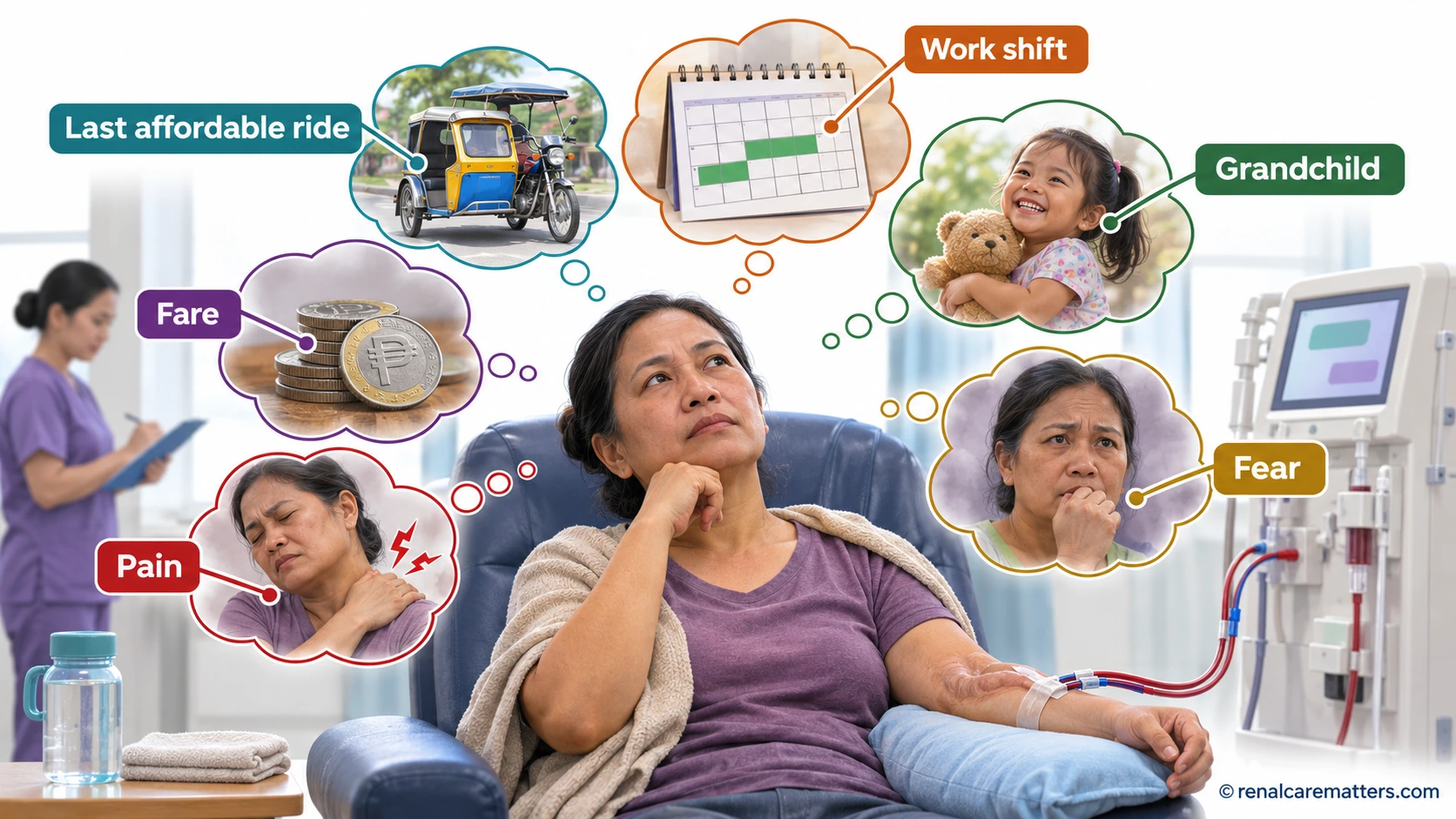
In plain wordsWhen a patient misses dialysis, it is tempting to see a choice. More often you are looking at a collision: the session landed on the same hours as the last affordable ride, a work shift, a sick grandchild, or a fear nobody has asked about.
Figure 1. Replace the label non-adherent with a question: what is competing with dialysis this week?
The picture has a limit. Some patients do choose, after reflection, to dialyze less or to stop. That is a decision that deserves a physician’s conversation, not a barrier to remove. The first job is to find out which you are facing.
Figure 2 · Key terms for this module
Missed sessionA scheduled treatment not received, for any reason.
BarrierAnything outside the patient’s preference that stands between the patient and the session.
Involuntary dischargeEnding a patient’s place at a unit without the patient’s agreement.
AICSAssistance to Individuals in Crisis Situation, a DSWD program that can help with medical costs.
Malasakit CenterA one-stop office in government hospitals that coordinates financial assistance for patients.
Conservative kidney managementPlanned care focused on symptoms and quality of life without dialysis.
Opening case · fictional
Case: The family at reception
Mrs. Perla Dizon, 54, has missed four sessions in three weeks since her husband’s tricycle was sold. She also disputes a charge from last month. On Friday she arrives an hour late. When the receptionist says her slot was given away, her son, Mr. Carlo Dizon, shouts, slams his hand on the counter, and stands in front of the exit door. Two other patients are waiting with their families.
The owner, who is on site, tells the head nurse: “Remove her from the schedule. We do not need this.”
Before reading on, decide:
What needs to happen at reception now?
Who makes sure Mrs. Dizon has a workable plan for her next treatment?
What would a defensible decision about her place at the unit require?
Keep your answers in mind. The lesson gives you what you need, and the case review near the end shows one sound response.
Lesson · part 1
What predicts a missed session
Missed sessions are common and they matter. Across 20 countries in the Dialysis Outcomes and Practice Patterns Study (DOPPS), the risk of missing at least one session in four months ranged from under 1% in Italy and Japan to 24% in the United States. Missing was more likely with younger age, less time on dialysis, shorter treatments, longer travel time to the unit, and symptoms of depression, and it was associated with higher mortality.1 In interviews, patients named transportation, feeling unwell, and competing demands as barriers, and asked for better transport and clearer explanations of the risk of skipping.2
Philippine figures on missed sessions were not found. Travel time, fares, and work are likely to weigh at least as heavily here. Calculator 12 tracks your unit’s missed-treatment rate so you can see whether it is rising.
RememberAsk what happened before you label what happened.
When a patient misses repeatedly, ask about transport, work, cost, caregiving, symptoms, language, and fear. Confirm the best way to reach them, with consent. Check clinical urgency with the attending nephrologist, then assign one person to address the barrier and confirm the next treatment.
Lesson · part 2
Four problems that look alike at the counter
Problem
Who handles it
What it needs
Credible safety threat
Security or emergency process
Make the area safe now; a blocked exit is a safety issue
Clinical disagreement
Attending nephrologist
A conversation and a documented shared decision
Complaint
Named complaint owner
A clear route, a timeline, and feedback
Ability to pay
Claims lead and social worker
Review of the charge and referral for assistance
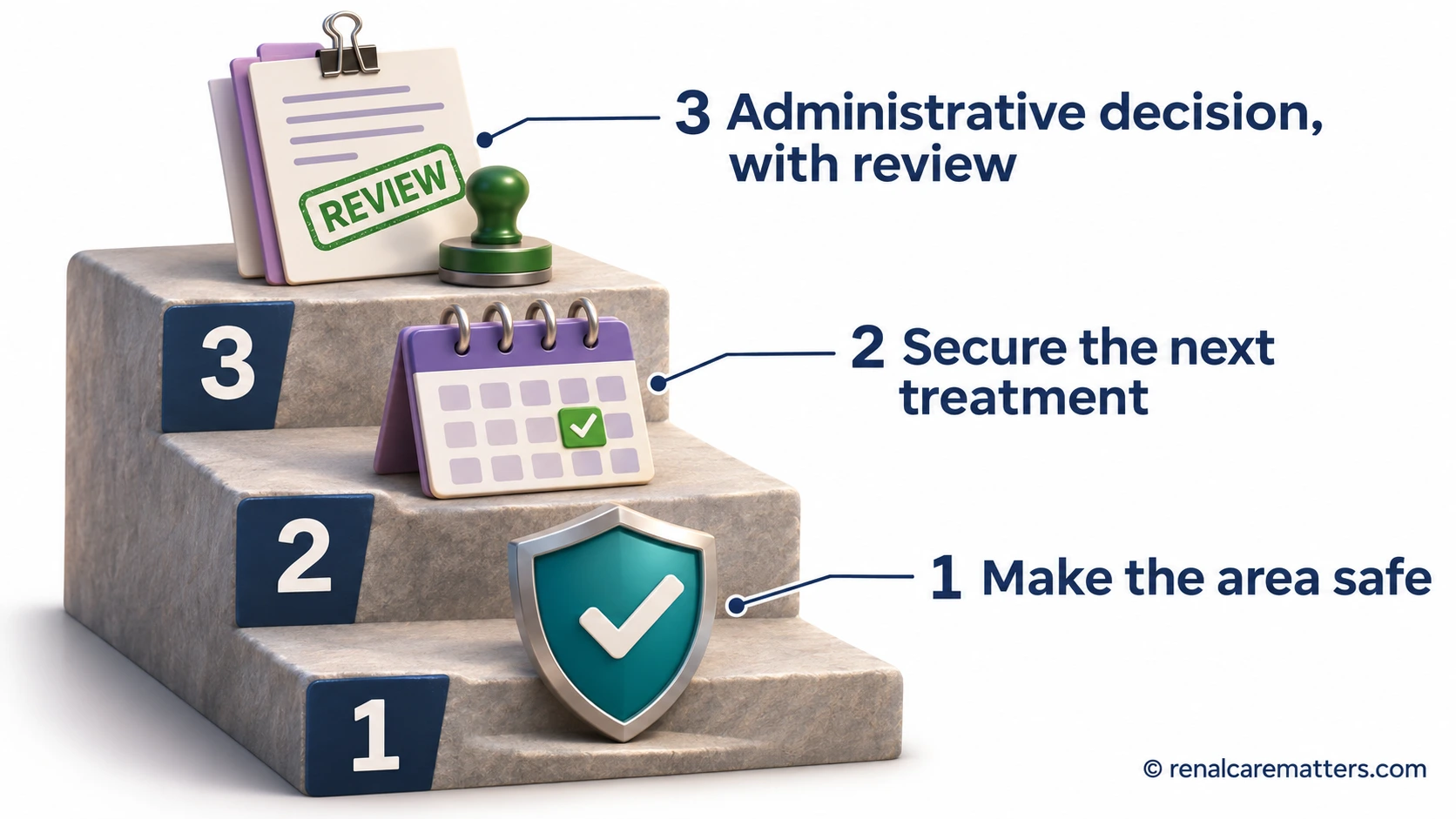
Figure 3. Order matters. Safety first, continuity second, administration last.
Order matters. First make the area safe. Second, secure the patient’s next treatment. Third, and only then, consider any administrative decision. A sudden change in behavior around dialysis also warrants a medical assessment: confusion from uremia, low blood sugar, or a stroke can look like anger.
Stop and callStop any removal from the schedule or involuntary transfer until immediate safety is secured, the patient’s next treatment is confirmed, and leadership and compliance have reviewed the obligations involved.
Lesson · part 3
Before any restriction or transfer
Involuntary discharge from a dialysis unit can leave a patient with no regular treatment, and in practice with only emergency dialysis. In the United States, Black patients are overrepresented among planned and executed involuntary discharges, and communication failures and system incentives are among the suspected contributors.3 When it happens, a structured second chance can work: one program placed 7 of 12 discharged patients in a new unit for 77 to 650 days without recurrence of the disruptive behavior, using debriefing, coaching, a face-to-face interview with the medical director, and a formal social-work handoff.4
Clinical urgency, scope, and verified capacity are defensible inputs to scheduling. Anger, a disputed bill, or inconvenience are not. Before any restriction, document the behavior and the clinical and administrative decisions separately, consider reasonable accommodations, and confirm a receiving unit and a continuity plan.
Lesson · part 4
Social assistance and referrals that close
Offer a social work referral early when money or transport threatens continuity. The DSWD Assistance to Individuals in Crisis Situation program lists dialysis among the medical needs it may help with, subject to assessment and its current rules.5 Malasakit Centers in government hospitals coordinate financial assistance from several agencies in one place.6 With the patient’s permission, help assemble the documents, and agree who checks the outcome. Keep the care plan separate from the assistance request, so treatment never waits for a pending grant.
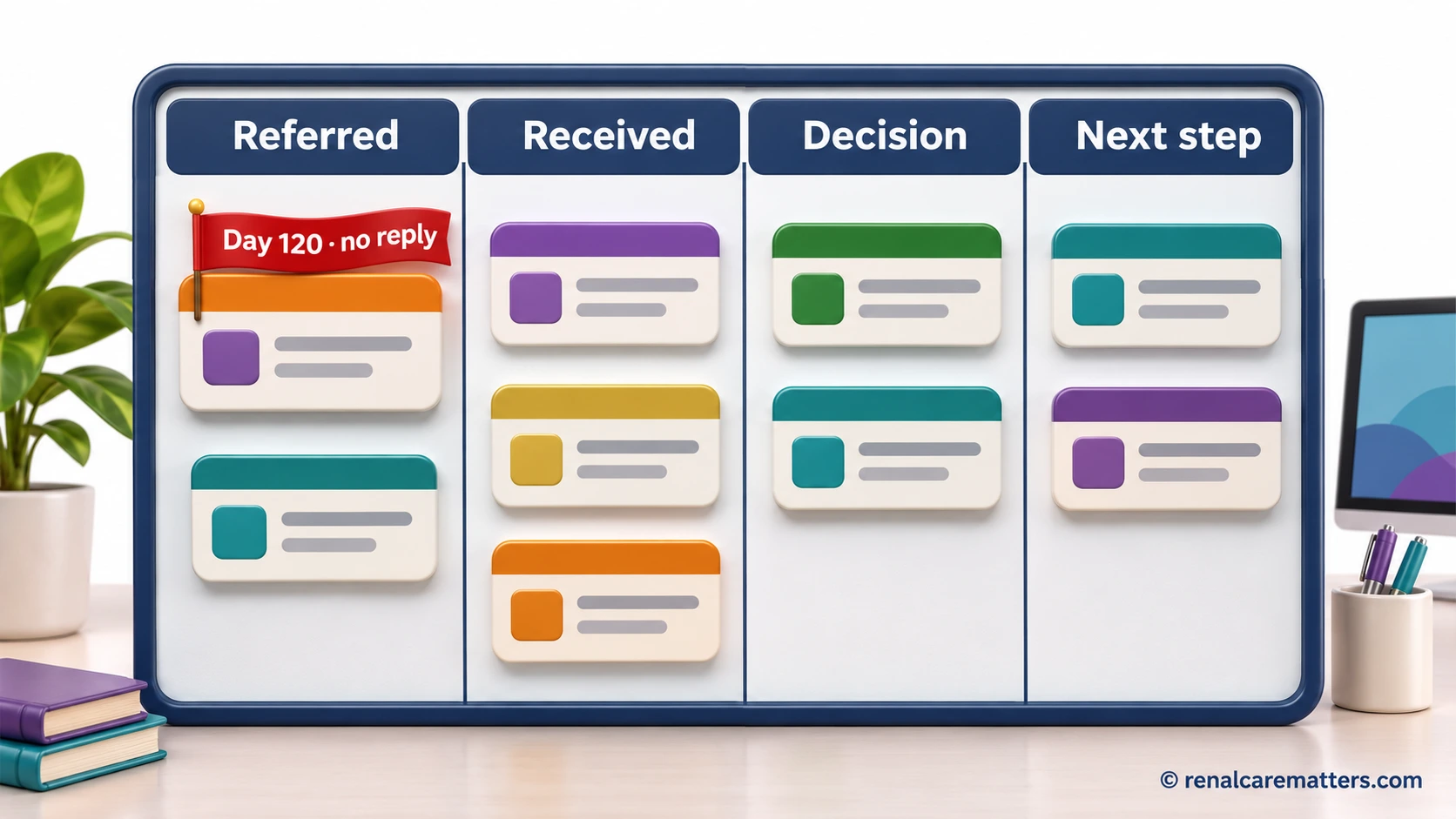
Figure 4. A referral stays open until an outcome is recorded.
Referrals for access creation or salvage, transplant evaluation, peritoneal dialysis, conservative kidney management, and psychosocial support each need an owner who tracks them to acceptance and outcome. A referral sent is not a referral received.
On the floor
Real situations: problems and solutions
These are fictional but typical. For each one, cover the answer, decide what you would do, then compare. Where a step depends on local rules, your unit’s procedure and your supervisor’s direction come first.
“Remove her from the schedule”
What you see
After a shouting incident, the owner orders a patient removed.
What is likely going on
An administrative decision taken before safety and continuity.
What to do
Make the area safe. Secure her next treatment. Then review any restriction with leadership and compliance.
Why it matters
Removal without a plan can be a death sentence.
Three missed Fridays
What you see
A patient has missed three Fridays in a row.
What is likely going on
A barrier nobody has asked about.
What to do
Ask. Friday may be the day the ride costs more.
Why it matters
The fix depends on the reason.
The referral with no reply
What you see
A transplant referral sent four months ago has no answer.
What is likely going on
An open loop.
What to do
Call, record the status, and give the patient a date.
Why it matters
Referrals die quietly.
Field notes
Separate clinical, financial, and safety issues before acting.
Offer a social work referral early.
Record what the patient wants, in the patient’s words.
Case review
Back to the case: The family at reception
At reception now. Make the area safe: clear the exit, use your security or emergency process, and move other patients and families away. One calm staff member speaks with Mr. Dizon; another checks Mrs. Dizon, who is an hour late and has missed four sessions, for urgent symptoms. If she is unwell, she is assessed now, whatever happened at the counter.
Her next treatment. The attending nephrologist decides how urgent it is; the head nurse or the physician on duty finds the slot today or confirms a placement elsewhere, by name. A social worker meets the family about transport and the disputed charge, which the claims lead reviews and answers with a date.
A defensible decision. The owner’s instruction is premature. Any restriction requires the behavior documented, the clinical and administrative decisions recorded separately, leadership and compliance review, reasonable accommodations considered, and a confirmed continuity plan. Removing her today, without a receiving unit, would leave a patient who has already missed four sessions with no treatment at all.
Skills lab · with your preceptor
Skills checklist: Reception safety, access barriers, and continuity
Simulate the reception incident and a follow-up meeting with the patient, her son, a social worker, and billing. Your preceptor rates each step as satisfactory, needs practice, or not observed. Steps marked Critical must all be satisfactory before sign-off. This checklist supports supervised learning; your unit’s own procedure and competency form are the authority. A printable version of every checklist is on the trainer page.
CriticalSecures immediate safety, including a blocked exit, through the facility process.
CriticalChecks the patient for urgent symptoms regardless of the incident.
CriticalSecures the next treatment before any administrative decision.
Asks about barriers rather than labeling the patient.
Separates clinical, complaint, payment, and safety issues.
Refers to social work and explains assistance pathways.
CriticalRefers any proposed restriction to leadership and compliance with a continuity plan.
Records clinical and administrative decisions separately.
Names an owner for each open referral.
Placement activity. Review every patient who missed two or more sessions last month. Record the reason in the patient’s words and the action taken.
Self-assessment
Check your understanding
Each visit draws 8 questions at random from this module’s 15-question bank. Choose the single best answer for each, then select Check answers; an explanation appears under the best answer. Select New set of questions for a different mix. A good target is 7 of 8 on two different sets. Nothing you select is sent anywhere; scoring happens in your browser.
Al Salmi, I., Larkina, M., Wang, M., Subramanian, L., Morgenstern, H., Jacobson, S. H., Hakim, R., Tentori, F., Saran, R., Akiba, T., Tomilina, N. A., Port, F. K., Robinson, B. M., & Pisoni, R. L. (2018). Missed hemodialysis treatments: International variation, predictors, and outcomes in the dialysis outcomes and practice patterns study (DOPPS). American Journal of Kidney Diseases, 72(5), 634–643. https://doi.org/10.1053/j.ajkd.2018.04.019
Chenitz, K. B., Fernando, M., & Shea, J. A. (2014). In-center hemodialysis attendance: patient perceptions of risks, barriers, and recommendations. Hemodialysis International, 18(2), 364–373. https://doi.org/10.1111/hdi.12139
Edwards, D. P., Kalantar-Zadeh, K., Streja, E., Ahdoot, R. S., Norris, K. C., & Molony, D. (2023). Practicing health equity in involuntary discharges to overcome disparities in dialysis and kidney patient care. Current Opinion in Nephrology and Hypertension, 32(1), 49–57. https://doi.org/10.1097/MNH.0000000000000851
Allon, M., Thornley-Brown, D., Rizk, D. V., & Carrasquillo, A. J. (2019). Second-chance placement of hemodialysis patients after involuntary discharge for disruptive behavior. American Journal of Kidney Diseases, 74(4), 544–548. https://doi.org/10.1053/j.ajkd.2019.05.008
Department of Social Welfare and Development. (n.d.). Assistance to Individuals in Crisis Situation: Frequently asked questions. Retrieved November 23, 2026, from https://aics.dswd.gov.ph/about-us/faqs/
Republic Act No. 11463: Malasakit Centers Act. (2019). Congress of the Philippines.
Educational material for physicians and unit leaders. Completing it is an Academy learning record only. It does not confer CPD units, PSN attestation, DOH eligibility, PhilHealth accreditation, or appointment authority, and it does not replace current regulations, your facility’s bylaws and protocols, or legal advice.