PhilHealth: Accreditation, the Package, and the Claim
Provider status, the 156-session package and what it must include, the chart-to-claim trace, and talking to a patient about a disputed charge.
PublishedNailathalaGipatikPepalwal:ReferencesMga SanggunianMga TinubdanReng Reperensya:6Audience: Physician heads of adult maintenance hemodialysis units · nephrologists preparing to take an appointment · head nurses, operations managers, and quality leads who share the leadership tableRead timeOras ng pagbasaOras sa pagbasaOras ning pamamasa:
Training track for physician heads of hemodialysis services
This module is study material for physician heads of adult maintenance hemodialysis services. It explains the reasoning behind common decisions; it is not a protocol and not legal advice. Regulations change: confirm every rule against the current text and your regional office before you rely on it. Clinical limits are set by your unit’s approved protocols and the attending nephrologist. Every case and record is fictional.
Learning objectives
After this module you should be able to
Keep a calendar of license, accreditation, and signatory validity so the unit never treats patients it cannot claim for.
Explain the current Philippine Health Insurance Corporation (PhilHealth) hemodialysis benefit in plain words: who qualifies, how many sessions, how much, and what the package must include.
Trace one session from the physician order to the claim, and find the record a discrepancy starts from.
Hold a claim that the records do not support, and correct an error with an audit trail.
Explain a disputed charge to a patient in the language the patient uses at home.
Use returned and denied claims as a quality signal.
Pre-testBefore you read, answer the 8 self-assessment questions and note your score. After the module, select New set of questions and compare. The difference is what you learned; the questions you still miss are what to reread.
Start here
The big picture, in plain words
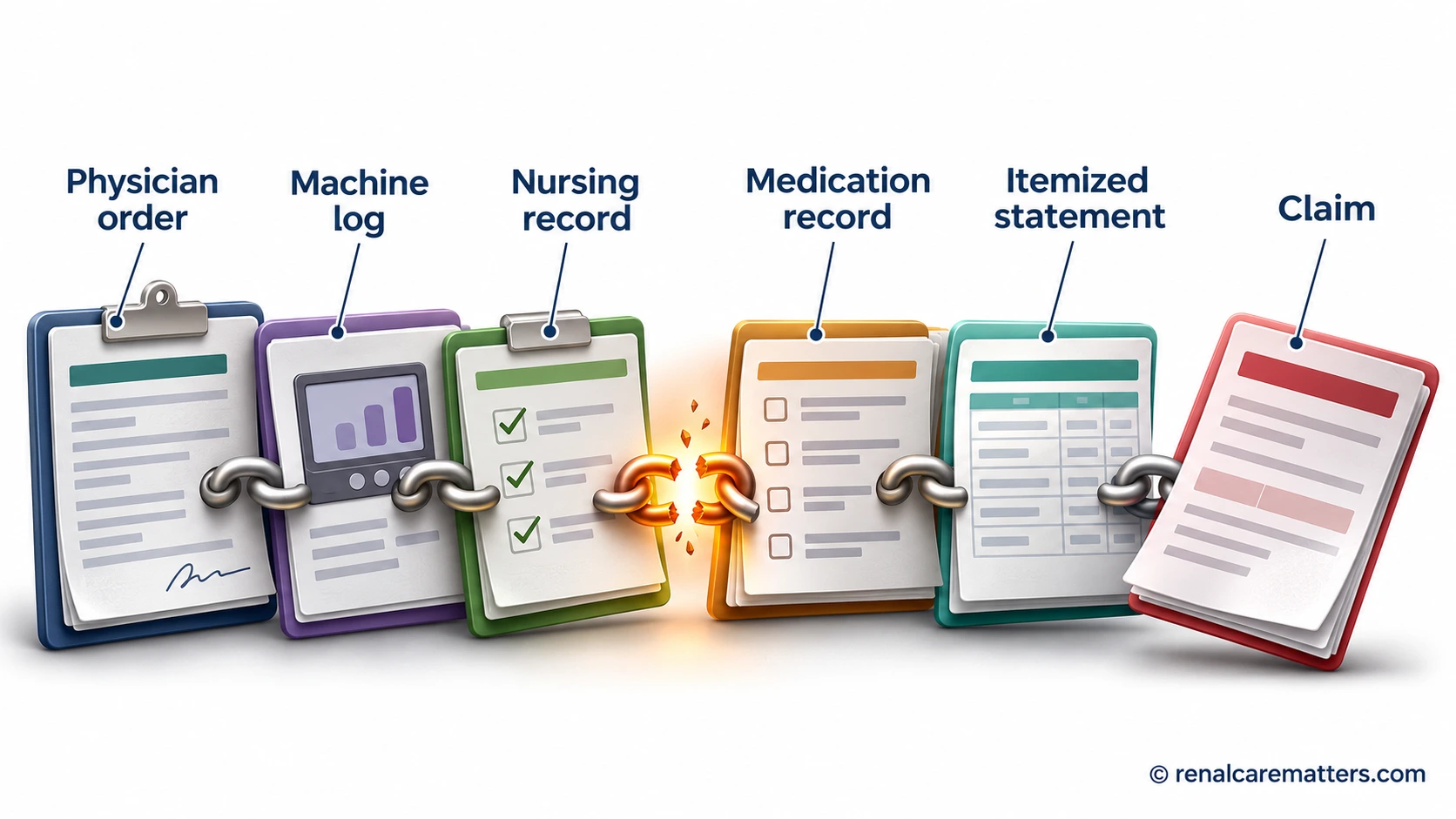
In plain wordsA claim is the last car of a train. It can only be as long and as straight as the cars in front of it: the order, the machine log, the nursing record, the medicine record. If one car is missing, the claim is pulling air.
The picture has a limit. A train runs in one direction. Errors in billing often start at the end, in a template or a batch upload, and travel backward into the record when someone “fixes” the chart to match the claim. The rule runs one way: the claim follows the record, never the reverse.
Figure 1 · Key terms for this module
PDDPhilHealth Dialysis Database. Patients with chronic kidney disease stage 5 must be registered to use the hemodialysis benefit.
Package rateThe fixed amount PhilHealth pays per covered session.
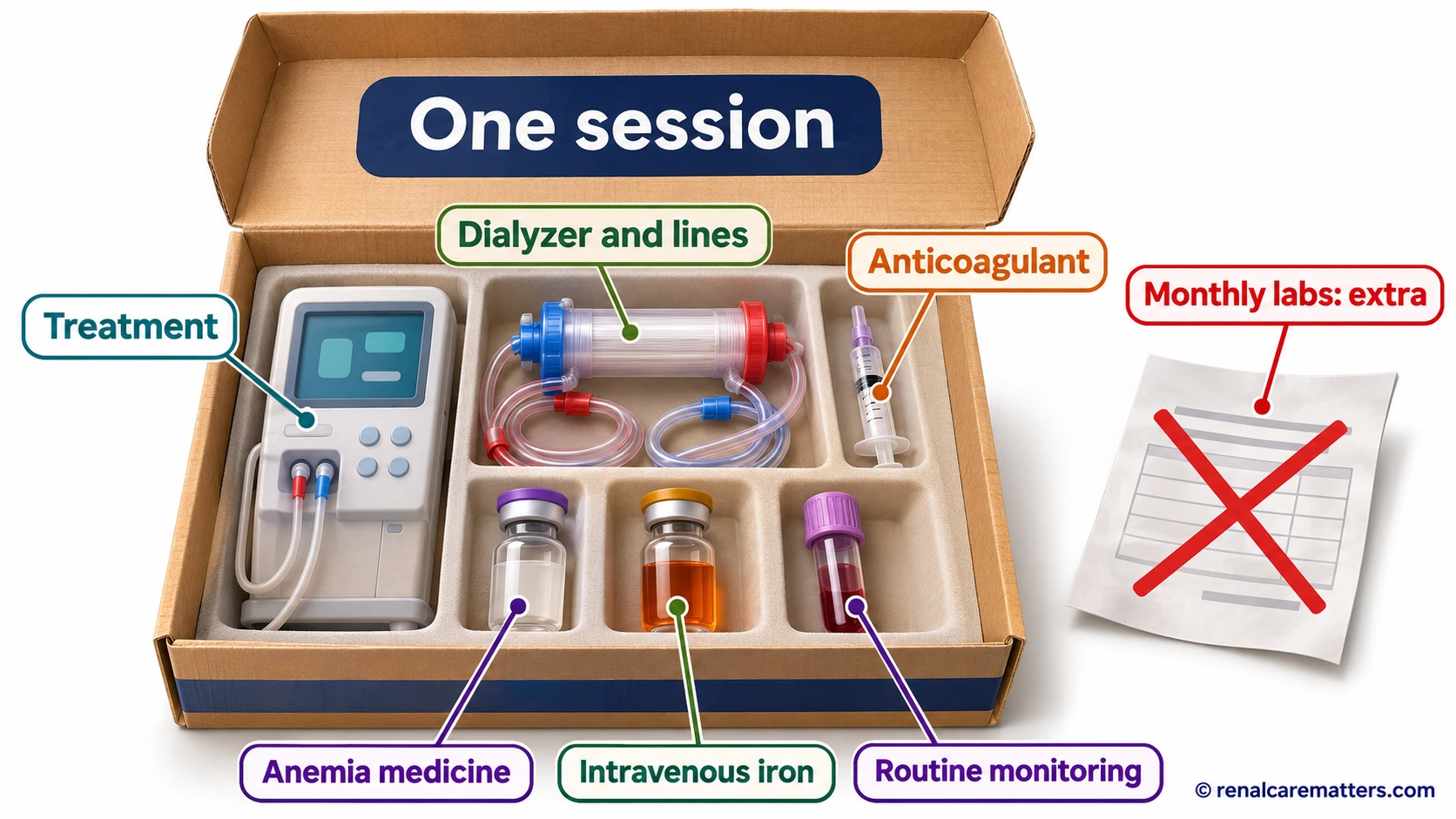
Minimum standardsThe services, medicines, supplies, and tests a covered session must include.
No copayThe rule that patients are not billed for items within the minimum standards.
Return to hospital (RTH)A claim sent back for correction or missing documents.
DenialA claim PhilHealth will not pay.
PROPhilHealth Regional Office.
Opening case · fictional
Case: The session on two dates
Mr. Leonardo Bautista, 61, dialyzes at your unit in Marilao. His treatment record shows a session on 10 November. The claim for that session is dated 11 November. His statement also shows a separate charge for a monthly laboratory panel that the package already includes. Last week a receiving unit in Valenzuela called: Mr. Bautista had two sessions there in October while his daughter was in hospital, which your records do not show.
His son, Mr. Jun Bautista, is at the front desk. “We were told there is no copay. Why are we being charged? And will Papa run out of sessions?”
Before reading on, decide:
Which record do you check first, and why?
What do you tell Mr. Jun Bautista today, before the records are reconciled?
What must happen to the claim, and to the separate charge?
Keep your answers in mind. The lesson gives you what you need, and the case review near the end shows one sound response.
Lesson · part 1
What the current benefit covers
PhilHealth Circular 2024-0023, Revision 2, took effect in October 2024. It covers up to 156 hemodialysis sessions a year, three a week, for members and qualified dependents with chronic kidney disease stage 5 registered in the PDD, at a package rate of 6,350 pesos per session, or up to 990,600 pesos a year.1,2 Earlier revisions set lower rates during 2024; always apply the rules in force on the date of treatment.
The package is designed for no copay for its minimum standards. PhilHealth’s advisory on the first revision clarified that coverage applies to the services listed in the circular’s minimum-standards table, that their provision depends on the patient’s clinical assessment, and that the no-copay provision applies to them.3 A separate circular, 2024-0029, sets out quality standards for maintenance hemodialysis that PhilHealth uses as its reference.4
Figure 2. What the session package must contain. A charge for a required item outside the package is a billing error, not an extra.
Read the minimum-standards table yourself, with your billing lead. Then check that the unit’s charge master cannot bill separately for anything inside it. A charge for an included item is a billing error, however it is labeled.
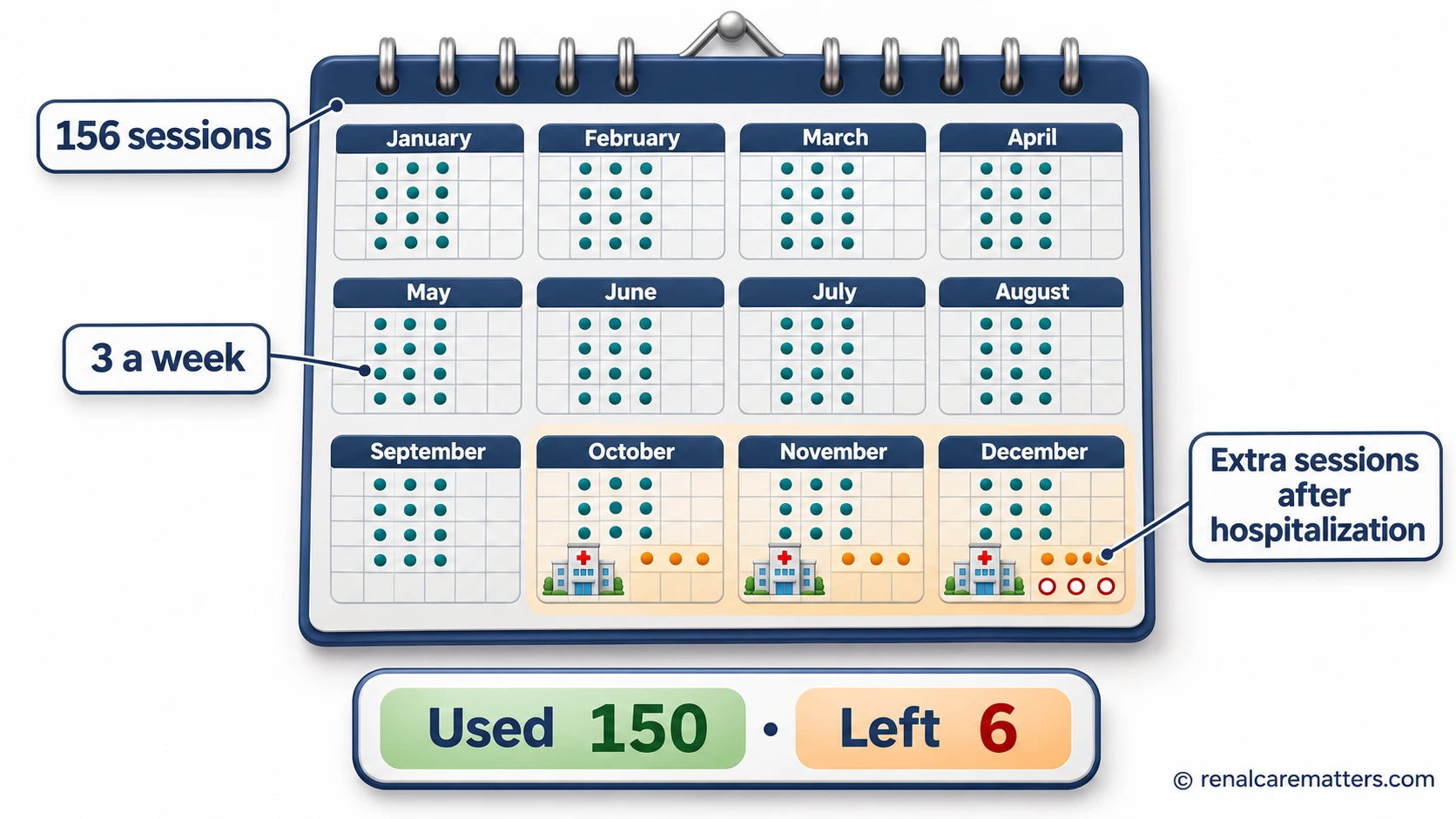
Figure 3. 156 sessions is three a week for a year. Patients who need extra sessions, or transfer between units, can run short before December.
Session arithmetic. 3 sessions a week × 52 weeks = 156. At 6,350 pesos each, 156 sessions = 990,600 pesos. A patient who needs a fourth weekly session for six weeks after a hospitalization uses 6 extra sessions and will run short near the end of the year. Calculator 5 projects the date.
RememberCoverage rules decide who pays. They never decide whether a patient is dialyzed today.
Lesson · part 2
Keep the unit claimable
A session delivered on a day the license, the accreditation, or a signatory’s authority had lapsed may not be payable, however good the care. Build one calendar for all of them.
Item
Owner
What to watch
Department of Health (DOH) License to Operate
Compliance lead
Expiry, scope, and any change that needs approval (Module 2)
PhilHealth accreditation
Compliance lead
The renewal filing window, the provider data record, the notarized performance commitment, and the fee5,6
Authorized signatories
Owner
Who may sign claims and certifications, and their validity
Patient registration
Claims lead
PDD registration for every new patient before the first claim
Session counts
Claims lead
Sessions used per patient across every unit the patient visited
Confirm the current accreditation cycle and filing dates with your PRO. Filing windows change from year to year.
Lesson · part 3
The chart-to-claim trace
Figure 4. The chart-to-claim trace. A claim is only as strong as the weakest record behind it.
Every month, pick five sessions at random and follow each one from the order to the claim. Start from the entry made at the time of treatment, because that is the record least likely to have been edited.
Figure 5 · The trace, one session
1. EligibilityPDD registration and sessions remaining on the date of service.
2. OrderA current, signed prescription for that session.
3. DeliveryMachine log and nursing record agree on date, start and end times, and fluid removed.
4. Medicines and testsRecorded as given or done, and inside the package where required.
5. ItemizationThe statement shows no separate charge for an included item.
6. ClaimDate, patient, and session match the treatment record.
When a claim is returned or denied, classify the reason. Compare it with the contemporaneous records. Correct a supported administrative error with an audit trail that shows the original entry, the correction, who made it, and when. Never change a clinical record to fit a claim. Send anything uncertain to the claims supervisor and hold it.
Stop and callStop and hold any claim that the treatment record does not support. Escalate a suspected pattern of billing errors to the owner and compliance lead in writing. Do not submit to meet a deadline.
Lesson · part 4
Explaining a disputed charge
Patients and families often hear about billing before they hear about anything else. A clear, early explanation in the language they use at home prevents a dispute from becoming a reason to stop coming.
Say
Avoid
“That charge looks wrong to us too. We are checking it, and we will tell you by Friday.”
“That is how the system works.”
“If it was charged by mistake, we will reverse it or refund it.”
Promising a refund before the record is checked
“Your father’s dialysis continues while we sort this out.”
Linking treatment to payment
“Here is how to file a complaint if you are not satisfied.”
Leaving the family without a route
Count sessions across units. Patients who dialyze elsewhere while traveling, or after a transfer, use the same annual allocation. Ask about other units at every transfer and every return.
On the floor
Real situations: problems and solutions
These are fictional but typical. For each one, cover the answer, decide what you would do, then compare. Where a step depends on local rules, your unit’s procedure and your supervisor’s direction come first.
The lab charged twice
What you see
A routine monthly laboratory test appears on the statement and inside the package.
What is likely going on
A charge for a package item.
What to do
Reverse it, refund if paid, and find out how the billing template allowed it.
Why it matters
No-copay rules make this a compliance problem, not a pricing choice.
Session 150 in October
What you see
A patient who needed extra sessions after a hospitalization will run out of covered sessions in November.
What is likely going on
A predictable shortfall.
What to do
Tell the patient and family early, involve the social worker, and plan the remaining sessions.
Why it matters
The coverage rule never decides whether a patient is dialyzed.
The returned batch
What you see
Twelve claims come back for the same missing signature.
What is likely going on
A process defect.
What to do
Fix the twelve with an audit trail, then fix the step that let them leave unsigned.
Why it matters
Returned claims are a quality measure in disguise.
Field notes
Trace five sessions from chart to claim every month.
Explain charges to patients in the language they use at home.
Track accreditation and license expiry dates on the same calendar.
Case review
Back to the case: The session on two dates
Which record first? The treatment record made at the time of the session: the machine log and nursing note for 10 November. If they confirm treatment on 10 November, the claim date is an administrative error to correct with an audit trail. If the records disagree with each other, hold the claim and investigate before anything is submitted.
What to tell Mr. Jun Bautista today. That the separate laboratory charge appears to be for an item the package already includes, that you are checking it, and that it will be reversed or refunded if confirmed, with a date. That his father’s dialysis continues regardless. That the two October sessions in Valenzuela count toward the 156, and you will work out with him how many remain.
The claim and the charge. Verify utilization through the approved PhilHealth channel, including the Valenzuela sessions. Hold the discrepant claim until the dates are reconciled. Reverse the laboratory charge if confirmed, and find out how the billing template allowed it. Then check five more statements for the same error.
Skills lab · with your preceptor
Skills checklist: Chart-to-claim trace and patient explanation
Trace three fictional sessions from order to claim, then explain one discrepancy to a preceptor playing a family member. Your preceptor rates each step as satisfactory, needs practice, or not observed. Steps marked Critical must all be satisfactory before sign-off. This checklist supports supervised learning; your unit’s own procedure and competency form are the authority. A printable version of every checklist is on the trainer page.
Checks PDD registration and sessions remaining on the date of service.
CriticalStarts from the contemporaneous treatment record.
Matches order, machine log, nursing record, medicines, itemization, and claim.
CriticalIdentifies a separate charge for a package-included item as an error.
CriticalHolds an unsupported claim and escalates the possible billing error.
CriticalCorrects an administrative error with an audit trail, without altering the clinical record.
Explains the charge in plain language, gives a date, and states that treatment continues.
Provides the complaint route.
Counts sessions delivered at other units.
Placement activity. Trace five sessions at your unit this month. Present the results and any template or process defect you found to your claims lead.
Self-assessment
Check your understanding
Each visit draws 8 questions at random from this module’s 15-question bank. Choose the single best answer for each, then select Check answers; an explanation appears under the best answer. Select New set of questions for a different mix. A good target is 7 of 8 on two different sets. Nothing you select is sent anywhere; scoring happens in your browser.
Philippine Health Insurance Corporation. (2024). PhilHealth Circular No. 2024-0023: Institutionalization of 156 hemodialysis sessions and coverage expansion (Revision 2).
Philippine Health Insurance Corporation. (2024, October 17). PhilHealth increases dialysis coverage to P1 million per year [News release]. https://www.philhealth.gov.ph/news/up/article/2024/news_6710c0050d979.php
Philippine Health Insurance Corporation. (2024). PhilHealth Advisory No. 2024-0036: Clarification on PhilHealth Circular No. 2024-0014 “Institutionalization of 156 hemodialysis sessions and coverage expansion (Revision 1)”. https://www.philhealth.gov.ph/advisories/2024/PA2024-0036_v1.pdf
Philippine Health Insurance Corporation. (2024). PhilHealth Circular No. 2024-0029: Quality standards on maintenance hemodialysis procedure as reference of the Corporation.
Philippine Health Insurance Corporation. (2023). PhilHealth Circular No. 2023-0012 [Accreditation of health care providers and performance commitment]. [Bracketed description; confirm the official title against the circular.]
Philippine Health Insurance Corporation. (2025). PhilHealth Advisory No. 2025-0055 [Filing of applications for renewal of accreditation of health facilities]. https://www.philhealth.gov.ph/advisories/2025/PA2025-0055.pdf
Educational material for physicians and unit leaders. Completing it is an Academy learning record only. It does not confer CPD units, PSN attestation, DOH eligibility, PhilHealth accreditation, or appointment authority, and it does not replace current regulations, your facility’s bylaws and protocols, or legal advice.