After this module you should be able to
- Keep the published roster, actual time, approved leave and corrections as separate, auditable records.
- Compute overtime, night differential, rest-day and holiday premiums for covered private employees.
- Apply the correct regional wage order and identify which workers the hours-of-work rules cover.
- Reconcile an approved payroll register to time records, headcount, bank disbursement and the ledger.
The big picture, in plain words
The picture has a limit. A story can be retold; time records should not be. Once the actual hours are recorded, they stay as recorded. A mistake is fixed by adding a correction with evidence, not by quietly changing the original. That is what makes the payslip something staff can check and auditors can trust.
Pay is not a clinical topic, but it is a safety topic. Nurses who are underpaid for holiday shifts stop volunteering for them. Units that cannot fill holiday shifts close them, and patients go longer between treatments (Module 4). This module keeps that chain from breaking.
Figure 1 · Key terms for this module
Case: The holiday that crossed midnight
At a 15-station unit in Imus, Cavite, Nurse Cherry Mae Aquino works the extended Christmas Eve shift, from 18:00 on December 24 to 02:00 on December 25. She volunteered so that patients would not miss their sessions over the holiday.
On January 10, her payslip shows the whole eight hours at her ordinary rate. She brings it to the manager, Mr. Paolo Esguerra, and says quietly: "Sir, I don't think this is right. And I don't think I will volunteer next year."
Before reading on, decide:
- Which rules apply to which hours of her shift?
- Who should recompute it, and what should Nurse Aquino receive in writing?
- How would you make sure the system gets it right next year?
Keep your answers in mind. The lesson gives you what you need, and the case review near the end shows one sound response.
The model: four records, never merged
- Published roster: what was planned.
- Actual time: biometric or logbook entries of time in and out, with breaks.
- Approved changes: shift swaps, leave, and overtime, each approved before, or promptly after.
- Corrections: missing punches or errors, with evidence, the employee's acknowledgment, and a reviewer's sign-off.
Payroll is computed from actual time plus approved changes and corrections, never from the roster alone. The originals are kept. A correction is a new entry, not an overwrite.
Keep coverage and pay decisions apart. The head nurse decides who covers a shift. Human resources and payroll decide how it is paid, under policy and law. Mixing the two invites complaints of favoritism.
The legal frame (private sector; confirm each item with human resources)
Who is covered. Book III of the Labor Code on hours of work covers rank-and-file employees. Managerial employees and certain officers are excluded from the hours-of-work and premium provisions (Article 82).1 Human resources classifies each position.
Health personnel. Under Article 83, health personnel in cities and municipalities of at least one million people, or in hospitals and clinics of at least 100 beds, normally work eight hours a day, five days a week. When service needs require a sixth day, they are entitled to at least 30% additional pay for that day. Human resources confirms whether your facility and each worker fall under this rule.
Minimum wage. Regional wage boards set minimum wages. In the National Capital Region, Wage Order NCR-28 raised the non-agricultural daily minimum from 695 to 755 pesos, effective September 26, 2026, while the earlier Wage Order NCR-27 remained under litigation.2 Units in Central Luzon or elsewhere follow their own regional order. Check the National Wages and Productivity Commission before each payroll that crosses a change.
Premiums for covered employees (standard Labor Code rules):
| Situation | Pay for the first 8 hours | Overtime hourly rate |
|---|---|---|
| Ordinary workday | 100% | 125% of the hourly rate |
| Rest day or special non-working day, worked | 130% | 130% of the day's hourly rate (169% of basic) |
| Special day falling on a rest day, worked | 150% | 130% of the day's hourly rate (195% of basic) |
| Regular holiday, worked | 200% | 130% of the day's hourly rate (260% of basic) |
| Regular holiday falling on a rest day, worked | 260% | 130% of the day's hourly rate (338% of basic) |
| Regular holiday, not worked (covered employee) | 100% | Not applicable |
| Night differential (10 PM to 6 AM) | An extra 10% of the applicable hourly rate for each night hour |
Collective agreements and company policy may be more generous, never less. DOLE publishes a holiday pay advisory each year with the list of regular and special days.
Government units follow Civil Service Commission and Department of Budget and Management rules, salary grades, and agency policy, not this table. Confirm with the agency's human resources office.
Cutoff review
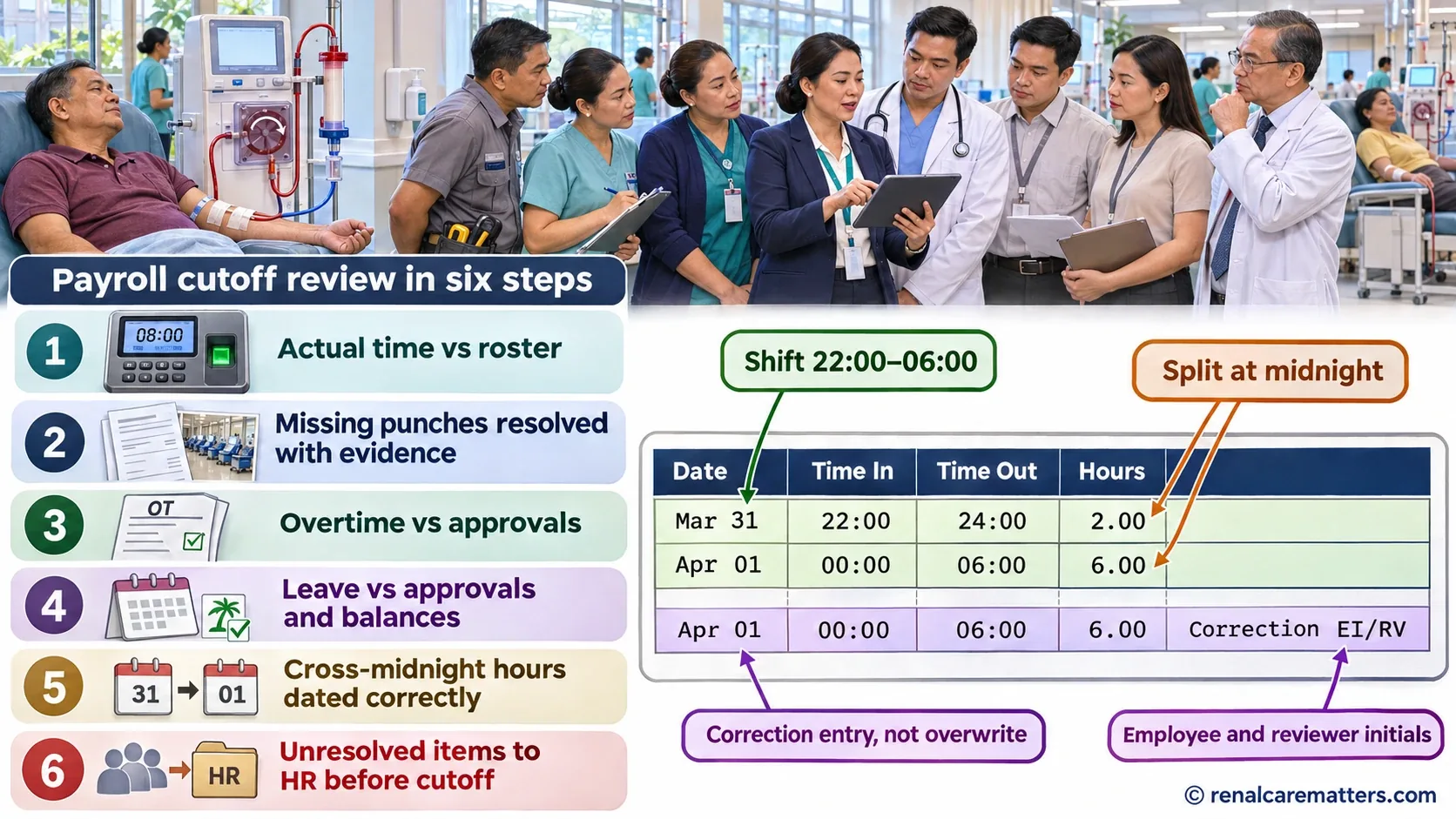
Figure 3 · Before each payroll cutoff
- CompareActual time against the roster for every staff member.
- ResolveMissing punches with evidence, not memory.
- VerifyOvertime against approvals.
- ConfirmLeave against approved requests and balances.
- DateShifts that cross midnight, especially near holidays, split by the calendar date of each hour.
- EscalateUnresolved items go to human resources before cutoff, not after payment.
Example. During a cutoff review at a unit in Bulacan, the manager finds that a technician has 22 hours of overtime with no approval on file, all on Saturdays. The technician is not hiding anything. The Saturday water disinfection takes three hours longer than the shift allows, and he has been staying to finish it. The overtime is approved retroactively with a note, and the biomedical lead adjusts the disinfection schedule so the work fits the shift. The review found a planning problem, not a pay problem.
Payroll register reconciliation
Gross pay minus authorized employee deductions (Social Security System, Philippine Health Insurance Corporation (PhilHealth), and Pag-IBIG employee shares, withholding tax, approved loans) equals net pay. Then reconcile:
- register headcount against the active employee list, so there are no ghost employees;
- total hours against the time records;
- the net pay total against the bank disbursement file;
- employer shares and payroll cost against the ledger (Module 18 covers remittances);
- this period against the last, explaining material changes.
Keep preparation, approval, and release of payroll with different people.
What the evidence shows
Payroll controls are legal and accounting requirements, not clinical interventions. The link to care is indirect but real: fair, accurate pay supports retention, and turnover is associated with weaker competency and safety (Module 15). Nurse burnout studies consistently list perceived unfairness and workload among its drivers.3
Common failure modes
- Paying the plan. Pay computed from the roster instead of actual time.
- Overwriting. Time records changed instead of corrected.
- Last year's wage. An old wage order applied after a new one took effect.
- "Supervisors don't get overtime." Positions treated as exempt without classification.
- Midnight blindness. Holiday shifts split by start date instead of by the hour.
Back to the case: The holiday that crossed midnight
The hours. Pay rules follow the calendar date of each hour, not the date the shift started. December 24 is often declared a special non-working day, and December 25 is a regular holiday; check the Department of Labor and Employment (DOLE) holiday advisory for that year. The six hours on December 24 take that day's rate. The two hours on December 25 take the regular holiday rate, 200%. The four hours from 22:00 to 02:00 also earn night differential.
The correction. Mr. Esguerra sends the time record and the advisory to payroll. Payroll recomputes with Calculator CALC-10 and issues an adjustment in the next payroll, with a written breakdown showing each component. Nurse Aquino can check every line.
The system. The payroll software split shifts by start date. The cutoff review (below) now includes a specific check for shifts that cross midnight on or near holidays. In December, Mr. Esguerra sends staff the holiday rates in advance. Nurse Aquino volunteers again.
Skills checklist: Supervised practice
Complete these with your preceptor at your own unit, using fictional or de-identified data. Your preceptor rates each step as satisfactory, needs practice, or not observed. Steps marked Critical must all be satisfactory before sign-off. This checklist supports supervised learning; your unit’s own procedure and competency form are the authority. A printable version of every checklist is on the trainer page.
- Audit one cutoff period: roster versus actual time versus approvals for five staff.
- Recompute three holiday or night shifts with CALC-10 and compare with payroll.
- Confirm the current wage order and effective date for your region.
- CriticalReconcile one payroll register to the bank file and the ledger.
Check your understanding
Each visit draws 5 questions at random from this module’s 15-question bank. Choose the single best answer for each, then select Check answers; an explanation appears under the best answer. Select New set of questions for a different mix. A good target is 4 of 5 on two different sets. Nothing you select is sent anywhere; scoring happens in your browser.
Read next on this site
- Workforce Issues in Nephrology: Crisis or Opportunity?Why fair pay and schedules keep teams together.