After this module you should be able to
- Calculate weekly station capacity, patient slots and utilization for your unit.
- Explain the physiology that makes missed, shortened and delayed sessions dangerous, and cite the evidence.
- Run a fair, documented waitlist and referral acceptance process.
- Reschedule patients after a disruption while keeping each within a clinically acceptable window.
The big picture, in plain words
The picture has a limit. A dam fills at a steady rate; patients do not. A fiesta weekend, a salty meal, or a missed tablet of potassium binder changes how fast it rises. And a dam does not die if it overflows; a patient can. That is why capacity in a dialysis unit is not a business word. It is the operational form of a clinical rule: every enrolled patient gets every session, on time, as prescribed.
This module teaches you to count capacity correctly, protect the long gap, run a waitlist you can defend, and rebuild the schedule after a typhoon or a holiday without letting any patient go too long.
Figure 1 · Key terms for this module
Case: The holiday week
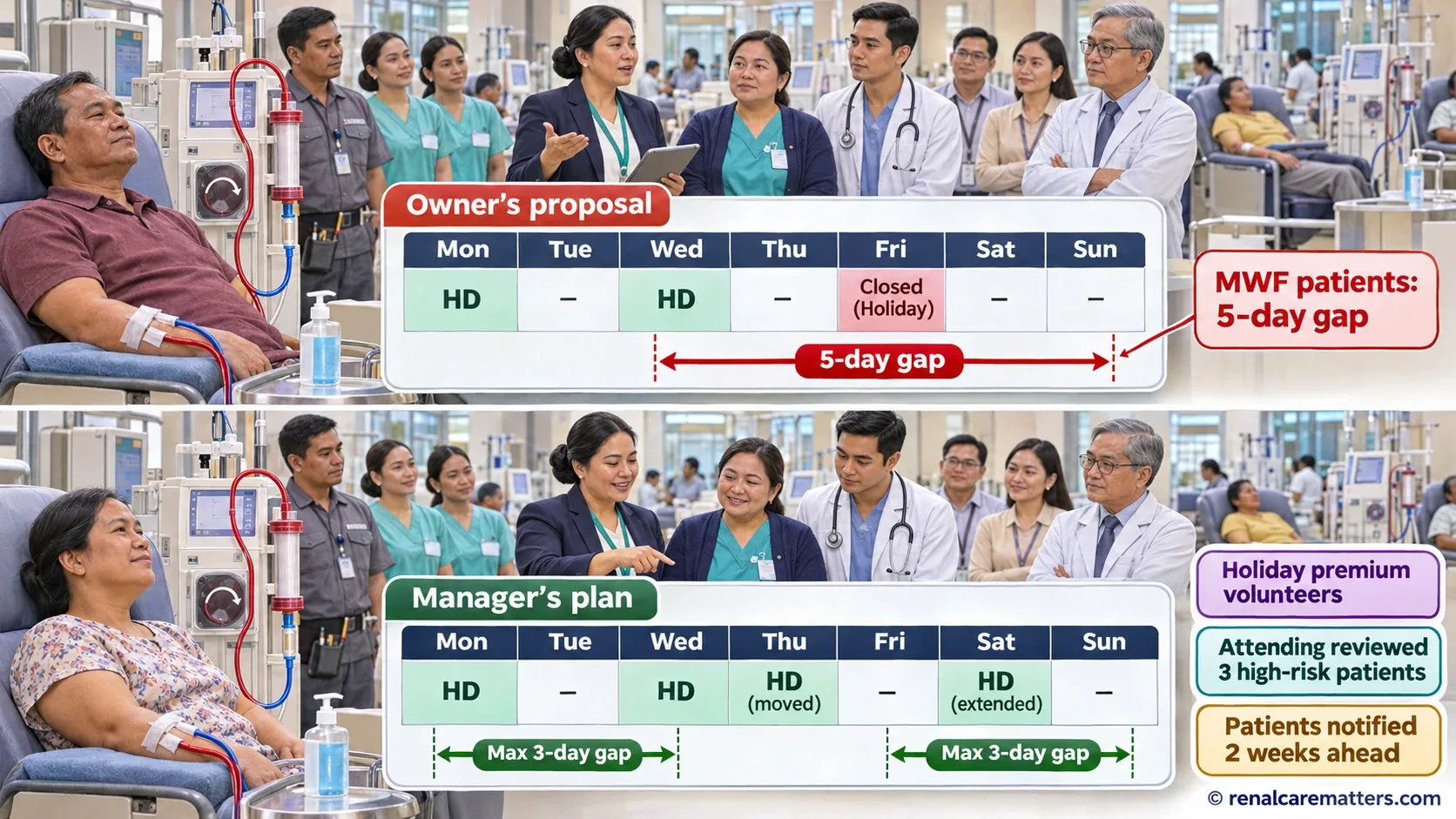
It is early December at a 15-station unit in San Fernando, Pampanga. Christmas Day and New Year's Day both fall on Fridays. Half the staff have asked for leave on both days. The owner, Mrs. Teresita Lugtu, proposes the simplest solution: close both Fridays.
The unit's manager, Ms. Joanna Pineda, pulls up the Friday list. Thirty patients dialyze Monday–Wednesday–Friday. Several had potassium results in the high-normal range on Mondays, after an ordinary two-day weekend gap. One, Mr. Rolando Sicat, 67, arrived last Monday with a weight gain of 4.2 kilograms.
Before reading on, decide:
- If the unit closes Friday, how long is the gap for a Monday–Wednesday–Friday patient?
- Who decides whether a longer gap is acceptable for a particular patient?
- What would a holiday schedule look like that keeps every patient within three days?
Keep your answers in mind. The lesson gives you what you need, and the case review near the end shows one sound response.
The physiology behind the schedule
Three things accumulate between sessions in a patient without kidney function.
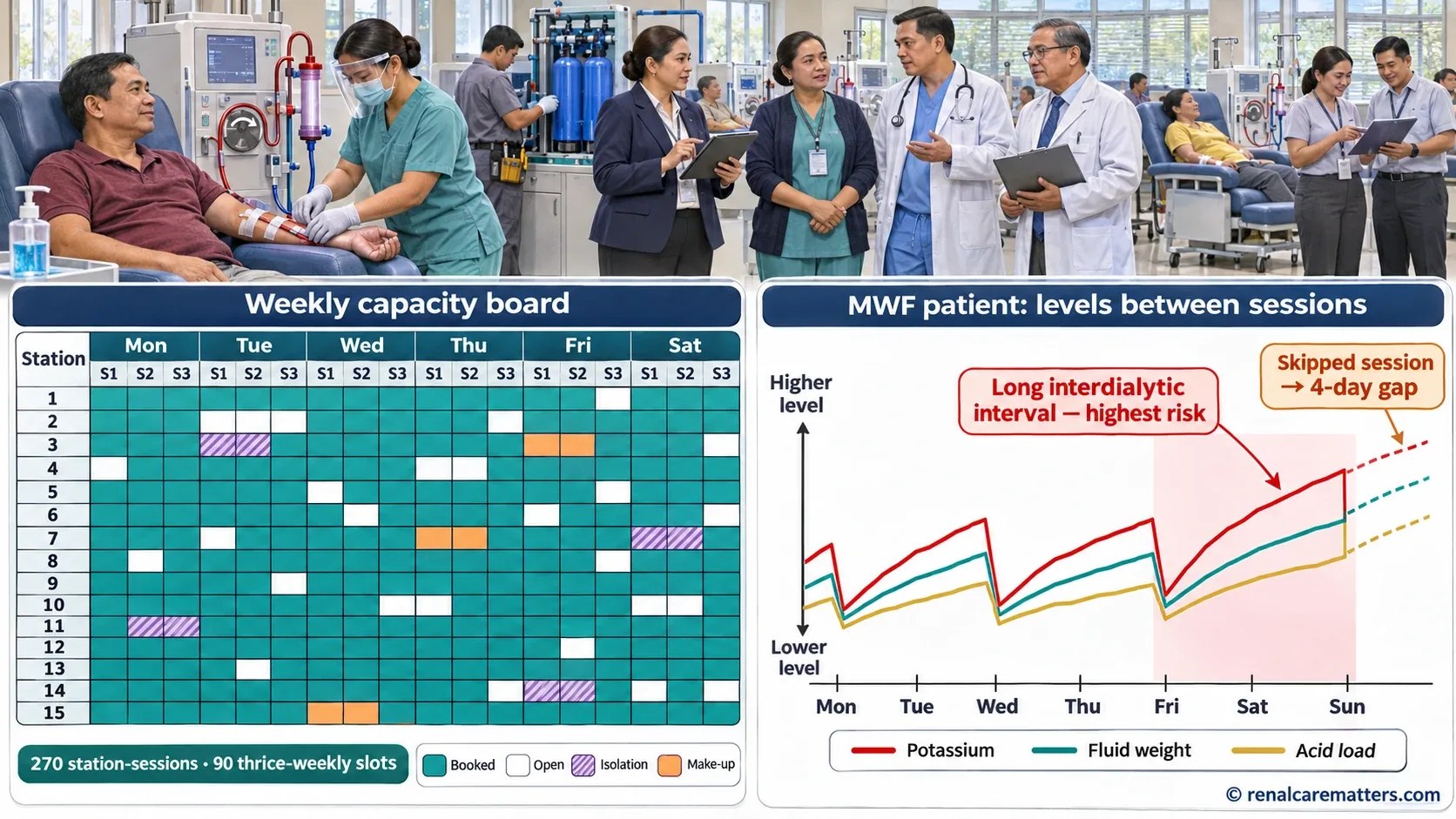
Potassium. Potassium from food enters the blood, and without kidney excretion the serum level rises. High potassium slows electrical conduction in the heart and can cause a fatal rhythm with no warning symptoms at all. A patient can feel perfectly well with a potassium level high enough to stop the heart.
Fluid. Every glass of water and every salty meal adds volume the patient cannot excrete. Volume expands the blood compartment, raises blood pressure, and, if large enough, floods the lungs. The patient who arrives breathless on a Monday morning is often the patient who had a family celebration on Saturday.
Acid. The body produces acid every day. Without the kidneys, bicarbonate is used up and the blood becomes acidic.
The long interdialytic interval, the weekend gap, lets all three build up the longest. That is why the day after the long gap carries the highest risk, and why a skipped session turns a two-day gap into a four-day gap.
What the evidence shows
Missed sessions are associated with death. In the international Dialysis Outcomes and Practice Patterns Study (DOPPS), skipping one or more sessions a month was associated with a 30% higher risk of death.1 The study was observational. Patients who skip sessions may differ in other ways, such as depression, transport problems, or illness, but the physiology makes the association plausible.
The day after the long gap is dangerous. In a large United States cohort, deaths and cardiovascular hospitalizations clustered on the day after the long interdialytic interval.2
Rescheduling helps, but only partly. In a matched United States cohort, a missed session was associated with a 2.09-fold higher hospitalization rate over the next seven days. Attending a rescheduled session the next day lowered that excess to 1.68-fold but did not remove it.3 A make-up session is better than none. It is not as good as the session that was never missed.
Shortened sessions matter too. In DOPPS, treatment longer than 240 minutes was associated with lower mortality, and ultrafiltration rates above 10 milliliters per kilogram per hour were associated with more low blood pressure during treatment.4 This too is observational, but it tells you that "let's cut everyone to three hours today" is a clinical decision that belongs to the attending nephrologist.
Philippine context
Philippine Health Insurance Corporation (PhilHealth) covers up to 156 maintenance hemodialysis sessions per calendar year for eligible patients with chronic kidney disease stage 5 registered in the PhilHealth Dialysis Database, based on three sessions a week for 52 weeks.5 A capacity plan that cannot deliver thrice-weekly treatment for every enrolled patient leaves benefits unused and patients under-dialyzed.
Demand is growing fast. Reported dialysis numbers rose from about 53,300 in 2023 to about 64,800 in 2024 (Philippine Renal Disease Registry data as reported by the National Kidney and Transplant Institute; confirm the latest figures with the registry). Most units cannot add stations as fast as patients arrive.
Calculator CALC-02: capacity, utilization, and waitlist
You need: stations, shifts per day, operating days per week, sessions per patient per week (usually three), sessions delivered last month, reserved isolation stations, and the number of patients on the waitlist.
Patient slots at three a week = available ÷ 3, rounded down.
Utilization = sessions delivered ÷ station-sessions available × 100.
Open slots = patient slots − enrolled patients.
Weeks to clear the waitlist = patients waiting ÷ expected openings per week.
Worked example. Fifteen stations, three shifts a day, six days a week: 15 × 3 × 6 = 270 station-sessions a week, or 90 patient slots at three sessions each. With 84 enrolled patients, there are six open slots.
Now look closer. One isolation station is reserved for two patients positive for hepatitis B surface antigen, who use six of its 18 weekly sessions. The other 12 sessions on that station sit idle, because a non-isolated patient cannot use them. That idle capacity is a design choice for infection safety. State it openly, rather than counting it as available.
Utilization above about 95% leaves no room for make-up sessions after an outage. Plan a buffer, the way a good hospital keeps a few beds empty for the emergency room.
The waitlist and referral process
A fair waitlist is written, dated, and ordered by criteria the Medical Director approves: urgency (a new start leaving the hospital, a patient with a catheter), the date of the request, and continuity (an existing patient changing shift).
Record every referral with:
- date and time received, the referring facility, and a contact;
- a clinical summary and serology status, needed to decide isolation placement;
- PhilHealth Dialysis Database and payer status;
- the decision, who made it, and the date;
- if declined, the reason and the alternative offered.
Example. A unit in Bacolod fills its last two slots in March through a board member's request and a councilor's call. In April, a 34-year-old jeepney driver who has been on the written waitlist since January is told there is still no slot. His sister files a complaint with the city. The unit cannot show why two later requests went first, because there was no rule. A written waitlist would not have made that conversation pleasant. It would have made it defensible.
Rescheduling after a disruption
When a typhoon, a power outage, or a water failure cancels sessions, work through the list in order.
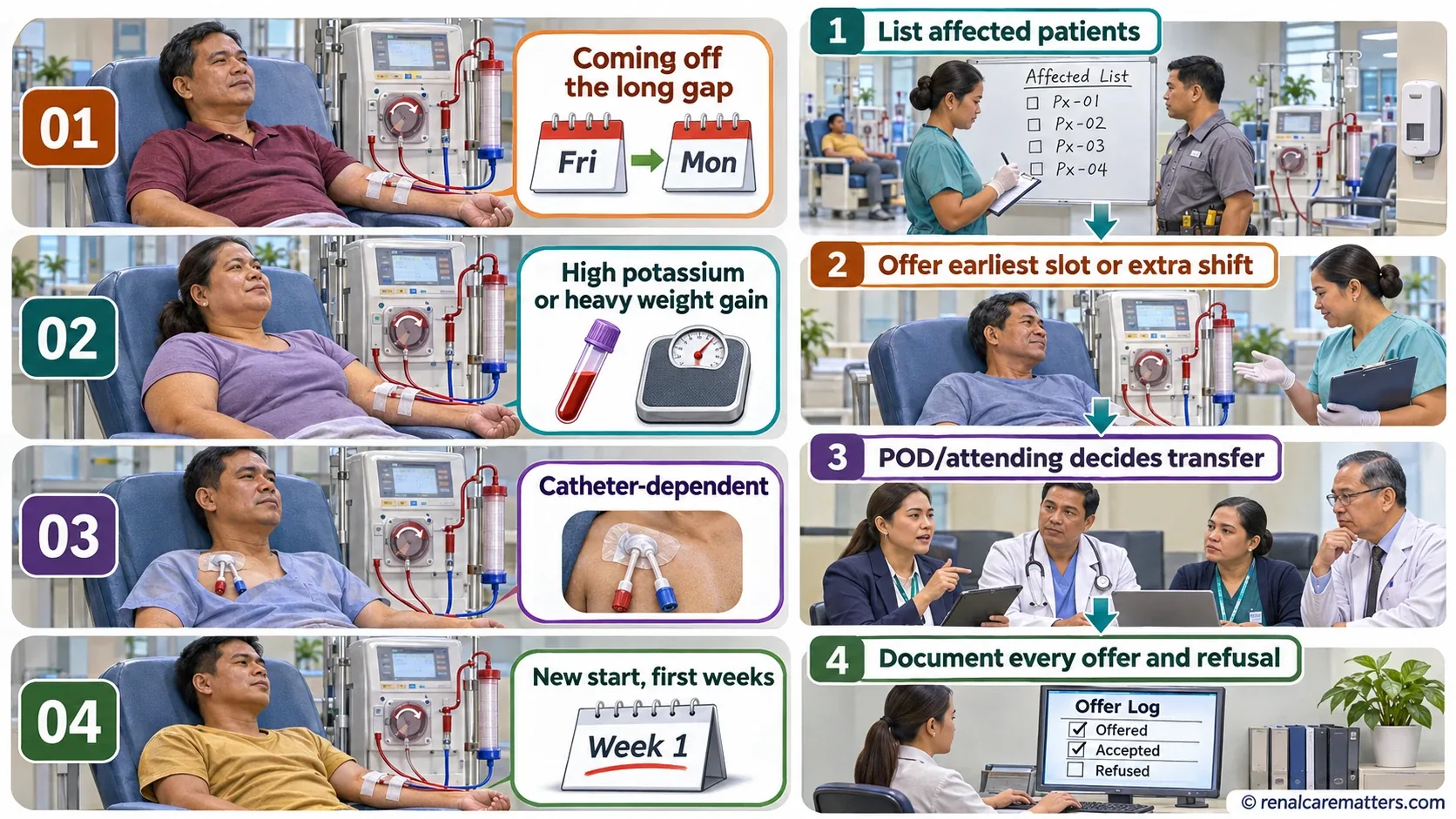
Figure 4 · Rescheduling after a disruption
- ListEvery affected patient and the date and time of their last completed session.
- PrioritizePatients coming off the long gap, those with high potassium or heavy weight gain last time, catheter users, and new starts go first.
- OfferThe earliest available slot. Run an extra shift if staffing allows.
- EscalateFor anyone you cannot place within the window, the physician on duty or attending decides on transfer to a partner unit or a hospital.
- DocumentEvery offer, acceptance, and refusal, with the time.
Example. After a 9-hour power outage on a Tuesday in Tacloban, 22 sessions are cancelled. The manager lists them by last treatment. Seven patients last dialyzed on Saturday; by Wednesday morning they will be four days out. They go first, on an early extra shift at 04:00. The remaining 15 fit into Wednesday's regular shifts and an evening extension. One patient refuses the 04:00 slot because he has no transport; the physician on duty calls him, documents the discussion, and arranges a tricycle through the barangay.
Common failure modes
- Stations instead of station-sessions. Counting 15 stations as 15 slots hides two-thirds of the real arithmetic.
- Holidays planned by finance. Closing days without a clinical review of who will be harmed by the gap.
- The phone is the waitlist. Referrals accepted by whoever answers.
- "Short treatments for everyone." Decided by operations to clear a backlog.
- The 100% unit. Running so full that one outage leaves nowhere to put anyone.
Back to the case: The holiday week
The gap. Closing Friday turns a two-day gap into four: Wednesday after treatment to Monday. For patients who already arrive on Mondays with high potassium and heavy fluid gains, that is the riskiest change you can make to a schedule. Whether any patient can tolerate a longer gap is a clinical decision for the attending nephrologist, not an operational one.
The plan. Ms. Pineda does not close Friday. She moves the Friday patients to Thursday and Saturday of the same week, runs an extended Saturday with two extra shifts, and offers holiday premium pay (Module 17) to volunteers. Eight nurses volunteer, enough for the extra shifts at safe ratios. The attending nephrologists review the three highest-risk patients, including Mr. Sicat, and ask that his Saturday session start early. No patient goes more than three days without treatment.
The communication. Patients receive the new schedule two weeks ahead, in writing and by text, in Filipino and Kapampangan, with a phone number for questions. Nurses confirm each patient's new slot at their last session before the holiday.
The owner. Mrs. Lugtu approves the plan once she sees it costs less in premium pay than the hospital admissions it is meant to prevent.
Skills checklist: Supervised practice
Complete these with your preceptor at your own unit, using fictional or de-identified data. Your preceptor rates each step as satisfactory, needs practice, or not observed. Steps marked Critical must all be satisfactory before sign-off. This checklist supports supervised learning; your unit’s own procedure and competency form are the authority. A printable version of every checklist is on the trainer page.
- CriticalRun CALC-02 for your unit and present utilization, open slots and isolation capacity.
- Audit last month's missed sessions: count, reasons and whether each was rescheduled.
- Rebuild a holiday schedule so that no patient exceeds a three-day gap.
- Review five referrals against the written acceptance criteria.
Check your understanding
Each visit draws 5 questions at random from this module’s 15-question bank. Choose the single best answer for each, then select Check answers; an explanation appears under the best answer. Select New set of questions for a different mix. A good target is 4 of 5 on two different sets. Nothing you select is sent anywhere; scoring happens in your browser.
Read next on this site
- Dialysis AdequacyWhy time on dialysis and dose matter.
- Hemodialysis Transfer Guide: How to Change Dialysis Centers or Nephrologists SafelyMoving a patient safely between units.