After this module you should be able to
- Identify the critical dependencies of a hemodialysis unit (power, water, staff, supplies, communications, transport) and their failure modes.
- Calculate how long the unit can operate on generator fuel and stored treated water.
- Write a phased plan for predictable hazards (typhoon) and sudden hazards (earthquake, grid failure).
- Coordinate transfers to partner units and phased reopening after an event.
The big picture, in plain words
The picture has a limit. The clock does not tick at the same speed for everyone. A patient who ate lechon at a fiesta, or who has little remaining kidney function, runs faster than one who still makes urine. And the clock does not ring an alarm. Patients can feel fine until they do not. That is why continuity plans start days before the storm, not the morning after.
The Philippines sits in the typhoon belt and on the Ring of Fire. Every unit will face these events. The units that do well are not the ones with the biggest generators. They are the ones that planned, rehearsed, and knew where every patient was.
Figure 1 · Key terms for this module
Case: The brownout that lasted
It is 08:00 on a Monday at a 15-station unit in Roxas City, Capiz. A provincial grid failure takes out power across the city. The generator starts within seconds, and the morning shift continues.
At 13:00, the water technician, Mr. Danilo Arceo, reports a problem. The reverse osmosis system is running at reduced pressure on generator power, and the treated-water storage tank is falling faster than it refills. The afternoon shift of 15 patients starts at 14:00. The power company says the grid may be back "tonight or tomorrow."
Before reading on, decide:
- Which will run out first, fuel or water? How would you find out?
- If you cannot treat all 15 afternoon patients, who decides which ones are treated?
- What happens to the patients who are not treated today?
Keep your answers in mind. The lesson gives you what you need, and the case review near the end shows one sound response.
The model: dependencies and buffers
A hemodialysis session needs, all at once, electricity, treated water at the right quality and pressure, a trained team, supplies, a working machine, and a patient who can reach the unit. Losing any one stops the session. For each dependency, ask two questions: how long can we run without it, and what is our backup?
| Dependency | Typical failure | Buffer |
|---|---|---|
| Grid power | Brownout, typhoon damage | Generator sized for machines, reverse osmosis, and lighting; automatic transfer switch; fuel contract |
| Municipal water | Supply interruption, contamination after floods | Raw-water and treated-water storage; tanker agreement; testing after supply resumes |
| Staff | Cannot travel; families affected | Staff contact tree; map of who lives near; accommodation; mutual aid |
| Supplies | Road closure, port delays | Safety stock (Module 8); supplies pre-positioned before typhoon season |
| Communications | Mobile network failure | Landline, SIMs on a second network, radio if available; printed patient list |
| Patients | Flooded roads, evacuation centers | Early dialysis; emergency information sheet; partner-unit list |
What the evidence shows
Early dialysis before a predictable disaster is associated with better outcomes. Before Hurricane Sandy, patients who received an early session had, in adjusted analyses, about 20% lower odds of an emergency department visit, 21% lower odds of hospitalization, and 28% lower odds of death within 30 days.1 The study was observational, but it fits the physiology of missed treatment (Module 4).
Disasters disrupt care and increase harm. Dialysis patients in areas hit by Sandy had more emergency department visits and hospitalizations, and a small rise in deaths, compared with patients in unaffected regions.2
The lessons are the same across Asia and the Pacific. Reviews of earthquakes, tsunamis, and typhoons in the region, including the Philippines, describe the same priorities: tracking every patient, pre-agreed transfer arrangements, emergency supplies, and staff welfare.3
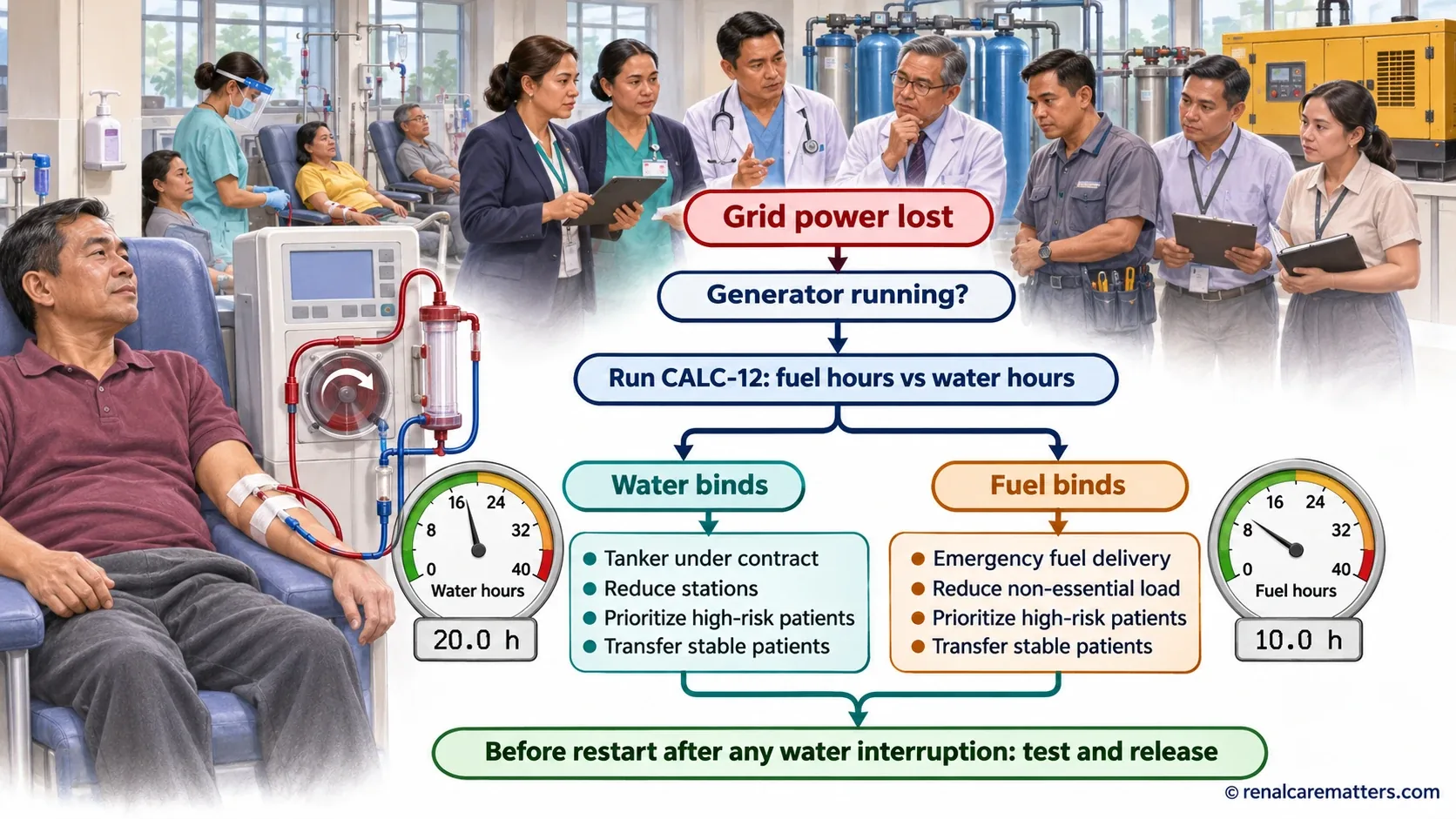
Calculator CALC-12: outage autonomy
You need: usable generator fuel in liters, the generator's consumption per hour at expected load, the number of active machines, the dialysate flow rate, other treated-water use per hour (rinsing, reprocessing, reverse osmosis reject not recycled), and usable treated-water storage.
Treated-water demand (liters per hour) = machines × dialysate flow (liters per minute) × 60 + other use.
Water autonomy (hours) = usable treated-water storage ÷ demand.
Operating autonomy = the smaller of the two. That is the binding constraint.
Sessions possible = operating autonomy ÷ session length × machines, rounded down.
Worked example. The unit has 400 liters of fuel and burns 22 liters an hour: about 18 hours. Fifteen machines at 500 milliliters a minute use 15 × 0.5 × 60 = 450 liters an hour, plus 100 liters an hour of other use, for 550 liters an hour. With 3,000 liters of storage, water lasts 3,000 ÷ 550 = about 5.5 hours. Water is the binding constraint: enough for one full shift of 4-hour sessions on all 15 machines, not two. The plan needs a water tanker agreement or fewer stations, not more diesel.
Check generator sizing with the biomedical technician. Consumption depends on load, and the reverse osmosis pumps add a lot of it.
A phased typhoon plan
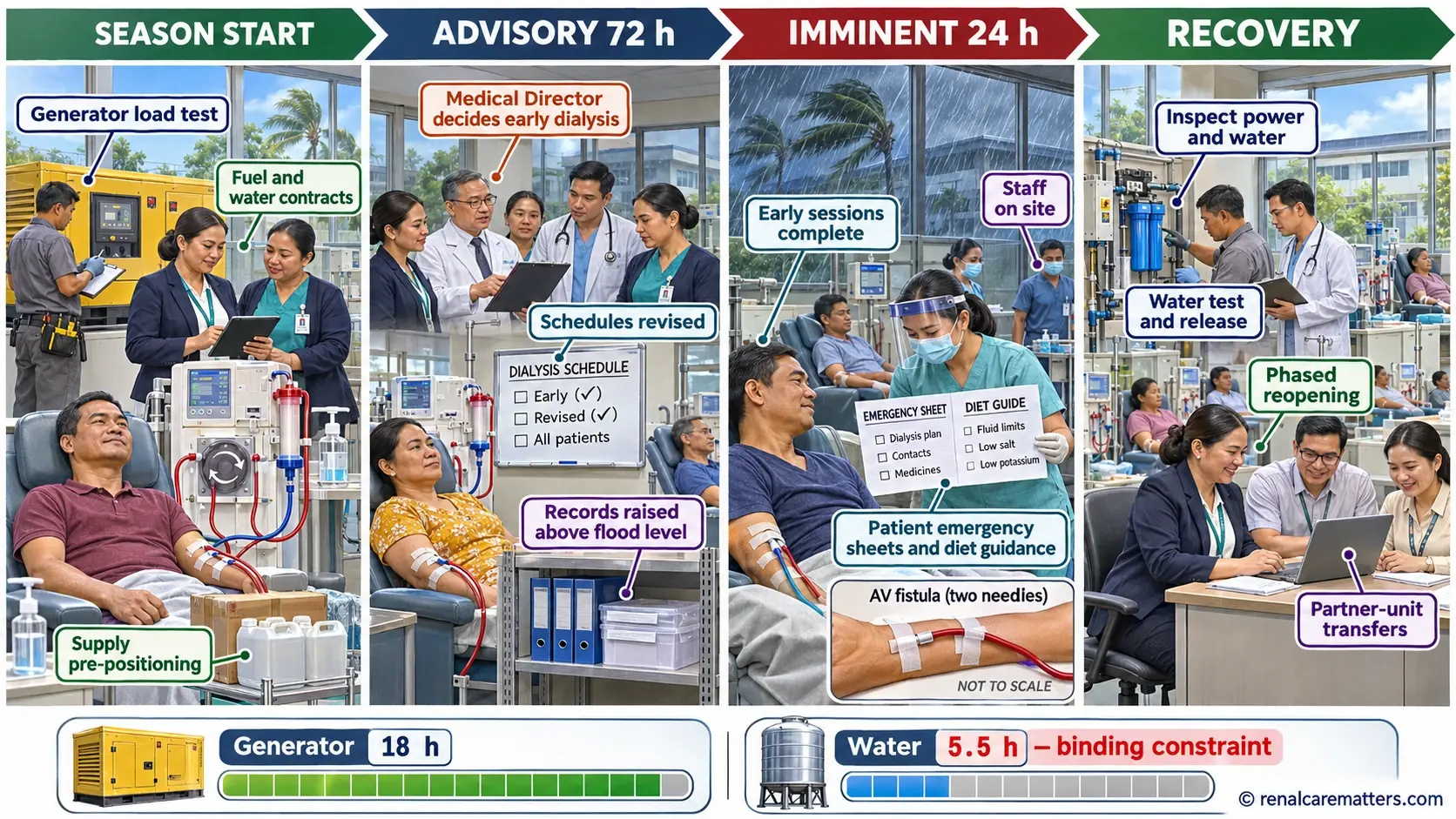
Figure 4 · Typhoon plan by phase
- Season start (May to June)Test the generator under load, confirm fuel and water contracts, update every patient's emergency information sheet, pre-position at least two weeks of supplies, refresh the staff contact tree, confirm partner units.
- Advisory (72 hours before landfall)Monitor PAGASA bulletins. The Medical Director decides on early dialysis. Notify patients of revised schedules. Top up fuel and water. Move records and equipment above flood level.
- Imminent (24 hours)Complete early sessions. Give each patient the emergency information sheet and the dietitian's emergency diet guidance. Confirm where each patient will shelter. Identify staff who will stay on site, with food and a place to sleep.
- DuringClose safely if travel is dangerous. Keep communication open. Record every patient contact.
- RecoveryInspect the building, power, and water. Have the water tested and released before treatment (Module 6). Reopen in phases, highest-risk patients first. Contact every patient. Arrange transfers for those who cannot reach the unit.
Example. With a Signal No. 3 typhoon forecast to make landfall in Eastern Samar on Thursday night, the manager of a unit in Borongan meets with the Medical Director on Tuesday. All Thursday and Friday patients are moved to Wednesday and early Thursday morning. By Thursday noon, every patient has been treated within the previous 36 hours and has a printed sheet in a plastic folder. The nurses call each patient on Saturday morning; 31 of 34 are reached. The barangay health workers find the other three in an evacuation center. The unit reopens on Sunday after the water is released, starting with the three patients whose families could not be reached.
Partner units and transfer
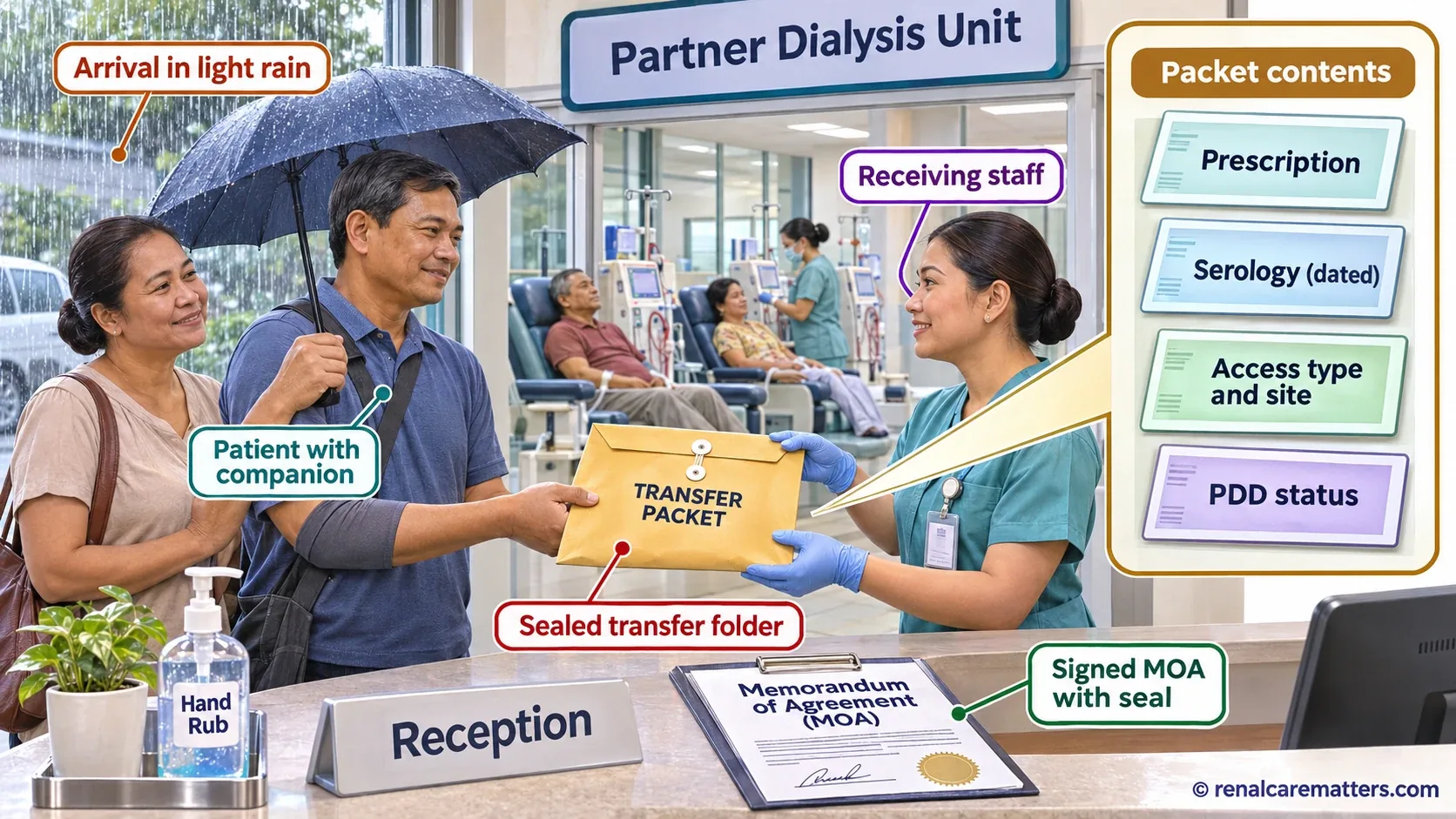
Keep written memoranda of agreement with at least two partner units outside your likely hazard zone. Each agreement states how patients are referred, what records travel with them (prescription, serology, access type, Philippine Health Insurance Corporation (PhilHealth) Dialysis Database status), and how billing is handled. Test it once a year by sending one transient patient through the process.
Common failure modes
- The generator that was never loaded. Tested every week with no machines running.
- Power only. Planning for electricity and forgetting water.
- The list in the dead computer. Patient contacts only in the electronic system that went down.
- Paper partners. Agreements signed and never used.
- Late decisions. Waiting for landfall to decide on early dialysis.
Back to the case: The brownout that lasted
The binding constraint. The manager, Ms. Lorelie Bautista, runs the outage calculator with current figures. The fuel will last another 16 hours. The water, at full load, will last about two hours. Water is the binding constraint. Buying more diesel would not help.
Who decides. Ms. Bautista brings the numbers to the Medical Director and the head nurse. They reduce the afternoon shift to the eight highest-risk patients: those with the longest gap, the highest last potassium, and the heaviest weight gains. Ms. Bautista's job is to make the plan work, not to choose the patients.
The other seven. She calls the partner unit in Iloilo City, which can take seven patients on its evening shift. Each patient travels with an emergency information sheet: prescription, access type, serology, and PhilHealth Dialysis Database status. She arranges a van. She calls the water tanker under the standing contract.
Recovery. Power returns at 02:00. Before the morning shift, Mr. Arceo tests the water and the Medical Director's designee releases it. All 15 stations open at 06:00. Ms. Bautista adds a line to the plan: test the reverse osmosis output on generator power during the next generator load test, so this is known in advance.
Skills checklist: Supervised practice
Complete these with your preceptor at your own unit, using fictional or de-identified data. Your preceptor rates each step as satisfactory, needs practice, or not observed. Steps marked Critical must all be satisfactory before sign-off. This checklist supports supervised learning; your unit’s own procedure and competency form are the authority. A printable version of every checklist is on the trainer page.
- Map your unit's dependencies and buffers using the table above.
- Run CALC-12 with your actual generator and storage figures.
- Write the four-phase typhoon plan for your location.
- Test one partner-unit transfer with complete records.
Check your understanding
Each visit draws 5 questions at random from this module’s 15-question bank. Choose the single best answer for each, then select Check answers; an explanation appears under the best answer. Select New set of questions for a different mix. A good target is 4 of 5 on two different sets. Nothing you select is sent anywhere; scoring happens in your browser.
Read next on this site
- Typhoon and Disaster Preparedness in DialysisTyphoon preparedness for dialysis patients.
- Green, Prepared and Resilient: Kidney Care in an Era of Climate ExtremesHeat, floods and kidney care.