After this module you should be able to
- Explain the link between staff burnout, turnover, patient safety and patient experience, and cite the evidence.
- Calculate turnover and vacancy rates and interpret them.
- Coach a staff member using a structured conversation.
- Respond to a patient grievance fairly, on time and with documented closure.
The big picture, in plain words
The picture has a limit. A loop sounds like a machine that runs by itself, and that can make a manager feel helpless. It does not run by itself. Every turn passes through decisions a manager can change: how many people are hired, how the work is arranged, whether problems raised by staff get fixed, and whether a complaint from a patient leads to a scolding or to a system change. You cannot make anyone resilient. You can stop making their work harder than it needs to be.
This module covers the evidence on burnout, the numbers that show the loop turning, a simple way to coach, a fair grievance process, and what to do about the patient everyone calls "difficult."
Figure 1 · Key terms for this module
Case: The "difficult" patient
At a 20-station unit in Mandaue City, Cebu, the nurses have a name for Mr. Wilfredo Abellana, 52: "the shouter." Three times in two weeks, he has raised his voice at the reception desk about waiting times. Last Thursday he held up his phone and said he would post a video "so everyone sees how this clinic treats patients." Two nurses have asked the head nurse to have him discharged from the unit.
The manager, Ms. Maricel Ybañez, reads the incident notes. Every one describes what Mr. Abellana said. None says what time he was seated.
Before reading on, decide:
- What would you want to know before deciding anything about Mr. Abellana?
- Who decides whether a patient may be discharged from a unit?
- How would you protect the staff and still respect the patient's right to dialysis?
Keep your answers in mind. The lesson gives you what you need, and the case review near the end shows one sound response.
The model: a loop, not a line
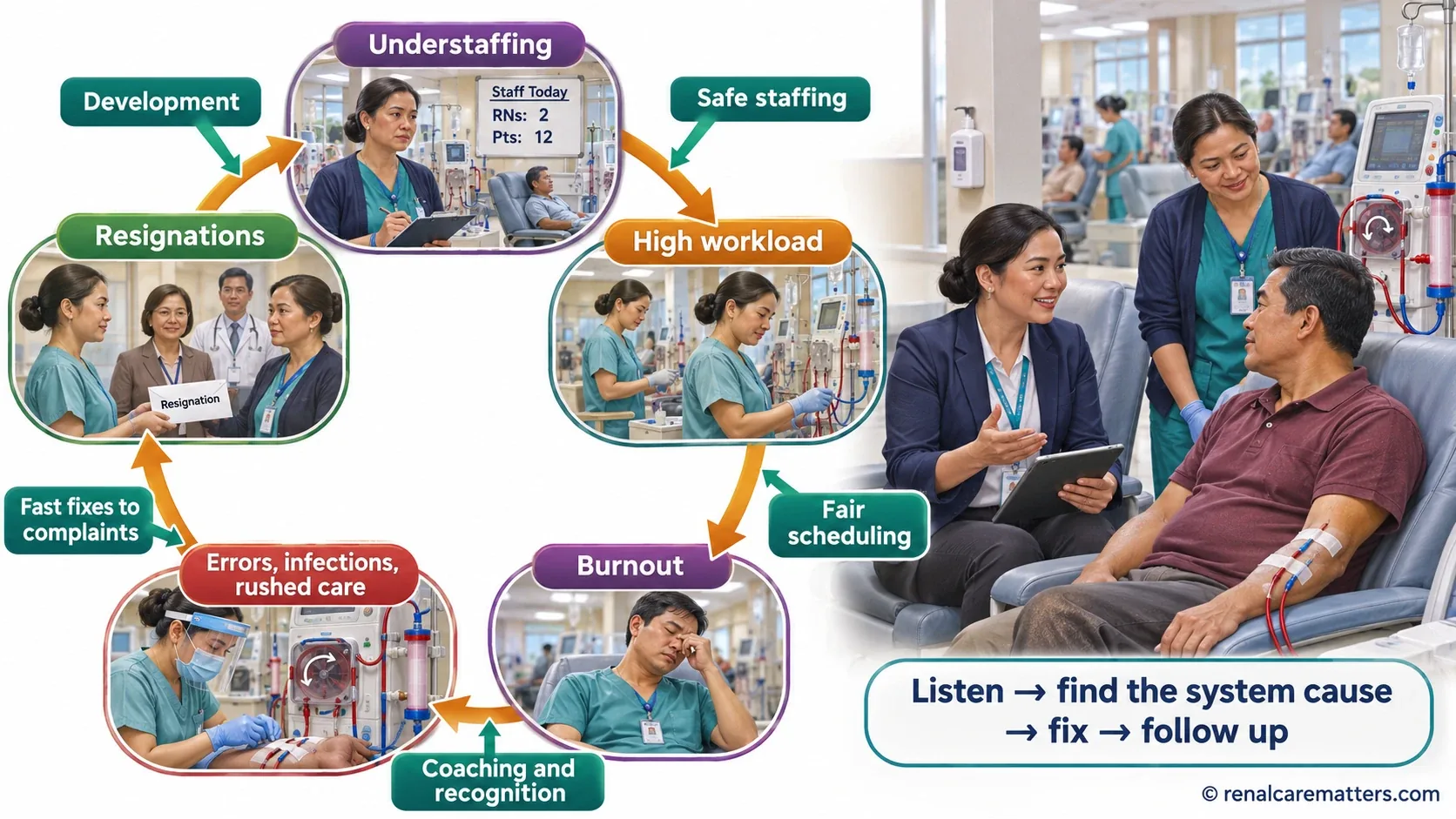
Chronic understaffing raises workload. High workload raises burnout. Burnout increases errors, infections, and rudeness, and drives resignations. Resignations deepen understaffing. Patients feel each turn as longer waits, rushed cannulation, and less explanation.
The manager's levers sit at every point: staffing (Module 3), how the work is designed, recognition, fair schedules, development, and how fast problems are fixed.
What the evidence shows
Burnout is associated with worse safety and patient experience. A 2024 meta-analysis of 85 studies and 288,581 nurses found burnout associated with a weaker safety climate, more healthcare-associated infections, more falls and medication errors, and lower patient satisfaction.1 The data are observational but consistent across countries and settings.
Burnout can be reduced. A meta-analysis of intervention studies in clinical nurses found that programs such as mindfulness, stress management, education, and organizational changes reduced emotional exhaustion and detachment, with moderate to large effects.2 Study quality varied, so treat this as supported rather than proven, and pair individual programs with fixes to the workload itself. A yoga session does not help a nurse carrying six patients.
Staffing burden is associated with patient outcomes (Module 3).3
Patient experience can be measured. Patient experience surveys for in-center hemodialysis assess communication, staff care, and information. Locally validated tools are better. A translated survey that has not been validated should be described as such.
Calculator CALC-13: turnover and vacancy
You need: staff who left in the period (resignations, terminations, retirements), headcount at the start and end of the period, months in the period, budgeted positions, and filled positions.
Turnover for the period = departures ÷ average headcount × 100.
Annualized turnover = period turnover × (12 ÷ months in the period).
Vacancy rate = (budgeted − filled) ÷ budgeted × 100.
Worked example. Six nurses left in six months. Headcount was 18 at the start and 16 at the end, so the average was 17. Turnover for the half year is 6 ÷ 17 × 100 = 35%. Annualized, that is about 71%. Two of 18 budgeted positions are vacant: an 11% vacancy rate.
At that rate, the unit replaces most of its nurses every 18 months, and competency (Module 3) never stabilizes. That is a strategic risk. Bring it to governance with the exit-interview themes attached.
Example. A unit in Lipa City does exit interviews for the first time after losing five nurses in four months. Four of the five give the same reason: the schedule is posted only three days ahead, so they cannot plan family life or second jobs. Posting the schedule four weeks ahead costs nothing. In the following six months, one nurse leaves.
Coaching conversations
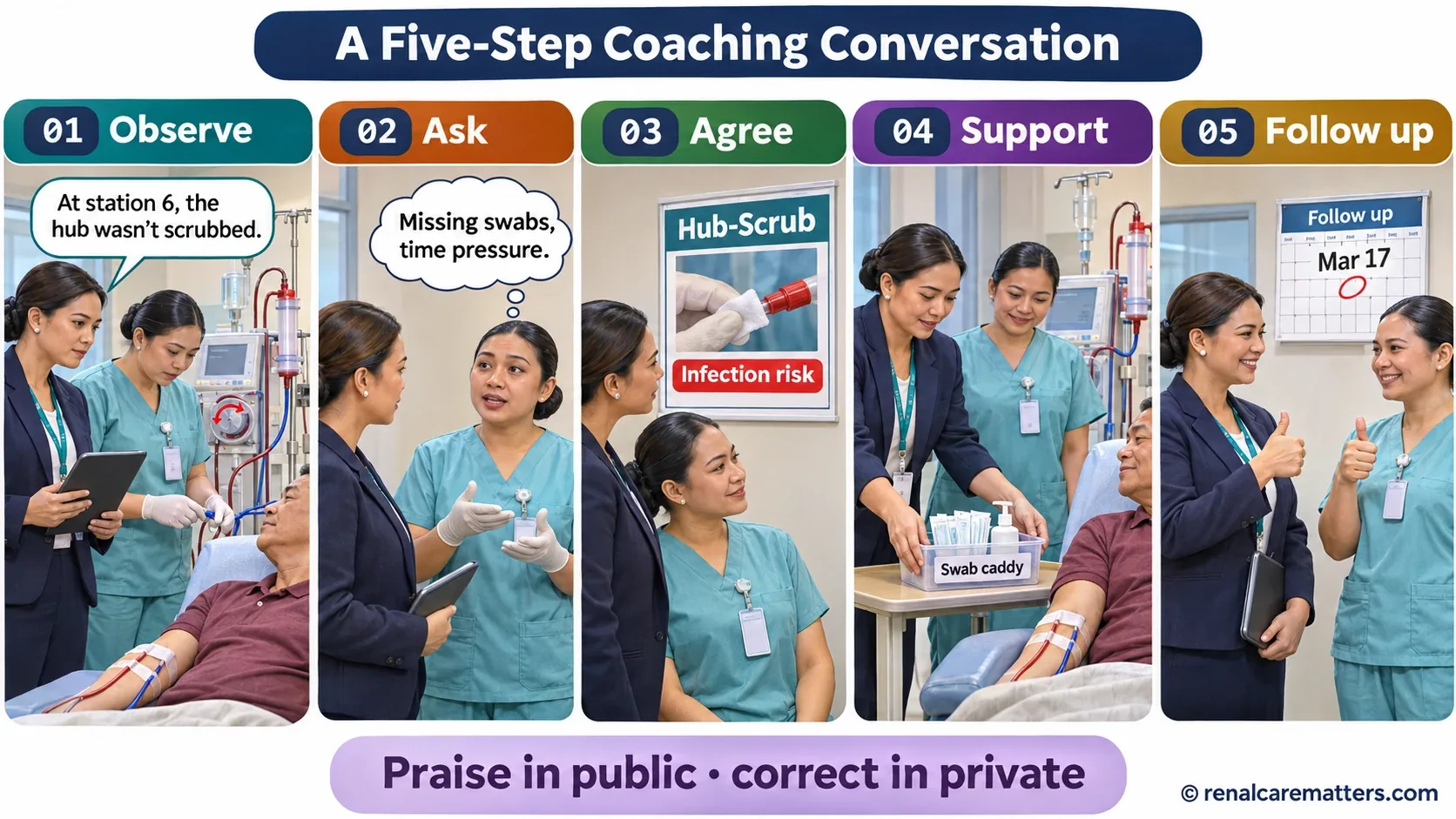
Figure 4 · A five-step coaching conversation
- ObserveState what you saw, specifically. "Yesterday at station 6, the catheter hub was not scrubbed before connection."
- Ask"Walk me through what happened." Listen for system causes: missing supplies, time pressure, unclear procedure.
- AgreeThe expected practice and why it matters. Link it to infection risk, not to rules.
- SupportWhat you will fix: supplies at the bedside, time in the schedule.
- Follow upA date to observe again, and recognition when it improves.
Praise specific good practice in public. Correct in private.
Example. When the manager in the example above asks the nurse to walk through what happened at station 6, she learns that the chlorhexidine swabs were kept in the supply room at the far end of the unit, and the nurse had four patients coming off at once. The swabs now sit in a holder on every machine. The coaching conversation ended up fixing the supply room as much as the practice.
Patient grievances
A grievance process that works:
- Receive complaints in any form: spoken, written, or on social media. Thank the patient for raising it.
- Log it with the date, the issue, an owner, and a response deadline: acknowledge within 24 hours; resolve or update within seven days.
- Investigate the facts with the staff involved, without prejudging.
- Respond in plain language: what you found, what you will change, and what the patient can do if still unsatisfied.
- Learn: review grievance themes every month at the quality meeting.
Clinical complaints, about a prescription or a clinical decision, go to the Medical Director. Privacy complaints go to the Data Protection Officer. Allegations of abuse or harassment follow the facility's protection policy without delay.
Workplace safety and aggression
Some patients, burdened by chronic illness, confusion, or family stress, become verbally or physically aggressive. Have a written policy that covers de-escalation training, a way to call for help, documentation, and a clinical review of the patient's needs. Transfer to another unit is a last resort, and the Medical Director decides it.
Common failure modes
- Burnout as weakness. Treating exhaustion as a personal failing instead of a workload signal.
- Silent departures. Exit interviews never done, or done and never read.
- Defensive replies. Grievances answered with explanations instead of fixes.
- Public correction. Coaching delivered in front of patients.
- The label that sticks. Calling a patient "difficult" and never asking why.
Back to the case: The "difficult" patient
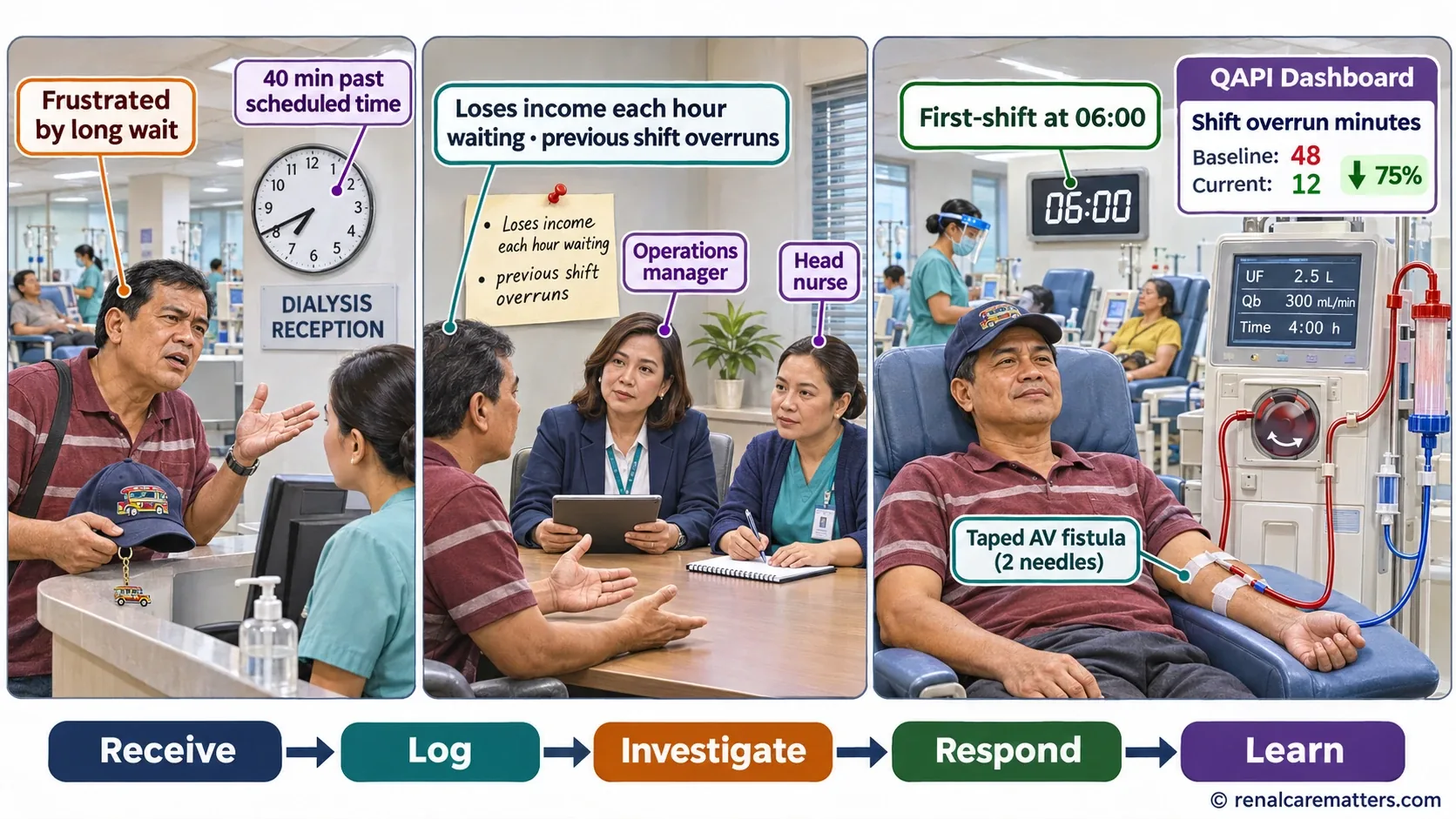
What she finds. Ms. Ybañez pulls a month of start times. Mr. Abellana's second-shift sessions have started a median of 40 minutes late, because the first shift regularly overruns. He is a jeepney driver who earns by the trip. Every hour he waits is an hour of income his family loses.
The meeting. She meets him with the head nurse, in a private room. She listens first. Then she says: "You were right that you have been waiting too long. Here is why, and here is what we are changing." She offers him a first-shift slot, which he accepts. She also says, calmly, that shouting at staff and filming them is not acceptable, and asks him to bring complaints to her directly. He agrees.
The system. First-shift overrun goes on the quality dashboard. The head nurse finds that late arrivals and slow turnover cleaning cause most of it, and a cleaning aide is moved to the changeover period. Median second-shift delay falls to 10 minutes.
The staff. In the next staff meeting, Ms. Ybañez explains what happened and what changed. The nurses see that the complaint led to a fix, not just a scolding. Discharge from the unit was never her decision to make; it belongs to the Medical Director, and it was not needed.
Skills checklist: Supervised practice
Complete these with your preceptor at your own unit, using fictional or de-identified data. Your preceptor rates each step as satisfactory, needs practice, or not observed. Steps marked Critical must all be satisfactory before sign-off. This checklist supports supervised learning; your unit’s own procedure and competency form are the authority. A printable version of every checklist is on the trainer page.
- Run CALC-13 for the last 12 months and summarize exit themes.
- CriticalHold two coaching conversations with your preceptor observing.
- Resolve one grievance through all five steps.
- Propose one workload change that addresses a burnout driver.
Check your understanding
Each visit draws 5 questions at random from this module’s 15-question bank. Choose the single best answer for each, then select Check answers; an explanation appears under the best answer. Select New set of questions for a different mix. A good target is 4 of 5 on two different sets. Nothing you select is sent anywhere; scoring happens in your browser.
Read next on this site
- Workforce Issues in Nephrology: Crisis or Opportunity?Burnout, retention and team culture.
- Dialysis Access CareAccess care, from the patient side.