After this module you should be able to
- Map the hospital departments your unit depends on and define the service agreement with each.
- Balance outpatient schedules with inpatient and acute requests using a transparent triage rule.
- Run a structured handoff (I-PASS adapted for dialysis) between ward and unit.
- Distinguish claims and documentation routes for maintenance outpatient hemodialysis (HD), inpatient HD and acute treatments.
The big picture, in plain words
The picture has a limit. Traffic is predictable on a map; hospital demand is not. Some mornings bring three emergency requests at once, and some weeks bring none. A crossroads also has no memory, but patients carry their histories with them, and the most dangerous moment is when that history is passed from a ward nurse to a dialysis nurse in a hurry.
This module is for managers of hospital units. It covers the departments you depend on, a fair rule for competing demands, the structured handoff, and the billing routes that differ between outpatients and inpatients.
Figure 1 · Key terms for this module
Case: The patient who arrived unprepared
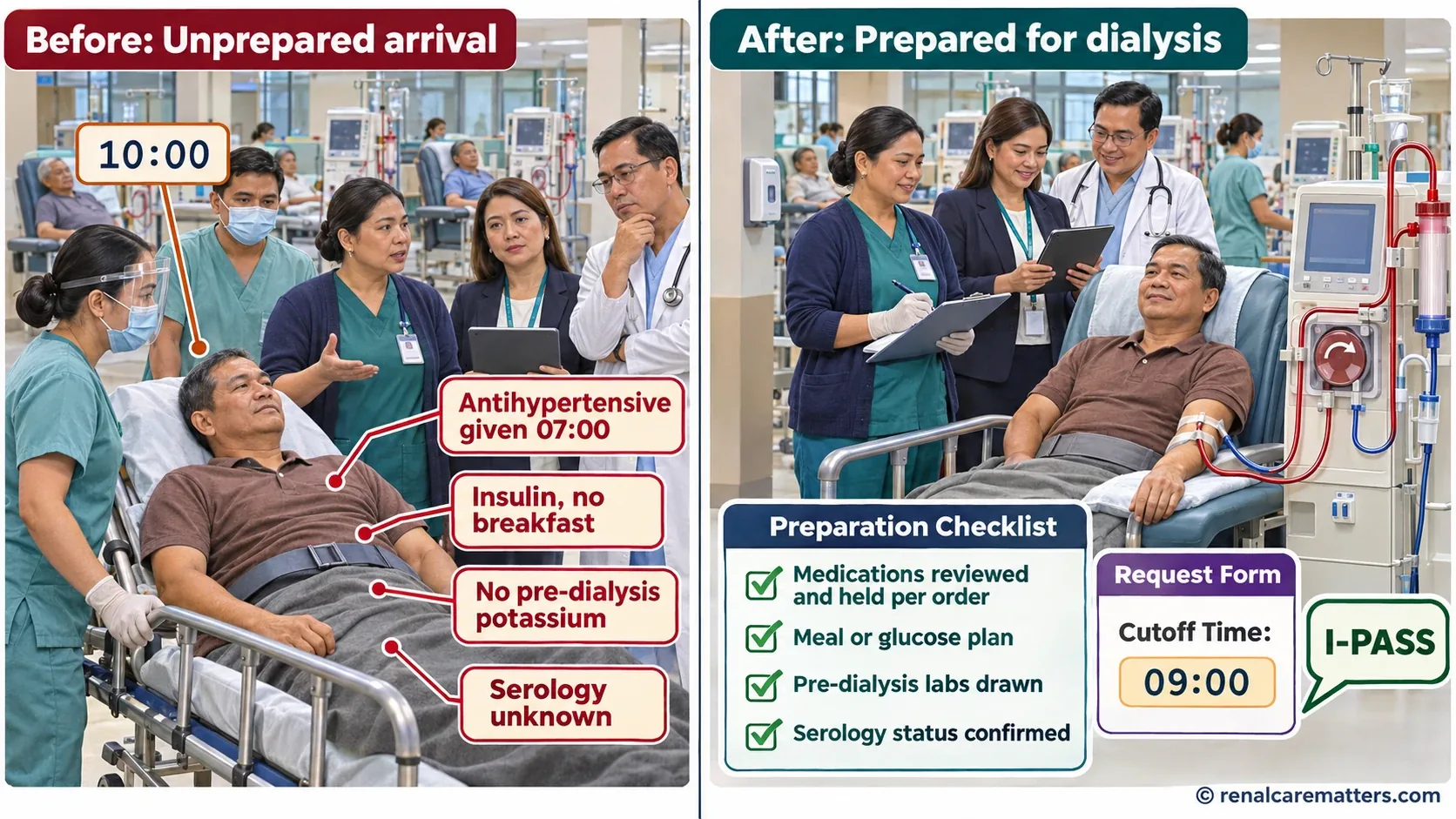
It is 10:00 on a Wednesday at a 24-station unit in a tertiary hospital in Olongapo City. A ward orderly wheels in Mr. Rodrigo Sangalang, 59, admitted two days ago for pneumonia, with a note: "For HD today." No one called ahead.
The dialysis nurse, Mr. Kevin Lacson, asks the orderly a few questions and checks the chart. Mr. Sangalang received his usual amlodipine and insulin at 07:00. He has not eaten since last night because he was "on hold for a procedure" that was cancelled. No pre-dialysis potassium was drawn. His hepatitis B status is not in the chart. All 24 stations are in use.
Before reading on, decide:
- What are the clinical risks of dialyzing Mr. Sangalang right now?
- Who decides whether and where he dialyzes?
- What would prevent this from happening with the next inpatient?
Keep your answers in mind. The lesson gives you what you need, and the case review near the end shows one sound response.
The model: one unit, many interfaces
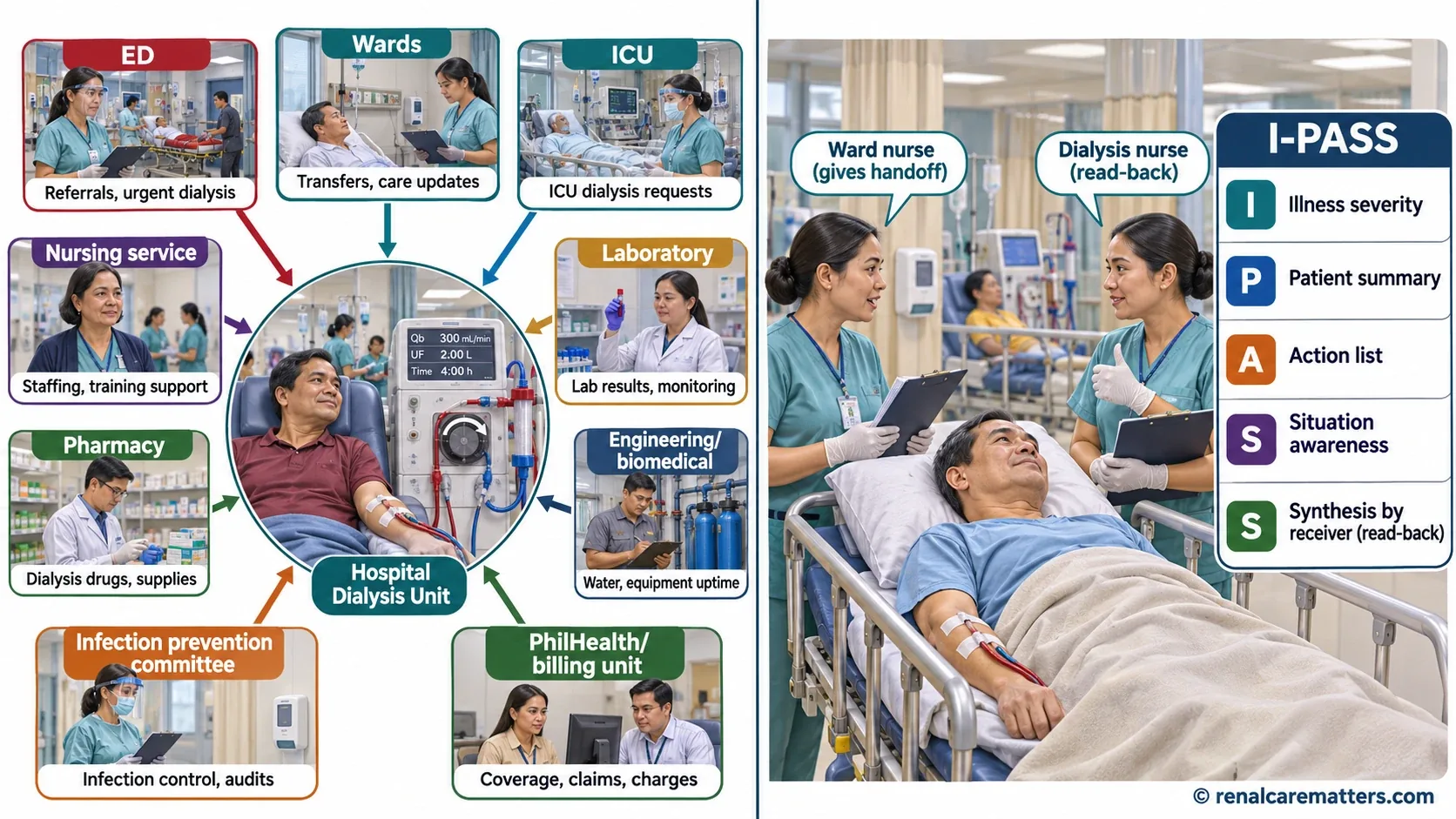
| Interface | What flows | What to agree in writing |
|---|---|---|
| Emergency room | Urgent dialysis requests, high potassium, fluid overload | Request process, response time, who transports |
| Wards | Scheduled inpatient sessions | Daily request cutoff, patient preparation, transport, return handoff |
| ICU | Bedside dialysis or other treatments where privileged | Who brings the machine, water source, staffing, physician responsibility |
| Nursing service | Staff allocation, floating, competency | Who can float into the unit and with which signed competencies |
| Laboratory | Pre- and post-dialysis tests, serology | Turnaround times, critical value calls |
| Pharmacy | Heparin, erythropoiesis-stimulating agents (ESAs), emergency drugs | Stock, dispensing, formulary |
| Engineering and biomedical | Power, water, machines | Response times, preventive maintenance |
| Infection prevention committee | Surveillance, outbreak response | Reporting and audit schedule |
| Billing and Philippine Health Insurance Corporation (PhilHealth) unit | Claims for outpatient and inpatient sessions | Route, documentation, and responsibility |
Write each as a short service agreement: what is requested, by whom, by when, how it is delivered, and how failures are escalated.
Balancing outpatient and inpatient demand
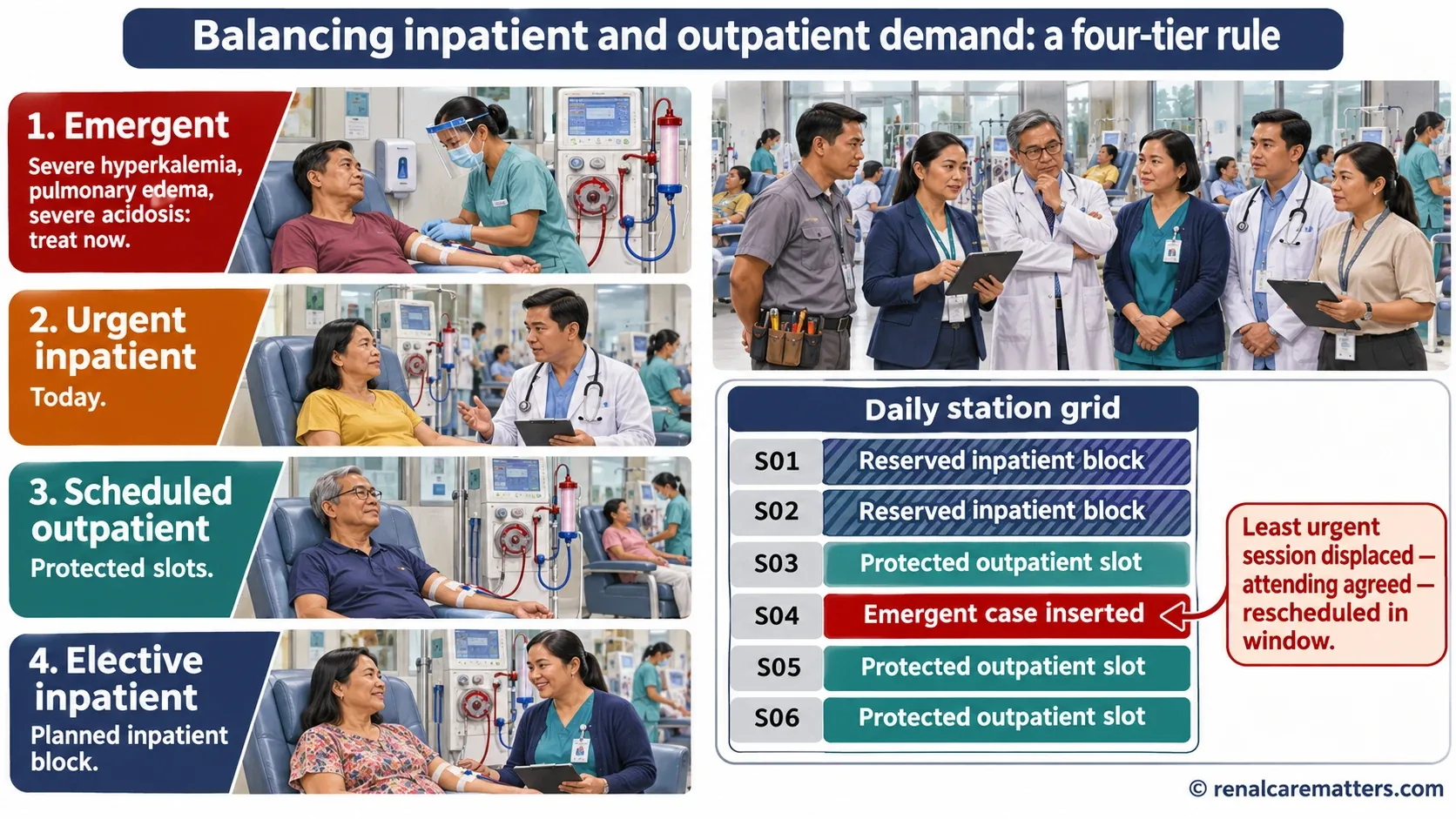
A typical rule, approved by the Medical Director, has four tiers:
- Emergent (life-threatening high potassium, fluid in the lungs, severe acidosis): treat immediately, wherever capacity can be made, displacing the least urgent session after the attending agrees.
- Urgent inpatient (needs dialysis today): the next available station the same day.
- Scheduled outpatient: protected slots, displaced only by emergent cases, and rescheduled within the safe window.
- Elective inpatient (a routine maintenance session for an admitted chronic patient): fitted into planned inpatient slots.
Reserve inpatient capacity based on past demand (Calculator CALC-02 with an inpatient block). A unit that books every station with outpatients will displace them every day.
Example. A hospital unit in Davao City reviews three months of data and finds it receives an average of 9 inpatient requests a day, with a peak of 15. It reserves 6 station-sessions a day for inpatients and protects the rest for outpatients. Outpatient displacements fall from about 20 a week to 3. On days with fewer inpatients, the unused reserved slots are offered for make-up sessions.
What the evidence shows
Structured handoffs reduce harm. The I-PASS bundle was associated with a 23% fall in medical errors and a 30% fall in preventable adverse events across nine hospitals, without making handoffs longer.1 The study involved pediatric residents. Applying it to handoffs between ward nurses and dialysis nurses is reasonable inference, not tested evidence.
Missed and delayed inpatient dialysis carries the same physiology as missed outpatient sessions (Module 4). Transport delays and incomplete preparation are among the most common causes.
I-PASS adapted for the ward-to-dialysis handoff
| Element | What the ward nurse tells the dialysis nurse |
|---|---|
| Illness severity | Stable, watcher, or unstable |
| Patient summary | Reason for admission, dialysis prescription, access type and site, isolation status, allergies, code status |
| Action list | Pre-dialysis tests pending, medicines held or given (blood pressure medicines, insulin), blood products ordered |
| Situation awareness | Fall risk, confusion, oxygen needs, recent low blood pressure, what to do if something changes |
| Synthesis by receiver | The dialysis nurse reads back key points and confirms questions are answered |
Use the same structure in reverse when the patient returns to the ward: the treatment summary, fluid removed, events, and post-dialysis instructions.
Claims and documentation routes
Maintenance outpatient hemodialysis for patients registered in the PhilHealth Dialysis Database follows the outpatient package (Module 10). Sessions for admitted patients and acute dialysis for acute kidney injury may follow different benefit rules and documentation. Train billing and nursing to identify the route for each session when it is requested. Confirm the current rules with your PhilHealth Regional Office and the hospital's PhilHealth unit.
Nursing governance in a hospital
The hospital's chief nurse holds overall nursing authority. The dialysis head nurse leads within that structure. If you are the unit manager but not the head nurse, your staffing decisions route through nursing service.
A nurse floated from a ward into dialysis needs signed dialysis competencies (Module 3). A ward nurse without them cannot take a dialysis assignment, however short the day.
Common failure modes
- Every station booked. Outpatients displaced by inpatients every day.
- Transport by whoever is free. Patients waiting on stretchers in the corridor.
- The willing ward nurse. Floated into dialysis without signed competencies.
- The wrong claim route. Inpatient sessions billed as outpatient, or the reverse.
- "For HD today." A note instead of a handoff.
Back to the case: The patient who arrived unprepared
The risks. A blood pressure medicine taken three hours ago raises the risk of low blood pressure during fluid removal. Insulin with no breakfast raises the risk of low blood sugar. Without a potassium result, the prescription is a guess. And without hepatitis B status, the isolation decision cannot be made safely.
The decisions. The physician on duty, Dr. Mylene Garcia, reviews him, orders a blood sugar check, a potassium level, and an urgent hepatitis B screen, and asks for a snack. Because his status is unknown, he dialyzes at the isolation-capable station under precautions until the result returns. The manager, Ms. Aileen David, makes the station available by moving one stable outpatient's start by 40 minutes, with the outpatient's agreement.
The fix. Ms. David meets the ward head nurses that afternoon. Together they agree on a request process: a request form by 16:00 the day before, a preparation checklist (hold or give which medicines, a meal, pre-dialysis laboratory tests, serology), and the I-PASS handoff below. She audits it weekly for a month. In week one, 6 of 14 requests used the form. By week four, 13 of 15 did.
Skills checklist: Supervised practice
Complete these with your preceptor at your own unit, using fictional or de-identified data. Your preceptor rates each step as satisfactory, needs practice, or not observed. Steps marked Critical must all be satisfactory before sign-off. This checklist supports supervised learning; your unit’s own procedure and competency form are the authority. A printable version of every checklist is on the trainer page.
- Draft service agreements with three hospital departments.
- Analyze one month of inpatient requests to size a reserved inpatient block.
- Observe and score five ward-to-unit handoffs against the I-PASS elements.
- Trace three sessions (outpatient, inpatient, acute) through their documentation and claims route.
Check your understanding
Each visit draws 5 questions at random from this module’s 15-question bank. Choose the single best answer for each, then select Check answers; an explanation appears under the best answer. Select New set of questions for a different mix. A good target is 4 of 5 on two different sets. Nothing you select is sent anywhere; scoring happens in your browser.
Read next on this site
- Hemodialysis ComplicationsComplications staff must recognize during treatment.