Follow one child from a newborn with valves to an adolescent with a transplant, owning every decision and every handoff.
PublishedNailathalaGipatikPepalwal:ReferencesMga SanggunianMga TinubdanReng Reperensya:5Audience: Pediatric nephrologists · pediatric nephrology fellows · adult nephrologists, intensivists and neonatologists who share kidney care for children in the clinic, ward, NICU, PICU, dialysis unit and homeRead timeOras ng pagbasaOras sa pagbasaOras ning pamamasa:
Training track for attending pediatric nephrologists
This module is study material for attending pediatric nephrologists and fellows. It explains the reasoning behind common decisions; it is not a protocol and it gives no doses. Doses, fill volumes and thresholds must come from current pediatric guidelines, product labels, your institution’s approved pediatric protocols and a pediatric pharmacist. Benefit rules change: confirm them on the date of service. Every case is fictional.
Learning objectives
After this module you should be able to
Follow one child through every setting of pediatric nephrology, making and justifying each attending decision at the right time.
Perform every critical action in the capstone: escalation, infection response, safe dialysis in an adult unit, ethical transplant preparation and a closed-loop transition.
Defend the plan to a preceptor using the five scored areas, linking each decision to the module and evidence that support it.
Pre-testBefore you read, answer the 5 self-assessment questions and note your score. After the module, select New set of questions and compare. The difference is what you learned; the questions you still miss are what to reread.
Start here
The big picture, in plain words
Your role · the attending across eighteen yearsEvery earlier module took one setting at a time. Real children do not. The same child moves from the nursery to the clinic, the peritoneal dialysis (PD) home, the hemodialysis (HD) unit, the transplant program and the adult clinic, and the attending pediatric nephrologist is the one physician who follows the whole story. This capstone asks you to carry one child through all of it, to decide at each stage, and to defend your decisions to a preceptor.
In plain wordsThink of the capstone as the logbook of a long voyage. Each port is a module you have studied. What the examiner reads is not whether you know each port, but whether you steered between them without losing the passenger.
The picture has a limit. A voyage has a fixed route; a child’s does not. Decisions made in the nursery, such as which veins were used, how the bladder was managed, and whether the family trusted you, change what is possible at 15. The capstone is scored on whether you see those links and act on them before they become problems.
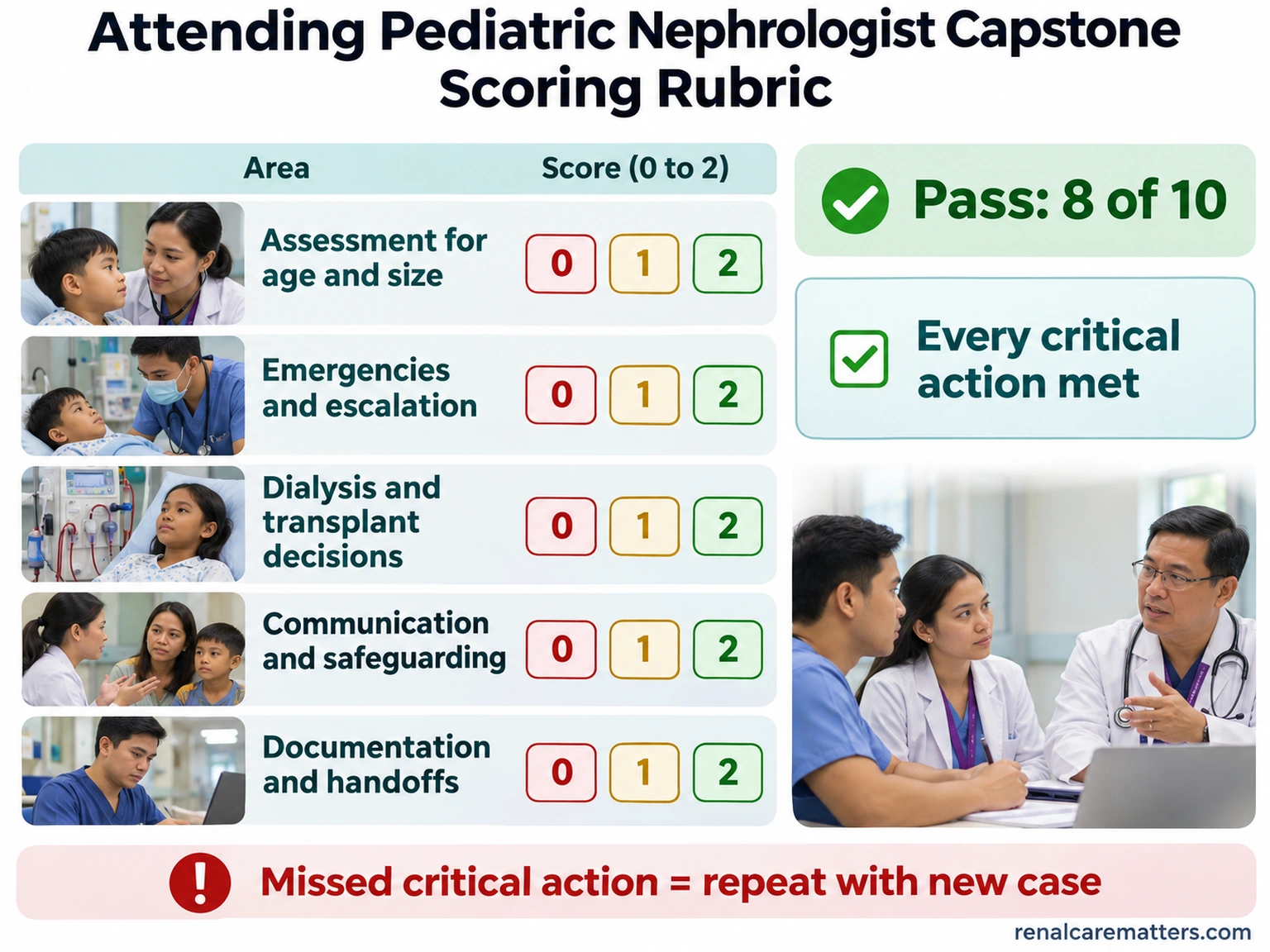
Figure 1 · How the capstone is scored
FormatOne child, six stages, written or oral defense with a preceptor; about 4 hours
ScoringFive areas, each scored 0, 1 or 2
Pass8 of 10, with every critical action met
A missed critical actionFeedback and a repeat with a different case, whatever the total
What completion meansAn Academy learning record, not a credential or a privilege
Most of the capstone tests judgment you already have from the modules. A few moments are critical actions: if they are missed in real practice, a child can die or lose a kidney. Your work is to make every decision at the right moment, to name the module and the evidence behind it, and never to miss a critical action.
Opening case · fictional
Case: Nathan, from the nursery to the adult clinic
Nathaniel “Nathan” Reyes is born at 37 weeks in a provincial hospital in Dagupan, Pangasinan. An antenatal scan had shown bilateral hydronephrosis, but no one acted on it. On day 1 he has a palpable bladder and a poor urinary stream. His mother, Aling Grace, sells fish at the market; his father, Mang Rico, works on a construction site in Metro Manila. The nearest pediatric nephrologist, you, practices in Quezon City, about four hours away by bus.
Over the next eighteen years Nathan will need you in every setting this track has covered. The six stages below give the facts available at each point. At each stage, say what you would do, who you would call, what you would write, and which module supports your decision. Your preceptor scores your defense with the rubric in the final section.
Before reading on, decide:
At each stage, what are the decisions only the attending can make?
Where are the critical actions, and why is each one critical?
How do early decisions shape what is possible for Nathan at 15 to 18?
Keep your answers in mind. The lesson gives you what you need, and the case review near the end shows one sound response.
Lesson · part 1
Stages 1 and 2: the newborn with valves, and childhood chronic kidney disease
Stage 1, day 2 of life. The provincial pediatrician calls: Nathan has a distended bladder, a creatinine above his mother’s and rising, and both kidneys are hydronephrotic on ultrasound. He is feeding poorly. A urethral catheter has not been placed. The hospital has no pediatric urologist.
Decision
What a strong answer includes
Module
Immediate bladder drainage
A urethral catheter placed today by the most experienced person available, with urine output and electrolytes watched
Stage 2, ages 1 to 5. Valves are ablated at the pediatric center. Nathan’s nadir creatinine leaves him with chronic kidney disease (CKD). By age 4 he is below the 3rd percentile for height, has had three febrile urinary tract infections, a hemoglobin of 9 g/dL and bowed legs. His mother catheterizes his bladder irregularly because the catheters are expensive. Blood pressure measured with an adult cuff at the health center is “normal.”
Domain
What a strong answer includes
Module
Assessment
Kidney function estimated for age and height; blood pressure remeasured with the right cuff and read against percentiles; growth plotted as a vital sign
RememberIn the nursery, drain the bladder and move the baby; in childhood, protect the bladder, the growth chart and the veins. Each pays off a decade later.
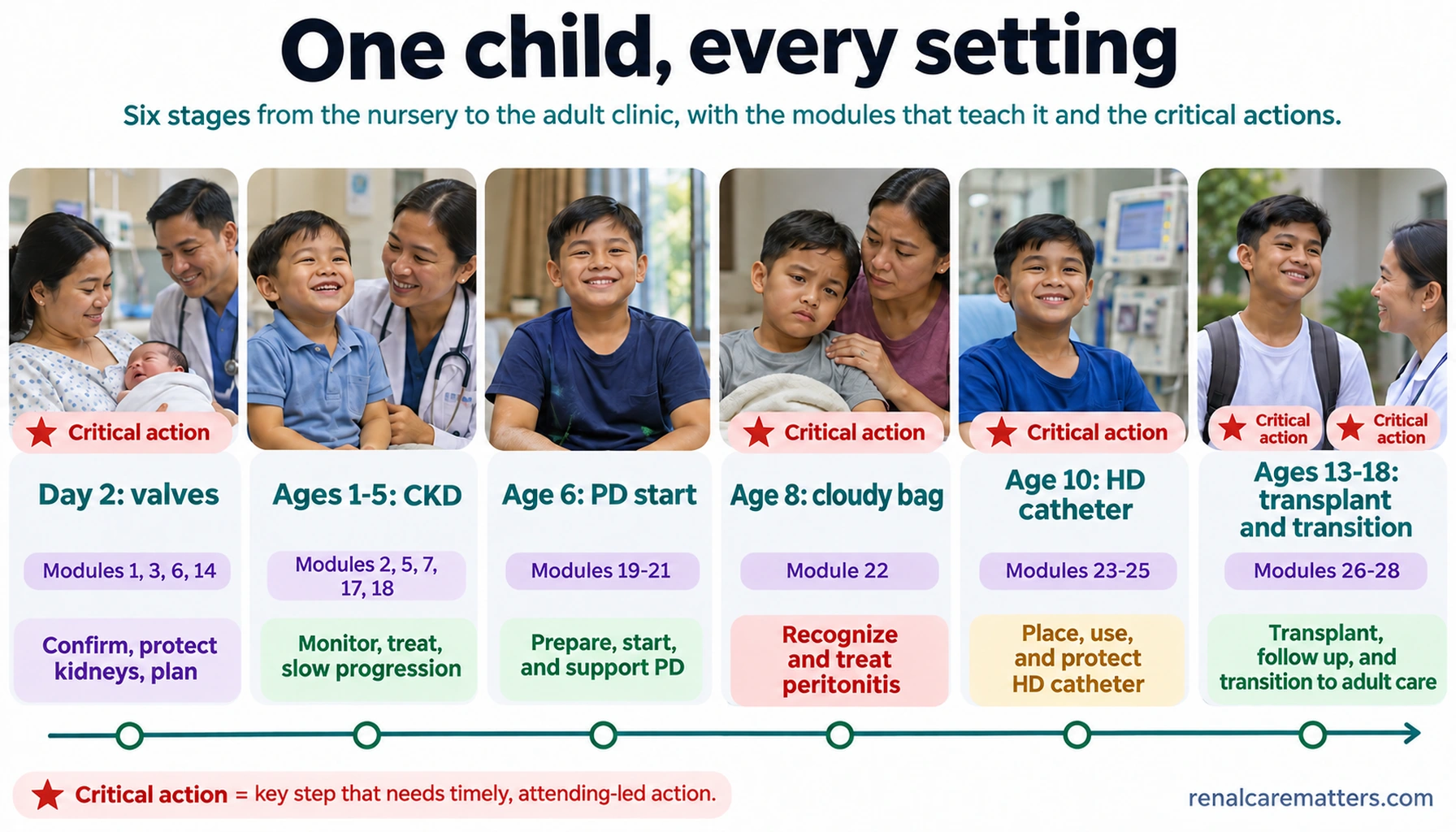
Figure 2. One child, every setting. Nathan’s six stages from the nursery to the adult clinic, each linked to the modules that teach it, with the critical actions marked.
Lesson · part 2
Stages 3 and 4: starting PD, and the peritonitis night
Stage 3, age 6. Nathan’s estimated glomerular filtration rate (eGFR) has fallen to the range where dialysis must be planned. He weighs 17 kilograms. No living donor is ready: his father has hypertension and his mother has not yet been evaluated. The family lives four hours from you. They ask whether Philippine Health Insurance Corporation (PhilHealth) will pay for machine PD at night so Nathan can go to school.
Decision
What a strong answer includes
Module
Choice of therapy
Shared decision with both parents; PD as the usual choice for a small child at home; transplant work-up started in parallel
PD catheter with an exit site away from the diaper and belt line; a prescription scaled to body size as the guideline describes, written from the unit’s protocol
The PhilHealth pediatric PD Z benefit covers continuous ambulatory PD and automated PD for children under PhilHealth Circular 2024-0036; the automated PD pilot was extended to July 31, 2026; its status after that date is unresolved in this track and must be confirmed with the PhilHealth liaison. Coverage never sets the clinical prescription.1
Stage 4, age 8, 10 p.m. Aling Grace calls your mobile phone: Nathan’s bag is cloudy, his abdomen hurts, and he has a fever of 38.6 °C. The nearest hospital with any PD experience is 90 minutes away. She asks whether she can wait until your clinic on Monday.
Decision
What a strong answer includes
Module
Same-night assessment (critical action)
Cloudy effluent is peritonitis until proven otherwise; the child is seen tonight, with the first cloudy bag brought along
Effluent cell count and differential, Gram stain and culture; the diagnosis made by the criteria the International Society for Peritoneal Dialysis (ISPD) 2022 sets out2
Empirical intraperitoneal antibiotics covering gram-positive and gram-negative organisms started the same night, with doses from the ISPD pediatric guidance and the unit formulary
RememberCoverage is not a prescription, and a cloudy bag cannot wait for Monday. Both rules are critical in this stage.
Lesson · part 3
Stage 5: PD fails, a catheter, and HD in an adult unit
Stage 5, age 10. After a second peritonitis episode and falling ultrafiltration, PD is no longer working. Nathan, now 27 kilograms, starts HD through a right internal jugular tunneled catheter at an adult freestanding unit in Dagupan. The nearest pediatric HD unit is in Manila. In his third month, at 7:30 a.m., he develops rigors 20 minutes into a session, with a heart rate of 140 per minute and a falling blood pressure. The physician on duty (POD), an internist, wants to give paracetamol and finish the session. The covering nurse ran today’s session from the adult template.
Decision
What a strong answer includes
Module
Access choice
A catheter is reasonable for an expected short bridge to transplant; the access plan names the veins to protect and a date to reconsider a fistula
Stop fluid removal; blood cultures before antibiotics; empirical gram-positive and gram-negative cover within the hour from the unit’s pediatric protocol; transfer if unstable
The European Society for Pediatric Nephrology consensus reserves cuffed catheters for very small children, urgent starts, patient preference or a short expected time to transplant, and suggests a functioning fistula where appropriate for children who need chronic HD.3 If Nathan’s transplant stalls, the catheter stops being a bridge, and the plan must change.
RememberA child in an adult unit needs an order the adult default cannot reach, and a fever on a catheter needs cultures and antibiotics within the hour.
Figure 3. How the capstone is scored. Five areas, 0 to 2 each; a pass is 8 of 10 with every critical action met, and a missed critical action means a repeat with a different case.
Lesson · part 4
Stage 6: transplant preparation, the adolescent, and the handover
Stage 6a, age 13. Aling Grace completes donor evaluation. The transplant program asks for your readiness summary. Nathan has a thick-walled bladder on his last study, two years ago. A neighbor tells Mang Rico that a broker can “speed things up.” The family asks whether PhilHealth’s kidney transplant Z benefit will cover the operation.
Decision
What a strong answer includes
Module
Bladder first (critical action)
A current urodynamic study and a bladder plan before a date is set
Stage 6b, ages 16 to 18. Two years after a successful transplant, Nathan’s tacrolimus levels swing and his creatinine has crept up. He has moved to a boarding house for senior high school. At 17 he asks to see you without his mother. At 18 he will move to an adult nephrologist.
Decision
What a strong answer includes
Module
Graft work-up
Rejection, BK virus, obstruction from the bladder, drug toxicity and volume tested in parallel; no dose increase on a swinging level until adherence is understood
An individualized transition with self-management skills, a joint visit, a handover letter naming the accepting adult nephrologist, and a confirmed first adult visit5
RememberThe bladder before the date, no money for a kidney, and a transition that ends with a confirmed adult visit. Each is a critical action.
Lesson · part 5
How the preceptor scores the capstone
The preceptor scores five areas across all six stages. Each area is scored 0 (not demonstrated or unsafe), 1 (partly demonstrated, with prompting) or 2 (demonstrated independently and justified). A pass is 8 of 10 and every critical action met. A missed critical action means feedback and a repeat with a different case, whatever the total. Simulated evidence is labeled simulated.
Area
Score 2 looks like
Score 0 looks like
1. Assessment adjusted for age and size
Creatinine, blood pressure, growth and fluid read against age, height and weight at every stage
Adult reference values used for a child
2. Recognition and escalation of emergencies
Neonatal obstruction, peritonitis, catheter sepsis and graft dysfunction recognized early, with a named receiving physician and written endorsement
Delay, or a plan that waits for the next clinic
3. Dialysis and transplant decisions within privileges
Modality, access, first sessions and transplant readiness justified from physiology and evidence; doses deferred to protocol and pharmacist
Decisions driven by coverage or habit; doses quoted from memory
4. Communication, consent, assent and safeguarding
Both parents and the child involved; assent sought; adolescent seen alone; safeguarding concerns acted on lawfully
The child excluded; a concern ignored
5. Documentation, handoffs and coverage
Truthful records; coverage explained without becoming a prescription; automated PD (APD) status after July 31, 2026 stated as unresolved; transition closed
A checklist signed for services not given; a handover never confirmed
Critical actions. All must be met:
Stage
Critical action
1
Bladder drainage and transfer of the newborn with valves arranged the same day
4
Cloudy effluent assessed the same night, with empirical antibiotics covering gram-positive and gram-negative organisms
5
Blood cultures before antibiotics and treatment within the hour for fever on HD through a catheter; transfer if unstable
5
No adult template for a child’s HD orders
6a
A bladder plan before a transplant date; a clear refusal of any paid donation
6b
A transition ending in a confirmed first adult visit
All
No coverage rule used as a clinical prescription
At the capstone defense · fictional
A candidate scores 9 of 10. In stage 5 she gave a careful account of catheter care but let the POD finish the session and culture at the next one.
The preceptor records a missed critical action, gives feedback, and schedules a repeat with a different case. The candidate passes the repeat a month later.
What this shows. The total measures judgment; the critical actions protect children. A high score cannot buy back a missed one.
RememberScore the five areas, then check every critical action. A pass needs both.
On the floor
Real situations: problems and solutions
These are fictional but typical. For each one, cover the answer, decide what you would do, then compare. Where a step depends on local rules, your unit’s procedure and your supervisor’s direction come first.
The candidate who quotes a dose
What you see
During the defense, a fellow states an exact intraperitoneal antibiotic dose from memory for the peritonitis stage.
What is likely going on
Knowledge is good; but doses belong to the current ISPD tables, the unit formulary and the pharmacist.
What to do
The preceptor asks where the dose would come from in real practice and scores area 3 on the reasoning, not the number.
Why it matters
The track teaches judgment, not order sets; a remembered dose can be out of date or wrong for the child.
The stage that is skipped
What you see
A candidate moves from PD failure straight to transplant without discussing the catheter, the adult unit or the access plan.
What is likely going on
The candidate sees HD as a waiting room rather than a setting with its own risks.
What to do
The preceptor prompts for the access plan and the adult-unit safety steps; a missed critical action is recorded if fever on HD is not handled.
Why it matters
Many Filipino children spend years on HD in adult units; that stage carries real danger.
The coverage answer
What you see
Asked about automated PD after July 31, 2026, a candidate says confidently that the pilot ended.
What is likely going on
The track holds the post-pilot status as unresolved.
What to do
The preceptor asks how the candidate would confirm it: the PhilHealth liaison, on the date of service.
Why it matters
Stating an unverified policy as fact misleads families.
Field notes
Prepare by writing one paragraph per stage before the defense, naming the module behind each decision.
List the critical actions on a card and check each one off as you defend the case.
Say where a dose or threshold would come from instead of quoting it.
Practice the transition letter; it is the most often forgotten document.
Case review
Back to the case: Nathan, from the nursery to the adult clinic
Decisions only the attending makes. At each stage the attending decides where the child is safest and who owns the next step: the newborn’s transfer, the choice of PD and the prescription principles, the catheter and the access plan, the first HD sessions in an adult unit, the transplant readiness summary, the graft work-up, and the transition. Others act at the bedside; the attending makes sure every decision has an owner and is written down.
The critical actions. Same-day bladder drainage and transfer in the newborn, because obstruction injures the kidneys by the hour; same-night treatment of cloudy effluent, because each day of peritonitis damages the membrane; cultures and antibiotics within the hour for catheter sepsis, because a child with a falling pressure is already septic; a pediatric order the adult template cannot reach, because the adult default causes disequilibrium and hypotension; the bladder before the transplant date and no paid donation, because a lost graft and an exploited donor are both irreversible; a confirmed first adult visit, because graft loss peaks at the age of transfer; and never letting coverage become a prescription.
Early decisions, late consequences. The veins protected at 4 decide whether Nathan can have a fistula at 12 if his transplant is delayed. The bladder managed in childhood decides whether a graft is safe at 13. The family’s trust earned on the first night decides whether Aling Grace calls you at 10 p.m. with a cloudy bag instead of waiting for Monday. The adolescent seen alone at 14 is the one who tells you at 17 that he misses evening doses. The capstone rewards the attending who sees these links in advance.
Skills lab · with your preceptor
Skills checklist: Capstone checklist
Completed with a preceptor as a written or oral defense, or in simulation. Sign-off is local; completion is an Academy learning record only. Your preceptor rates each step as satisfactory, needs practice, or not observed. Steps marked Critical must all be satisfactory before sign-off. This checklist supports supervised learning; your unit’s own procedure and competency form are the authority. A printable version of every checklist is on the trainer page.
Defends a decision at each of the six stages, naming the supporting module
Meets every critical action
Scores at least 8 of 10 across the five areas
Writes the transition handover letter for the adolescent stage
Placement activity. Capstone defense with a preceptor
Self-assessment
Check your understanding
Each visit draws 5 questions at random from this module’s 5-question bank. Choose the single best answer for each, then select Check answers; an explanation appears under the best answer. Select New set of questions for a different mix. A good target is 4 of 5 on two different sets. Nothing you select is sent anywhere; scoring happens in your browser.
Philippine Health Insurance Corporation. (2026). Extension of the pilot implementation of the Z benefits package for peritoneal dialysis (PD) covering automated PD in children (PhilHealth Advisory No. 2026-0013). https://www.philhealth.gov.ph/advisories/2026/PA2026-0013.pdf
Li, P. K., Chow, K. M., Cho, Y., Fan, S., Figueiredo, A. E., Harris, T., Kanjanabuch, T., Kim, Y. L., Madero, M., Malyszko, J., Mehrotra, R., Okpechi, I. G., Perl, J., Piraino, B., Runnegar, N., Teitelbaum, I., Wong, J. K., Yu, X., & Johnson, D. W. (2022). ISPD peritonitis guideline recommendations: 2022 update on prevention and treatment. Peritoneal Dialysis International, 42(2), 110–153. https://doi.org/10.1177/08968608221080586
Shroff, R., Calder, F., Bakkaloğlu, S., Nagler, E. V., Stuart, S., Stronach, L., Schmitt, C. P., Heckert, K. H., Bourquelot, P., Wagner, A., Paglialonga, F., Mitra, S., Stefanidis, C. J., & European Society for Paediatric Nephrology Dialysis Working Group. (2019). Vascular access in children requiring maintenance haemodialysis: A consensus document by the European Society for Paediatric Nephrology Dialysis Working Group. Nephrology Dialysis Transplantation, 34(10), 1746–1765. https://doi.org/10.1093/ndt/gfz011
Foster, B. J., Pai, A. L. H., Zelikovsky, N., Amaral, S., Bell, L., Dharnidharka, V. R., Hebert, D., Holly, C., Knauper, B., Matsell, D., Phan, V., Rogers, R., Smith, J. M., Zhao, H., & Furth, S. L. (2018). A randomized trial of a multicomponent intervention to promote medication adherence: The Teen Adherence in Kidney Transplant Effectiveness of Intervention Trial (TAKE-IT). American Journal of Kidney Diseases, 72(1), 30–41. https://doi.org/10.1053/j.ajkd.2017.12.012
Watson, A. R., Harden, P. N., Ferris, M. E., Kerr, P. G., Mahan, J. D., Ramzy, M. F., International Society of Nephrology, & International Pediatric Nephrology Association. (2011). Transition from pediatric to adult renal services: A consensus statement by the International Society of Nephrology (ISN) and the International Pediatric Nephrology Association (IPNA). Kidney International, 80(7), 704–707. https://doi.org/10.1038/ki.2011.209
Educational material for physicians. Completing it is an Academy learning record only. It does not confer CPD units, PNSP or board certification, privileges, or PhilHealth accreditation, and it does not replace current guidelines, regulations, your institution’s pediatric protocols and formulary, or clinical judgment.