Pediatric CKD: progression, growth, nutrition and development
Slow progression with blood pressure and proteinuria control, and protect growth, nutrition and schooling.
PublishedNailathalaGipatikPepalwal:ReferencesMga SanggunianMga TinubdanReng Reperensya:10Audience: Pediatric nephrologists · pediatric nephrology fellows · adult nephrologists, intensivists and neonatologists who share kidney care for children in the clinic, ward, NICU, PICU, dialysis unit and homeRead timeOras ng pagbasaOras sa pagbasaOras ning pamamasa:
Training track for attending pediatric nephrologists
This module is study material for attending pediatric nephrologists and fellows. It explains the reasoning behind common decisions; it is not a protocol and it gives no doses. Doses, fill volumes and thresholds must come from current pediatric guidelines, product labels, your institution’s approved pediatric protocols and a pediatric pharmacist. Benefit rules change: confirm them on the date of service. Every case is fictional.
Learning objectives
After this module you should be able to
Explain how reduced nephron mass, hyperfiltration, proteinuria and blood pressure drive progression of chronic kidney disease (CKD) in children, and estimate a child’s risk with estimated glomerular filtration rate (eGFR) and proteinuria together.
Apply the ESCAPE trial and Kidney Disease: Improving Global Outcomes (KDIGO) 2024 pediatric guidance to blood pressure, proteinuria and nutrition, stating what each source does and does not show.
Assess growth failure, nutrition, neurocognition and schooling in a child with CKD, and decide when growth hormone is appropriate.
Pre-testBefore you read, answer the 5 self-assessment questions and note your score. After the module, select New set of questions and compare. The difference is what you learned; the questions you still miss are what to reread.
Start here
The big picture, in plain words
Your role · the doctor who sees the child grow upA child with CKD may see you every few months for fifteen years, from the first clinic visit to the handover to an adult nephrologist. You own the long plan: the blood pressure and proteinuria that set the speed of decline, the growth chart that shows whether the child is thriving, the diet the family is actually following, and whether the child is in school. In the Philippines you may also be the only person who explains to a grandmother why a growing child must not be put on an adult’s dialysis diet.
In plain wordsThink of a small team of workers who have to do the work of a full crew. Each one works harder and longer, and for a while the output looks normal. But overworked workers wear out faster, and every one who leaves adds to the load on the rest.
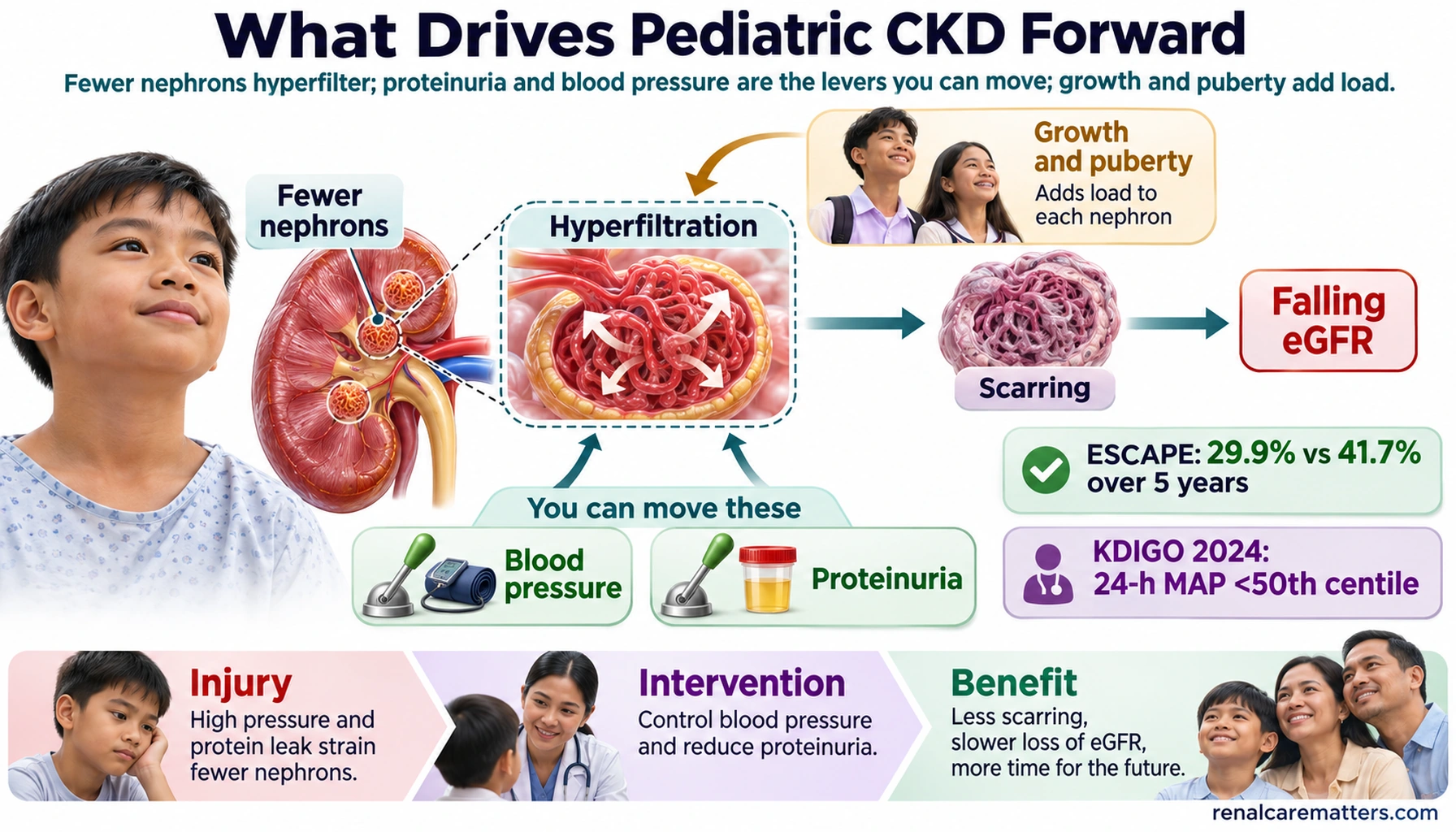
The picture has a limit. Nephrons do not choose to work harder; the remaining glomeruli dilate their afferent arterioles, raise their capillary pressure and filter more each. That hyperfiltration keeps total glomerular filtration rate (GFR) up for a time but stretches and injures the glomerulus, leaks protein into the tubules and drives scarring. A child adds something adults do not: the body keeps growing, so the demand on a fixed number of nephrons rises every year, most sharply in puberty.
Figure 1 · Key numbers
ESCAPE (385 children, 5 years)Primary end point 29.9% with intensified vs 41.7% with conventional blood pressure control
KDIGO 2024 pediatric blood pressure24-h mean arterial pressure <50th centile by ambulatory monitoring, or manual systolic at the 50th–75th centile
Risk staging (CKiD and ESCAPE, 1,232 children)Median time to event from >10 years to 0.8 years by eGFR and proteinuria
Growth hormone (Cochrane, 16 trials)Height standard deviation score +0.82 at 1 year
Neurocognition (CKiD, 368 children)21–40% scored ≥1 standard deviation below the mean on at least one domain
Most children with CKD progress slowly enough that what you do over years matters: blood pressure, proteinuria, nutrition, growth and school. A few, usually with glomerular disease and heavy proteinuria, move toward kidney failure within a year or two. Your work is to know which child is which, to slow decline where the evidence allows, and to protect the child’s growth and education while you do it.
Opening case · fictional
Case: Short for his age, and absent from school
Miguel Ocampo is 7 years old and lives in Malolos, Bulacan, with his mother Liza and his grandmother; his father works in Dubai. He has renal dysplasia diagnosed in infancy. At today’s clinic his eGFR is 28 mL/min/1.73 m² by the CKiD U25 equation, his urine protein-to-creatinine ratio is 1.2 mg/mg, and his clinic blood pressure, measured correctly, is at the 95th percentile for his height. He is 108 cm tall, below the 3rd percentile, and weighs 16 kg. His serum bicarbonate is 18 mmol/L and his hemoglobin 10.2 g/dL. He wakes twice a night to urinate and drinks large amounts of water.
His grandmother has put him on the low-protein, low-salt diet that her husband followed on dialysis “to save his kidneys.” He has missed 25 school days this year because of clinic visits, tiredness and nighttime wetting, and his teacher has suggested he stay home until he is “better.” Liza has seen a Facebook post about “height injections” and asks whether he can have them; she is worried about the cost.
Before reading on, decide:
How fast is Miguel likely to progress, and what can slow him down?
Why is he short, and what must be fixed before growth hormone is considered?
What will you say about his diet and his schooling?
Keep your answers in mind. The lesson gives you what you need, and the case review near the end shows one sound response.
Lesson · part 1
How a child’s CKD progresses
The causes of CKD in children differ from adults. In a registry analysis of 23,620 children starting maintenance kidney replacement therapy (KRT) in 80 countries, congenital anomalies of the kidney and urinary tract (CAKUT) and hereditary nephropathies predominated in younger children, while adolescents more often had immune-mediated glomerular disease; immune-mediated glomerulopathies were the most common cause in Southeast Asia.1 For a Filipino pediatric nephrologist that means two clinics in one: young children with dysplasia and valves, and adolescents with glomerulonephritis who often present late.
Nephron mass and hyperfiltration. A dysplastic or hypoplastic kidney starts with fewer nephrons. Each remaining nephron hyperfilters, with afferent dilation and angiotensin II–driven efferent constriction raising glomerular capillary pressure. Over years this causes glomerular enlargement, podocyte loss and segmental sclerosis. Proteinuria is both a marker of this injury and a cause of more: filtered protein is reabsorbed by proximal tubular cells, which then release inflammatory and fibrotic signals.
Blood pressure. Systemic pressure is transmitted to dilated glomeruli that have lost their autoregulation. Lowering it, and blocking angiotensin II with renin–angiotensin system (RAS) inhibitors, reduces glomerular pressure and proteinuria. This is the mechanistic basis for ESCAPE and for renin–angiotensin system inhibition.
Growth and puberty. The kidney does not grow its nephron number with the child. As body mass increases, the filtration demand rises on the same nephrons, and puberty adds hormonal effects on glomerular hemodynamics. Many children with CAKUT are stable for years and then decline in adolescence, which is why KDIGO 2024 asks for more frequent monitoring during puberty than the severity stage alone would suggest.2
Dysplasia wastes salt and water. Dysplastic kidneys often cannot concentrate urine or conserve sodium. These children are polyuric, crave salt, and become volume depleted quickly with diarrhea or fever. Restricting salt in a salt-wasting child can lower his GFR further and impair growth, which is the opposite of what an adult with hypertensive CKD needs.
Driver
Mechanism
What you see
What can change it
Reduced nephron mass
Hyperfiltration in remaining nephrons
Slowly falling eGFR, rising proteinuria
Little directly; protect the rest
Proteinuria
Glomerular leak and tubular injury
Rising urine protein-to-creatinine ratio
RAS inhibition, blood pressure control
Hypertension
Pressure transmitted to glomeruli
Blood pressure above target, often masked on clinic readings
ABPM-guided treatment
Puberty and growth
Rising demand on fixed nephrons
Decline accelerating in adolescence
Closer monitoring; plan for KRT
Salt and water wasting (dysplasia)
Tubules cannot conserve sodium or concentrate urine
RememberProteinuria and blood pressure are the drivers you can move. Measure both at every visit, and measure blood pressure properly.
Figure 2. What drives pediatric CKD forward. Fewer nephrons hyperfilter; proteinuria and blood pressure are the levers you can move; growth and puberty add load.
Lesson · part 2
What the evidence shows
ESCAPE. The Effect of Strict Blood Pressure Control and ACE Inhibition on the Progression of CRF in Pediatric Patients (ESCAPE) trial randomized 385 children aged 3 to 18 years with GFR 15 to 80 mL/min/1.73 m², all receiving a fixed high dose of an angiotensin-converting enzyme (ACE) inhibitor, to intensified control (24-hour mean arterial pressure, MAP, below the 50th percentile) or conventional control (50th to 95th percentile), with non-RAS drugs added to reach the target. Over 5 years, 29.9% of the intensified group and 41.7% of the conventional group reached a 50% decline in GFR or kidney failure (hazard ratio 0.65, 95% confidence interval 0.44 to 0.94), an absolute difference of about 12 percentage points, or roughly one child spared the end point for every 8 or 9 treated to the lower target over 5 years. Adverse events and withdrawals did not differ. Proteinuria fell by about half at first and then rebounded despite continued ACE inhibition and good pressure control.3 The trial was in European children, mostly with CAKUT, and its end point combines a laboratory surrogate (a halving of GFR) with kidney failure; it shows a benefit on the path to kidney failure, not on survival or quality of life.
KDIGO 2024. The Kidney Disease: Improving Global Outcomes (KDIGO) 2024 CKD guideline covers children throughout. Its pediatric summary asks clinicians to use renin–angiotensin system inhibitors, plus other agents as needed, to keep 24-hour mean arterial pressure below the 50th centile on ambulatory blood pressure monitoring (ABPM), or systolic pressure measured manually at the 50th to 75th centile for age, sex and height; not to restrict protein in children because of the risk to growth, and to aim protein and energy at the upper end of the normal range for healthy children; to flag an eGFR below 90 mL/min/1.73 m² as low in children over 2 years; to monitor more often in puberty; to refer for persistent albuminuria or proteinuria above stated thresholds; and to begin transition planning early, around 11 to 14 years.4,2 The summary document does not list grades; quote the full guideline when you need the grade of a specific statement.
Estimating speed. Furth and colleagues pooled 1,232 children from the North American Chronic Kidney Disease in Children (CKiD) cohort and the ESCAPE trial, median age 12 and median eGFR 47. Combining eGFR and urine protein-to-creatinine ratio into six ordered stages described the risk of a composite of KRT, a 50% fall in eGFR or eGFR below 15: median time to event ranged from more than 10 years (eGFR 45 to 90 with a ratio below 0.5 mg/mg) to 0.8 years (eGFR 15 to 30 with a ratio above 2 mg/mg). Children with glomerular disease had a 43% shorter time to event than those with nonglomerular disease.5 The staging was cross-validated but not externally validated, and it does not include Asian cohorts. The site’s pediatric CKD KRT risk calculator applies this logic; use it to plan, not to promise.
Source
Design
What it shows
What it does not show
ESCAPE
Randomized, 385 children, 5 years
Lower 24-h MAP target slowed progression (29.9% vs 41.7%)
Effect on survival; generalizability to Asian or glomerular-predominant cohorts
KDIGO 2024 pediatric points
Guideline
Blood pressure target, no protein restriction, transition timing
Grades are in the full text, not the summary
CKiD and ESCAPE risk staging
Observational, 1,232 children
eGFR plus proteinuria predicts time to kidney failure
External validation; Filipino children
RememberUse eGFR and proteinuria together to estimate speed, and aim for the low blood pressure target ESCAPE tested, measured by ABPM where you can get it.
Lesson · part 3
Growth, nutrition and growth hormone
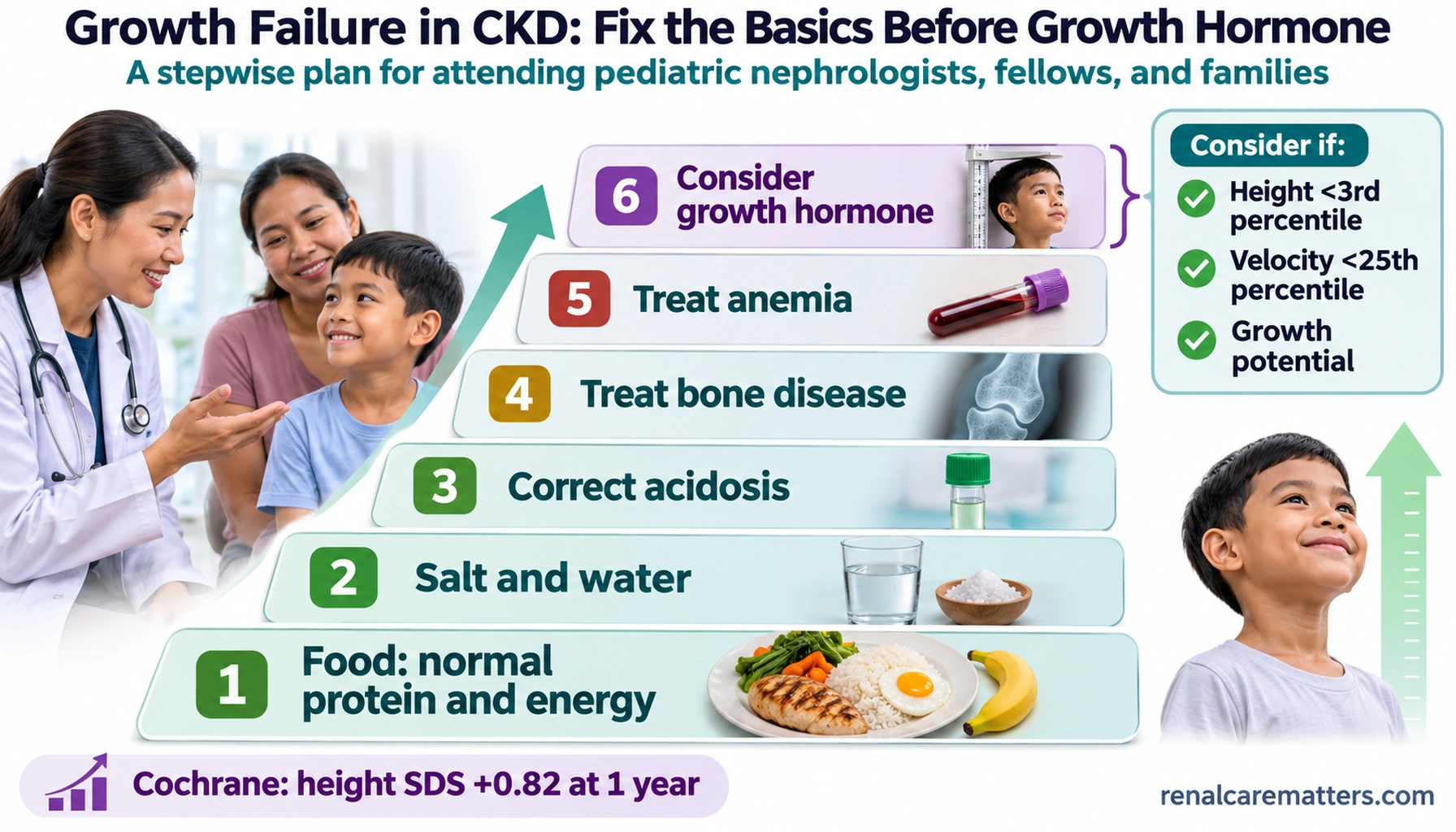
Growth failure in CKD has many causes, and growth hormone fixes only one of them. A child with CKD may be small from birth (intrauterine growth restriction is common in CAKUT), may not eat enough because of anorexia, vomiting or a restrictive diet, may be losing salt and water, may be acidotic, may have mineral and bone disease, may be anemic, and may be resistant to his own growth hormone because CKD reduces the effect of insulin-like growth factor 1 (IGF-1). Each of these lowers growth velocity; together they are why many children with CKD reach adulthood short.
Measure growth properly. The KDIGO 2017 CKD–mineral and bone disorder (CKD-MBD) update recommends that infants with CKD G2 to G5D have their length measured at least quarterly and that children with CKD G2 to G5D be assessed for linear growth at least annually (1B).6 In practice, measure height at every visit with a wall-mounted stadiometer, plot it on the growth chart, calculate height velocity over at least six months, and estimate the target height from the parents.
Nutrition first. The Pediatric Renal Nutrition Taskforce (PRNT) published recommendations for energy and protein in children with CKD stages 2 to 5 and on dialysis, addressing poor growth, obesity and activity, and extra protein to replace dialysate losses.7 KDIGO 2024 asks clinicians not to restrict protein in children and to aim protein and energy at the upper end of the normal range.2 The protein restriction used in some adults with CKD is not a pediatric therapy. In a salt-wasting child, sodium and water are part of nutrition, not something to remove.
Growth hormone. A Cochrane review of 16 randomized trials enrolling 809 children with CKD found that recombinant human growth hormone (rhGH) increased height standard deviation score (SDS) by 0.82 at one year compared with placebo or no treatment (8 studies, 391 children) and increased height velocity by about 3.9 cm per year; the authors judged study quality poor or poorly reported, and evidence on final adult height and long-term harms was limited.8 Height SDS is a measured surrogate for what families care about, which is adult height and how a child feels about being small. European pediatric nephrology working groups recommend that children with CKD stage 3 to 5 or on dialysis be considered for growth hormone if they have persistent growth failure, defined as height below the 3rd percentile and height velocity below the 25th percentile, once other treatable causes have been addressed and the child has growth potential.9 The dose and monitoring come from the endocrine and nephrology protocol.
Cause of poor growth
Why it slows growth
Check
First step
Low energy and protein intake
Not enough substrate for growth
Diet history; weight-for-height
Dietitian; stop unnecessary restriction
Salt and water wasting
Chronic volume depletion limits growth
Urine volume; salt craving; serum sodium
Adequate salt and water
Metabolic acidosis
Interferes with the growth hormone axis and bone
Serum bicarbonate
Correct (Module 18)
CKD-MBD
Growth plate disturbed by parathyroid hormone (PTH) and phosphate
Calcium, phosphate, PTH, alkaline phosphatase
Treat (Module 18)
Anemia
Fatigue, poor appetite
Hemoglobin, iron studies
Treat (Module 18)
Growth hormone resistance
Reduced IGF-1 action in CKD
Persistent failure after the above
Consider rhGH
RememberFix food, salt, acid, bone and anemia first. Growth hormone is for the child who is still failing to grow after those are corrected.
In clinic, the growth chart nobody plotted · fictional
A 9-year-old girl with reflux nephropathy from Pangasinan has been seen for two years. Her heights are in the chart as numbers but have never been plotted. You plot them: she has crossed from the 25th to below the 3rd percentile, and her height velocity is very low.
Her bicarbonate has been low on every visit and was never treated, and her family has been limiting protein on advice from a neighbor.
What this shows. The growth chart is a vital sign. A number in the chart is not a measurement until it is plotted.
Figure 3. Fix the basics before growth hormone. Correct nutrition, salt and water, acidosis, mineral and bone disease and anemia; then consider growth hormone for persistent growth failure.
Lesson · part 4
What the attending does
Every visit. Measure height and weight and plot them; measure blood pressure correctly with the right cuff and arrange ABPM when you can; check urine protein-to-creatinine ratio, eGFR with a pediatric equation, bicarbonate, hemoglobin, calcium, phosphate and PTH at intervals the stage requires; review the diet with the family, not just the dietitian’s plan. Ask about school.
Neurocognition and school. In the CKiD cohort, 368 children aged 6 to 16 with a median measured GFR of 43 had neurocognitive scores in the average range overall, but 21% to 40% scored at least one standard deviation (SD) below the mean on intelligence, academic achievement, attention or executive function; higher GFR predicted better executive function, and children with heavy proteinuria scored lower on verbal and full-scale intelligence quotient (IQ).10 The study was cross-sectional, so it cannot separate CKD from the disadvantages that come with chronic illness, but it means you should ask about school performance and refer for assessment when it falls.
School is also where a child with CKD learns to be normal. Write to the school: the diagnosis in plain words, why he needs free access to water and the toilet, why clinic visits cause absences, what to do if he is unwell, and that he should be in school. In the Philippines a clear medical certificate often changes how a teacher responds.
Talk about the future early. Use the eGFR and proteinuria stage to explain, in plain words, roughly how long the kidneys may last, that this can change, and that planning for kidney replacement starts years ahead (Module 19). Begin transition conversations around 11 to 14 years, as KDIGO 2024 suggests.2
Figure 4 · The CKD clinic visit
GrowHeight and weight measured and plotted; height velocity; target height.
PressureCorrect cuff; percentile for height; ABPM when possible.
ProteinUrine protein-to-creatinine ratio trend.
ChemistryeGFR, bicarbonate, hemoglobin, calcium, phosphate, PTH at stage-appropriate intervals.
EatWhat the family actually feeds; salt and water for salt-wasters.
LearnSchool attendance and performance.
PlanRisk stage; next visit; who calls whom.
Family belief
What is true physiologically
What you say
“Less protein saves the kidneys”
Growing children need protein; restriction impairs growth
He needs normal amounts of protein for his age; the dietitian will show you how
“No salt at all”
Dysplastic kidneys often waste salt
His kidneys lose salt; he needs it unless his pressure or swelling says otherwise
“He should rest at home”
Activity and school support development; KDIGO suggests daily activity
School and play are part of his treatment
“Height injections will fix it”
rhGH helps only after other causes are corrected
First we fix food, salt, acid, bone and blood; then we decide together
Stop and call
eGFR falling faster than the risk stage predicts, or a step fall after an illness
Blood pressure above the 95th percentile despite treatment
Urine protein-to-creatinine ratio rising above 2 mg/mg
Height velocity falling despite corrected nutrition and acidosis
Dehydration with diarrhea in a salt-wasting child
RememberAt every visit, plot the growth, measure the pressure, track the protein, and ask about school. Those four lines tell you how the child is really doing.
On the floor
Real situations: problems and solutions
These are fictional but typical. For each one, cover the answer, decide what you would do, then compare. Where a step depends on local rules, your unit’s procedure and your supervisor’s direction come first.
The adolescent who stopped coming
What you see
A 14-year-old with posterior urethral valves and stable eGFR for years has missed two clinic visits. When she returns, her eGFR has fallen by a third and her blood pressure is high.
What is likely going on
Puberty has increased demand on a fixed nephron mass, and the missed visits hid the change.
What to do
Re-stage her with eGFR and proteinuria, restart or intensify blood pressure and proteinuria control, check her bladder management with urology, and begin a frank conversation with her about kidney replacement planning and transition.
Why it matters
Adolescence is when many CAKUT kidneys decline; it is also when clinic attendance falls.
The clinic cuff that was too small
What you see
A 10-year-old’s blood pressure is recorded as high at every visit, and the family has bought three different medicines over a year.
What is likely going on
A cuff too small for the arm overestimates pressure; or the pressure is truly high but has never been confirmed by ABPM.
What to do
Remeasure with the correct cuff by auscultation, arrange ABPM if possible, and adjust treatment to the confirmed reading.
Why it matters
A wrong cuff produces a wrong diagnosis, and the family pays for it.
Dehydration on a Sunday
What you see
A 5-year-old with renal dysplasia has had diarrhea for a day. The mother has been giving only water because “salt is bad for his kidneys.” He is lethargic and his creatinine has doubled.
What is likely going on
A salt-wasting child became volume depleted; the AKI is prerenal on top of CKD.
What to do
Advise urgent rehydration with appropriate sodium-containing fluid at the nearest hospital, review nephrotoxins, and give the family a written sick-day plan.
Why it matters
In salt-wasting CKD, every diarrheal illness is a kidney emergency.
Field notes
Keep a wall stadiometer in your clinic and plot every height before the family leaves.
Give families a one-page sick-day plan for vomiting, diarrhea and fever.
Ask the school question at every visit: how many days missed, and how are the grades?
Write the progression risk stage in the clinic note so the next doctor sees the trajectory.
Case review
Back to the case: Short for his age, and absent from school
How fast? An eGFR of 28 with a urine protein-to-creatinine ratio of 1.2 mg/mg places Miguel in a high-risk stage of the CKiD and ESCAPE staging, likely measured in a few years rather than a decade, and puberty may speed it. Nonglomerular disease is in his favor. What you can move: blood pressure (at the 95th percentile, well above the KDIGO 2024 target of a 24-hour mean arterial pressure below the 50th centile; ESCAPE showed that a lower target slowed progression), proteinuria with renin–angiotensin system inhibition, acidosis, anemia, and avoidance of dehydration and nephrotoxins. Arrange ABPM if possible, and start planning for kidney replacement with the family now.
Why short? Several causes are present: a restricted diet low in protein and salt, salt and water wasting from dysplasia, acidosis (bicarbonate 18), anemia, and probably CKD-MBD. Each must be corrected first: stop the protein restriction, give back salt and water as his kidneys need, treat the acidosis and anemia, check calcium, phosphate and PTH, and plot height velocity over the next six months. If he remains below the 3rd percentile with a height velocity below the 25th percentile after these are corrected, he meets the criteria for considering growth hormone. Tell Liza honestly that it works on height in trials, that it is expensive, and that it comes after the basics.
Diet and school. Explain to the grandmother, respectfully, that a growing child is not an adult on dialysis: Miguel needs normal protein for his age and, because his kidneys lose salt, he needs salt and water too; the dietitian will build meals the family can afford. Write to his teacher that he must be in school, with free access to water and the toilet, and explain why he wets at night. Ask about his reading and attention, and refer for assessment if he is falling behind.
Skills lab · with your preceptor
Skills checklist: Pediatric CKD: progression, growth, nutrition and development
Complete with a preceptor, in simulation or at your own unit. Sign-off is local. Your preceptor rates each step as satisfactory, needs practice, or not observed. Steps marked Critical must all be satisfactory before sign-off. This checklist supports supervised learning; your unit’s own procedure and competency form are the authority. A printable version of every checklist is on the trainer page.
Measures height correctly, plots it, and calculates height velocity and target height
Stages a child’s progression risk from eGFR and proteinuria and explains it to a family
Lists and checks the correctable causes of growth failure before discussing growth hormone
Writes a school letter for a child with CKD
Placement activity. Pediatric nephrology clinic under supervision
Self-assessment
Check your understanding
Each visit draws 5 questions at random from this module’s 5-question bank. Choose the single best answer for each, then select Check answers; an explanation appears under the best answer. Select New set of questions for a different mix. A good target is 4 of 5 on two different sets. Nothing you select is sent anywhere; scoring happens in your browser.
Borzych-Dużałka, D., Bonthuis, M., Ali, U., Yap, Y.-C., Manno, M., Zhai, Y., Loza, R., Hashmi, S., Choi, N., Soulami, K., Exantus, J., Al Riyami, M. S., Mabrouk, S., Angeles, M. M., Zelaya-Camacho, C., Puspitasari, H. A., Huque, S. S., Cano, F., Ng, K. H., ... Schaefer, F. (2026). Regional variation of underlying kidney diseases in children undergoing chronic kidney replacement therapy around the globe. Pediatric Nephrology, 41(5), 1451–1463. https://doi.org/10.1007/s00467-025-07096-3
ESCAPE Trial Group, Wühl, E., Trivelli, A., Picca, S., Litwin, M., Peco-Antic, A., Zurowska, A., Testa, S., Jankauskiene, A., Emre, S., Caldas-Afonso, A., Anarat, A., Niaudet, P., Mir, S., Bakkaloglu, A., Enke, B., Montini, G., Wingen, A.-M., Sallay, P., ... Schaefer, F. (2009). Strict blood-pressure control and progression of renal failure in children. The New England Journal of Medicine, 361(17), 1639–1650. https://doi.org/10.1056/NEJMoa0902066
Kidney Disease: Improving Global Outcomes (KDIGO) CKD Work Group. (2024). KDIGO 2024 clinical practice guideline for the evaluation and management of chronic kidney disease. Kidney International, 105(4S), S117–S314. https://doi.org/10.1016/j.kint.2023.10.018
Furth, S. L., Pierce, C., Hui, W. F., White, C. A., Wong, C. S., Schaefer, F., Wühl, E., Abraham, A. G., Warady, B. A., Chronic Kidney Disease in Children (CKiD), & Effect of Strict Blood Pressure Control and ACE Inhibition on the Progression of CRF in Pediatric Patients (ESCAPE) Study Investigators. (2018). Estimating time to ESRD in children with CKD. American Journal of Kidney Diseases, 71(6), 783–792. https://doi.org/10.1053/j.ajkd.2017.12.011
Kidney Disease: Improving Global Outcomes (KDIGO) CKD-MBD Update Work Group. (2017). KDIGO 2017 clinical practice guideline update for the diagnosis, evaluation, prevention, and treatment of chronic kidney disease–mineral and bone disorder (CKD-MBD). Kidney International Supplements, 7(1), 1–59. https://doi.org/10.1016/j.kisu.2017.04.001
Shaw, V., Polderman, N., Renken-Terhaerdt, J., Paglialonga, F., Oosterveld, M., Tuokkola, J., Anderson, C., Desloovere, A., Greenbaum, L., Haffner, D., Nelms, C., Qizalbash, L., Vande Walle, J., Warady, B., Shroff, R., & Rees, L. (2020). Energy and protein requirements for children with CKD stages 2–5 and on dialysis: Clinical practice recommendations from the Pediatric Renal Nutrition Taskforce. Pediatric Nephrology, 35(3), 519–531. https://doi.org/10.1007/s00467-019-04426-0
Hodson, E. M., Willis, N. S., & Craig, J. C. (2012). Growth hormone for children with chronic kidney disease. Cochrane Database of Systematic Reviews, 2012(2), CD003264. https://doi.org/10.1002/14651858.CD003264.pub3
Drube, J., Wan, M., Bonthuis, M., Wühl, E., Bacchetta, J., Santos, F., Grenda, R., Edefonti, A., Harambat, J., Shroff, R., Tönshoff, B., Haffner, D., & European Society for Paediatric Nephrology Chronic Kidney Disease Mineral and Bone Disorders, Dialysis, and Transplantation Working Groups. (2019). Clinical practice recommendations for growth hormone treatment in children with chronic kidney disease. Nature Reviews Nephrology, 15(9), 577–589. https://doi.org/10.1038/s41581-019-0161-4
Hooper, S. R., Gerson, A. C., Butler, R. W., Gipson, D. S., Mendley, S. R., Lande, M. B., Shinnar, S., Wentz, A., Matheson, M., Cox, C., Furth, S. L., & Warady, B. A. (2011). Neurocognitive functioning of children and adolescents with mild-to-moderate chronic kidney disease. Clinical Journal of the American Society of Nephrology, 6(8), 1824–1830. https://doi.org/10.2215/CJN.09751110
Educational material for physicians. Completing it is an Academy learning record only. It does not confer CPD units, PNSP or board certification, privileges, or PhilHealth accreditation, and it does not replace current guidelines, regulations, your institution’s pediatric protocols and formulary, or clinical judgment.