Home PD: training the family, school, and non-infectious complications
Train and support the caregiver, keep the child in school, and solve outflow failure, leaks, hernias and ultrafiltration failure.
PublishedNailathalaGipatikPepalwal:ReferencesMga SanggunianMga TinubdanReng Reperensya:18Audience: Pediatric nephrologists · pediatric nephrology fellows · adult nephrologists, intensivists and neonatologists who share kidney care for children in the clinic, ward, NICU, PICU, dialysis unit and homeRead timeOras ng pagbasaOras sa pagbasaOras ning pamamasa:
Training track for attending pediatric nephrologists
This module is study material for attending pediatric nephrologists and fellows. It explains the reasoning behind common decisions; it is not a protocol and it gives no doses. Doses, fill volumes and thresholds must come from current pediatric guidelines, product labels, your institution’s approved pediatric protocols and a pediatric pharmacist. Benefit rules change: confirm them on the date of service. Every case is fictional.
Learning objectives
After this module you should be able to
Run caregiver training for home peritoneal dialysis (PD) as a curriculum with return demonstration, a home visit and retraining, and explain what the training evidence does and does not show.
Diagnose and manage the non-infectious complications of pediatric PD: outflow failure, leaks, hernias, hydrothorax, ultrafiltration failure, encapsulating peritoneal sclerosis (EPS) and hypokalemia.
Explain the Philippine Health Insurance Corporation (PhilHealth) pediatric PD Z package and the automated PD (APD) pilot to a family accurately, keeping coverage separate from the prescription.
Pre-testBefore you read, answer the 5 self-assessment questions and note your score. After the module, select New set of questions and compare. The difference is what you learned; the questions you still miss are what to reread.
Start here
The big picture, in plain words
Your role · the attending of a home therapyOnce a child goes home on peritoneal dialysis (PD), the dialysis unit is a bedroom and the dialysis nurse is a mother. You certify that the caregiver is trained, you review the home record every month, you sign the PhilHealth pediatric checklist as attending pediatric nephrologist, and you decide when a complication means a change of prescription, a surgeon, or a change of modality.1
In plain wordsHome PD is like teaching a family to fly a small plane every night. The plane is simple and reliable, but only if the pre-flight checks are done every time, the instruments are read, and the pilot is rested.
The picture has a limit. A plane fails suddenly; PD usually fails slowly. Drains shrink over weeks, a hernia grows, the membrane changes over years, and a caregiver’s strength runs down without anyone noticing. Most of these failures are visible in the home record before they reach the emergency room, if someone looks.
Figure 1 · Key numbers
International Pediatric Peritoneal Dialysis Network (IPPN) training surveyMedian total training 24 hours; under 20 hours associated with higher peritonitis rates
Standardizing Care to Improve Outcomes in Pediatric End Stage Kidney Disease (SCOPE) training cohort1,450 trainings; only 23% met all four training components; no association with early peritonitis
EPS in European childrenPrevalence 1.5%; 8.7 per 1,000 patient-years
PhilHealth pediatric PD eligibilityAge 0 to 18 years and 364 days
Pediatric APD pilotExtended to July 31, 2026; status after that date unresolved
Most children on home PD do well when the family is trained, supported and rested. A few develop mechanical problems that look like dialysis failure, and a very few develop membrane failure or sclerosis after years. Your work is to build a training program that keeps families safe, to separate mechanical from membrane causes when drains fall, and to notice the exhausted caregiver before the exhaustion becomes an infection or a missed night.
Opening case · fictional
Case: Three weeks without sleep
Joshua Manalo is 9 years old and weighs 24 kg. He has been on nightly automated PD (APD) for 14 months for kidney failure after posterior urethral valves. He lives with his mother, Liezl, and two younger sisters in San Fernando, Pampanga; his father works in Saudi Arabia. You see him at your clinic in a provincial hospital; his cycler and solutions come through a program in Metro Manila.
For three weeks the cycler has alarmed for low drain three or four times a night. Liezl gets up for each alarm and has not slept more than three hours a night. Joshua’s home weight is up 1.4 kg in ten days, his blood pressure today is 128/86 mm Hg, above the 95th percentile for his age and height, his abdomen is distended, and there is a soft bulge at the umbilicus when he coughs. He has not passed stool for four days. He has missed six school days this month.
Liezl asks whether he can switch to hemodialysis at the adult unit 15 minutes from their house so that she can sleep. She has also heard that PhilHealth coverage for children on the machine may end.
Before reading on, decide:
What is the most likely cause of the poor drains, and what will you do first?
What is the bulge at the umbilicus, and how does it change the prescription?
How will you answer Liezl about switching to hemodialysis and about coverage?
Keep your answers in mind. The lesson gives you what you need, and the case review near the end shows one sound response.
Lesson · part 1
Training the family and preparing the home
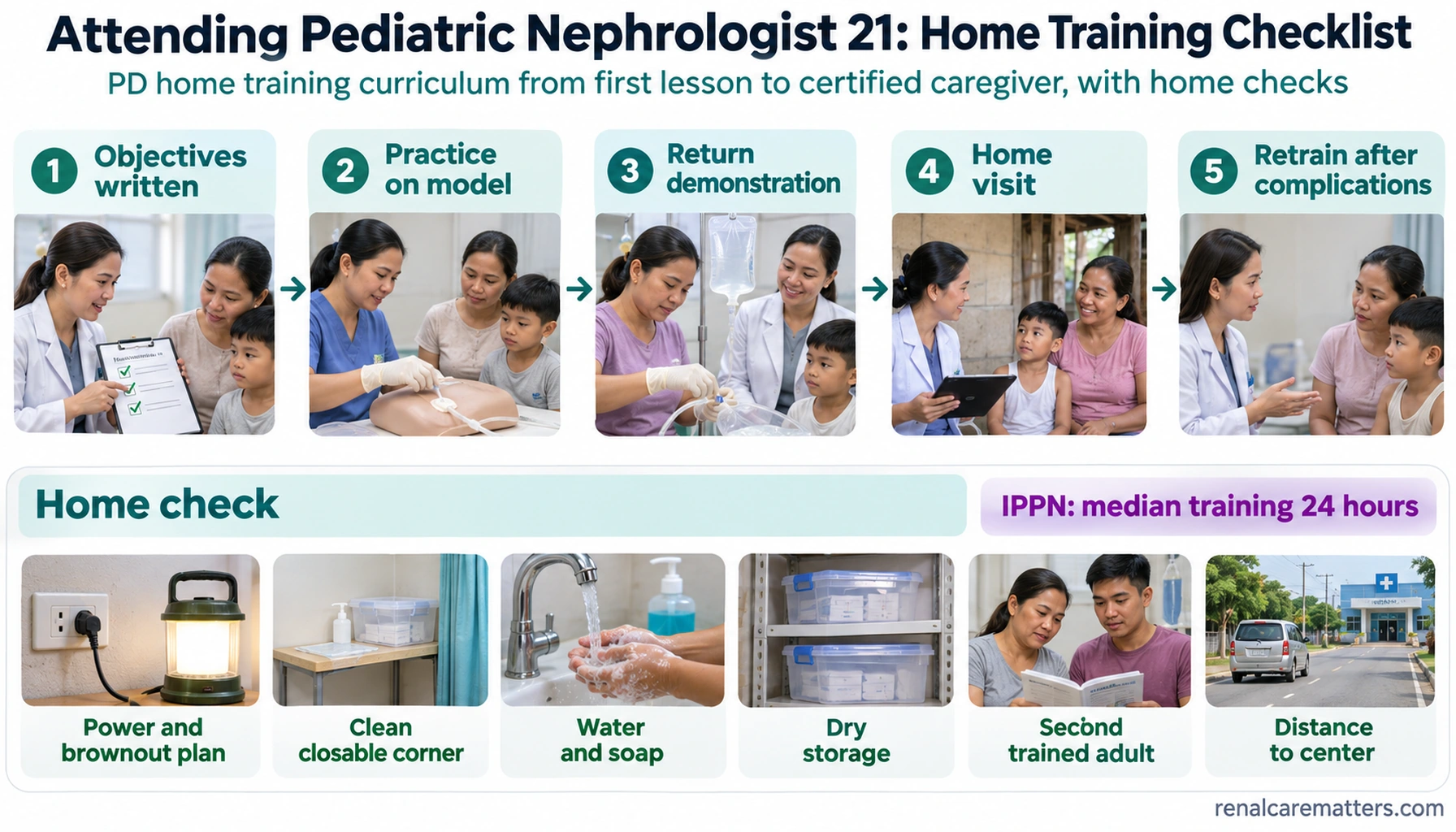
Every home PD program depends on one or two people at home who do the exchanges, set up the cycler, care for the exit site and recognize trouble. Training turns a frightened parent into that person. It is a curriculum, not a demonstration: written objectives, practice on a training model, return demonstration until the skill is safe, a written or oral test, a home visit, and retraining at set times and after every complication.
What the guideline suggests. The 2024 international pediatric guideline on PD-associated infections suggests that session length and total training duration be tailored to the child and caregivers, favoring longer total training where possible, and that a home visit be part of training (both 2D, weak suggestions on very low-quality evidence).2
What the studies show. In an International Pediatric Peritoneal Dialysis Network (IPPN) survey, 62 of 137 centers responded. A PD nurse trained families in 93.5% of centers; median total training was 24 hours; 58% of centers made home visits. Training shorter than 20 hours and fewer training tools were associated with higher peritonitis rates after adjustment for the proportion of infants and country income.3 In the Standardizing Care to Improve Outcomes in Pediatric End Stage Kidney Disease (SCOPE) collaborative, 1,450 trainings were analyzed for four components: a home visit, one-to-one training, starting training at least 10 days after catheter insertion, and sessions of 3 hours or less. Only 23% met all four, and neither single components nor all-or-none compliance was associated with peritonitis within 90 days of training.4 The authors note that SCOPE’s required monthly review of catheter care may have blunted any training effect. A 2026 scoping review of 12 studies found pediatric training programs poorly aligned with International Society for Peritoneal Dialysis (ISPD) guidance, rarely defined by objectives and criteria, and silent on family outcomes.5
The honest summary: longer, structured training is associated with fewer infections in one survey but not in a cohort with strong monthly follow-up, and no trial has tested it. Training still matters because it is the only way a family learns to do the procedure; the evidence gap is about which details matter most.
The Philippine home. The home visit is where training meets reality. Check what a training room cannot show.
Home check
Why it matters
What you arrange
Electricity, brownout pattern, outlet with grounding
APD stops when power fails mid-cycle
A written plan for brownouts: manual drain, switch to continuous ambulatory PD (CAPD) exchanges per protocol, who to call
A clean, closable space with a table and good light
Touch contamination happens on cluttered surfaces near pets and visitors
A dedicated corner; pets out of the room during connection
Clean water and soap for hand washing
Hand hygiene before every connection
Alcohol hand rub where water is unreliable
Dry storage for a month of solution boxes
Flooding and heat damage supplies
Raised shelving; typhoon plan with a two-week reserve where possible
Who else can do the exchanges
One caregiver cannot cover every night for years
Train a second adult: a grandmother, aunt or older sibling who is an adult
Distance and transport to the PD center
Peritonitis needs treatment within hours
A named nearer hospital and a written plan for cloudy effluent (Module 22)
School. Nightly APD is chosen partly so that a child can attend school by day. Write a letter for the school with what the teacher should know: the catheter is not contagious, the child can join most activities but should avoid contact that pulls on the catheter, swimming follows the unit’s policy, and who to call for abdominal pain or fever. Ask about school days missed at every review; absence is an outcome.
Figure 2 · When to retrain
After every peritonitis or exit-site infectionWatch a full exchange and exit-site care; find the step that failed.
After a touch contaminationReview the connection technique the same week.
When the caregiver changesA new grandmother, aunt or adult sibling is trained to the same standard, not by the tired parent alone.
When the equipment changesA new cycler, a switch from CAPD to APD, or new solution bags.
After a long hospital staySkills fade; observe before discharge.
Each yearEven a perfect caregiver drifts.
The first night at home · fictional
A mother in Cavite, discharged that afternoon after two weeks of training, calls at 11 p.m.: the cycler shows an error code she does not recognize and her son is crying.
The PD nurse on call talks her through the screen, the code turns out to be a clamp left closed, and the cycle restarts. The next morning the program adds a page of common error codes, in Filipino and English, to every discharge packet.
What this shows. The first nights at home are part of training. A phone line that answers is the last training tool.
RememberTrain to a standard, not to a schedule. Certify the caregiver only after a safe return demonstration, then visit the home and retrain after every complication.
Figure 3. Training as a curriculum. The steps from first lesson to certified caregiver, and the home checks that a training room cannot show.
Lesson · part 2
PhilHealth: what the package covers and what it does not decide
PhilHealth Circular 2024-0036 created the Z benefits package for PD with separate adult and pediatric packages. For children it covers continuous ambulatory PD (CAPD) and, as a pilot at selected facilities, automated PD (APD).6 The pediatric eligibility checklist requires an age of 0 to 18 years and 364 days, written informed consent from parents or guardian, stage 5 chronic kidney disease (CKD) requiring kidney replacement therapy (not temporary dialysis for acute kidney injury), a permanent PD catheter, PD initiation completed at an accredited facility, a patient or caregiver adequately trained to do PD at home, and no known allergy to PD solutions.7 The guide to the circular adds registration in the PhilHealth Dialysis Database.6
What it covers. The package is organized in coverage tiers of solution bags per day (for children, tiers of 2-liter bags for CAPD and of 5-liter bags for APD), supplies such as transfer sets and APD cassettes, PD catheter insertion and initiation, exit-site and peritonitis prevention care, outpatient treatment of PD-related peritonitis, laboratory tests and medicines, and administration that includes monthly monitoring, follow-up visits and training.6 The pediatric CAPD checklist names the attending pediatric nephrologist and is certified by the attending physician or pediatric nephrologist.1
The APD pilot. PhilHealth Advisory 2025-0074 set the pilot implementation of APD in children at three government tertiary centers in Metro Manila.8 Advisory 2026-0013 extended the pilot to July 31, 2026, with pilot sites continuing under the existing guidelines.9 No later issuance had been found when this module was written. The status after July 31, 2026 is unresolved: confirm it with your PhilHealth liaison and the program coordinator before you tell a family that APD is covered, not covered, or ending.
The package decides
The package does not decide
Who is eligible and what documents are needed
Whether PD is the right modality for this child
Which coverage tier is paid
The fill volume, number of exchanges or glucose strength
Which facilities may provide APD during the pilot
Whether this child needs APD for school, sleep or fluid control
What is reimbursed on the date of service
What you write in the chart: that must be the true prescription
At the program office · fictional
The PD coordinator asks you to sign the monthly pediatric checklist for a 7-year-old. The form lists the highest CAPD tier, but your prescription for the past two months uses fewer exchanges because his residual urine has held up.
You correct the checklist to match the prescription in the chart and ask the coordinator to file it that way.
What this shows. The signature certifies the true prescription. A form filled to the highest tier is a false claim, however well meant.
RememberCoverage is not a prescription. Prescribe what the child needs, document it truthfully, and confirm the benefit on the date of service.
Lesson · part 3
Outflow failure, leaks, hernias and hydrothorax
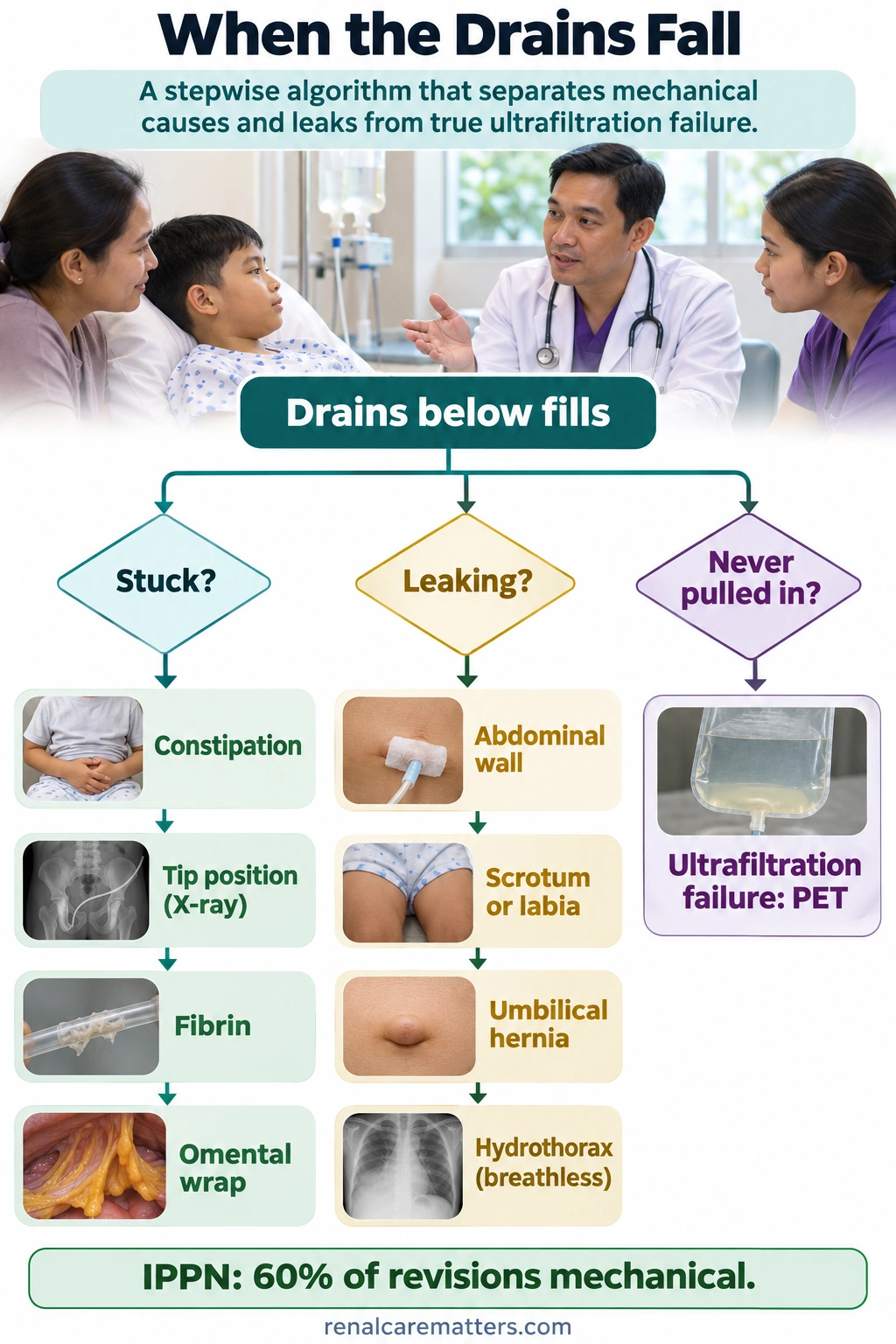
When drains fall, the question is whether the fluid cannot get out (mechanical), has gone somewhere else (leak), or was never pulled in by the membrane (ultrafiltration failure). Mechanical causes are far more common. In the IPPN registry, mechanical malfunction accounted for 60% of PD access revisions in children and leakage for 6%, and mechanical failure doubled the risk of technique failure compared with infectious causes (hazard ratio 1.95).10
Outflow failure. The catheter drains by gravity from the lowest part of the pelvis. A loaded rectum pushes the tip up and out of the pelvis and compresses the catheter. The omentum can wrap the side holes, and fibrin can block them, especially after peritonitis or bloody effluent. The classic sign is inflow that runs well with outflow that is slow or incomplete. Work from the simple to the surgical: constipation, then position, then fibrin, then the omentum.
Leaks and hernias. Raised intraperitoneal pressure (IPP) drives fluid into the abdominal wall, along the catheter tunnel, through a patent processus vaginalis into the scrotum or labia, or through the umbilicus. Large fills, coughing, constipation and sitting upright with a full abdomen all raise IPP; Fischbach and Warady list hernia and hydrothorax among the harms of an excessive fill.11 A hernia in a child on PD needs surgical repair; until then, lower the IPP.
Hydrothorax. Dialysate can pass through a defect in the diaphragm into the pleural space, usually on the right. The child becomes breathless, drains fall, and a pleural effusion appears. Fluid from the chest has a high glucose compared with blood. Stop PD, support breathing, and decide with the surgeon and the family whether to repair the defect or change modality.
Finding
Most likely cause
First steps
Inflow good, outflow slow, no stool
Constipation
Laxative plan per protocol; recheck drains after stools
Outflow poor after stool; tip high on abdominal X-ray
Catheter migration
Mobility, repeat X-ray; surgical or radiological repositioning
Strands in effluent, slow both ways
Fibrin
Heparin in the dialysate or catheter as protocol directs
Recurrent outflow failure despite the above
Omental wrap
Laparoscopic review, omentectomy
Swelling of abdominal wall, scrotum, labia or umbilicus
A 6-year-old girl from Nueva Ecija is referred for “PD failure, for Hemodialysis (HD)” after two weeks of poor drains. Her abdominal X-ray shows a rectum full of stool and the catheter tip in the left upper quadrant.
After a bowel regimen the tip returns to the pelvis and her drains recover in three days. The HD referral is withdrawn.
What this shows. Most outflow failure is mechanical, and constipation is the commonest reversible cause. Rule it out before anyone talks about changing modality.
RememberWhen drains fall, ask three questions in order: is the fluid stuck, is it leaking, or was it never pulled in? Treat the bowel first.
Figure 4. When the drains fall. A stepwise algorithm that separates mechanical causes and leaks from true ultrafiltration failure.
Lesson · part 4
Ultrafiltration failure, sclerosis and the slow complications
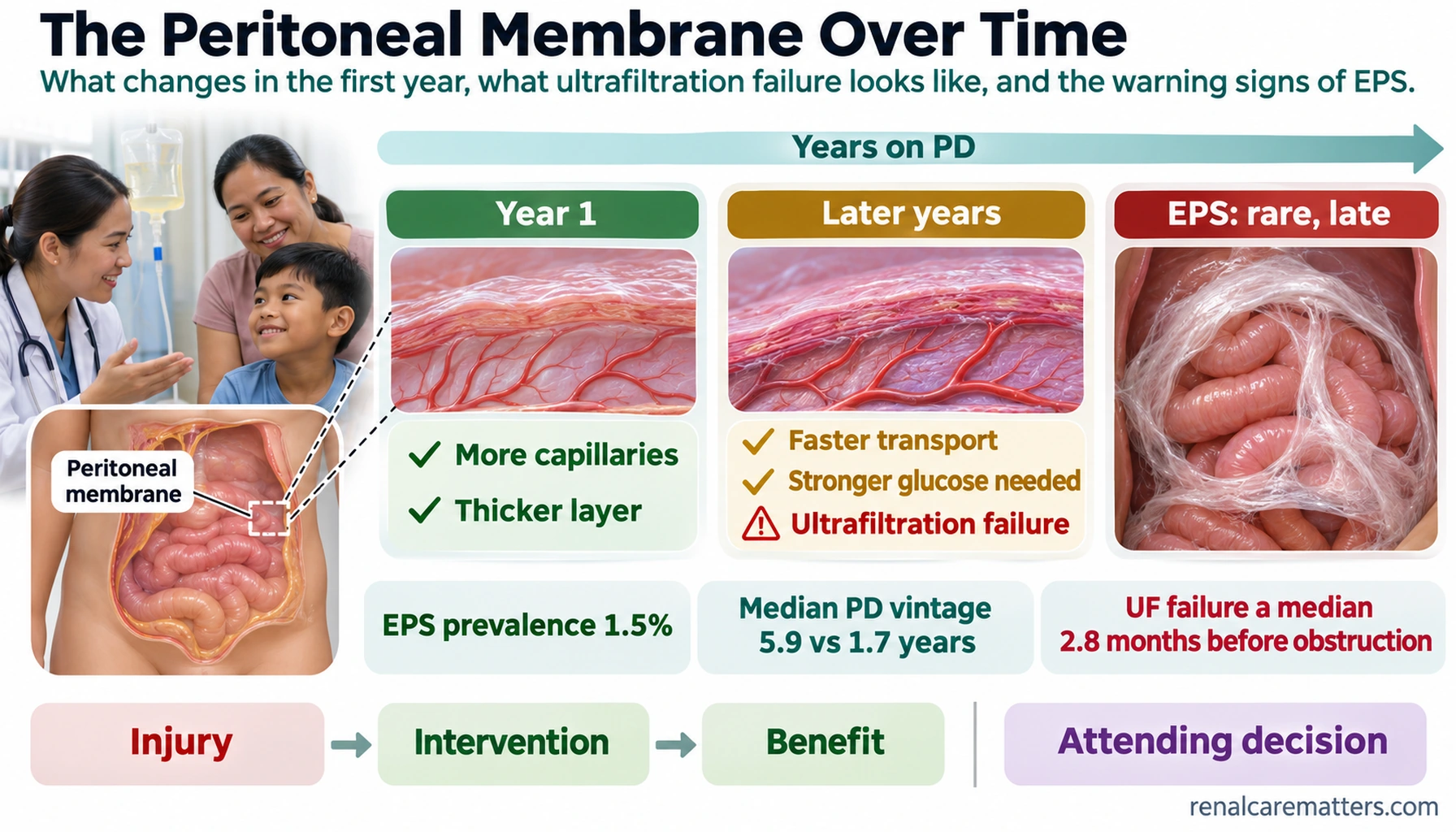
The membrane changes from the start. In a multicenter biopsy study of children on PD with neutral-pH, low glucose degradation product solutions, peritoneal blood microvessel density was 110% and 93% higher after up to 6 and 12 months of PD than before dialysis, and the submesothelial layer was 23% and 58% thicker. Microvessel density correlated with faster small-solute transport.12 More capillaries mean glucose is absorbed faster and the osmotic pull is lost sooner. This is an observational tissue study; it shows that even the more biocompatible solutions alter the membrane, not that any one solution changes clinical outcome.
Ultrafiltration failure. Before blaming the membrane, exclude a catheter problem, a leak to the abdominal wall or pleura, and excess salt and water intake. Fischbach and Warady list the membrane causes: a fill too small for the membrane, a large vascular surface from inflammation or glucose injury, impaired water transport through aquaporins, high lymphatic absorption at high IPP, and a reduced surface after adhesions or sclerosis.11 A peritoneal equilibration test (PET) with a stronger glucose solution shows the early dip in dialysate sodium that reflects water moving through aquaporins; little or no dip points to impaired free-water transport.11 The 2020 International Society for Peritoneal Dialysis (ISPD) volume recommendations, written as practice points because no randomized trial informs blood pressure targets in PD, ask that euvolemia be pursued while protecting residual urine output and that blood pressure be a key measure of prescription quality.13
Encapsulating peritoneal sclerosis (EPS). EPS is the rare, late threat: the peritoneum thickens into a cocoon around the bowel. A 10-year survey of 14 European pediatric units found 22 cases, a prevalence of 1.5% (8.7 per 1,000 patient-years on PD). Children with EPS had a median PD vintage of 5.9 years versus 1.7 years in the rest. Fifteen of 17 children diagnosed on PD (88%) developed ultrafiltration failure first, a median of 2.8 months before bowel obstruction; 20 of 22 had signs of bowel obstruction; 3 died during follow-up.14 EPS can also appear after transfer to hemodialysis (HD) or after transplantation. The survey is descriptive and cannot tell you how to prevent EPS, but it tells you who to watch: the child with long PD vintage, many peritonitis episodes and new ultrafiltration failure.
Potassium and protein. Children on PD lose potassium in effluent and often eat little. In SCOPE, 437 of 1,186 children (37%) had sustained hypokalemia (3.5 mmol/L or lower in at least two of three consecutive months), and it was not associated with the peritonitis rate (rate ratio 1.07, 95% confidence interval 0.80 to 1.44).15 That differs from adult data, where the ISPD 2022 guideline treats hypokalemia as a modifiable peritonitis risk factor.16 Correct hypokalemia for the heart, muscle and bowel, through diet and the unit’s protocol, whatever its link to infection. Protein is lost in effluent every day and more during peritonitis; the dietitian’s protein target must account for it, and many infants need tube feeds to grow.17
Residual urine. Residual kidney function eases fluid and solute control and makes PD last longer. Protect it: avoid nephrotoxic drugs and contrast where there is an alternative, avoid volume depletion from overly aggressive ultrafiltration, and measure urine output at every review. The ISPD volume practice points ask that fluid removal by ultrafiltration and urine output be considered together and that residual function not be compromised.13
Slow complication
Mechanism
What you see first
Fast transport over time
Neoangiogenesis from glucose and inflammation
Day dwell drains less than it took in; rising glucose strength needed
Impaired free-water transport
Aquaporin dysfunction
No sodium dip on PET; poor response to stronger glucose
EPS
Fibrosis encasing the bowel
Ultrafiltration failure, then vomiting, distension, bloody effluent, obstruction
Hypokalemia
Effluent loss, low intake
Weakness, constipation, ileus
Protein loss
Large pores, peritonitis
Falling albumin, poor growth
RememberNew ultrafiltration failure in a child with years on PD and repeated peritonitis is EPS until proven otherwise. Plan the exit from PD before the bowel obstructs.
Figure 5. The membrane over time. What changes in the first year, what ultrafiltration failure looks like, and the warning signs of encapsulating peritoneal sclerosis.
Lesson · part 5
The monthly home review and the tired caregiver
The monthly review of a child on home PD covers four things: the child, the dialysis, the home and the caregiver. Do it face to face at the interval your unit sets, with the home log, the growth chart and the exit-site photograph in front of you.
The caregiver is a clinical problem. In a study of 41 children on APD in Poland, 51.2% of primary caregivers scored in the range that suggests possible abnormal mental functioning on the General Health Questionnaire, and most reported a medium burden.18 It was a cross-sectional survey in a different health system, but the pattern is familiar in Philippine homes, where one mother often carries the nights alone while the father works abroad. Ask directly: “How many hours did you sleep last night?” Then act: train a second adult, reduce alarms by fixing the mechanics, involve the social worker, and consider respite admissions or a planned period of in-center care if the family is breaking.
When to change modality. PD should change when it cannot keep the child well or safe: refractory ultrafiltration failure, EPS, a membrane lost to peritonitis, a hernia or leak that cannot be repaired, or a home that cannot sustain it despite support. Exhaustion alone is a reason to fix the burden first, then decide with the family. HD in an adult unit near home has its own costs for a child: vascular access, three sessions a week during school hours, and a unit not built for children (Modules 23 to 25).
Typhoon season. From June to November, review the disaster plan before the first storm: a two-week reserve of solution where the program allows, a dry raised shelf, the manual exchange the family will use if the cycler cannot run, a charged phone, and the name of the nearest hospital that can drain a peritoneum and take an effluent culture if roads to the PD center close. Families on islands or in flood-prone barangays need this plan in writing.
The growing child. As a child on PD reaches adolescence, teach self-care step by step: exit-site care first, then connection under supervision, then the whole procedure. A teenager who can do a safe exchange can sleep over at a relative’s house, join a school trip with a plan, and carry that skill into transplant preparation and the adult unit.
Figure 6 · Home PD review: the order of questions
Is the child growing and normotensive?Growth chart, blood pressure percentile, edema.
Is the dialysis delivering?Drains, ultrafiltration, residual urine, alarms.
Is anything mechanical?Stool, catheter position, leaks, hernias.
Is the membrane changing?Rising glucose needs, PET when indicated, EPS risk with long vintage.
Is the home safe?Power, water, storage, pets, supplies.
Is the caregiver coping?Sleep, money, help at home, observed technique.
At the monthly review · fictional
Aling Merly has done her granddaughter’s exchanges for two years. On a short observed exchange she touches the tip of the transfer set while opening the cap. She says she has been doing it this way “for months, to save time.”
You arrange retraining with the PD nurse that week and record a touch contamination in the program log.
What this shows. Technique drifts over time. Observing one exchange at review finds errors that no questionnaire will.
RememberReview the child, the dialysis, the home and the caregiver every month. A tired caregiver is a risk factor you can treat.
Stop and call
Breathlessness or a new pleural effusion in a child on PD
Vomiting, abdominal distension and bloody or cloudy effluent in a child with long PD vintage (possible EPS or peritonitis)
A hernia that is tender, hard or cannot be reduced
No outflow after the bowel is emptied
A caregiver who says she cannot continue
On the floor
Real situations: problems and solutions
These are fictional but typical. For each one, cover the answer, decide what you would do, then compare. Where a step depends on local rules, your unit’s procedure and your supervisor’s direction come first.
The brownout at 2 a.m.
What you see
A father in Iloilo messages that the power went out mid-cycle and the cycler stopped with fluid still in his daughter's abdomen.
What is likely going on
No written brownout plan was given at discharge, so the family does not know whether to wait, drain or call.
What to do
Talk him through the manual drain the program taught, tell him what to do for the rest of the night under your unit's protocol, and give the family a written brownout plan at the next visit.
Why it matters
Power interruptions are predictable in many provinces. A plan written before discharge prevents a frightened call in the dark.
The referral that says PD failure
What you see
A provincial pediatrician refers an 8-year-old for hemodialysis because drains have fallen for a week.
What is likely going on
Constipation and catheter migration are more likely than membrane failure in a child on PD for one year.
What to do
Ask for an abdominal X-ray and a bowel history before accepting the HD referral, and start the bowel regimen your unit uses.
Why it matters
Most falling drains are mechanical. Changing modality for a loaded rectum costs the child a vascular access and the family its home therapy.
The scrotal swelling
What you see
A mother notices her 3-year-old son's scrotum swelling during day dwells.
What is likely going on
Dialysate is passing through a patent processus vaginalis, a form of leak or hernia driven by intraperitoneal pressure.
What to do
Lower the intraperitoneal pressure as your protocol allows, avoid upright day dwells with large volumes, and request pediatric surgical repair.
Why it matters
Hernias and genital leaks are common in young children on PD and are fixable; left alone they worsen and can incarcerate.
The grandmother who does every exchange
What you see
A grandmother has done every night of a 5-year-old's PD for 18 months while both parents work in Manila.
What is likely going on
One caregiver carrying years of nights is a safety risk: fatigue leads to missed exchanges and touch contamination.
What to do
Ask how she is sleeping, observe one exchange, train a second adult in the household, and involve the social worker.
Why it matters
Caregiver burden is common and treatable. A second trained adult is part of the prescription for home therapy.
Field notes
Write a brownout and typhoon plan into every discharge packet for home PD.
Observe one real exchange at every quarterly review, not only at training.
Ask about stools before you order a catheter X-ray.
Record school days missed in the monthly review; absence is an outcome.
Case review
Back to the case: Three weeks without sleep
The poor drains. Four days without stool, a distended abdomen and alarms for low drain point first to constipation, which pushes the catheter tip out of the pelvis and compresses it. Start the unit’s bowel regimen today, ask Liezl to log drains for the next two nights, and order an abdominal X-ray if drains do not recover after stools. His rising weight and blood pressure follow from fluid that is not coming out; reassess his fluid allowance and blood pressure medicines once the bowel is cleared, and look for a leak.
The bulge. A soft umbilical bulge on coughing in a child on PD is a hernia, driven by intraperitoneal pressure and made worse by constipation and a full abdomen. Ask for a pediatric surgical review for repair. Until then, lower the pressure as your protocol allows: avoid large day dwells, keep exchanges lying down where possible, and treat the constipation. Teach Liezl the signs of incarceration: a hard, tender bulge, vomiting, or a bulge that will not go back.
Liezl. Thank her and take the exhaustion seriously; it is part of the clinical problem. Fixing the constipation should reduce the alarms. Offer to train a second adult and involve the social worker. Explain honestly that hemodialysis would mean a catheter or fistula, three daytime sessions a week in an adult unit, and more missed school, so you would rather make PD workable first; if it still is not, you will plan the change together. On coverage, tell her what is true: the APD benefit for children was a pilot extended to July 31, 2026, and you will confirm its current status with the PhilHealth liaison and the program coordinator before anything changes. His prescription will follow his needs, not the coverage.
Skills lab · with your preceptor
Skills checklist: Home PD: training the family, school, and non-infectious complications
Complete with a preceptor, in simulation or at your own unit. Sign-off is local. Your preceptor rates each step as satisfactory, needs practice, or not observed. Steps marked Critical must all be satisfactory before sign-off. This checklist supports supervised learning; your unit’s own procedure and competency form are the authority. A printable version of every checklist is on the trainer page.
Certifies a caregiver after observed return demonstration using a written training checklist
Completes a home visit checklist covering power, water, storage, pets and a second trained adult
Works up outflow failure in order: bowel, position, fibrin, omentum, leak
Explains the pediatric PD Z package and APD pilot status to a family without turning coverage into a prescription
Placement activity. Home PD program, clinic or simulated family meeting
Self-assessment
Check your understanding
Each visit draws 5 questions at random from this module’s 5-question bank. Choose the single best answer for each, then select Check answers; an explanation appears under the best answer. Select New set of questions for a different mix. A good target is 4 of 5 on two different sets. Nothing you select is sent anywhere; scoring happens in your browser.
Warady, B. A., Same, R., Borzych-Duzalka, D., Neu, A. M., El Mikati, I., Mustafa, R. A., Begin, B., Nourse, P., Bakkaloglu, S. A., Chadha, V., Cano, F., Yap, H. K., Shen, Q., Newland, J., Verrina, E., Wirtz, A. L., Smith, V., & Schaefer, F. (2024). Clinical practice guideline for the prevention and management of peritoneal dialysis associated infections in children: 2024 update. Peritoneal Dialysis International, 44(5), 303–364. https://doi.org/10.1177/08968608241274096
Kamath, N., Borzych-Dużałka, D., Kaur, A., Neto, G., Arbeiter, K., Yap, Y. C., Lahoche, A., Eid, L., Hooman, N., Richardson, T., Schaefer, F., Warady, B. A., & IPPN participants. (2023). Pediatric peritoneal dialysis training program and its relationship to peritonitis: A study of the International Pediatric Peritoneal Dialysis Network. Pediatric Nephrology, 38(12), 4111–4118. https://doi.org/10.1007/s00467-023-05995-x
Begin, B., Richardson, T., Ehrlich, J., Warady, B. A., Neu, A. M., & Standardizing Care to Improve Outcomes in Pediatric End Stage Kidney Disease (SCOPE) collaborative participating centers. (2023). Training practices and peritonitis rates in children on maintenance peritoneal dialysis: Results from the Standardizing Care to Improve Outcomes in Pediatric End Stage Kidney Disease (SCOPE) collaborative. Pediatric Nephrology, 38(10), 3401–3406. https://doi.org/10.1007/s00467-023-05975-1
Jones, J., Ullman, A., & Mitchell, A. E. (2026). Training programs for families of children on home peritoneal dialysis: A scoping review. Pediatric Nephrology. Advance online publication. https://doi.org/10.1007/s00467-026-07509-x
Philippine Health Insurance Corporation. (2025). Conduct of the pilot implementation of the Z benefits package for peritoneal dialysis (PD) covering automated PD in children (PhilHealth Advisory No. 2025-0074). https://www.philhealth.gov.ph/advisories/2025/PA2025-0074.pdf
Philippine Health Insurance Corporation. (2026). Extension of the pilot implementation of the Z benefits package for peritoneal dialysis (PD) covering automated PD in children (PhilHealth Advisory No. 2026-0013). https://www.philhealth.gov.ph/advisories/2026/PA2026-0013.pdf
Borzych-Duzalka, D., Aki, T. F., Azocar, M., White, C., Harvey, E., Mir, S., Adragna, M., Serdaroglu, E., Sinha, R., Samaille, C., Vanegas, J. J., Kari, J., Barbosa, L., Bagga, A., Galanti, M., Yavascan, O., Leozappa, G., Szczepanska, M., Vondrak, K., ... International Pediatric Peritoneal Dialysis Network (IPPN) Registry. (2017). Peritoneal dialysis access revision in children: Causes, interventions, and outcomes. Clinical Journal of the American Society of Nephrology, 12(1), 105–112. https://doi.org/10.2215/CJN.05270516
Fischbach, M., & Warady, B. A. (2009). Peritoneal dialysis prescription in children: Bedside principles for optimal practice. Pediatric Nephrology, 24(9), 1633–1642. https://doi.org/10.1007/s00467-008-0979-7
Schaefer, B., Bartosova, M., Macher-Goeppinger, S., Sallay, P., Vörös, P., Ranchin, B., Vondrak, K., Ariceta, G., Zaloszyc, A., Bayazit, A. K., Querfeld, U., Cerkauskiene, R., Testa, S., Taylan, C., VandeWalle, J., Yap, Y., Krmar, R. T., Büscher, R., Mühlig, A. K., ... Schmitt, C. P. (2018). Neutral pH and low-glucose degradation product dialysis fluids induce major early alterations of the peritoneal membrane in children on peritoneal dialysis. Kidney International, 94(2), 419–429. https://doi.org/10.1016/j.kint.2018.02.022
Wang, A. Y., Dong, J., Xu, X., & Davies, S. (2020). Volume management as a key dimension of a high-quality PD prescription. Peritoneal Dialysis International, 40(3), 282–292. https://doi.org/10.1177/0896860819895365
Shroff, R., Stefanidis, C. J., Askiti, V., Edefonti, A., Testa, S., Ekim, M., Kavaz, A., Ariceta, G., Bakkaloglu, S., Fischbach, M., Klaus, G., Zurowska, A., Holtta, T., Jankauskiene, A., Vondrak, K., Vande Walle, J., Schmitt, C. P., Watson, A. R., & European Paediatric Dialysis Working Group. (2013). Encapsulating peritoneal sclerosis in children on chronic PD: A survey from the European Paediatric Dialysis Working Group. Nephrology Dialysis Transplantation, 28(7), 1908–1914. https://doi.org/10.1093/ndt/gfs603
Bauer, A., Pottanat, N., Grills, N. K., Dutta, S., Parsons, J., Swartz, S., Munshi, R., Neu, A., & Warady, B. A. (2026). Sustained hypokalemia and peritonitis rates in children undergoing peritoneal dialysis. Pediatric Nephrology. Advance online publication. https://doi.org/10.1007/s00467-026-07597-9
Li, P. K., Chow, K. M., Cho, Y., Fan, S., Figueiredo, A. E., Harris, T., Kanjanabuch, T., Kim, Y. L., Madero, M., Malyszko, J., Mehrotra, R., Okpechi, I. G., Perl, J., Piraino, B., Runnegar, N., Teitelbaum, I., Wong, J. K., Yu, X., & Johnson, D. W. (2022). ISPD peritonitis guideline recommendations: 2022 update on prevention and treatment. Peritoneal Dialysis International, 42(2), 110–153. https://doi.org/10.1177/08968608221080586
Zurowska, A. M., Fischbach, M., Watson, A. R., Edefonti, A., Stefanidis, C. J., & European Paediatric Dialysis Working Group. (2013). Clinical practice recommendations for the care of infants with stage 5 chronic kidney disease (CKD5). Pediatric Nephrology, 28(9), 1739–1748. https://doi.org/10.1007/s00467-012-2300-z
Kiliś-Pstrusińska, K., Wasilewska, A., Medyńska, A., Bałasz-Chmielewska, I., Grenda, R., Kluska-Jóźwiak, A., Leszczyńska, B., Olszak-Szot, I., Miklaszewska, M., Szczepańska, M., Tkaczyk, M., Urzykowska, A., Zachwieja, K., Zajączkowska, M., Ziółkowska, H., Zagożdżon, I., & Zwolińska, D. (2013). Psychosocial aspects of children and families of children treated with automated peritoneal dialysis. Pediatric Nephrology, 28(11), 2157–2167. https://doi.org/10.1007/s00467-013-2532-6
Educational material for physicians. Completing it is an Academy learning record only. It does not confer CPD units, PNSP or board certification, privileges, or PhilHealth accreditation, and it does not replace current guidelines, regulations, your institution’s pediatric protocols and formulary, or clinical judgment.