The growing kidney and the pediatric renal assessment
Read creatinine against height and age, measure blood pressure correctly, and turn urine, growth and eGFR into a problem statement.
PublishedNailathalaGipatikPepalwal:ReferencesMga SanggunianMga TinubdanReng Reperensya:7Audience: Pediatric nephrologists · pediatric nephrology fellows · adult nephrologists, intensivists and neonatologists who share kidney care for children in the clinic, ward, NICU, PICU, dialysis unit and homeRead timeOras ng pagbasaOras sa pagbasaOras ning pamamasa:
Training track for attending pediatric nephrologists
This module is study material for attending pediatric nephrologists and fellows. It explains the reasoning behind common decisions; it is not a protocol and it gives no doses. Doses, fill volumes and thresholds must come from current pediatric guidelines, product labels, your institution’s approved pediatric protocols and a pediatric pharmacist. Benefit rules change: confirm them on the date of service. Every case is fictional.
Learning objectives
After this module you should be able to
Interpret a child’s creatinine against height, age, sex and muscle mass, and choose a validated pediatric estimating equation.
Measure and classify blood pressure in a child correctly, and quantify proteinuria with the definitions children’s guidelines use.
Combine growth, blood pressure, urine and estimated glomerular filtration rate into a single problem statement.
Pre-testBefore you read, answer the 5 self-assessment questions and note your score. After the module, select New set of questions and compare. The difference is what you learned; the questions you still miss are what to reread.
Start here
The big picture, in plain words
Your role · reading the child, not the numberMost children reach you because someone saw one abnormal value: a creatinine flagged on a school physical, a dipstick after a fever, a blood pressure taken with the wrong cuff. Your duty is to decide whether the kidney is actually abnormal, and to say so in a way the family, the school and the referring doctor can act on.
In plain wordsA creatinine value without the child is like a shoe size without the wearer. Size 6 is enormous for a toddler, ordinary for a 12-year-old and small for an adult.
The picture has a limit. Shoe size depends on one thing; creatinine depends on several. Its production follows muscle mass, which tracks height but also sex, puberty, training, diet and supplements. Its clearance follows the glomerular filtration rate (GFR), which in a child is still maturing in the first year and later rises with body size. And it lags: after an injury, creatinine catches up with the GFR only over a day or more. So a number on a report is a clue, not a verdict.
CKiD U25, creatinineK 41.8 for males and 37.6 for females (sex-dependent form)
Low eGFR flag (KDIGO 2024)eGFRcr below 90 mL/min per 1.73 m² in children and adolescents over age 2
Nephrotic-range proteinuria (IPNA 2022)UPCR ≥200 mg/mmol (2 mg/mg) in a spot urine
Clinical hypertension in children (AAP 2017)About 3.5%
Most children with an “abnormal” kidney test have normal kidneys measured badly or interpreted against adult rules. A few have real, silent disease that the first number hinted at. Your work is to repeat the right test the right way, read it against the child’s age and size, and write a problem statement that separates the two.
Opening case · fictional
Case: The varsity player with a “high” creatinine
Monday, 9 a.m., your clinic in Lipa City, Batangas. Miguel Santos is 12 years old, 158 cm and 52 kg, and plays guard for his school’s varsity basketball team. The school physician has barred him from the provincial meet because his pre-participation creatinine was 1.1 mg/dL, flagged high against the laboratory’s pediatric range. The same screen showed a urine dipstick of 1+ protein and a blood pressure of 134/86 mm Hg, taken with an adult cuff at the end of practice.
His mother, Mrs. Teresa Santos, has brought a bag of his supplements, including a creatine powder the coach recommended, and asks whether he needs an ultrasound and “kidney vitamins.” The coach has texted her twice: the team list closes Friday. Miguel says he feels fine and wants to play.
Before reading on, decide:
Does Miguel have reduced kidney function?
What will you repeat, and how will you measure it this time?
What will you tell Miguel, his mother and the school physician?
Keep your answers in mind. The lesson gives you what you need, and the case review near the end shows one sound response.
Lesson · part 1
The growing kidney
A child’s kidney is a moving target. Nephrons form through late gestation, and in most preterm infants nephrogenesis is still under way at birth. An autopsy study of preterm neonates found that renal maturation accelerated after preterm birth, with a larger share of abnormal glomeruli and enlarged renal corpuscles than in gestational controls, which suggests fewer functional nephrons and a kidney already working hard.1 The study was small and descriptive; it shows structure, not outcome. The clinical message is the one the site’s Born Small guide carries: prematurity is a lifelong kidney risk worth recording.
Filtration matures quickly after birth. GFR rises through fetal life, matures rapidly after birth according to gestational and postmenstrual age, and reaches adult values, normalized to body surface area, by about 1 year of postnatal age, as one review summarizes.2 In the first days of life the infant’s creatinine also reflects the mother’s, so a single early value says little about the baby’s own kidneys. Module 14 covers the newborn in detail.
After infancy, GFR normalized to surface area is roughly stable, but absolute GFR and muscle mass both grow. That is why a normal creatinine for a 3-year-old is a worrying creatinine for a 1-year-old, and why a fit adolescent boy can have a creatinine that would alarm you in his younger sister.
Stage
What the kidney is doing
What you see
Preterm newborn
Nephrogenesis may still be under way; maturation accelerates after birth
Creatinine shaped by the mother’s in the first days; fragile handling of salt and water
First year
GFR rising toward adult values per body surface area
Creatinine falling from birth values; small changes matter
Childhood
Normalized GFR stable; body and muscle growing
Creatinine rising slowly with height
Puberty
Rapid growth in body and muscle; a reduced kidney mass may not keep up
Creatinine rising, sometimes sharply in boys; a high-risk period for children with Chronic kidney disease (CKD)
Puberty deserves its own line. The Kidney Disease: Improving Global Outcomes (KDIGO) 2024 chronic kidney disease (CKD) guideline advises monitoring children more often than their CKD stage alone would suggest during puberty, because a kidney with reduced capacity may not grow enough to match the body.3
RememberAsk three questions of every pediatric creatinine: how old, how tall, and how much muscle. The answer may change the number’s meaning more than the number itself.
Lesson · part 2
From creatinine to estimated GFR
Because creatinine production scales with muscle, and muscle scales roughly with height, pediatric equations divide height by creatinine and multiply by a constant, K.
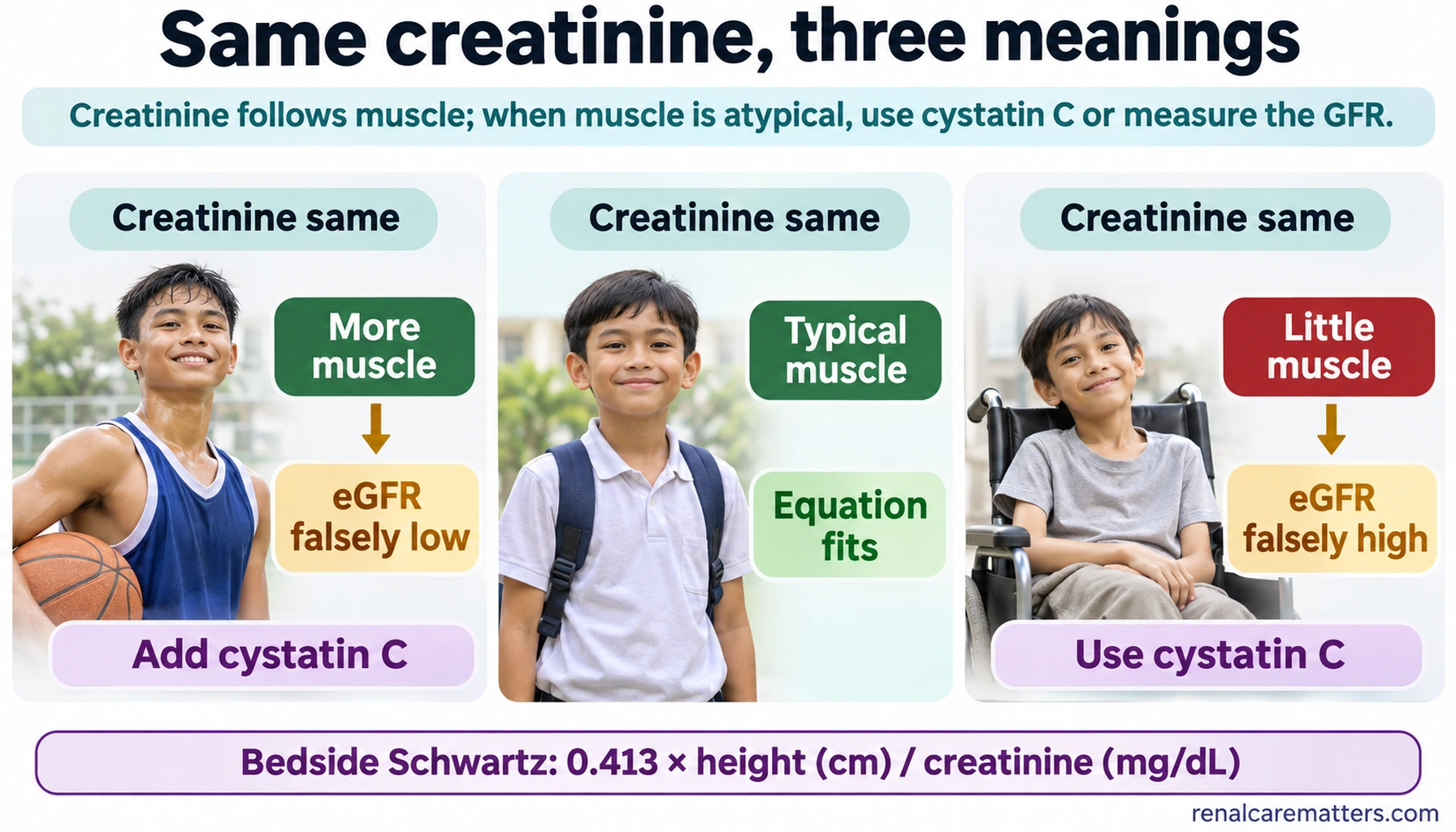
Bedside Schwartz. In 2009 the Chronic Kidney Disease in Children (CKiD) investigators refit the old Schwartz formula to creatinine measured by modern enzymatic methods. Their data came from 349 children aged 1 to 16 with CKD, median measured GFR 41.3 mL/min per 1.73 m². With height in centimeters, 0.413 × height / creatinine gave a good approximation of their full equation.4 The authors noted that children with higher GFR were needed to validate it for screening. In a healthy, muscular adolescent, the bedside formula was never designed to be precise.
CKiD U25. In 2021 the same group developed equations for ages 1 to 25 from 2,655 observations in 928 participants, with GFR measured by iohexol disappearance. The creatinine equations use K × height / creatinine with a sex-specific K of 41.8 for males and 37.6 for females, or an age- and sex-dependent K that rises through childhood (from 35.7 at age 1 to 50.8 at 18 and older in males; from 33.1 to 41.4 in females). Cystatin C equations use K × 1 / cystatin C, with constant K of 81.9 for males and 74.9 for females. The age-dependent creatinine form reduced bias, notably in young children and young adults.5 These are estimates in children with CKD; they are less tested at normal GFR.
What KDIGO 2024 adds. Estimate GFR in children with equations developed or validated in comparable populations. Measure GFR when a more accurate value would change a treatment decision. Use a cystatin C-based equation in children with low muscle mass, such as neuromuscular conditions, because creatinine-based equations may give falsely high values. An eGFRcr below 90 mL/min per 1.73 m² can be flagged as low in children and adolescents over age 2.3
Situation
How creatinine misleads
What to do
Muscular adolescent athlete, creatine supplements, high protein intake
More creatinine produced: eGFR falsely low
Repeat after rest and stopping supplements; add cystatin C
Use cystatin C; measure GFR if a decision depends on it
First days of life
Mother’s creatinine still present
Follow the trend, not one value (Module 14)
Acute illness
Creatinine lags the GFR change
Do not use steady-state equations to stage acute injury
Different laboratory methods
Older non-enzymatic assays read higher
Ask how the laboratory measures creatinine; compare like with like
RememberAn eGFR is an estimate built on assumptions about muscle. When the child breaks the assumptions, change the marker or measure the GFR.
In the pediatric ward · fictional
Bea, 10, has spastic cerebral palsy and weighs 19 kg. Her creatinine is 0.3 mg/dL, and the resident writes “excellent kidney function” before starting a nephrotoxic antibiotic.
You ask for a cystatin C. Her cystatin C-based estimate is about half of what the creatinine suggested, and the pharmacist adjusts the drug interval.
What this shows. A low creatinine in a child with little muscle is not reassurance.
Figure 2. Same creatinine, three meanings. Creatinine follows muscle; when muscle is atypical, use cystatin C or measure the GFR.
Lesson · part 3
Blood pressure and urine, measured properly
Blood pressure. The American Academy of Pediatrics (AAP) 2017 guideline classifies children aged 1 to under 13 by percentiles for age, sex and height, and adolescents 13 and older by fixed cut points that match adult categories: normal below 120/80, elevated 120–129/<80, stage 1 hypertension 130/80 to 139/89, and stage 2 at 140/90 mm Hg or above. For younger children, elevated starts at the 90th percentile (or 120/80, whichever is lower), stage 1 at the 95th percentile (or 130/80), and stage 2 at the 95th percentile plus 12 mm Hg (or 140/90).6 The guideline puts the prevalence of clinical hypertension in children at about 3.5%.6 Module 5 covers diagnosis and treatment.
Measurement errors are common and usually raise the reading. The guideline asks for the right arm, standard technique, and a cuff whose bladder length is 80% to 100% of the arm circumference and whose width is at least 40%. Oscillometric screening readings that are high should be confirmed by auscultation.6 An adult cuff on a thin arm, a reading straight after exercise, or a child talking during measurement can each turn normal into “hypertension.”
Protein. Children make proteinuria for benign reasons (fever, exercise, standing) and for serious ones. Quantify it with a spot urine protein-to-creatinine ratio (UPCR), ideally on a first-morning sample, which excludes orthostatic protein. The International Pediatric Nephrology Association (IPNA) defines nephrotic-range proteinuria as a UPCR of 200 mg/mmol (2 mg/mg) or more in a spot urine, or 1,000 mg/m² per day or more in a 24-hour collection, corresponding to 3+ or 4+ on the dipstick.7 KDIGO 2024 suggests referring children for specialist care with a sustained albumin-to-creatinine ratio (ACR) of 30 mg/g (3 mg/mmol) or more, or a protein-to-creatinine ratio of 200 mg/g (20 mg/mmol) or more, using an early-morning sample taken when the child is well.3
Blood and sediment. The dipstick detects heme, not red cells. Look at the sediment yourself when you can. Dysmorphic red cells and red cell casts point to the glomerulus; uniform red cells with clots point to the urinary tract; heme without red cells suggests hemoglobin or myoglobin. Module 11 builds on this.
Finding
Benign explanation to exclude
Test that settles it
High blood pressure on one reading
Wrong cuff, exercise, anxiety, talking
Repeat with correct cuff, seated and rested, by auscultation; then ambulatory monitoring if needed
Dipstick 1+ protein
Exercise, fever, standing, concentrated urine
First-morning UPCR, repeated when well
Dipstick blood
Menstruation, exercise, trauma
Microscopy of a fresh sample; repeat when well
Creatinine above the pediatric range
Muscle, supplements, laboratory method
Repeat after rest; cystatin C; compare with height-based estimate
RememberMeasure once properly before you measure many times badly. The right cuff and a first-morning urine settle most referrals.
Lesson · part 4
Putting it together: the problem statement
A child’s growth chart is a vital sign. Plot height, weight and, where relevant, head circumference at every visit, and look at the velocity, not only the percentile. A child whose height crosses percentile lines downward may have CKD, acidosis or a tubular disorder long before creatinine says so. A child whose weight rises while height stalls may be retaining fluid or eating badly.
Then write a problem statement in one or two sentences that a resident or a school physician can act on. It should name the child’s age and size, the estimated GFR and the equation used, the blood pressure category, the urine findings with their quantity, the growth trend, and whether the picture is acute, chronic or not yet known.
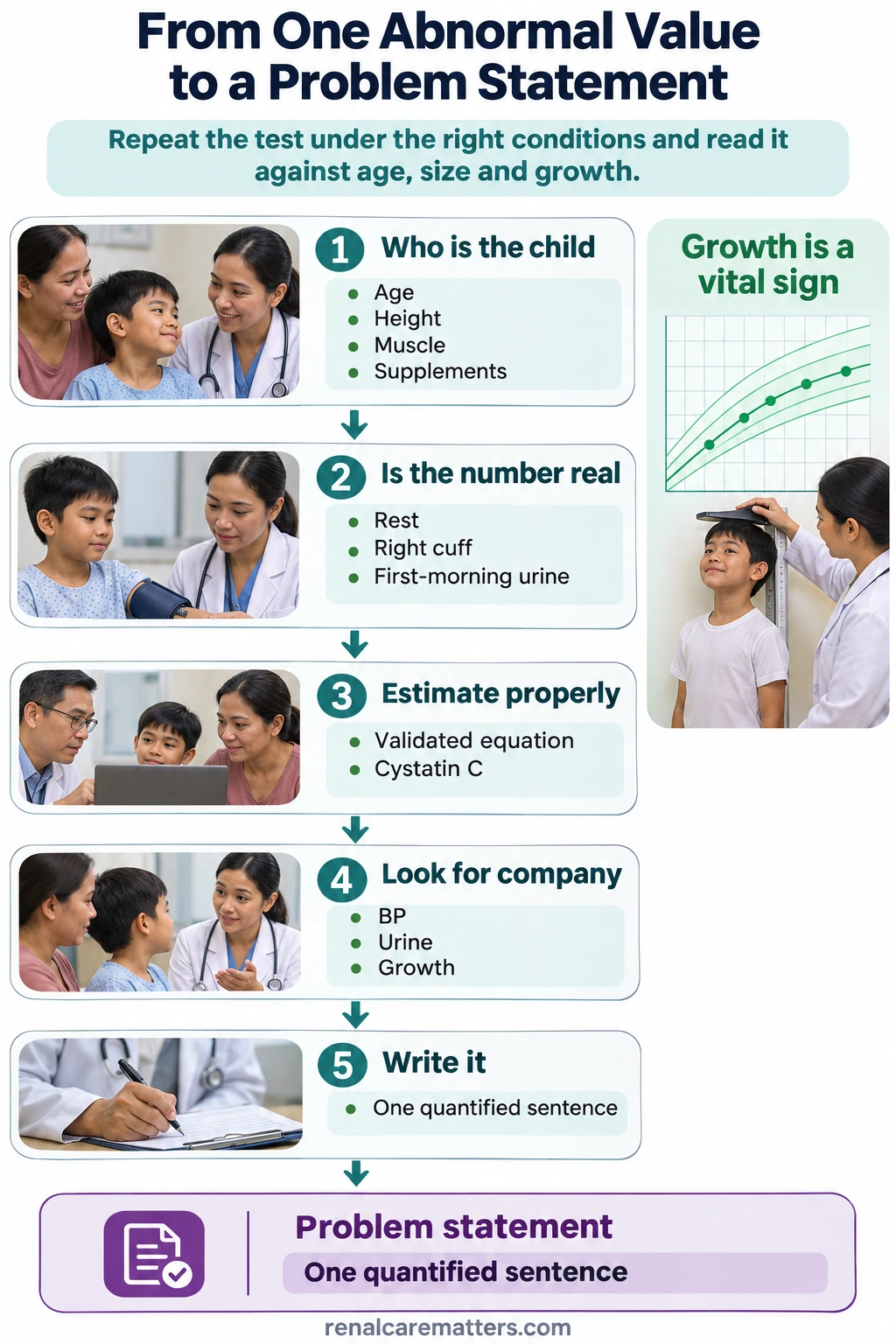
Figure 3 · Five steps from referral to problem statement
Who is the childAge, sex, height, weight, puberty stage, prematurity, muscle mass, medicines and supplements.
Is the number realRepeat under the right conditions: rested, well, correct cuff, first-morning urine, same laboratory.
Estimate properlyA validated pediatric equation; cystatin C when muscle is atypical; measured GFR when a decision depends on it.
Look for companyBlood pressure, urine sediment and protein, growth velocity, ultrasound if structure is in question.
Write itOne sentence naming eGFR and equation, blood pressure category, urine findings and growth trend, and the plan.
Problem statement element
Example
Child
12-year-old boy, 158 cm, early puberty, athlete, on creatine powder
Kidney function
Creatinine-based estimate low on one sample; cystatin C estimate normal
Blood pressure
Normal for age, sex and height on correct cuff after rest
Urine
First-morning UPCR normal; no blood on microscopy
Growth
Tracking the 60th percentile for height
Conclusion
No evidence of kidney disease; repeat in 6–12 months
Stop and call
eGFR below the low flag on repeat with a valid equation, or falling over time
Nephrotic-range proteinuria, edema or low albumin
Stage 2 hypertension confirmed by auscultation, or any blood pressure with headache, vomiting or visual change
Red cell casts or visible hematuria with edema or hypertension
Height velocity falling across percentile lines with any abnormal kidney test
RememberA good problem statement is short, quantified and honest about what is not yet known.
By Viber, a referring pediatrician · fictional
A pediatrician in Naga sends a photo of a report: creatinine 0.6 mg/dL in a 2-year-old, “normal range,” with a growth chart showing height falling from the 50th to below the 3rd percentile over a year.
You calculate a height-based estimate and ask for a blood gas, electrolytes, urinalysis and a kidney ultrasound before the child is seen.
What this shows. “Normal range” on an adult-style report may be abnormal for a toddler. Read the child, then the number.
Figure 4. From one abnormal value to a problem statement. Repeat the test under the right conditions and read it against age, size and growth.
On the floor
Real situations: problems and solutions
These are fictional but typical. For each one, cover the answer, decide what you would do, then compare. Where a step depends on local rules, your unit’s procedure and your supervisor’s direction come first.
The adult reference range on a toddler’s report
What you see
A 20-month-old’s creatinine of 0.7 mg/dL is printed as “normal” because the laboratory uses an adult range.
What is likely going on
For a toddler of that height, the value suggests a substantially reduced GFR.
What to do
Calculate a height-based estimate, repeat with electrolytes and a blood gas, examine the urine, and arrange a kidney ultrasound.
Why it matters
Adult ranges hide pediatric disease. Many Philippine laboratories do not print age-specific ranges.
Hypertension on a school clinic reading
What you see
A thin 8-year-old girl is referred for a blood pressure of 128/84 mm Hg taken by an oscillometric device with a cuff borrowed from a teacher.
What is likely going on
The cuff was too small, and the reading was not confirmed by auscultation.
What to do
Measure with a correctly sized cuff on the right arm after rest, by auscultation, on more than one visit, and classify by percentile.
Why it matters
A wrong diagnosis of hypertension can lead to needless tests, medicines and worry.
Protein after a fever
What you see
A 6-year-old has 2+ protein on a dipstick taken during a febrile illness. The parents have read about nephrotic syndrome online.
What is likely going on
Fever causes transient proteinuria.
What to do
Repeat a first-morning UPCR two weeks after recovery. Look for edema and check albumin only if protein persists or the child is swollen.
Why it matters
Most fever proteinuria vanishes. Repeating when well spares the child a workup and the family a fright.
The child with spina bifida and a “perfect” creatinine
What you see
A 13-year-old who uses a wheelchair has a creatinine of 0.4 mg/dL, recurrent urinary infections and a thick-walled bladder on ultrasound.
What is likely going on
Low muscle mass hides reduced GFR; the bladder may be harming the kidneys.
What to do
Use a cystatin C estimate, check blood pressure and urine protein, and coordinate with urology about bladder pressures.
Why it matters
Children with neurogenic bladders can lose kidney function silently while their creatinine stays low.
Field notes
Keep a set of pediatric cuffs in every clinic room, labeled by arm circumference.
Write the equation and the height you used next to every eGFR you report.
Ask for a first-morning urine at the first visit; it saves a second trip.
Plot height on the chart yourself; do not rely on a printed percentile.
Case review
Back to the case: The varsity player with a “high” creatinine
Does he have reduced function? Probably not, but one sample cannot tell you. A bedside Schwartz estimate (0.413 × 158 / 1.1) is about 59 mL/min per 1.73 m², but Miguel is a muscular adolescent taking creatine, and the sample followed training. Each of these raises creatinine without any change in GFR, and the bedside formula was built in children with CKD, not in athletes. Treat the result as unconfirmed.
What to repeat. Ask him to stop the creatine and avoid heavy training for a few days, then repeat creatinine with a cystatin C at the same laboratory and calculate CKiD U25 estimates from both. Collect a first-morning urine for UPCR and microscopy. Measure blood pressure on his right arm with a correctly sized cuff after five minutes of rest, by auscultation. If all are normal, no ultrasound is needed now. If the cystatin C estimate is also low or protein persists, proceed to a full evaluation.
What to say. Tell Miguel and his mother what each test showed and why the first creatinine probably overstated the problem. Explain that “kidney vitamins” are not needed and that supplements can confuse tests. Write to the school physician with the repeat results and a clear statement: no evidence of kidney disease on repeat testing, cleared to play, with a repeat check in 6 to 12 months. If the results are not back by Friday, say so honestly rather than clearing him on hope.
Skills lab · with your preceptor
Skills checklist: The growing kidney and the pediatric renal assessment
Complete with a preceptor, in simulation or at your own unit. Sign-off is local. Your preceptor rates each step as satisfactory, needs practice, or not observed. Steps marked Critical must all be satisfactory before sign-off. This checklist supports supervised learning; your unit’s own procedure and competency form are the authority. A printable version of every checklist is on the trainer page.
Calculates bedside Schwartz and CKiD U25 estimates and explains when each misleads
Measures blood pressure in a child with a correctly sized cuff and classifies it by AAP 2017 categories
Orders and interprets a first-morning UPCR and examines a urine sediment
Writes a quantified problem statement that includes growth velocity
Placement activity. Outpatient clinic or simulation
Self-assessment
Check your understanding
Each visit draws 5 questions at random from this module’s 5-question bank. Choose the single best answer for each, then select Check answers; an explanation appears under the best answer. Select New set of questions for a different mix. A good target is 4 of 5 on two different sets. Nothing you select is sent anywhere; scoring happens in your browser.
Sutherland, M. R., Gubhaju, L., Moore, L., Kent, A. L., Dahlstrom, J. E., Horne, R. S., Hoy, W. E., Bertram, J. F., & Black, M. J. (2011). Accelerated maturation and abnormal morphology in the preterm neonatal kidney. Journal of the American Society of Nephrology, 22(7), 1365–1374. https://doi.org/10.1681/ASN.2010121266
Iacobelli, S., & Guignard, J. P. (2021). Maturation of glomerular filtration rate in neonates and infants: An overview. Pediatric Nephrology, 36(6), 1439–1446. https://doi.org/10.1007/s00467-020-04632-1
Kidney Disease: Improving Global Outcomes (KDIGO) CKD Work Group. (2024). KDIGO 2024 clinical practice guideline for the evaluation and management of chronic kidney disease. Kidney International, 105(4S), S117–S314. https://doi.org/10.1016/j.kint.2023.10.018
Schwartz, G. J., Muñoz, A., Schneider, M. F., Mak, R. H., Kaskel, F., Warady, B. A., & Furth, S. L. (2009). New equations to estimate GFR in children with CKD. Journal of the American Society of Nephrology, 20(3), 629–637. https://doi.org/10.1681/ASN.2008030287
Pierce, C. B., Muñoz, A., Ng, D. K., Warady, B. A., Furth, S. L., & Schwartz, G. J. (2021). Age- and sex-dependent clinical equations to estimate glomerular filtration rates in children and young adults with chronic kidney disease. Kidney International, 99(4), 948–956. https://doi.org/10.1016/j.kint.2020.10.047
Flynn, J. T., Kaelber, D. C., Baker-Smith, C. M., Blowey, D., Carroll, A. E., Daniels, S. R., de Ferranti, S. D., Dionne, J. M., Falkner, B., Flinn, S. K., Gidding, S. S., Goodwin, C., Leu, M. G., Powers, M. E., Rea, C., Samuels, J., Simasek, M., Thaker, V. V., Urbina, E. M., & Subcommittee on Screening and Management of High Blood Pressure in Children. (2017). Clinical practice guideline for screening and management of high blood pressure in children and adolescents. Pediatrics, 140(3), e20171904. https://doi.org/10.1542/peds.2017-1904
Trautmann, A., Boyer, O., Hodson, E., Bagga, A., Gipson, D. S., Samuel, S., Wetzels, J., Alhasan, K., Banerjee, S., Bhimma, R., Bonilla-Felix, M., Cano, F., Christian, M., Hahn, D., Kang, H. G., Nakanishi, K., Safouh, H., Trachtman, H., Xu, H., ... International Pediatric Nephrology Association. (2023). IPNA clinical practice recommendations for the diagnosis and management of children with steroid-sensitive nephrotic syndrome. Pediatric Nephrology, 38(3), 877–919. https://doi.org/10.1007/s00467-022-05739-3
Educational material for physicians. Completing it is an Academy learning record only. It does not confer CPD units, PNSP or board certification, privileges, or PhilHealth accreditation, and it does not replace current guidelines, regulations, your institution’s pediatric protocols and formulary, or clinical judgment.