Diagnose hypertension by percentile and ABPM, find the secondary cause, and lower a hypertensive emergency safely.
PublishedNailathalaGipatikPepalwal:ReferencesMga SanggunianMga TinubdanReng Reperensya:5Audience: Pediatric nephrologists · pediatric nephrology fellows · adult nephrologists, intensivists and neonatologists who share kidney care for children in the clinic, ward, NICU, PICU, dialysis unit and homeRead timeOras ng pagbasaOras sa pagbasaOras ning pamamasa:
Training track for attending pediatric nephrologists
This module is study material for attending pediatric nephrologists and fellows. It explains the reasoning behind common decisions; it is not a protocol and it gives no doses. Doses, fill volumes and thresholds must come from current pediatric guidelines, product labels, your institution’s approved pediatric protocols and a pediatric pharmacist. Benefit rules change: confirm them on the date of service. Every case is fictional.
Learning objectives
After this module you should be able to
Classify blood pressure in children and adolescents by the American Academy of Pediatrics (AAP) 2017 categories, and use ambulatory monitoring to confirm hypertension and find white-coat and masked forms.
Look for the secondary cause that fits the child’s age, and lower a hypertensive emergency at the speed the guideline describes.
Set and monitor a blood pressure target in a child with chronic kidney disease (CKD), using the ESCAPE trial and the Kidney Disease: Improving Global Outcomes (KDIGO) guidelines with their stated grades.
Pre-testBefore you read, answer the 5 self-assessment questions and note your score. After the module, select New set of questions and compare. The difference is what you learned; the questions you still miss are what to reread.
Start here
The big picture, in plain words
Your role · the hypertension referral and the emergency callYou see two kinds of hypertensive child: the one referred from a school or clinic with a reading nobody trusts, and the one in an emergency room with a headache and a pressure that frightens everyone. Your duty is to confirm the first properly, and to keep the second from being harmed by a pressure lowered too fast.
In plain wordsThink of the brain’s blood supply as a house with a pressure regulator on its water main. Within a range, the regulator keeps the taps steady whatever the street pressure does.
The picture has a limit. A regulator is fixed; the brain’s autoregulation is not. In a child with long-standing high pressure, the range shifts upward. A pressure that is normal for a healthy child may then be too low for that child’s brain, kidneys and eyes, and lowering it to “normal” within an hour can cause the ischemia you meant to prevent. In a child whose pressure rose suddenly, as in acute glomerulonephritis, the regulator has had no time to adapt, and encephalopathy can appear at pressures that would seem modest in an adult.
Figure 1 · Key numbers
Adolescents 13 and older (AAP 2017)Stage 1 130/80 to 139/89 mm Hg; stage 2 ≥140/90 mm Hg
Acute severe hypertension (AAP 2017)Lower by no more than 25% of the planned reduction over the first 8 hours (expert opinion, grade D, weak)
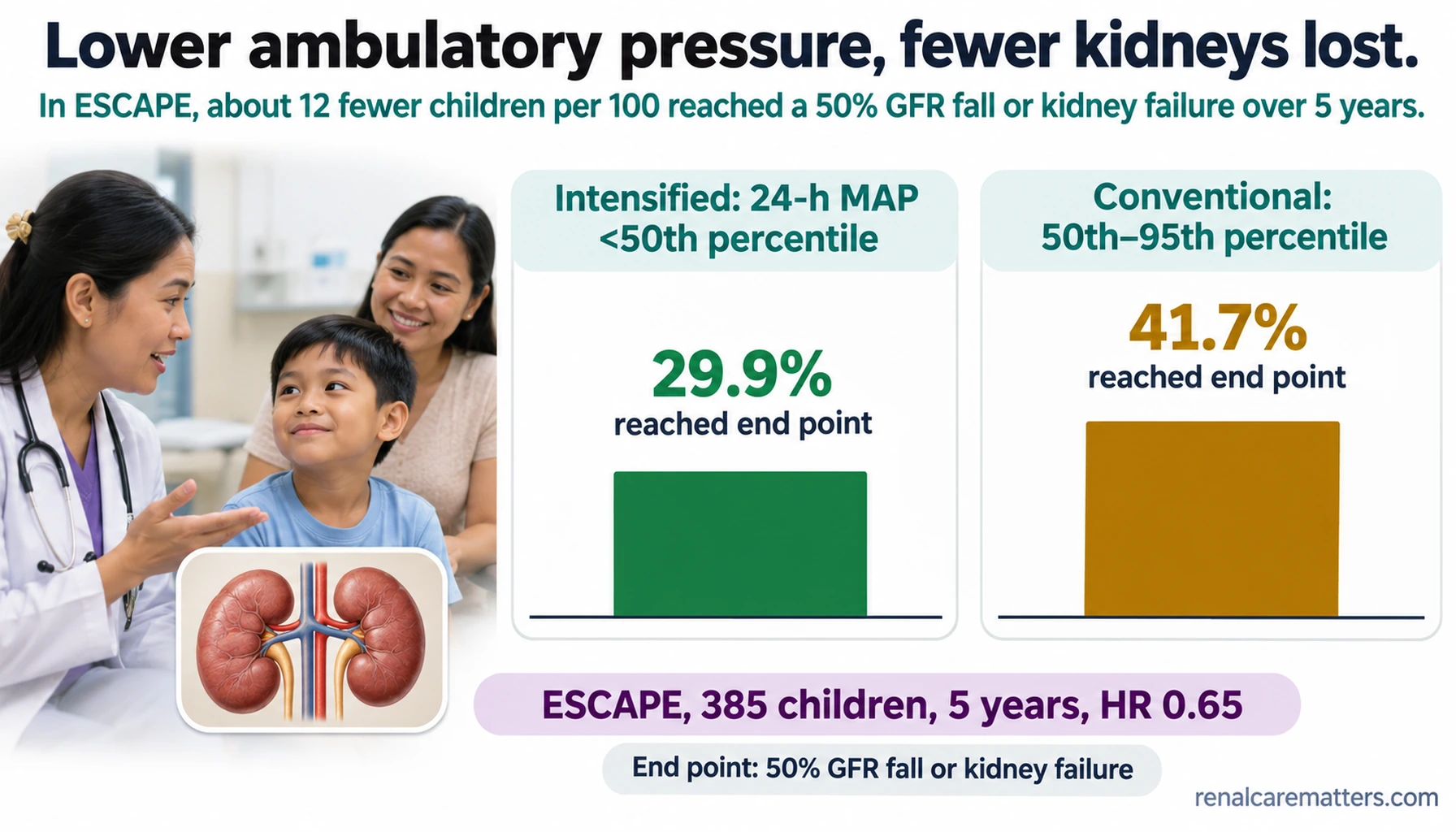
ESCAPE trial, 5 yearsPrimary end point in 29.9% with intensified control versus 41.7% with conventional control
KDIGO 2021, children with CKD24-hour mean arterial pressure (MAP) by ambulatory blood pressure monitoring (ABPM) lowered to ≤50th percentile for age, sex and height (2C)
Share of pediatric hypertension attributable to CKD (AAP 2017)Almost 20%
Most children referred for hypertension have white-coat readings, a wrong cuff, or obesity-related primary hypertension. A few have a kidney or vascular cause that can be found and sometimes fixed, and a few arrive in crisis. Your work is to confirm before you label, to look for the cause that fits the age, to lower an emergency slowly and deliberately, and to protect the kidneys of children with CKD with a target that has trial evidence behind it.
Opening case · fictional
Case: The headache in the emergency room
Tuesday, 11 p.m., the emergency room of a provincial hospital in Iloilo City. Rafael Aquino, 14 years old and 48 kg, has had a headache for three days and vomited twice this evening. He says the lights look blurred. His blood pressure, taken twice on the right arm with a correctly sized cuff, is 182/112 and 178/110 mm Hg. He is alert and oriented, with no focal deficit. His creatinine is 1.6 mg/dL; his urine shows 2+ protein and no red cell casts.
A bedside ultrasound shows a scarred left kidney of 7.2 cm and a right kidney of 9.4 cm. His mother, Mrs. Nora Aquino, recalls “fevers with smelly urine” when he was a baby that were treated at a health center and never imaged. The emergency resident has given an oral antihypertensive and wants “120/80 within the hour.” Mrs. Aquino says his father also has high blood pressure, “so it is in the family.”
Before reading on, decide:
Is this a hypertensive emergency, and how fast should his pressure come down?
What is the likely cause, and what will you look for?
What long-term target will you set, and how will you know he is reaching it?
Keep your answers in mind. The lesson gives you what you need, and the case review near the end shows one sound response.
Lesson · part 1
Defining hypertension in a growing child
Blood pressure rises with age and height, so a single number cannot define hypertension across childhood. The American Academy of Pediatrics (AAP) 2017 guideline uses percentiles for age, sex and height in children aged 1 to under 13, and fixed cut points aligned with adult categories from age 13.1
Category
Ages 1 to <13 years
Ages ≥13 years
Normal
<90th percentile
<120/<80 mm Hg
Elevated
90th to <95th percentile, or 120/80 to <95th percentile, whichever is lower
120/<80 to 129/<80 mm Hg
Stage 1 hypertension
95th percentile to <95th + 12 mm Hg, or 130/80 to 139/89, whichever is lower
130/80 to 139/89 mm Hg
Stage 2 hypertension
≥95th percentile + 12 mm Hg, or ≥140/90, whichever is lower
≥140/90 mm Hg
The guideline puts the prevalence of clinical hypertension in children and adolescents at about 3.5%.1 Measurement decides much of that. Use the right arm, a cuff bladder at least 40% of arm circumference in width and 80% to 100% in length, a seated, rested child, and confirm high oscillometric readings by auscultation.1 Module 2 covers technique.
Ambulatory blood pressure monitoring (ABPM). A clinic reading is a snapshot taken in a frightening place. The AAP recommends ABPM to confirm hypertension in children and adolescents whose office readings have been in the elevated category for 1 year or more, or in stage 1 over three clinic visits (grade C, moderate recommendation).1 For suspected white-coat hypertension, it recommends ABPM, with the diagnosis confirmed by mean systolic and diastolic pressures below the 95th percentile and loads below 25% (grade B, strong).1 ABPM also finds masked hypertension: normal clinic readings with high readings at home or at night, common in children with CKD, where night-time pressure often fails to dip.
Clinic reading
ABPM
What it means
High
Normal
White-coat hypertension: monitor, do not treat on clinic readings
Normal
High
Masked hypertension: risk is real, and the clinic misses it
High
High
Confirmed hypertension: evaluate and treat
Any
No nocturnal dip
Common in CKD; adds to target-organ risk
RememberConfirm before you label. A child called hypertensive on one reading carries the label, the tests and the medicines for years.
Lesson · part 2
Finding the cause that fits the age
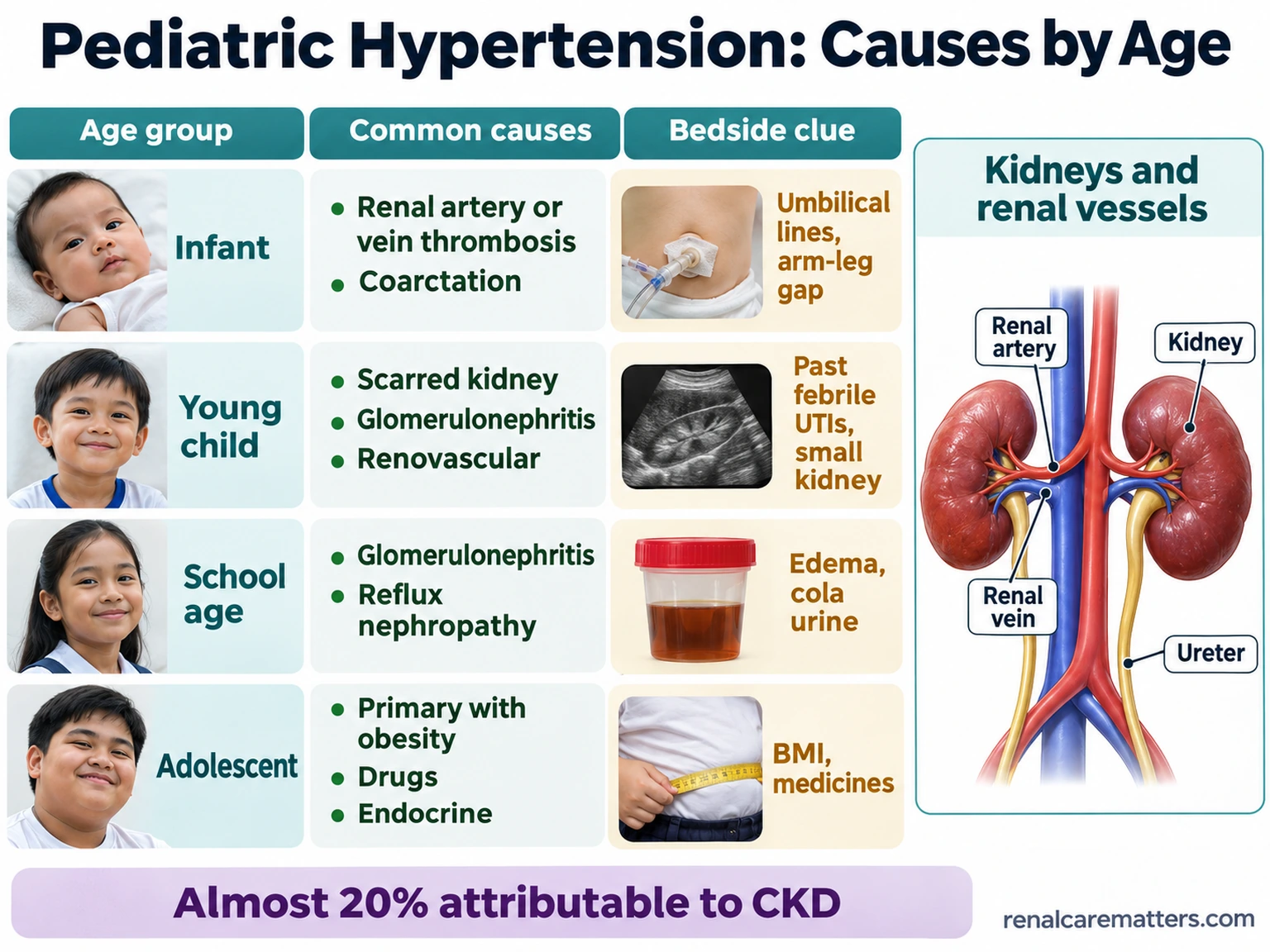
Secondary hypertension is relatively more common in children than in adults, and renal disease is a more common cause in younger children, as the AAP guideline notes; almost 20% of pediatric hypertension may be attributable to CKD.1 The guideline advises a high index of suspicion for renal and renovascular disease, particularly under age 6, and suggests that children and adolescents 6 years and older do not need an extensive search for secondary causes if they have a positive family history of hypertension, are overweight or obese, and have no history or examination findings that suggest a secondary cause (grade C, moderate).1 It advises suspecting renovascular hypertension in selected children with stage 2 hypertension.1
The mechanisms are worth tracing. A scarred or ischemic kidney releases renin; angiotensin II constricts arterioles and drives aldosterone, and the pressure rises with a high-renin pattern. A kidney with fewer working nephrons retains sodium and water, and the pressure rises with volume. A narrowed aorta (coarctation) raises pressure in the arms and lowers it in the legs. Endocrine tumors add catecholamines, cortisol or mineralocorticoid. Obesity adds sympathetic activity, insulin resistance and sodium retention.
Age
Causes to think of first
Clue at the bedside
Infant
Renal artery or venous thrombosis after umbilical catheters, coarctation, congenital anomalies of the kidney and urinary tract (CAKUT), bronchopulmonary dysplasia
History of umbilical lines; weak femoral pulses; arm-leg pressure gap
Edema, cola urine, proteinuria; obesity and family history
Adolescent
Primary hypertension with obesity; still renal disease, drugs (stimulants, steroids, oral contraceptives), endocrine causes
Body mass index, sleep apnea symptoms, medication and supplement history
The workup starts with a urinalysis, creatinine, electrolytes and a kidney ultrasound in almost every child, and grows with the clues. Echocardiography to look for left ventricular hypertrophy is recommended when medication is being considered (grade C, moderate).1 A strong family history does not exclude a secondary cause, especially in a child with stage 2 pressures and abnormal kidneys.
RememberMatch the search to the age and the clues. Under 6, or with stage 2 pressure and abnormal kidneys, assume a cause until you find one or exclude it.
In clinic · fictional
Bianca, 4, is referred for a pressure of 128/86 mm Hg found during a cough. Her height is at the 25th percentile. Her mother mentions two hospital admissions for “kidney infection” before age 2.
The pressure is above the 95th percentile on repeat. Her ultrasound shows a small, scarred right kidney, and you arrange a nuclear scan and an ABPM.
What this shows. In a young child, hypertension is a kidney question until proven otherwise.
Figure 2. The cause that fits the age. Renal and renovascular causes dominate in younger children; primary hypertension with obesity rises in adolescence.
Lesson · part 3
Acute severe hypertension: lower it slowly on purpose
Acute severe hypertension becomes an emergency when organs are being injured: encephalopathy (headache, vomiting, visual change, confusion, seizures), heart failure, or acute kidney injury. In children, posterior reversible encephalopathy can present with seizures and cortical blindness, and acute glomerulonephritis can cause encephalopathy at pressures that would seem moderate in an adult because the rise was sudden.
The danger in treatment is speed. In chronic hypertension the autoregulatory range has shifted upward. A fast fall below that range lowers flow to the brain, retina and kidney. The AAP recommends immediate treatment with short-acting antihypertensive medication for acute severe hypertension with life-threatening symptoms, reducing the pressure by no more than 25% of the planned reduction over the first 8 hours (expert opinion, grade D; weak recommendation).1 The grade tells you this is careful clinical consensus rather than trial evidence; the physiology behind it is well established.
Phase
Physiology
What the attending does
First minutes
Organs at risk from the pressure
Confirm the reading; look for encephalopathy, heart failure, kidney injury; secure monitoring and intravenous access
First 8 hours
Autoregulation shifted upward; fast falls cause ischemia
Titratable intravenous agent per pediatric formulary in a monitored bed; no more than a quarter of the planned reduction
Next 1–2 days
Range begins to readjust
Continue gradual lowering toward the target; start oral therapy
After
Cause still present
Complete the workup; set the long-term target
Choose an agent whose effect can be titrated and stopped, given in a bed with frequent pressure monitoring, ideally a pediatric intensive care unit. Avoid drugs whose fall in pressure cannot be predicted or reversed. The specific drugs and doses come from your unit’s pediatric formulary. In a volume-overloaded child with glomerulonephritis, removing salt and water may matter more than any vasodilator.
Stop and call
Blood pressure at stage 2 levels with headache, vomiting, visual change, confusion or seizure
Signs of heart failure or pulmonary edema
Pressure falling faster than the written plan, or new neurological signs during treatment
No monitored bed available for intravenous treatment
RememberIn a hypertensive emergency, write the target for the first 8 hours as a number, and make it a quarter of the way, not the whole way.
Lesson · part 4
Targets in children with CKD: ESCAPE and KDIGO
ESCAPE. The Effect of Strict Blood Pressure Control and ACE Inhibition on the Progression of CRF in Pediatric Patients (ESCAPE) trial randomized 385 children aged 3 to 18 with an estimated glomerular filtration rate (GFR) of 15 to 80 mL/min per 1.73 m², all receiving a fixed high dose of an angiotensin-converting enzyme (ACE) inhibitor after a 6-month run-in, to intensified control (target 24-hour mean arterial pressure [MAP] below the 50th percentile) or conventional control (50th to 95th percentile), with other antihypertensives added as needed. Over 5 years, 29.9% of the intensified group and 41.7% of the conventional group reached the primary end point of a 50% fall in GFR or kidney failure (hazard ratio 0.65, 95% confidence interval 0.44 to 0.94). Adverse events and withdrawals did not differ significantly (28.0% versus 26.5%). Proteinuria fell by about half and then gradually rebounded despite good pressure control.2 In absolute terms, about 12 fewer children per 100 reached the end point over 5 years, roughly one for every 8 or 9 treated to the lower target. The end point is a hard kidney outcome, not a surrogate. The trial was in European and other centers with reliable ABPM; it does not tell you the effect of lowering clinic pressure alone.
KDIGO. The Kidney Disease: Improving Global Outcomes (KDIGO) 2021 blood pressure guideline suggests that in children with chronic kidney disease (CKD), 24-hour MAP by ABPM be lowered to the 50th percentile or below for age, sex and height (2C).3 Its ungraded practice points suggest ABPM once a year and standardized auscultatory office readings every 3 to 6 months; when ABPM is unavailable, targeting an office systolic pressure below the 90th percentile is a reasonable approach; and an ACE inhibitor or angiotensin receptor blocker (ARB) is first-line, with attention to hyperkalemia and to fetal risk in adolescents who could become pregnant.3 The KDIGO 2024 CKD guideline keeps the 24-hour MAP target below the 50th percentile and, where ABPM is unavailable, suggests a manually measured systolic pressure at the 50th to 75th percentile.4,5 Note the difference between the two office targets: the newer guideline’s office target is lower. Both rest on ESCAPE, which used ambulatory MAP, so the office figures are extrapolations.
Source
Target
Grade or status
AAP 2017, children with hypertension
<90th percentile and <130/80 mm Hg from age 13
Grade C, moderate
KDIGO 2021, children with CKD
24-hour MAP ≤50th percentile by ABPM
2C
KDIGO 2021, no ABPM
Office systolic <90th percentile
Practice point (ungraded)
KDIGO 2024, no ABPM
Manual systolic at 50th–75th percentile
As stated in KDIGO pediatric summary
ESCAPE
24-hour MAP <50th percentile
randomized controlled trial (RCT): 29.9% vs 41.7% reached end point at 5 years
The AAP treatment goal for children with hypertension generally is below the 90th percentile and below 130/80 mm Hg from age 13 (grade C, moderate).1 For children with CKD, the lower ambulatory target has the trial behind it.
ABPM is not available in every Philippine province. When it is not, measure carefully in clinic, teach home measurement with a validated device and a correctly sized cuff, and send the child for ABPM at the nearest center at least once a year if the family can manage the trip.
RememberIn a child with CKD, the target is ambulatory: a 24-hour MAP at or below the 50th percentile. Office readings are a fallback, not the goal.
Figure 3. Lower ambulatory pressure, fewer kidneys lost. In ESCAPE, about 12 fewer children per 100 reached a 50% GFR fall or kidney failure over 5 years.
On the floor
Real situations: problems and solutions
These are fictional but typical. For each one, cover the answer, decide what you would do, then compare. Where a step depends on local rules, your unit’s procedure and your supervisor’s direction come first.
The anxious teenager in clinic
What you see
A 15-year-old girl has readings of 142/88 mm Hg at three clinic visits, but her mother’s home readings with a validated device are normal.
What is likely going on
White-coat hypertension is likely; masked or true hypertension has not been excluded.
What to do
Arrange ABPM. If mean pressures and loads are normal, label white-coat hypertension and monitor rather than treat.
Why it matters
Treating clinic readings alone exposes a healthy adolescent to years of unnecessary medicine.
The child with CKD whose clinic pressure is perfect
What you see
A 10-year-old with CKD stage 3 has clinic pressures at the 60th percentile, but his left ventricle is thick on echocardiography.
What is likely going on
Masked or nocturnal hypertension.
What to do
Arrange ABPM; treat to a 24-hour MAP at or below the 50th percentile if it is high.
Why it matters
Children with CKD often fail to dip at night, and clinic readings miss it.
The post-streptococcal child who seized
What you see
An 8-year-old with cola-colored urine, edema and a pressure of 150/100 mm Hg has a seizure in the ward.
What is likely going on
Hypertensive encephalopathy from sudden-onset, volume-driven hypertension in acute glomerulonephritis.
What to do
Treat the seizure, move to a monitored bed, lower pressure with a titratable agent per formulary, and remove salt and water; plan the first 8 hours explicitly.
Why it matters
Sudden rises cause encephalopathy at lower pressures than chronic hypertension; volume control is part of the treatment.
The adolescent girl on an ACE inhibitor
What you see
A 16-year-old with reflux nephropathy is well controlled on an ACE inhibitor and has a new boyfriend.
What is likely going on
ACE inhibitors and ARBs carry fetal risk.
What to do
Talk with her privately about contraception and pregnancy plans, document it, and agree on what she will do if she becomes pregnant.
Why it matters
KDIGO lists fetal risk among the cautions for first-line agents; the conversation is part of safe prescribing.
Field notes
Keep a printed AAP percentile table or the site’s calculator open in every clinic room.
Write the cuff size used next to every pediatric blood pressure you record.
In an emergency, write the 8-hour pressure target on the order sheet as a number.
Teach families to bring home readings to clinic; a phone photo of the device screen is enough.
Case review
Back to the case: The headache in the emergency room
Emergency, and how fast. Yes. Stage 2 pressure with headache, vomiting and blurred vision is acute severe hypertension with signs of encephalopathy and a kidney that is already impaired. He needs a monitored bed and a titratable intravenous agent from the pediatric formulary, not a single oral dose and not 120/80 within the hour. His scarred kidney suggests long-standing hypertension with a shifted autoregulatory range. Plan a reduction of no more than a quarter of the planned fall over the first 8 hours, then continue gradually over the next one to two days, watching vision and consciousness.
The likely cause. A small, scarred left kidney beside a larger right kidney, with a history of untreated febrile urinary infections, points to reflux nephropathy with renin-mediated hypertension and CKD. His father’s hypertension does not explain stage 2 pressures and scarred kidneys at 14. Look for proteinuria quantity, electrolytes, a nuclear scan of differential function, an echocardiogram for left ventricular hypertrophy, and fundoscopy. Consider renovascular disease if the picture does not fit, as the AAP suggests for selected children with stage 2 hypertension.
The long-term target. He has CKD, so aim for a 24-hour MAP at or below the 50th percentile on ABPM, as ESCAPE tested and KDIGO 2021 suggests (2C). An ACE inhibitor or ARB is first-line once his potassium and creatinine allow, with monitoring. Arrange ABPM at least yearly, home readings with a correctly sized cuff in between, and growth, urine protein and kidney function at each visit. Explain to Mrs. Aquino that lowering his pressure steadily is the best-proven way to protect his remaining kidney.
Skills lab · with your preceptor
Skills checklist: Hypertension in children
Complete with a preceptor, in simulation or at your own unit. Sign-off is local. Your preceptor rates each step as satisfactory, needs practice, or not observed. Steps marked Critical must all be satisfactory before sign-off. This checklist supports supervised learning; your unit’s own procedure and competency form are the authority. A printable version of every checklist is on the trainer page.
Classifies blood pressure by AAP 2017 categories for a child under 13 and an adolescent
Fits and interprets an ABPM, including white-coat, masked and non-dipping patterns
Writes a first-8-hour plan for acute severe hypertension that limits the fall to a quarter of the planned reduction
Sets a CKD blood pressure target with its source and grade, and a monitoring schedule
Placement activity. Outpatient clinic, emergency department or simulation
Self-assessment
Check your understanding
Each visit draws 5 questions at random from this module’s 5-question bank. Choose the single best answer for each, then select Check answers; an explanation appears under the best answer. Select New set of questions for a different mix. A good target is 4 of 5 on two different sets. Nothing you select is sent anywhere; scoring happens in your browser.
Flynn, J. T., Kaelber, D. C., Baker-Smith, C. M., Blowey, D., Carroll, A. E., Daniels, S. R., de Ferranti, S. D., Dionne, J. M., Falkner, B., Flinn, S. K., Gidding, S. S., Goodwin, C., Leu, M. G., Powers, M. E., Rea, C., Samuels, J., Simasek, M., Thaker, V. V., Urbina, E. M., & Subcommittee on Screening and Management of High Blood Pressure in Children. (2017). Clinical practice guideline for screening and management of high blood pressure in children and adolescents. Pediatrics, 140(3), e20171904. https://doi.org/10.1542/peds.2017-1904
ESCAPE Trial Group, Wühl, E., Trivelli, A., Picca, S., Litwin, M., Peco-Antic, A., Zurowska, A., Testa, S., Jankauskiene, A., Emre, S., Caldas-Afonso, A., Anarat, A., Niaudet, P., Mir, S., Bakkaloglu, A., Enke, B., Montini, G., Wingen, A. M., Sallay, P., ... Schaefer, F. (2009). Strict blood-pressure control and progression of renal failure in children. The New England Journal of Medicine, 361(17), 1639–1650. https://doi.org/10.1056/NEJMoa0902066
Kidney Disease: Improving Global Outcomes (KDIGO) Blood Pressure Work Group. (2021). KDIGO 2021 clinical practice guideline for the management of blood pressure in chronic kidney disease. Kidney International, 99(3S), S1–S87. https://doi.org/10.1016/j.kint.2020.11.003
Kidney Disease: Improving Global Outcomes (KDIGO) CKD Work Group. (2024). KDIGO 2024 clinical practice guideline for the evaluation and management of chronic kidney disease. Kidney International, 105(4S), S117–S314. https://doi.org/10.1016/j.kint.2023.10.018
Educational material for physicians. Completing it is an Academy learning record only. It does not confer CPD units, PNSP or board certification, privileges, or PhilHealth accreditation, and it does not replace current guidelines, regulations, your institution’s pediatric protocols and formulary, or clinical judgment.