Stage neonatal AKI against a falling maternal creatinine, steward nephrotoxins, and dialyze the newborn when you must.
PublishedNailathalaGipatikPepalwal:ReferencesMga SanggunianMga TinubdanReng Reperensya:8Audience: Pediatric nephrologists · pediatric nephrology fellows · adult nephrologists, intensivists and neonatologists who share kidney care for children in the clinic, ward, NICU, PICU, dialysis unit and homeRead timeOras ng pagbasaOras sa pagbasaOras ning pamamasa:
Training track for attending pediatric nephrologists
This module is study material for attending pediatric nephrologists and fellows. It explains the reasoning behind common decisions; it is not a protocol and it gives no doses. Doses, fill volumes and thresholds must come from current pediatric guidelines, product labels, your institution’s approved pediatric protocols and a pediatric pharmacist. Benefit rules change: confirm them on the date of service. Every case is fictional.
Learning objectives
After this module you should be able to
Interpret serum creatinine and urine output in the first weeks of life, accounting for maternal creatinine, gestational age and immature tubular function, and stage neonatal Acute kidney injury (AKI) with the neonatal modified Kidney Disease: Improving Global Outcomes (KDIGO) criteria.
Lead nephrotoxin stewardship in the neonatal intensive care unit, using the AWAKEN and Baby NINJA evidence with its limits.
Choose kidney replacement for a newborn when it is needed, from acute peritoneal dialysis to small-infant machines, within what your hospital can safely deliver.
Pre-testBefore you read, answer the 5 self-assessment questions and note your score. After the module, select New set of questions and compare. The difference is what you learned; the questions you still miss are what to reread.
Start here
The big picture, in plain words
Your role · the consultant the neonatal intensive care unit (NICU) callsIn most Philippine hospitals the neonatologist owns the baby and you are the consultant who is asked, often late, whether a creatinine “is normal for a preemie.” Your duty is to read the number against the baby’s age, to name acute kidney injury (AKI) when it is present, to change the drug chart with the neonatologist and pharmacist, and to plan dialysis honestly when it is needed and possible. You also own the follow-up of a kidney that started life short of nephrons.
In plain wordsThink of a newborn’s creatinine as the water level in a tank that was filled by the mother. At birth the level is the mother’s; over the next days it should drain as the baby’s own kidneys open the outlet. A level that stops falling, or rises, means the outlet is blocked.
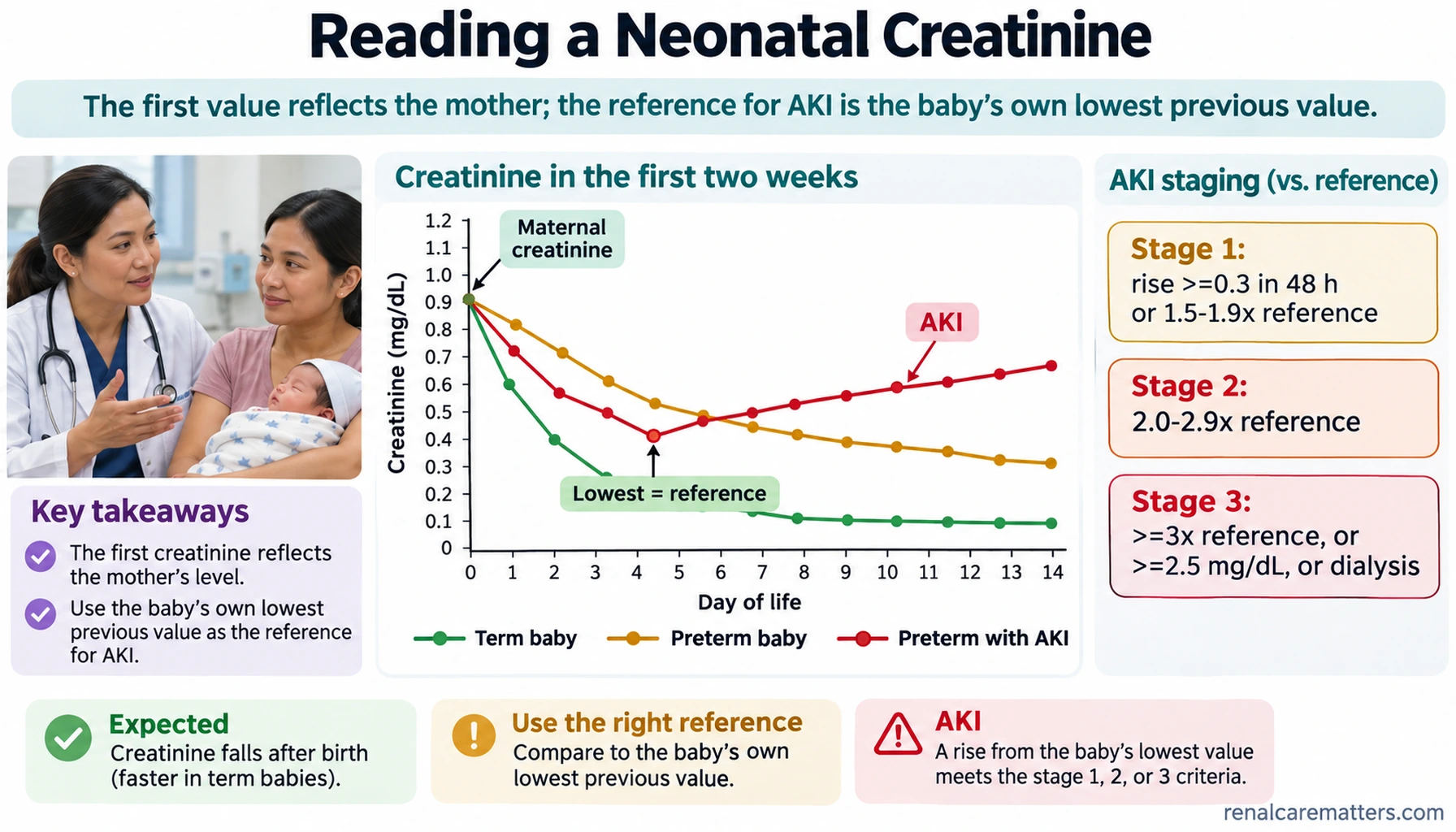
The picture has a limit. The outlet does not open at a fixed speed. A baby born at 28 weeks drains far more slowly than a term baby, and in the first days the preterm creatinine can even rise a little as the immature tubule reabsorbs creatinine back into the blood. So you judge each value against the baby’s own previous lowest value and gestational age, not against an adult range and not against a single number.
Figure 1 · Key numbers
Neonatal AKI, stage 1 (neonatal modified KDIGO)Creatinine rise ≥0.3 mg/dL within 48 h, or 1.5–1.9 times the lowest previous value within 7 days
Stage 3≥3 times the lowest previous value, or creatinine ≥2.5 mg/dL, or dialysis
AWAKEN (2,022 NICU infants)AKI in 29.9%; adjusted odds of death 4.6
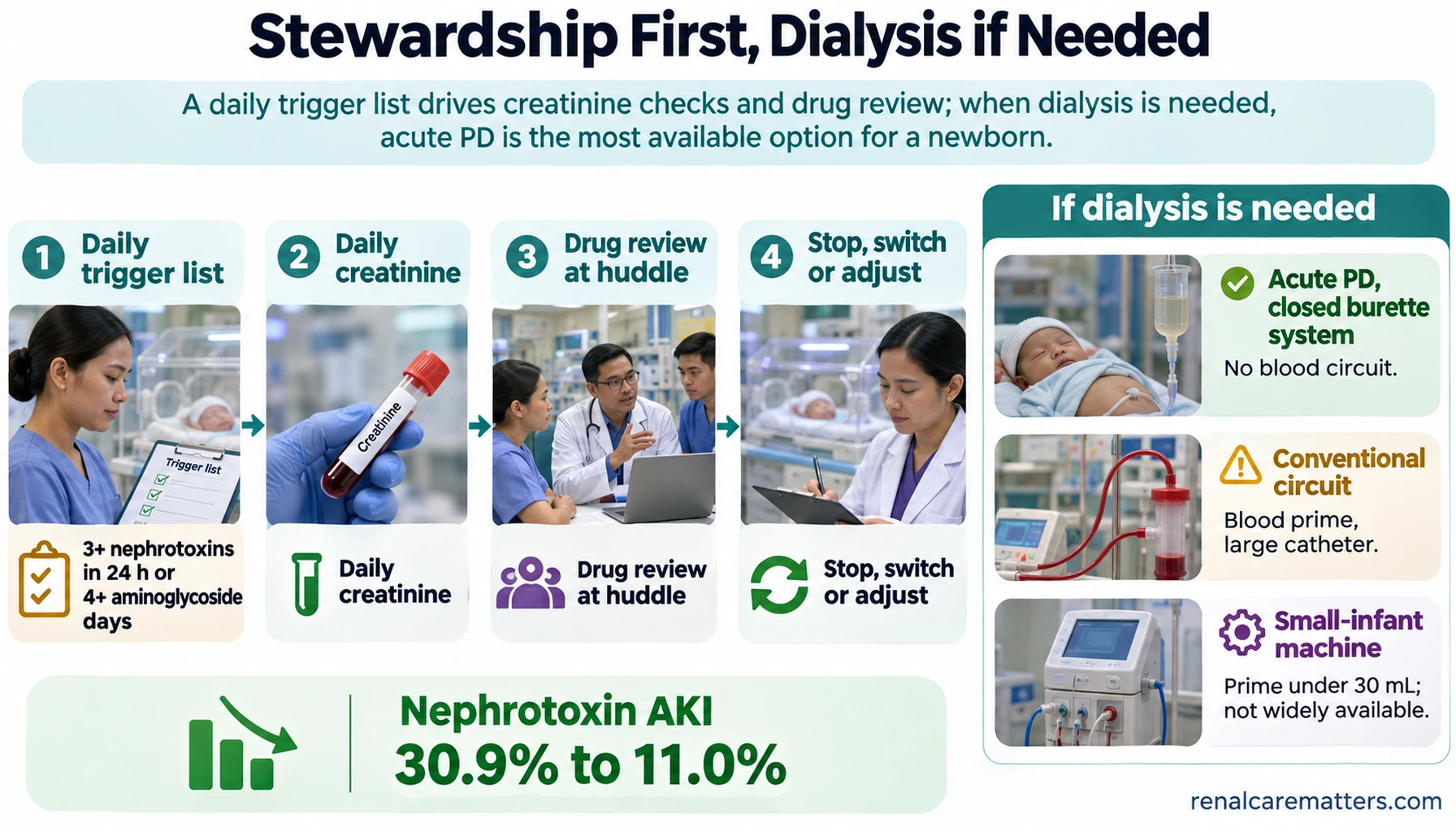
Baby NINJA (single-center quality project)Nephrotoxin-associated AKI 30.9% to 11.0%
CARPEDIEM machineCircuit priming volume under 30 mL
Most neonatal AKI is nonoliguric, multifactorial and quiet, and it is found only by someone who looks at the creatinine trend and the drug chart together. A few babies need dialysis, usually peritoneal. Your work is to make the creatinine mean something, to remove the avoidable injuries, and to have a realistic plan for the baby who will not recover without help.
Opening case · fictional
Case: Day 9 in the NICU
It is day 9 in the NICU of a tertiary government hospital in Davao City. Baby Boy Dela Cruz was born at 28 weeks weighing 1,050 g after preterm labor. He is on noninvasive respiratory support and caffeine. A course of ibuprofen for a patent ductus arteriosus ended on day 7. He has been on gentamicin for 8 days and vancomycin for 5 days for suspected late-onset sepsis; the blood culture remains negative.
His creatinine was 1.1 mg/dL on day 1, fell to 0.8 mg/dL on day 4, and is 1.4 mg/dL today. His urine output over the last 24 hours was 0.8 mL/kg per hour; it was above 2 mL/kg per hour last week. His weight is up 90 g in two days, and his sodium is 129 mmol/L. The neonatologist calls you: “Preemies always have high creatinine. Is this just the mother’s? And can we keep the gentamicin until tomorrow’s level?” His father, a seafarer, joins the mother on a video call from abroad and asks whether his son’s kidneys are failing.
Before reading on, decide:
Is this AKI, and what stage?
What should change on the drug chart today, and how will you make that stick in this NICU?
If he needed kidney replacement, what could your hospital offer a 1 kg baby, and what would you tell the parents?
Keep your answers in mind. The lesson gives you what you need, and the case review near the end shows one sound response.
Lesson · part 1
The newborn kidney
Nephrogenesis continues until about 34 to 36 weeks of gestation. A baby born at 28 weeks is born mid-construction: nephrons continue to form for a short time after birth, but the final number is often lower, and the deepest, oldest nephrons carry most of the early filtration. After birth, glomerular filtration rises as systemic pressure climbs, renal vascular resistance falls and renal blood flow increases. That rise is slower the more preterm the baby.1
Creatinine crosses the placenta, so the creatinine at birth reflects the mother’s. A term baby clears it over the first week or two. A very preterm baby clears it more slowly, and the immature tubule can reabsorb creatinine, so values in the first days may rise slightly before they fall. That is why the neonatal criteria use the baby’s lowest previous value as the reference, and why a single creatinine in the first 48 hours tells you more about the mother than the baby.1
The newborn tubule is also immature. Fractional excretion of sodium is high in preterm babies at baseline, so a high value does not prove tubular injury and a single fractional excretion of sodium (FENa) is hard to read. The concentrating ability is limited, so urine output may stay normal or high while filtration falls; nonoliguric AKI is common. Sodium handling is fragile in both directions.
Neonatal AKI has typical causes: perinatal asphyxia and low perfusion, sepsis, cardiac surgery, necrotizing enterocolitis, and drugs. Indomethacin and ibuprofen constrict the afferent arteriole by blocking prostaglandins on which neonatal renal blood flow depends. Aminoglycosides accumulate in proximal tubular cells. Vancomycin adds tubular toxicity, especially with an aminoglycoside. Each exposure adds to the last.
Feature of the newborn kidney
Consequence
What you see at the bedside
Maternal creatinine at birth
Day 1 value reflects the mother
A “high” first creatinine that falls over days
Slow glomerular filtration rate (GFR) maturation in preterm babies
Creatinine falls slowly; drugs clear slowly
Higher values for longer; prolonged drug levels
Tubular creatinine back-leak early on
Small early rises can be physiologic
A modest rise in the first days in a very preterm baby
High baseline sodium excretion
FENa is hard to interpret; hyponatremia is common
Low sodium with normal urine output
Prostaglandin-dependent renal blood flow
Nonsteroidal anti-inflammatory drugs (NSAIDs) lower GFR
Falling urine output after ibuprofen or indomethacin for a ductus
Limited concentrating ability
Nonoliguric AKI
Rising creatinine with “good” urine output
RememberRead every neonatal creatinine against the baby’s own lowest previous value and gestational age. The trend is the test.
On a teleconsult, the “high” first value · fictional
A pediatrician in a provincial hospital in Samar messages you about a term baby, born yesterday, with a creatinine of 1.0 mg/dL. The baby is feeding, passing urine and well.
You ask for the mother’s creatinine and a repeat on day 3. The mother’s is 0.9 mg/dL; the baby’s falls to 0.6 mg/dL by day 3.
What this shows. A first-day value is the mother’s report card. Judge the baby by the direction of travel.
Lesson · part 2
Staging neonatal AKI
The Kidney Disease: Improving Global Outcomes (KDIGO) 2012 AKI definition was built mainly for older patients.2 The neonatal modified KDIGO criteria, set out by the group that formed the Neonatal Kidney Collaborative, keep the structure but change two things: the reference creatinine is the lowest previous value, and the absolute creatinine for stage 3 is 2.5 mg/dL instead of 4.0 mg/dL, because a neonatal creatinine of 2.5 mg/dL already corresponds to a very low GFR.1
Stage
Serum creatinine (neonatal modified KDIGO)
What it usually means clinically
0
No change, or a rise of less than 0.3 mg/dL
No AKI by creatinine; keep watching drug exposures
1
Rise of ≥0.3 mg/dL within 48 h, or 1.5–1.9 times the lowest previous value within 7 days
Early injury; often reversible if the cause is removed
2
2.0–2.9 times the lowest previous value
Significant loss of function; drug dosing must change
3
≥3 times the lowest previous value, or ≥2.5 mg/dL, or receipt of dialysis
Severe AKI; fluid and electrolyte balance at risk; think about dialysis
Urine output criteria in neonates are less settled. Published versions differ, and several set the oliguria threshold higher than in older children, because newborns normally pass more urine per kilogram. AWAKEN used urine output below 1 mL/kg per hour on postnatal days 2 to 7 as its urine criterion.3 Use the version your NICU has adopted, and measure urine properly: weighed diapers, recorded at fixed times, are the usual method in a ward without catheters.
Two traps. First, a baby whose creatinine has stopped falling may have AKI before it rises, because the expected fall did not happen. Second, fluid overload dilutes creatinine and can hide AKI; weight gain and hyponatremia, as in the case, are warnings.
Figure 2 · Reading a neonatal creatinine
Find the referenceThe lowest creatinine recorded so far, not the day 1 value.
CompareRise of ≥0.3 mg/dL in 48 h or ≥1.5 times the reference in 7 days is stage 1 or more.
Check the expected courseA value that has stopped falling in a baby who should be clearing maternal creatinine deserves the same attention.
Add urine output and weightWeighed diapers at fixed times; weight gain can dilute creatinine.
Look at the drug chartAminoglycoside, vancomycin, ibuprofen or indomethacin, contrast, other nephrotoxins.
Write the stageRecord the stage, the reference value and the date in the chart.
RememberName the stage, write down the reference value, and say which drugs and exposures are contributing. A stage without a cause is only half a consultation.
At the morning NICU round, a creatinine that stopped falling · fictional
A 31-week baby in Cagayan de Oro had creatinine values of 1.0, 0.9 and 0.9 mg/dL on days 2, 5 and 8. The resident reports that there is no AKI because the value never rose. The baby has had a week of amikacin and a course of indomethacin.
You point out that at 31 weeks the creatinine should still be falling, look at the diaper weights (lower than last week), and ask for a review of both drugs and a repeat in 48 hours.
What this shows. In a newborn, a plateau can be the first sign of injury. The expected course is part of the reference.
Figure 3. Reading a neonatal creatinine. The first value reflects the mother; the reference for AKI is the baby’s own lowest previous value.
Lesson · part 3
What the evidence shows
How common, and how dangerous. The Assessment of Worldwide Acute Kidney Injury Epidemiology in Neonates (AWAKEN) study screened 4,273 babies admitted to 24 NICUs in Australia, Canada, India and the United States in early 2014 and included 2,022. AKI occurred in 605 (29.9%): 47.9% of babies born at 22 to under 29 weeks, 18.3% at 29 to under 36 weeks, and 36.7% at 36 weeks or more. Death occurred in 9.7% of babies with AKI and 1.4% without; after adjustment, the odds of death were 4.6 times higher (95% confidence interval 2.5 to 8.3), and hospital stay was 8.8 days longer.3 AWAKEN was observational. It shows that AKI marks babies at high risk; it does not prove that preventing AKI would save those lives, because sicker babies have both.
Can nephrotoxic AKI be prevented? Baby NINJA (Nephrotoxic Injury Negated by Just-in-Time Action) was a single-center quality improvement project in a level intravenous (IV) NICU from 2015 to 2017. Babies with high-risk exposure, defined as three or more nephrotoxic drugs within 24 hours or four or more calendar days of an intravenous aminoglycoside, had daily creatinine until two days after the exposure or the AKI ended. Comparing the initiation and sustainability eras, high-risk exposures fell from 16.4 to 9.6 per 1,000 patient-days, the proportion of AKI attributable to nephrotoxins fell from 30.9% to 11.0%, and AKI intensity fell from 9.1 to 2.9 days per 100 susceptible patient-days; the authors estimated 100 AKI episodes prevented in 18 months.4 A before-and-after design at one well-resourced center is vulnerable to secular trends, and long-term kidney outcomes were not measured. The finding that matters for you is that a simple surveillance rule, run by pharmacists and nurses, changed exposure.
Caffeine. In a secondary analysis of AWAKEN including 675 babies born before 33 weeks, AKI in the first 7 days occurred in 11.2% of those who received caffeine and 31.6% of those who did not; the adjusted odds ratio was 0.20 (0.11 to 0.34).5 Caffeine is given for apnea, not for the kidney, and babies who receive it may differ from those who do not in ways the adjustment cannot capture. The study supports caffeine’s safety for the kidney and suggests a protective effect, possibly through adenosine-receptor blockade and afferent vasodilation; it does not justify caffeine as a kidney drug.
Study
Design and size
Main finding
What it does not show
AWAKEN
Observational, 24 NICUs, 2,022 babies
AKI 29.9%; adjusted odds ratio (OR) for death 4.6
That preventing AKI lowers mortality
Baby NINJA
Single-center before-and-after quality project
Nephrotoxin-associated AKI 30.9% to 11.0%
Long-term kidney outcomes; generalizability to low-resource NICUs
Caffeine and AKI (AWAKEN secondary analysis)
Observational, 675 babies under 33 weeks
AKI 11.2% vs 31.6%; adjusted OR 0.20
That caffeine should be given to protect the kidney
After discharge. KDIGO 2012 advises evaluating patients about 3 months after AKI for recovery or new CKD (ungraded).2 Babies born preterm, with or without AKI, start life with fewer nephrons, and the neonatal review calls for long-term follow-up of babies with AKI to find those who develop chronic kidney disease (CKD).1
RememberAKI marks the NICU babies who die, and nephrotoxin exposure is the part of it you can change. Count exposures every day.
Lesson · part 4
What the attending does
Make stewardship a system. You cannot round in every NICU every day. A rule can. Agree with the neonatologist and pharmacist on a daily trigger list (three or more nephrotoxins in 24 hours, or a fourth day of an intravenous aminoglycoside, as Baby NINJA used), a daily creatinine for flagged babies, and a standing question for each flagged baby: is each drug still needed, is there a less nephrotoxic option, and is the dose and interval adjusted to the current kidney function? Doses and levels come from the NICU formulary and pharmacist, not from you by phone.
Treat the AKI you find. Restore perfusion, stop or substitute nephrotoxins, adjust every renally cleared drug, restrict fluid to insensible losses plus output when the baby is overloaded, correct sodium slowly, watch potassium and calcium, and image the kidneys and bladder with ultrasound to exclude obstruction and structural disease. Protect nutrition; a starved baby catabolizes and raises potassium and urea.
Fluid and sodium. A baby with AKI and rising weight needs total fluid matched to insensible losses plus urine output, recalculated at least daily, with the neonatologist owning the nutrition plan inside that limit. Hyponatremia in a gaining baby is usually dilutional and is treated by restricting free water, not by adding sodium; hyponatremia in a baby losing weight with high urine sodium is tubular loss and needs sodium. Weights twice a day where the scale allows are the best single guide. Potassium-free fluids, calcium checks and early recognition of hyperkalemia (a squeezed heel stick can give a falsely high value) complete the basics.
Know when dialysis is needed. Refractory hyperkalemia or acidosis, fluid overload that compromises breathing or blocks nutrition, and severe uremia are the usual reasons. For a newborn, peritoneal dialysis (PD) is the most widely available option. The International Society for Peritoneal Dialysis (ISPD) 2020 pediatric acute PD guideline rates PD as a suitable therapy for AKI in children (1C), prefers a surgically placed Tenckhoff catheter (1B) with a Seldinger kit as an acceptable alternative (1C), allows improvised catheters only when nothing else is available (practice point), and notes that automated PD machines do not suit neonates because the fill volumes are too small (1D). For manual PD in small children it describes a closed system with burettes to measure fill and drain (practice point), and in neonates and small infants shorter cycles to achieve ultrafiltration (practice point).6 The fill, cycle and dextrose orders come from your unit’s protocol and the dialysis team.
Machines built for babies. Conventional hemodialysis and continuous kidney replacement therapy (CKRT) circuits hold a large volume relative to a newborn’s blood volume, so they usually need blood priming. Two machines were designed for small infants. The Cardio-Renal Pediatric Dialysis Emergency Machine (CARPEDIEM) has a priming volume under 30 mL and scales accurate to 1 g; its first patient was a 2.9 kg neonate with 65% fluid overload who survived.7 The Newcastle infant dialysis and ultrafiltration system (Nidus) dialyzed 10 babies weighing 1.8 to 5.9 kg for 2,475 hours without blood priming, through a single-lumen line, with clearances of about 1.5 to 2.0 mL/min against 0.2 to 0.8 mL/min with PD.8 Both reports are small and from expert centers; neither machine is generally available in the Philippines. Module 16 discusses them with CKRT.
Option for a newborn
Strength
Limitation in a Philippine NICU
Acute PD, manual, closed system with burettes
No blood circuit, no anticoagulation, gentle fluid removal
Needs a catheter and nurses trained in neonatal exchanges; leaks; abdominal surgery or necrotizing enterocolitis (NEC) may preclude it
Acute PD with improvised catheter
Possible when nothing else exists
Higher leak and infection risk; a last resort per ISPD
Conventional CKRT or hemodialysis
Precise clearance in larger infants
Blood priming, large catheter relative to vessel size, hypotension at connection
Small-infant machines (CARPEDIEM, Nidus)
Small circuit, precise fluid control
Not widely available; experience limited to expert centers
Talk to the family honestly. Parents of a 1 kg baby need to hear what AKI means for their child now, what is being changed, what dialysis would involve and whether it is realistically available here, and that many babies with mild AKI recover. When dialysis is not feasible or not in the baby’s interest, say so with the neonatologist, and document the conversation.
Plan follow-up. At NICU discharge, write the AKI stage, the peak and discharge creatinine, the drug exposures and the follow-up: blood pressure, urinalysis for protein and creatinine at about 3 months and then periodically as the unit sets, with the family and the pediatrician told why.
At the NICU pharmacy desk · fictional
Pharmacist Anne Villanueva prints a list each morning of babies on three or more nephrotoxins or a fourth aminoglycoside day. On the first morning there are nine. You agree with the neonatologist to review each one at the 10 a.m. huddle.
By the end of the month the morning list has three names, and two babies have had gentamicin stopped on day 3 when cultures came back negative.
What this shows. A list printed every morning protects more kidneys than an expert called once.
Stop and call
Potassium rising despite treatment, or electrocardiogram (ECG) changes
Fluid overload limiting ventilation or feeding
Stage 3 AKI with anuria
Creatinine rising in a baby still on an aminoglycoside or vancomycin
Hyponatremia with seizures
RememberEvery NICU baby with AKI leaves with a stage, a list of exposures, a blood pressure and urine plan, and a named person who checks the kidney at about 3 months.
Figure 4. Stewardship first, dialysis if needed. A daily trigger list drives creatinine checks and drug review; when dialysis is needed, acute PD is the most available option for a newborn.
On the floor
Real situations: problems and solutions
These are fictional but typical. For each one, cover the answer, decide what you would do, then compare. Where a step depends on local rules, your unit’s procedure and your supervisor’s direction come first.
The asphyxiated term baby with “good urine”
What you see
A term baby after perinatal asphyxia in Iloilo has a creatinine that climbed from 0.9 to 1.6 mg/dL over three days. The nurses report normal diaper weights.
What is likely going on
Nonoliguric AKI from hypoxic-ischemic injury; the immature kidney cannot concentrate, so urine output stays up while filtration falls.
What to do
Stage it (1.8 times the lowest value, stage 1), review drugs and fluid, check sodium and potassium, and keep the daily creatinine going until it falls.
Why it matters
Normal urine output does not exclude AKI in a newborn.
The gentamicin level that will be back tomorrow
What you see
A neonatologist wants to continue gentamicin until a level returns, although the cultures are negative at 48 hours and the creatinine has risen.
What is likely going on
The habit of waiting for a level rather than asking whether the drug is needed.
What to do
Ask the indication question first: if sepsis is not supported, stopping is the safest level. If it is supported, the pharmacist adjusts the interval to current function.
Why it matters
Every extra aminoglycoside day adds tubular injury; stewardship starts with the indication, not the level.
The baby after cardiac surgery with a PD catheter in place
What you see
A 3 kg infant returns from cardiac surgery in Manila with a PD catheter placed in the operating room. Urine output is falling and weight is up 8%.
What is likely going on
The cardiac team planned for postoperative fluid overload, a common problem after bypass in infants.
What to do
Agree with the intensivist and surgeon on when the catheter will be used for drainage or dialysis, who orders it, and how fluid balance will be reviewed. See Module 16 for the trial evidence.
Why it matters
A catheter placed in theater only helps if someone owns the decision to use it.
Field notes
Ask for the mother’s creatinine when a first-day neonatal value worries anyone.
Write the reference creatinine and its date in every neonatal kidney consult note.
Ask the NICU to weigh diapers at fixed times so urine output is a number, not an impression.
Put “kidney follow-up at about 3 months” and the reason into the NICU discharge summary yourself.
Case review
Back to the case: Day 9 in the NICU
Is it AKI? Yes. His lowest previous creatinine is 0.8 mg/dL on day 4. A value of 1.4 mg/dL is 1.75 times that reference within 7 days, which is stage 1 by the neonatal modified KDIGO criteria. It is not maternal creatinine: his own kidneys had already lowered it, and it has turned upward. The fall in urine output, the weight gain and the low sodium suggest fluid retention that may be diluting the creatinine, so the true injury may be larger than the stage suggests.
The drug chart. He has had gentamicin for 8 days, vancomycin for 5, and ibuprofen until two days ago, with a negative blood culture. Ask the neonatologist whether the antibiotics are still needed; if sepsis is not supported, stop them today rather than wait for a level. If they are needed, ask the pharmacist to adjust dose and interval to his current function and to follow levels. Check daily creatinine, weighed diapers and sodium; restrict fluids to output and insensible losses if overloaded; order a kidney and bladder ultrasound. To make it stick, propose a daily trigger list run by the pharmacist, as in Baby NINJA.
If he needed dialysis. For a 1 kg baby the realistic option is acute PD with a closed, burette-measured manual system, if the abdomen allows and the NICU nurses are trained; conventional circuits would need blood priming and a large catheter, and small-infant machines are not generally available here. Tell his parents, including his father on the call, that his kidneys are injured but working, that the drugs that may be harming them are being reviewed today, that most mild injury in babies improves, and that if dialysis became necessary you would explain exactly what it involves and whether it is right for him.
Skills lab · with your preceptor
Skills checklist: The newborn kidney and neonatal AKI
Complete with a preceptor, in simulation or at your own unit. Sign-off is local. Your preceptor rates each step as satisfactory, needs practice, or not observed. Steps marked Critical must all be satisfactory before sign-off. This checklist supports supervised learning; your unit’s own procedure and competency form are the authority. A printable version of every checklist is on the trainer page.
Stages neonatal AKI from a creatinine series using the lowest previous value as reference
Reviews a NICU drug chart with the pharmacist and documents each nephrotoxin decision
Explains acute PD for a newborn to a nurse team, including closed burette systems and leak risk
Writes a NICU discharge kidney follow-up plan with stage, exposures and a 3-month review
Placement activity. Supervised NICU consultation or simulation
Self-assessment
Check your understanding
Each visit draws 5 questions at random from this module’s 5-question bank. Choose the single best answer for each, then select Check answers; an explanation appears under the best answer. Select New set of questions for a different mix. A good target is 4 of 5 on two different sets. Nothing you select is sent anywhere; scoring happens in your browser.
Selewski, D. T., Charlton, J. R., Jetton, J. G., Guillet, R., Mhanna, M. J., Askenazi, D. J., & Kent, A. L. (2015). Neonatal acute kidney injury. Pediatrics, 136(2), e463–e473. https://doi.org/10.1542/peds.2014-3819
Kidney Disease: Improving Global Outcomes (KDIGO) Acute Kidney Injury Work Group. (2012). KDIGO clinical practice guideline for acute kidney injury. Kidney International Supplements, 2(1), 1–138. https://doi.org/10.1038/kisup.2012.1
Jetton, J. G., Boohaker, L. J., Sethi, S. K., Wazir, S., Rohatgi, S., Soranno, D. E., Chishti, A. S., Woroniecki, R., Mammen, C., Swanson, J. R., Sridhar, S., Wong, C. S., Kupferman, J. C., Griffin, R. L., Askenazi, D. J., & Neonatal Kidney Collaborative. (2017). Incidence and outcomes of neonatal acute kidney injury (AWAKEN): A multicentre, multinational, observational cohort study. The Lancet Child & Adolescent Health, 1(3), 184–194. https://doi.org/10.1016/S2352-4642(17)30069-X
Stoops, C., Stone, S., Evans, E., Dill, L., Henderson, T., Griffin, R., Goldstein, S. L., Coghill, C., & Askenazi, D. J. (2019). Baby NINJA (Nephrotoxic Injury Negated by Just-in-Time Action): Reduction of nephrotoxic medication-associated acute kidney injury in the neonatal intensive care unit. The Journal of Pediatrics, 215, 223–228.e6. https://doi.org/10.1016/j.jpeds.2019.08.046
Harer, M. W., Askenazi, D. J., Boohaker, L. J., Carmody, J. B., Griffin, R. L., Guillet, R., Selewski, D. T., Swanson, J. R., Charlton, J. R., & Neonatal Kidney Collaborative. (2018). Association between early caffeine citrate administration and risk of acute kidney injury in preterm neonates: Results from the AWAKEN study. JAMA Pediatrics, 172(6), e180322. https://doi.org/10.1001/jamapediatrics.2018.0322
Nourse, P., Cullis, B., Finkelstein, F., Numanoglu, A., Warady, B., Antwi, S., & McCulloch, M. (2021). ISPD guidelines for peritoneal dialysis in acute kidney injury: 2020 update (paediatrics). Peritoneal Dialysis International, 41(2), 139–157. https://doi.org/10.1177/0896860820982120
Ronco, C., Garzotto, F., Brendolan, A., Zanella, M., Bellettato, M., Vedovato, S., Chiarenza, F., Ricci, Z., & Goldstein, S. L. (2014). Continuous renal replacement therapy in neonates and small infants: Development and first-in-human use of a miniaturised machine (CARPEDIEM). The Lancet, 383(9931), 1807–1813. https://doi.org/10.1016/S0140-6736(14)60799-6
Coulthard, M. G., Crosier, J., Griffiths, C., Smith, J., Drinnan, M., Whitaker, M., Beckwith, R., Matthews, J. N. S., Flecknell, P., & Lambert, H. J. (2014). Haemodialysing babies weighing <8 kg with the Newcastle infant dialysis and ultrafiltration system (Nidus): Comparison with peritoneal and conventional haemodialysis. Pediatric Nephrology, 29(10), 1873–1881. https://doi.org/10.1007/s00467-014-2923-3
Educational material for physicians. Completing it is an Academy learning record only. It does not confer CPD units, PNSP or board certification, privileges, or PhilHealth accreditation, and it does not replace current guidelines, regulations, your institution’s pediatric protocols and formulary, or clinical judgment.