Place the right catheter, scale the fill to the child, choose CAPD or APD, and judge adequacy by growth as well as Kt/V.
PublishedNailathalaGipatikPepalwal:ReferencesMga SanggunianMga TinubdanReng Reperensya:12Audience: Pediatric nephrologists · pediatric nephrology fellows · adult nephrologists, intensivists and neonatologists who share kidney care for children in the clinic, ward, NICU, PICU, dialysis unit and homeRead timeOras ng pagbasaOras sa pagbasaOras ning pamamasa:
Training track for attending pediatric nephrologists
This module is study material for attending pediatric nephrologists and fellows. It explains the reasoning behind common decisions; it is not a protocol and it gives no doses. Doses, fill volumes and thresholds must come from current pediatric guidelines, product labels, your institution’s approved pediatric protocols and a pediatric pharmacist. Benefit rules change: confirm them on the date of service. Every case is fictional.
Learning objectives
After this module you should be able to
Explain why peritoneal dialysis (PD) suits infants and small children, using the peritoneal membrane, the three-pore model and fill volume scaled to body surface area (BSA).
Plan the PD catheter with the surgeon (type, exit site, omentum, break-in) and recognize the early mechanical problems that threaten it.
Review a pediatric PD prescription each month against growth, blood pressure, fluid status and residual urine, treating Kt/V and creatinine clearance as surrogates.
Pre-testBefore you read, answer the 5 self-assessment questions and note your score. After the module, select New set of questions and compare. The difference is what you learned; the questions you still miss are what to reread.
Start here
The big picture, in plain words
Your role · the PD prescriber of recordYou decide with the family that a small child will start peritoneal dialysis (PD), you agree the catheter plan with the pediatric surgeon, and you write and sign the prescription. In a Philippine Health Insurance Corporation (PhilHealth)-contracted PD program you are also the attending pediatric nephrologist named on the pediatric checklist, so the prescription you write is the one the claim must match, never the reverse.
In plain wordsThink of the peritoneum as a sponge-lined room. You pour a measured amount of clean water into the room, let it sit while the walls trade waste for water, then pour it out. A bigger room needs more water to wet all the walls; a small room floods if you pour too much.
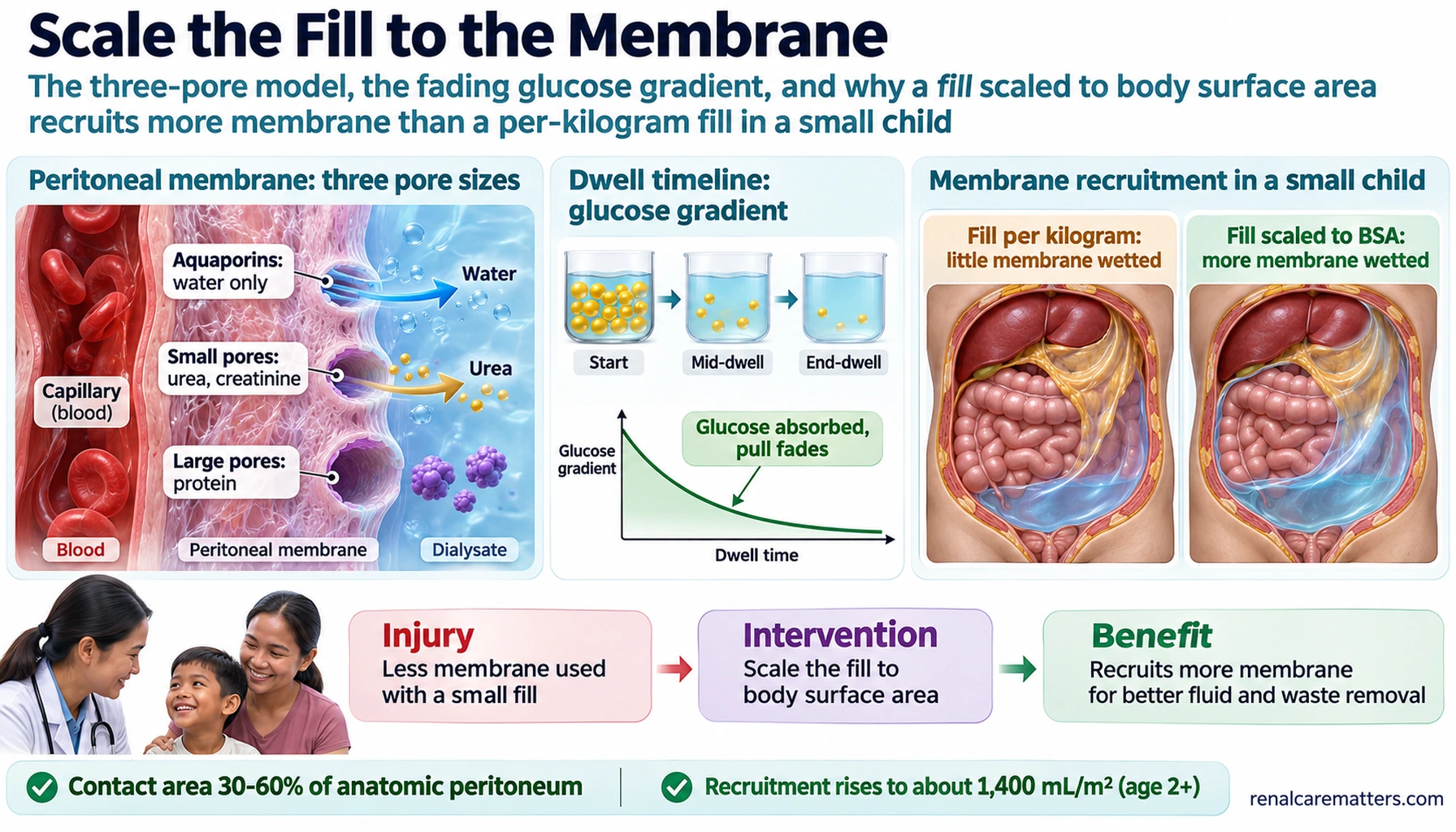
The picture has a limit. The walls of this room are living tissue. Only part of the anatomic peritoneum touches the fluid at any moment, and how much it touches depends on posture and on how much fluid you put in. The membrane is a bed of capillaries with pores of three sizes, and glucose in the fluid leaks away into the blood, so the pull that draws water out fades with every hour of the dwell. A child’s peritoneum is large relative to body weight but similar to an adult’s relative to body surface area (BSA), which is why pediatric fill volumes are scaled to BSA and not simply to kilograms.1
Figure 1 · Key numbers
Fill volume scalingScale the exchange to BSA (mL/m²), raised by tolerance and intraperitoneal pressure (IPP) [Fischbach and Warady 2009]
Children older than 2 yearsFill raised stepwise toward an upper limit of about 1,200–1,400 mL/m² for a night exchange [same source]
InfantsFill volumes of 600–900 mL/m², IPP ideally below 10 cm H₂O [European Pediatric Dialysis Working Group 2013]
Tolerated IPPNormal 7–14 cm H₂O; upper tolerated limit 18 cm H₂O [Fischbach and Warady 2009]
PD catheter revisions, International Pediatric Peritoneal Dialysis Network (IPPN) registry13% of 2,453 children; 60% for mechanical malfunction
These are ranges described by expert groups, not orders. Your unit’s pediatric PD protocol and your own bedside assessment set the actual fill, dwell and solution for each child.
Most small children start PD without trouble once the catheter has healed and the fill is matched to their size. A few leak, drain poorly or fail to grow on numbers that look adequate. Your work is to put the right catheter in the right place, scale the prescription to the child, and judge it every month by how the child grows and how the fluid balances, not by a Kt/V alone.
Opening case · fictional
Case: The leak on day two
Althea Ramos is 10 months old and weighs 7 kg. She has renal dysplasia, and over the past month her urine output has fallen and her potassium has risen. Two days ago a pediatric surgeon at a tertiary government hospital in Manila placed a PD catheter under general anesthesia. Because her potassium was 6.4 mmol/L and she was gaining weight, the team started small-volume manual exchanges within 24 hours.
At 6 a.m. the night nurse calls you. The dressing is soaked with clear fluid that tests positive for glucose. The drain volumes are smaller than the fills, and Althea cries during filling. The nurse asks, “Doctor, can we give a bigger fill so we get more out? The drains are so small.” Her mother, Rowena, came from Tarlac with Althea’s grandmother. She asks whether this means the catheter has failed and whether her baby will need to go on the machine with blood.
Before reading on, decide:
What is happening at the exit site, and what will you change now?
Why is a bigger fill the wrong answer this morning?
What will you tell Rowena, and what will you review before Althea goes home?
Keep your answers in mind. The lesson gives you what you need, and the case review near the end shows one sound response.
Lesson · part 1
Why PD fits a small child
Infants and small children have no good vein for long-term hemodialysis (HD), a circuit that holds a large share of their blood volume, and a blood pressure that falls easily when fluid is removed quickly. PD avoids all three. It uses the child’s own peritoneum, needs no blood outside the body, runs at home, and removes fluid slowly over many hours. The European Pediatric Dialysis Working Group names PD the preferred kidney replacement therapy (KRT) in infants (graded 1B in its system based on the Kidney Disease Outcomes Quality Initiative [KDOQI]) and notes that it preserves the veins and the residual urine output.2
The membrane. Water and solutes cross the capillary wall through pores of three sizes. The three-pore model describes them: ultrasmall pores (aquaporins) that let water through without sodium, small pores that carry most diffusion of urea and creatinine, and a few large pores that let protein leak.1 Two forces move solute and water. Diffusion follows the concentration gradient, so urea leaves the blood early in a dwell. Ultrafiltration follows the pressure gradient, which glucose creates and then loses as it is absorbed.
Contact area. Only 30–60% of the anatomic peritoneum touches the fluid at a time, as measured by computed tomography (CT) in humans. Recruitment of surface rises with fill volume, until the fill is close to 1,400 mL/m² in children 2 years and older, and is greater lying down.1 A small fill wets a small part of the membrane.
The infant illusion. Small children were once thought to have a “leaky” membrane, because their test exchanges equilibrated fast and lost ultrafiltration early. Fischbach and Warady explain this as a geometry problem: a fill prescribed per kilogram is small relative to a large membrane, so solute equilibrates fast, glucose is absorbed fast and the osmotic pull disappears. Scaling the fill to BSA removes most of the apparent difference between infants, children and adults.1
Pressure. Fluid in the abdomen raises intraperitoneal pressure (IPP). Above a certain pressure the child feels pain and breathlessness, fluid is pushed into the abdominal wall and along the catheter tunnel, lymphatic absorption rises and net ultrafiltration falls. The same review lists pain, dyspnea, hydrothorax, hernia, reflux with poor appetite and loss of ultrafiltration as harms of an excessive fill.1
Mechanism
What it means in a child
What you see
Membrane area similar to adults per m² of BSA
Fill per kilogram underfills the membrane
Fast equilibration, poor ultrafiltration, “high transporter” label on a test done with too small a fill
Recruitment rises with fill and supine posture
Night exchanges lying down tolerate larger fills
Better clearance on night cycles than on the day dwell at the same volume
Glucose absorbed during the dwell
The osmotic pull fades with time
Long day dwells drain less than they took in
IPP rises with volume
Each child has a tolerance limit
Crying at fill, grunting, vomiting, leak, hernia
Urea diffuses fast, phosphate slowly
Short dwells clear urea, long dwells clear phosphate
Good Kt/V with a high phosphate on fast cycling
RememberScale the fill to the child’s surface area and check it against the child’s tolerance. Volume is the first lever, not the last.
At a test exchange · fictional
A 4-year-old boy, Kian, is labeled a high transporter after a peritoneal equilibration test (PET). You check the record: the test fill was the same per-kilogram fill used when he started PD at 13 months.
You ask the nurse to repeat the test with the fill the unit protocol sets for a PET, scaled to his BSA. His transport falls into the average range, and his day dwell is changed.
What this shows. A PET is only as valid as its fill volume. Fischbach and Warady describe a test fill of about 1,000–1,100 mL/m² as the most valid in children beyond infancy.1
Figure 2. Scale the fill to the membrane. The three-pore model, the fading glucose gradient, and why a fill scaled to body surface area recruits more membrane than a per-kilogram fill in a small child.
Lesson · part 2
The catheter: the child’s lifeline for years
A PD catheter in a child may need to last until transplant, and a child who loses PD access early may lose PD altogether. In the IPPN registry, 452 access revisions occurred in 321 of 2,453 children (13%) over 3,134 patient-years, a rate of 0.14 per treatment year. Among new patients, 83% of revisions came in the first year. Mechanical malfunction caused 60% of revisions, peritonitis 16%, exit-site infection 12% and leakage 6%. Younger age, congenital anomalies of the kidney and urinary tract (CAKUT), ostomies, and a swan-neck tunnel with a curled intraperitoneal segment were associated with revision, and needing a revision was associated with more technique failure or death (hazard ratio 1.35).3 This is registry evidence; the catheter-design finding is an association, and the children who received each design differed in other ways.
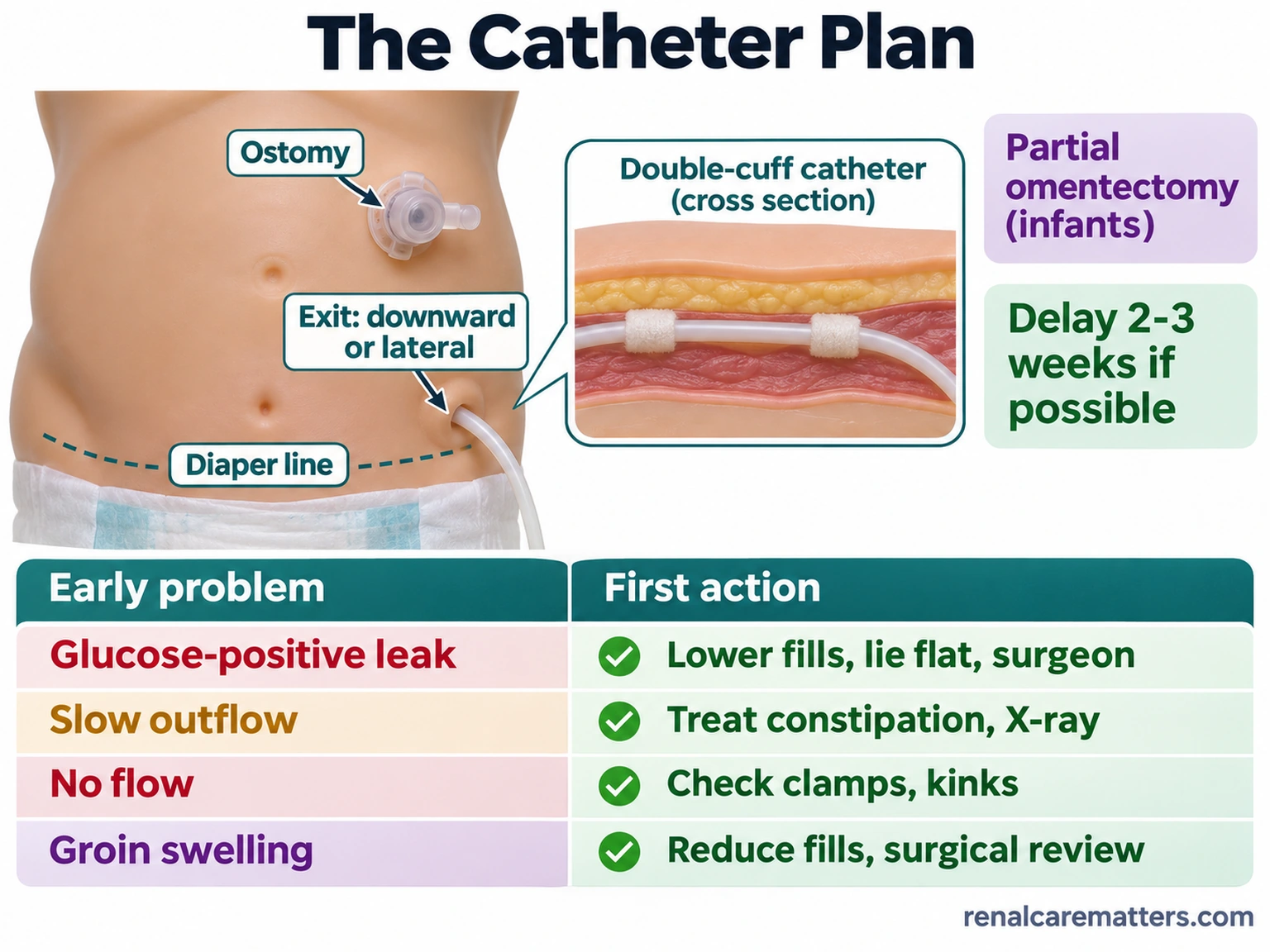
What the guidelines suggest. The 2024 international pediatric guideline on PD-associated infections suggests a double-cuff catheter with a downward or lateral exit site (2D, a weak suggestion on very low-quality evidence).4 For infants, the European Pediatric Dialysis Working Group recommends surgical insertion with partial omentectomy, an exit site away from the diaper area and from any ostomy, immobilization of the catheter, and, where possible, a delay of 2–3 weeks before dialysis so the wound can heal (1C). It notes that omentectomy is recommended because blockage is common in infants, although its preventive value is unproven, that most centers use single-cuff catheters below 3 kg and double-cuff catheters at 3–10 kg, and that fibrin glue at the inner cuff has reduced leaks in one report.2
Your part in the operating plan. The surgeon places the catheter; you set the requirements. Mark the exit site with the family before surgery, with the child sitting and lying, away from the diaper line, a gastrostomy, a vesicostomy or a future stoma. Ask for contralateral hernia repair if a hernia is present. Agree who dresses the site and when, and who decides the first use.
Break-in and urgent start. Early use is a trade. In the Standardizing Care to Improve Outcomes in Pediatric End Stage Kidney Disease (SCOPE) collaborative, 98 of 1,106 catheters (8.4%) were followed by peritonitis within 60 days of insertion; early use of the catheter was associated with this early-onset peritonitis, and use before the first year of life, first catheters, exit-site sutures and early dressing changes were associated with early use.5 A Cochrane review of 16 mostly adult studies found that starting PD within 2 weeks of insertion may increase dialysate leak (one randomized trial of 122 participants: 210 more leaks per 1,000, low certainty); effects on infection, technique and patient survival were uncertain.6 Urgent-start PD still saves lives when no other KRT fits: in a 2023 outbreak of Shiga toxin–producing E. coli hemolytic uremic syndrome (HUS) in Canada, nine children were dialyzed by urgent-start PD on general wards, beginning with low fills that were increased as tolerated, and all recovered kidney function.7 That is a nine-child case series, not a comparison.
Early problem
Likely mechanism
What you do first
Clear fluid at the exit site, glucose-positive
Pericatheter leak from early use or high IPP
Stop or reduce fills as the protocol allows, lie the child flat, consider a pause or temporary HD; never a bigger fill
Inflow fast, outflow slow
Constipation, catheter tip displaced, omentum, fibrin
Treat constipation, abdominal X-ray for tip position, heparinized flush per protocol
No inflow or outflow
Kink, clamp, clot
Check the line and clamps; surgical review if not resolved
Scrotal or labial swelling
Patent processus vaginalis or hernia
Reduce fills, surgical review
Bleeding or bloody effluent after insertion
Operative bleeding
Rapid in-and-out flushes per protocol; hemoglobin; surgeon
RememberThe catheter is placed once and used for years. Choose the exit site with the family, protect the first weeks, and treat every leak as a pressure problem.
Figure 3. The catheter plan. Where the exit site goes in an infant, what the guidelines suggest, and the first action for a leak, a slow drain, a blocked line and a hernia.
Lesson · part 3
Building the prescription for a growing child
A PD prescription has five levers: fill volume, dwell time, number of exchanges, total time on dialysis, and the solution. Each moves something different. The prescription aims at two goals at once: enough ultrafiltration to keep the child euvolemic, and enough removal of solute, not urea alone, to allow growth and bone health.1
Continuous ambulatory PD (CAPD) or automated PD (APD). In CAPD the family does several manual exchanges by day and leaves a long night dwell. In APD a cycler does short exchanges at night, often with a day dwell. Most children worldwide receive APD, because a full abdomen is better tolerated lying down, short dwells limit reabsorption, and night treatment leaves the day free for school and the parents’ work.1 Fischbach and Warady describe an initial APD dwell of about 1 hour as typical, to be revised for the child’s growth, residual function and membrane.1
Infants. The infant recommendations describe lower fills (600–900 mL/m²), shorter dwells (30–40 minutes), more exchanges (12–16) and longer sessions (10–16 hours) than in older children, with the daytime fill about half the night fill, and recommend individualizing the prescription to urine output and nutrition (1B).2 Very small fills bring their own problems: cycler alarms and a tubing recirculation volume that is large compared with the fill. Infants under about 2–3 kg with fills below 100 mL are usually dialyzed manually in hospital.2
Solutions and glucose. Use the lowest glucose that achieves the ultrafiltration the child needs, and prefer biocompatible solutions with neutral pH and low glucose degradation products where available; the infant recommendations grade this 1B, while noting that no infant trial compares solutions.2 Icodextrin, a glucose polymer that keeps its osmotic pull for many hours, helps the long day dwell; it should be used with caution in infants because of reported hyponatremia and rebound hypoglycemia.2 In the IPPN registry, icodextrin was used in 724 of 3,573 children (20.3%) on APD with a day dwell; children who started it within the first year had better blood pressure and slower loss of residual function than glucose-only matched children, and late starters had a higher risk of technique failure or death than early starters (hazard ratio 5.16).8 This was a propensity-matched observational analysis and does not prove that early icodextrin causes the better outcomes.
Sodium. Frequent short exchanges remove water with little sodium, because aquaporins move water without salt early in the dwell. Infants with salt-losing dysplasia lose more sodium in urine. Many infants need sodium supplements, which may help growth, and serum sodium reflects sodium status poorly.2 A low sodium, poor weight gain and a low blood pressure in an infant on PD point to salt depletion, not to a need for less dialysis.
Short: urea and water; long: creatinine and phosphate
Phosphate, net ultrafiltration of the day dwell
Number of exchanges and hours
Total clearance
Sleep, family fatigue, cost of solution
Glucose concentration
Ultrafiltration
Blood sugar, weight gain from absorbed glucose, membrane injury over time
Icodextrin for the long dwell
Sustained ultrafiltration
Sodium and glucose in infants, rash, residual urine
Sodium supplement
Extracellular volume and growth in salt-losing infants
Weight gain, blood pressure, edema
On a monthly review · fictional
Ezekiel, 3 years old on nightly APD, has a weekly Kt/V that the nurse calls “excellent”, but his phosphate is high and his height is falling across centiles. His cycler runs many short exchanges and no day dwell.
You add a day dwell within the unit’s protocol and ask the dietitian to review his phosphate intake. His phosphate settles over two months.
What this shows. Short dwells clear urea well and phosphate poorly. The time needed for phosphate to equilibrate is three to four times that for urea.1
RememberEach lever moves something different. Name the problem first (fluid, urea, phosphate, sodium, comfort) and then move the lever that fixes it.
Lesson · part 4
What the evidence shows, and how firm it is
Pediatric PD rests on expert consensus, physiology and registries. There are almost no randomized trials, so most recommendations carry grade 1C to 2D in the systems their authors use, or no grade at all. Read each one for what it is.
Fill volume and pressure. The scaling of fill to BSA, the 1,200–1,400 mL/m² upper range in children over 2, the suggested upper fill of 800 mL/m² (or 30–50 mL/kg) in infants under 2 with tolerance as the deciding factor, and the IPP values come from physiological studies and a narrative review, not from trials.1 They are reasonable starting rules, and tolerance in the individual child overrides them.
Transport, dialysis dose and growth. In a prospective cohort of 51 children followed for 18 months, a faster creatinine equilibration on the first PET correlated with less gain in height standard deviation score (SDS) (r = −0.31), and higher dialytic creatinine clearance was associated with better height gain.9 The effects were modest (partial r² 0.07 and 0.11) and the design cannot show that changing the prescription changes growth. It is still one of the few studies to link PD mechanics to the outcome children and parents care about.
Adequacy numbers. Weekly Kt/V (urea clearance scaled to body water) and weekly creatinine clearance are surrogates. Infants on frequent short exchanges often show a high Kt/V with a low creatinine clearance; the infant recommendations accept this if the child is biochemically stable and growing, and name appropriate growth and development as the most important measure of adequacy (1C).2 The 2020 International Society for Peritoneal Dialysis (ISPD) recommendations on prescribing high-quality goal-directed PD moved away from solute targets toward person-centered goals reached by shared decision-making, and labeled their statements practice points rather than graded recommendations, as a United States commentary by the Kidney Disease Outcomes Quality Initiative (KDOQI) explains.10 This module therefore gives no pediatric Kt/V target. Follow your unit’s protocol for measurement and thresholds, and read the number next to the growth chart.
Catheter outcomes. IPPN registry data show catheter survival in new patients of 84% at 12 months and 73% at 48 months.3 SCOPE data link early use with early peritonitis.5 Both are observational.
Coverage. Under PhilHealth Circular 2024-0036, the Z benefits package for PD covers CAPD for children and, for automated PD, a pilot in selected facilities. The package defines coverage in tiers of solution bags per day, plus catheter insertion and PD initiation, exit-site and peritonitis prevention care, outpatient treatment of PD peritonitis, and monthly monitoring.11 The pediatric APD pilot was extended to July 31, 2026 by Advisory 2026-0013; its status after that date is unresolved, so confirm it with your PhilHealth liaison before promising a family APD coverage.12 A coverage tier is not a prescription. Prescribe what the child needs, document it truthfully, and confirm the benefit on the date of service.
RememberIn pediatric PD, most rules are expert consensus. Quote the grade with the source and let the child’s growth decide.
Lesson · part 5
What the attending reviews every month
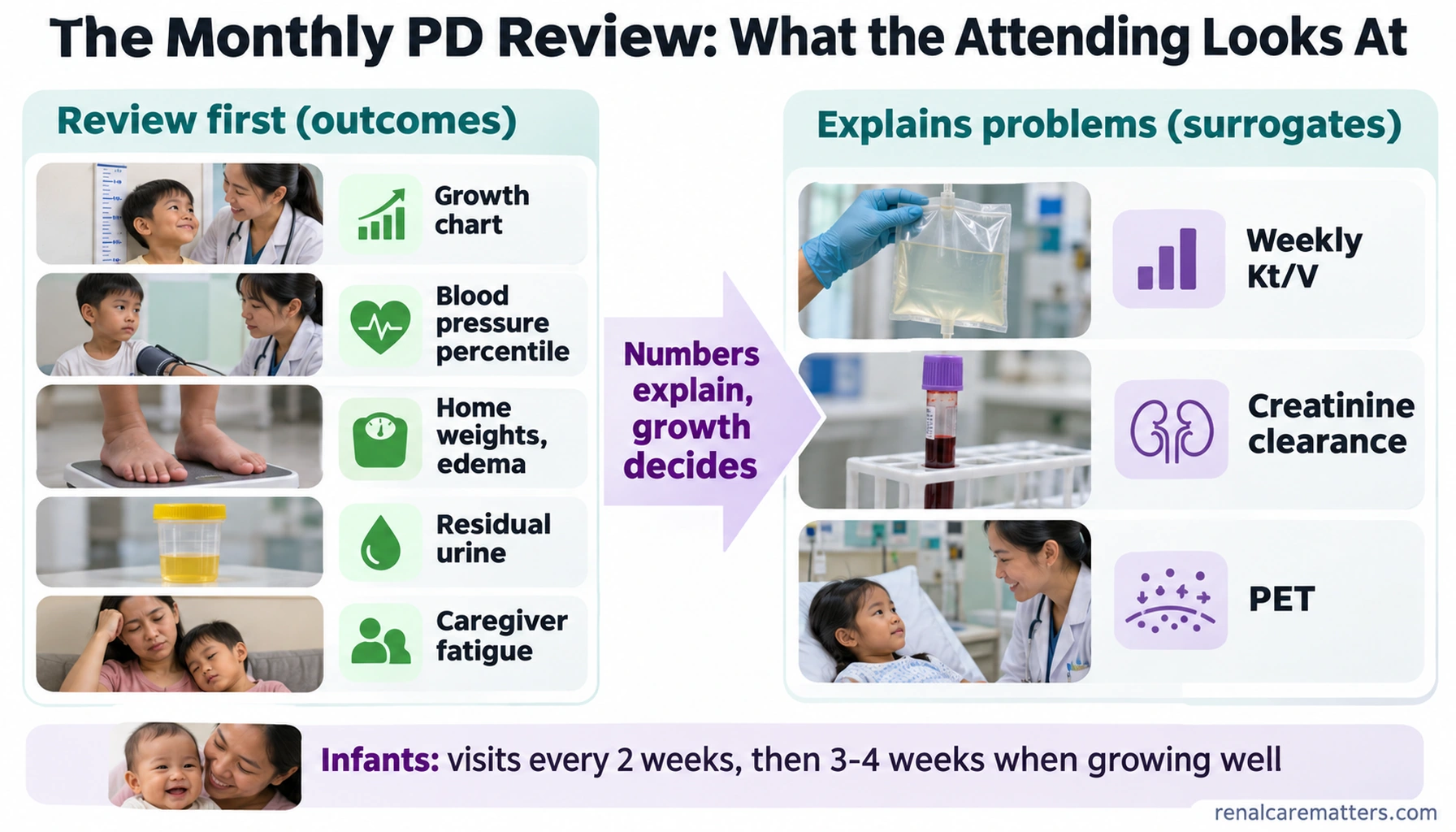
The monthly review is where the prescription is tested. The infant recommendations describe visits every two weeks for young infants, extended to every 3–4 weeks in older infants who are growing well, with weight, length and head circumference plotted at each visit and daily home records of weight, blood pressure, urine output, ultrafiltration and feeds.2 In a Philippine program the review often happens partly by phone or Viber with photographs of the home log; make sure the face-to-face visits still happen at the interval your unit sets.
What you review
Why it matters
What makes you change something
Growth chart: weight, length or height, head circumference in infants
The outcome that matters most in a small child
Falling height SDS, weight gain that is fluid not tissue
Blood pressure against percentiles, edema, home weights
Fluid status and cardiovascular risk
Rising pressure, edema, weight jumps between visits
Residual urine volume
Clearance and fluid allowance; it helps feeding
Falling output: re-check fluid allowance and nephrotoxins
Home log: fill, drain and net ultrafiltration by exchange; alarms
Low sodium in an infant, high phosphate on fast cycling, low potassium
Kt/V and creatinine clearance, PET when indicated
Surrogates that explain a problem
A discrepancy that fits poor growth or poor phosphate control
Exit site photograph and score
Infection prevention
Any score above zero (see Module 22)
Feeding route and dietitian plan
Most infants need tube feeds to grow
Vomiting, reflux, poor intake
The caregiver
The family is the dialysis unit at home
Exhaustion, missed exchanges, money for transport and solutions
Figure 4 · When a small child’s PD is not working
Name the problemFluid overload, poor clearance, poor growth, leak, poor drain, or the family cannot cope.
Rule out mechanics firstConstipation, catheter position, kinks, leaks. A poor drain is not a membrane problem until proven otherwise.
Check the fill against BSA and toleranceToo small a fill looks like a fast membrane; too large a fill leaks and is reabsorbed.
Match dwell to the soluteShort dwells for water and urea, a long dwell for phosphate and creatinine.
Look at sodium and residual urineSalt-losing infants need sodium; a falling urine output changes the whole fluid plan.
Write the change and the date to re-checkOne change at a time, with the measure that will show it worked.
By Viber, Sunday night · fictional
A father in Batangas sends a photograph of his son’s cycler log: three “low drain” alarms and a net ultrafiltration that has dropped by half. The boy has not passed stool in three days.
You advise the unit’s constipation plan for PD, ask the father to log the next two nights and send the drain volumes, and book an abdominal X-ray if drains do not recover.
What this shows. Constipation is the commonest reversible cause of poor drainage. Treat it before anyone blames the membrane.
RememberReview growth, fluid and the family before the numbers. A Kt/V explains a problem; it does not prove there is none.
Stop and call
Fluid leaking at the exit site or swelling of the abdominal wall, scrotum or labia
Breathlessness or a pleural effusion on a child on PD (possible hydrothorax)
Cloudy effluent, abdominal pain or fever (see Module 22)
No outflow after constipation is treated
An infant with falling sodium, poor feeding or weight loss
Figure 5. The monthly PD review. Outcomes first, surrogates second: what the attending looks at each month and what makes the prescription change.
On the floor
Real situations: problems and solutions
These are fictional but typical. For each one, cover the answer, decide what you would do, then compare. Where a step depends on local rules, your unit’s procedure and your supervisor’s direction come first.
The fill that matches the weight, not the child
What you see
A 2-year-old on APD has poor ultrafiltration and is labeled a high transporter. The prescription still uses the per-kilogram fill written when she started at 8 months.
What is likely going on
The fill has not kept pace with her growth. A small fill on a large membrane equilibrates fast and loses its osmotic pull early.
What to do
Calculate her BSA, compare the fill with the range in your unit protocol, and raise it stepwise while the nurse records comfort and, where available, intraperitoneal pressure. Repeat the PET with a protocol fill before relabeling her membrane.
Why it matters
Prescriptions written for a baby are often left unchanged as the child grows. Every monthly review should re-check the fill against the current BSA.
The gastrostomy request
What you see
A dietitian asks for a gastrostomy in an infant who has been on PD for four months and is not gaining weight.
What is likely going on
Placing a gastrostomy after PD has started carries a high risk of peritonitis, including fungal peritonitis.
What to do
Discuss with the surgeon and the infection team. If the tube is still needed, plan an open procedure with antibiotic and antifungal cover as your protocol directs, and ask why feeding was not secured before PD began.
Why it matters
The infant recommendations advise placing a gastrostomy before or at the same time as the PD catheter whenever possible.
The cycler that alarms every night
What you see
A mother in Laguna reports four or five low-drain alarms every night and is sleeping two hours a night.
What is likely going on
Constipation, catheter tip migration or a fill too small for the cycler's sensing are the usual causes. Exhaustion will soon cause errors.
What to do
Treat constipation first, get an abdominal X-ray if alarms persist, check that the fill and tubing suit the cycler, and ask the PD nurse to visit or video-call during a night session.
Why it matters
Repeated alarms are a mechanical problem and a safety problem. A tired caregiver is more likely to touch-contaminate a connection.
The family that wants APD now
What you see
Parents read that PhilHealth covers APD for children and ask to switch from CAPD next month.
What is likely going on
Pediatric APD coverage began as a pilot at selected facilities, extended to July 31, 2026; the status after that date is unresolved.
What to do
Explain the clinical reasons for or against APD for their child, confirm the coverage with the PhilHealth liaison and the program coordinator, and document the clinical decision separately from the coverage answer.
Why it matters
Families should hear the clinical plan and the coverage facts as two different things.
Field notes
Write the BSA and the date it was calculated at the top of every PD prescription.
Mark the exit site with a skin pen with the child sitting and lying, before the child goes to theater.
Ask families to photograph the home log every week and send it before the clinic visit.
When drains fall, ask about stools before anything else.
Case review
Back to the case: The leak on day two
The exit site. Glucose-positive clear fluid at the exit site is dialysate: a pericatheter leak in a catheter used within a day of insertion, in a 7 kg infant whose abdominal wall has not healed. Leaks are a known cost of early use, and the infant recommendations favor waiting 2–3 weeks where possible. Stop or reduce the fills as your protocol allows, keep her flat and dressed with a sterile dressing, and decide with the surgeon whether to rest the catheter. If her potassium or fluid status cannot wait, temporary HD or a short pause with medical management of potassium may be safer than pushing fluid through a leaking tunnel. Document the leak; a leak raises the risk of tunnel infection and peritonitis.
Why not a bigger fill. Small drains in this setting do not mean too little dialysis. Fluid is escaping through the tunnel and the abdominal wall, and she cries at filling because the pressure is already above her tolerance. A larger fill raises IPP further, widens the leak, can cause a hernia and is partly absorbed by lymphatics, so the net drain may fall. In infants the expert range is 600–900 mL/m² with IPP ideally below 10 cm H₂O, and the fill is raised slowly once the catheter has healed and only as the child tolerates it.
Rowena. Tell her plainly: the catheter has not failed. A leak in the first days is common in babies, it usually seals if the catheter rests, and PD remains the best dialysis for a baby Althea’s size. If a few HD sessions are needed while the wound heals, say so and explain why. Before discharge, review a home plan you can check every month: her growth chart, home weights and blood pressure, urine output, drain log, sodium and feeding plan, the exit site, and how Rowena and the grandmother will share the night work. Confirm the PhilHealth PD package enrollment with the program coordinator, and do not let the coverage tier decide her prescription.
Skills lab · with your preceptor
Skills checklist: Pediatric PD: access, membrane and prescription
Complete with a preceptor, in simulation or at your own unit. Sign-off is local. Your preceptor rates each step as satisfactory, needs practice, or not observed. Steps marked Critical must all be satisfactory before sign-off. This checklist supports supervised learning; your unit’s own procedure and competency form are the authority. A printable version of every checklist is on the trainer page.
Calculates BSA and states the fill-volume range the unit protocol uses for a given child
Marks a PD catheter exit site with the surgeon and family, away from diaper and ostomy sites
Distinguishes leak, constipation, malposition and membrane causes of poor drainage at the bedside
Leads a monthly PD review that starts with growth, blood pressure and fluid status
Placement activity. Pediatric PD unit or supervised clinic
Self-assessment
Check your understanding
Each visit draws 5 questions at random from this module’s 5-question bank. Choose the single best answer for each, then select Check answers; an explanation appears under the best answer. Select New set of questions for a different mix. A good target is 4 of 5 on two different sets. Nothing you select is sent anywhere; scoring happens in your browser.
Fischbach, M., & Warady, B. A. (2009). Peritoneal dialysis prescription in children: Bedside principles for optimal practice. Pediatric Nephrology, 24(9), 1633–1642. https://doi.org/10.1007/s00467-008-0979-7
Zurowska, A. M., Fischbach, M., Watson, A. R., Edefonti, A., Stefanidis, C. J., & European Paediatric Dialysis Working Group. (2013). Clinical practice recommendations for the care of infants with stage 5 chronic kidney disease (CKD5). Pediatric Nephrology, 28(9), 1739–1748. https://doi.org/10.1007/s00467-012-2300-z
Borzych-Duzalka, D., Aki, T. F., Azocar, M., White, C., Harvey, E., Mir, S., Adragna, M., Serdaroglu, E., Sinha, R., Samaille, C., Vanegas, J. J., Kari, J., Barbosa, L., Bagga, A., Galanti, M., Yavascan, O., Leozappa, G., Szczepanska, M., Vondrak, K., ... International Pediatric Peritoneal Dialysis Network (IPPN) Registry. (2017). Peritoneal dialysis access revision in children: Causes, interventions, and outcomes. Clinical Journal of the American Society of Nephrology, 12(1), 105–112. https://doi.org/10.2215/CJN.05270516
Warady, B. A., Same, R., Borzych-Duzalka, D., Neu, A. M., El Mikati, I., Mustafa, R. A., Begin, B., Nourse, P., Bakkaloglu, S. A., Chadha, V., Cano, F., Yap, H. K., Shen, Q., Newland, J., Verrina, E., Wirtz, A. L., Smith, V., & Schaefer, F. (2024). Clinical practice guideline for the prevention and management of peritoneal dialysis associated infections in children: 2024 update. Peritoneal Dialysis International, 44(5), 303–364. https://doi.org/10.1177/08968608241274096
Keswani, M., Redpath Mahon, A. C., Richardson, T., Rodean, J., Couloures, O., Martin, A., Blaszak, R. T., Warady, B. A., Neu, A., & SCOPE Investigators. (2019). Risk factors for early onset peritonitis: The SCOPE collaborative. Pediatric Nephrology, 34(8), 1387–1394. https://doi.org/10.1007/s00467-019-04248-0
Htay, H., Johnson, D. W., Craig, J. C., Teixeira-Pinto, A., Hawley, C. M., & Cho, Y. (2020). Urgent-start peritoneal dialysis versus conventional-start peritoneal dialysis for people with chronic kidney disease. Cochrane Database of Systematic Reviews, 12(12), CD012913. https://doi.org/10.1002/14651858.CD012913.pub2
Al Dhawi, N., Midgley, J. P., Hamiwka, L. A., Wade, A. W., Banks, A. M., Samuel, S. M., Archibald, A. J., & Grisaru, S. (2026). Urgent-start peritoneal dialysis in a large pediatric STEC-HUS outbreak: Clinical and operational rationale. Peritoneal Dialysis International. Advance online publication. https://doi.org/10.1177/08968608261434803
Khandelwal, P., Borzych-Dużałka, D., Hofstetter, J., Ranchin, B., Vondrak, K., Ahn, Y. H., Yap, H. K., Awad, H. S., Hooman, N., Erickson, R., Rebori, A., Kaur, A., Yuruk Yildirim, Z. N., Zhai, Y., Kari, J. A., Consolo, S., Chan, E. Y., Yap, Y. C., Szczepańska, M., ... Shroff, R. (2025). Early-start versus late-start icodextrin for children receiving chronic peritoneal dialysis: Findings from the International Pediatric Peritoneal Dialysis Network. Clinical Journal of the American Society of Nephrology, 20(12), 1729–1743. https://doi.org/10.2215/CJN.0000000837
Schaefer, F., Klaus, G., & Mehls, O. (1999). Peritoneal transport properties and dialysis dose affect growth and nutritional status in children on chronic peritoneal dialysis. Journal of the American Society of Nephrology, 10(8), 1786–1792. https://doi.org/10.1681/ASN.V1081786
Teitelbaum, I., Glickman, J., Neu, A., Neumann, J., Rivara, M. B., Shen, J., Wallace, E., Watnick, S., & Mehrotra, R. (2021). KDOQI US commentary on the 2020 ISPD practice recommendations for prescribing high-quality goal-directed peritoneal dialysis. American Journal of Kidney Diseases, 77(2), 157–171. https://doi.org/10.1053/j.ajkd.2020.09.010
Philippine Health Insurance Corporation. (2026). Extension of the pilot implementation of the Z benefits package for peritoneal dialysis (PD) covering automated PD in children (PhilHealth Advisory No. 2026-0013). https://www.philhealth.gov.ph/advisories/2026/PA2026-0013.pdf
Educational material for physicians. Completing it is an Academy learning record only. It does not confer CPD units, PNSP or board certification, privileges, or PhilHealth accreditation, and it does not replace current guidelines, regulations, your institution’s pediatric protocols and formulary, or clinical judgment.