Medicines, safeguarding, documentation and leading the service
Prescribe safely for a changing kidney, protect the child, document truthfully, transfer adolescents, and improve the service.
PublishedNailathalaGipatikPepalwal:ReferencesMga SanggunianMga TinubdanReng Reperensya:11Audience: Pediatric nephrologists · pediatric nephrology fellows · adult nephrologists, intensivists and neonatologists who share kidney care for children in the clinic, ward, NICU, PICU, dialysis unit and homeRead timeOras ng pagbasaOras sa pagbasaOras ning pamamasa:
Training track for attending pediatric nephrologists
This module is study material for attending pediatric nephrologists and fellows. It explains the reasoning behind common decisions; it is not a protocol and it gives no doses. Doses, fill volumes and thresholds must come from current pediatric guidelines, product labels, your institution’s approved pediatric protocols and a pediatric pharmacist. Benefit rules change: confirm them on the date of service. Every case is fictional.
Learning objectives
After this module you should be able to
Prescribe safely for a child whose kidneys, liver and body size are changing, and design the safeguards that prevent tenfold and formulation errors.
Recognize and act on a safeguarding concern as Philippine law requires, while keeping the child’s kidney care going.
Document truthfully for Philippine Health Insurance Corporation (PhilHealth), hand adolescents over to adult care with a closed loop, and lead a quality-improvement project with a run chart.
Pre-testBefore you read, answer the 5 self-assessment questions and note your score. After the module, select New set of questions and compare. The difference is what you learned; the questions you still miss are what to reread.
Start here
The big picture, in plain words
Your role · the physician whose name is on every pageThe attending pediatric nephrologist signs the prescriptions, the PhilHealth checklists, the transfer letters and, when it comes to that, the child protection report. Each signature is a statement of fact. In a service with few pediatric nephrologists, you are also the person who teaches the residents, sets the unit’s standards and watches its numbers. This module gathers the duties that sit behind every other module: medicines, protection, records, transition and improvement.
In plain wordsThink of a child’s care as a relay race. Every handoff, from doctor to pharmacist, from parent to school, from pediatric to adult clinic, is where the baton is dropped. The fastest runners lose if the handoffs fail.
The picture has a limit. In a relay, a dropped baton is obvious to everyone. In medicine, the dropped baton is often invisible: a decimal point in a liquid dose, bruises no one asks about, a checklist signed for services not given, a teenager who never reached the adult clinic. Nobody sees the drop until harm appears, sometimes months later. The attending’s job is to build handoffs that make the drop visible early.
Where potential adverse drug events began79% at the ordering stage; 34% involved incorrect dosing
Mandatory child-abuse reporting (DOJ rules, 1993)Within 48 hours, by the head of the hospital and the attending physician and nurse
Age of majority in the Philippines18 years
International Society for Peritoneal Dialysis (ISPD) 2022 peritonitis targets (a unit quality measure)No more than 0.40 episodes per year at risk; more than 80% of patients peritonitis-free per year
Most of the harm in this module is not dramatic. It comes from systems: a prescribing habit that allows a tenfold error, a clinic that never asks why a child stopped coming, a form filled in to satisfy a claim. A few situations are urgent: a child who appears to have been hurt, a child who is not being given dialysis at home. Your work is to make safe prescribing the default, to recognize and report abuse and neglect without abandoning the child’s care, to sign only what is true, and to measure the service so that it improves.
Opening case · fictional
Case: Missed visits, weight loss and bruises
Joy Pascual is 11 and does continuous ambulatory peritoneal dialysis (CAPD) at home in San Jose City, Nueva Ecija. She has missed three monthly visits. Today she arrives with her 19-year-old stepbrother, who says he does her exchanges because their mother works in Manila and their father is away driving trucks. Joy has lost 2.1 kilograms in two months. Her peritoneal dialysis (PD) logbook has blank days. On her upper arms and back you see bruises of different colors. Her stepbrother says she falls a lot. Joy says nothing and will not look up.
Her liquid blood pressure medicine was compounded by a new pharmacy last month; the label gives a different concentration from the old bottle, and her stepbrother has been measuring the same number of milliliters. The clinic’s PhilHealth coordinator reminds you that the monthly essential-services checklist for Joy’s PD Z benefit is due today and needs your signature.
Before reading on, decide:
What could explain Joy’s presentation, and what do you do today?
What does Philippine law require of you, and how do you protect Joy while keeping her dialysis going?
What can you sign, and what system changes follow?
Keep your answers in mind. The lesson gives you what you need, and the case review near the end shows one sound response.
Lesson · part 1
A changing body, a changing drug
A child is not a small adult, and a 2-year-old is not a small 12-year-old. Absorption, distribution, metabolism and excretion all change with age. Glomerular filtration matures over the first two years; hepatic enzymes mature on their own timetables; body water and fat change the volume a drug distributes into.1 Kidney disease adds a second layer: reduced clearance in chronic kidney disease (CKD), removal by PD, hemodialysis (HD) or continuous kidney replacement therapy (CKRT), and protein loss in nephrotic syndrome that changes free drug levels.
Dosing by weight or body surface area (BSA) follows from that physiology: both are attempts to scale a dose to a body that is growing. Each has limits. Weight-based dosing can overshoot in an obese adolescent, BSA requires height, which is often not measured on the ward, and neither accounts for a kidney that clears less. Every pediatric dose must be capped at the adult dose and checked against the child’s kidney function and dialysis modality by the prescriber and a pharmacist. The doses themselves come from the hospital’s pediatric formulary and current references, not from this module.
Error type
Why it happens in children
What it looks like
The safeguard
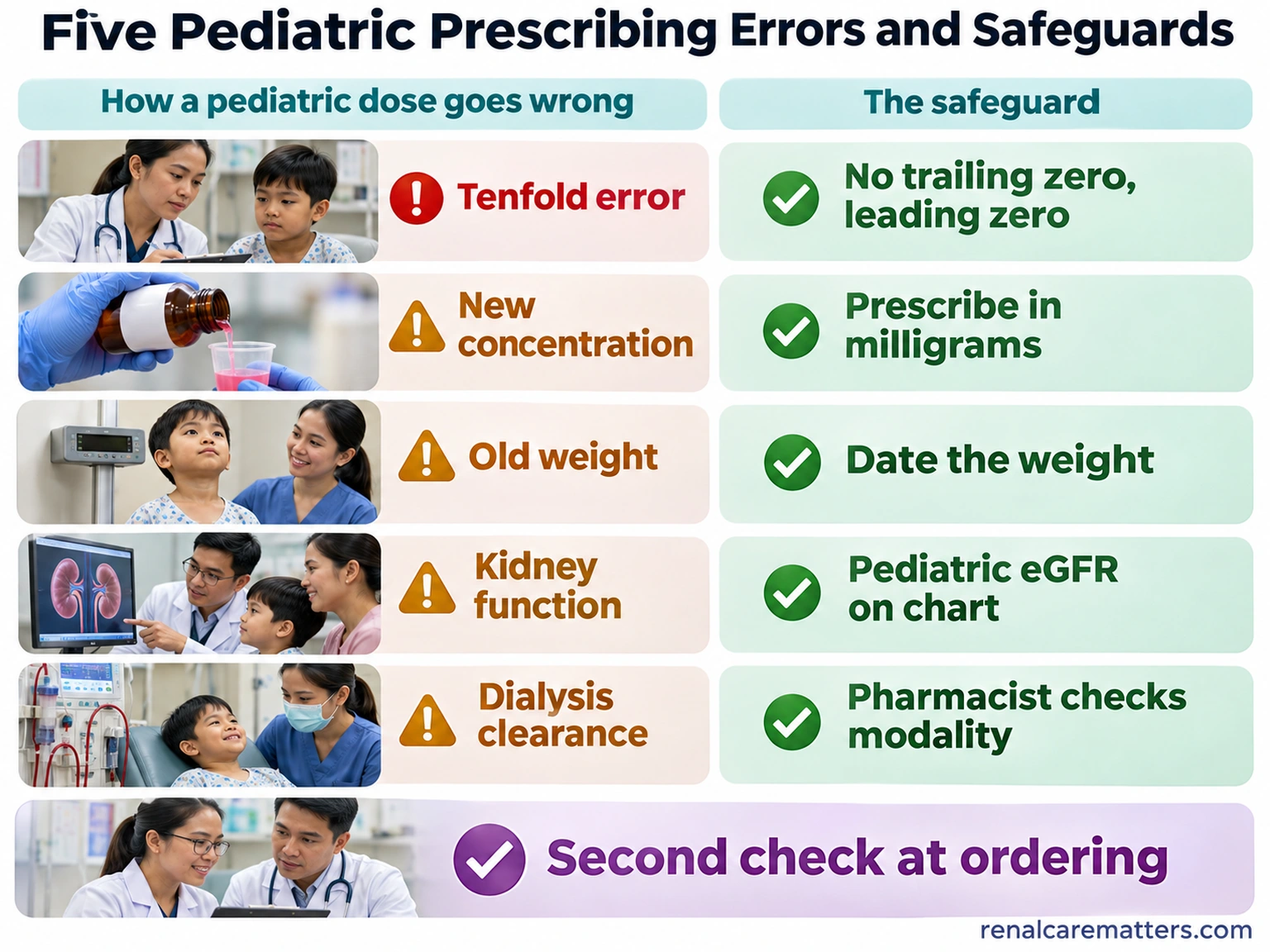
Tenfold error
Doses calculated per kilogram; decimal points; trailing zeros
“1.0 mL” read as “10 mL”; a dose ten times too large or small
No trailing zeros, always a leading zero; dose written in milligrams and milliliters; independent pharmacist check
Formulation change
Liquids compounded locally at different concentrations
Same milliliters, different milligrams
Prescribe in milligrams; ask the family to bring every bottle; one pharmacy where possible
Weight not updated
Children grow, or lose weight when unwell
Underdosing as a child grows; overdosing after weight loss
Date the weight used on every prescription
Kidney function ignored
Creatinine read as normal for an adult
Accumulation of renally cleared drugs
Pediatric estimated glomerular filtration rate (eGFR) on the chart; dialysis modality on every order
Dialysis clearance ignored
Drug removed by PD, HD or CKRT
Subtherapeutic antibiotic levels
Pharmacist review with the dialysis prescription
Medicines across settings. A child with kidney disease is prescribed for in many places: your clinic, a provincial emergency room, a barangay health center, an adult HD unit, a pharmacy that compounds a liquid. Each prescriber sees a part. Reconcile the full list at every transition: admission, discharge, start of dialysis, transplant, and transfer to adult care. Ask the family to bring every bottle and box, not a list, because the bottle shows the concentration and the list does not.
On the ward, the bottle in the bag · fictional
Daniel, 4, on PD, is admitted with drowsiness and a low blood pressure. His mother shows you two bottles of the same antihypertensive from two pharmacies; one is five times as concentrated as the other, and she has been using the same syringe mark for both.
You hold the medicine, monitor him until he recovers, rewrite the prescription in milligrams with a single pharmacy named, and ask the pharmacist to mark the syringe and teach the mother with the bottle in her hand.
What this shows. A prescription in milliliters is only safe while the concentration never changes, and in compounded liquids it often does.
RememberWrite every pediatric dose in milligrams, with the weight and date used, the kidney function and the dialysis modality, and let a second person check it.
Figure 2. Five ways a pediatric dose goes wrong, and the safeguard for each. Write doses in milligrams with the weight and date, the kidney function and the dialysis modality, and have a pharmacist check every change.
Lesson · part 2
What the evidence shows about errors, consent and improvement
Errors are common. Kaushal and colleagues studied 1,120 pediatric inpatients at two academic hospitals over six weeks in 1999. Of 10,778 medication orders, 616 contained an error (5.7%); there were 115 potential adverse drug events (1.1%) and 26 actual adverse drug events (0.24%). Most potential adverse events began at the ordering stage (79%) and involved incorrect dosing (34%), anti-infective drugs (28%) and intravenous medicines (54%). The potential adverse event rate was about three times that of an earlier adult study and was highest in neonates in intensive care. Physician reviewers judged that computerized order entry could have prevented 93% and ward-based clinical pharmacists 94% of potential adverse events.2 The study is old, American and observational, and the prevention figures are reviewers’ judgments, not measured effects. Its lesson still applies wherever doses are calculated by hand at night.
Consent and assent. The American Academy of Pediatrics (AAP) describes informed consent in pediatrics as an active process of parental permission and the child’s assent, with the child’s and adolescent’s opinion included more fully as they mature, and with particular attention to adolescent consent, assent and refusal.3 It is a policy framework, not a trial-tested intervention, and it is written for American law. In the Philippines the age of majority is 18, so a parent or guardian gives consent for a minor; the child’s assent is still sought and recorded.
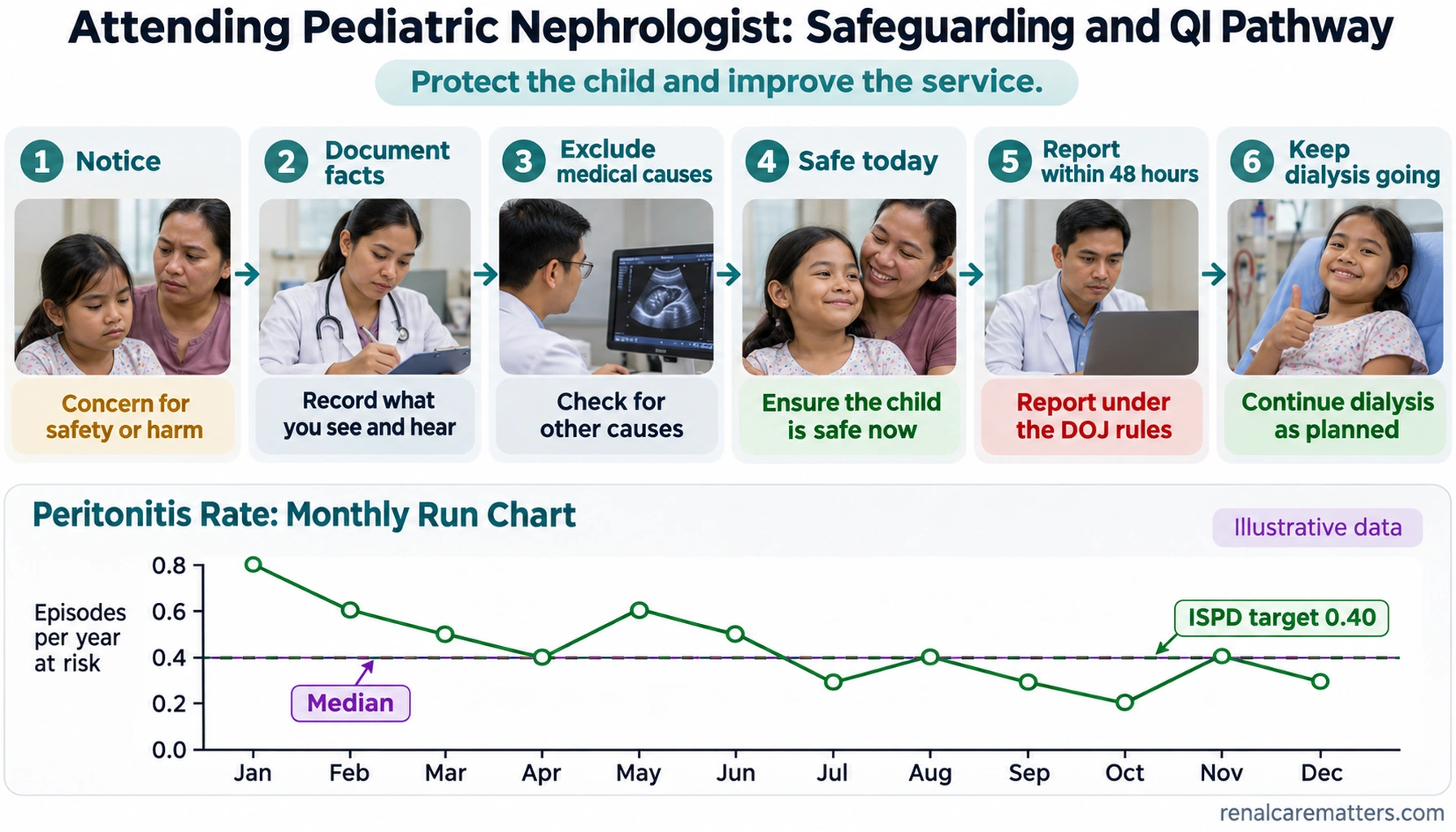
Improvement. Perla, Provost and Murray describe the run chart: data plotted in time order with a median line, read with probability-based rules that distinguish a real change from random variation. They argue that this is more useful to improvement teams than aggregate summary statistics that ignore time order.4 For a pediatric PD service, an obvious measure is the peritonitis rate, for which the International Society for Peritoneal Dialysis (ISPD) 2022 recommends no more than 0.40 episodes per year at risk and more than 80% of patients peritonitis-free per year.5
Transition. The International Society of Nephrology (ISN) and International Pediatric Nephrology Association (IPNA) consensus describes transfer as the end of an individualized transition process involving both pediatric and adult teams, focused on self-management skills and support structures.6 It is a consensus statement and gives a framework rather than tested outcomes.
RememberMedication errors begin mostly where doses are written. Put the second check at the point of ordering, not at the bedside.
Lesson · part 3
Protecting the child: what the law requires and what the attending does
Why chronic kidney disease raises the risk. A child on home dialysis depends on adults for treatment every day. Exhausted caregivers, poverty, absent parents working abroad or far away, and a child who cannot easily tell anyone all raise the risk of neglect and abuse. Missed visits, unexplained weight loss, a logbook with blank days and injuries that do not fit the story are signals. They are not proof; each has innocent explanations, and in CKD, bruising can come from platelet dysfunction or anticoagulation. Your job is to notice, examine, document, and involve the people trained to assess.
The law. Republic Act (RA) 7610, the Special Protection of Children Against Child Abuse, Exploitation and Discrimination Act, defines children as persons below 18, or older but unable to protect themselves because of a disability, and declares that the State shall intervene on behalf of a child when the parent or guardian fails or is unable to protect the child.7 The Department of Justice (DOJ) rules on reporting and investigation (1993) require the head of any public or private hospital, clinic or similar institution, and the attending physician and nurse, to report the examination or treatment of a child who appears to have suffered abuse to the Department of Social Welfare and Development (DSWD) or the equivalent local agency within 48 hours of knowledge, orally or in writing. Failure to report is punishable by a fine; a person who reports in good faith is free from civil or administrative liability.8
The hospital resource. Department of Health (DOH) Administrative Order (AO) 2013-0011 set the revised policy for women and children protection units (WCPUs) in all government hospitals, to standardize their services.9 Where your hospital has a WCPU, it is the team to call; where it does not, the hospital social worker and the local social welfare office are.
Step
What the attending does
Why
Notice
Ask about missed visits and weight loss without accusation; see the child alone if age and situation allow
Children rarely disclose in front of a possible abuser
Examine and document
Record injuries objectively: site, size, color, pattern; the explanation given, in the words used; photographs per hospital policy
Facts, not conclusions, protect the child and the record
If you believe the child is unsafe going home, admit for medical reasons and involve the WCPU or social worker
Dialysis cannot stop while the situation is assessed
Report
Report through the hospital’s process to DSWD or the local social welfare office within 48 hours
A legal duty for the head of the institution, the attending physician and nurse
Keep caring
Plan who will do dialysis, and where, during the assessment
Protection that interrupts dialysis harms the child
Confidentiality. Health information is sensitive personal information under the Data Privacy Act of 2012 (RA 10173).10 Share what the child’s safety and care require, with the people who need it, and record why. Adolescents deserve confidential time with you; tell them at the start that you will keep what they say private unless someone is at risk of serious harm, and keep that promise both ways.
Stop and call
Injuries with no plausible explanation, or an explanation that changes
A child who discloses abuse
A child on home dialysis whose treatments are not being done
Weight loss, missed visits and a caregiver who cannot be reached
An adolescent who discloses self-harm or thoughts of suicide
RememberYou do not have to be certain to report; you have to have reason to be concerned. Report within 48 hours, keep the child safe, and keep the dialysis going.
Lesson · part 4
Truthful records, the handover letter, and a quality project
PhilHealth documentation. The pediatric essential-services checklist for the PD Z benefit under PhilHealth Circular (PC) 2024-0036 carries the name of the attending pediatric nephrologist.11 Your signature says the listed services were delivered. If they were not, the record must say so. A checklist completed to keep a claim flowing, for a child whose exchanges were not done, is false, and it also hides the clinical problem from everyone who reads the chart later. Coverage rules change; confirm them with the coordinator on the date of service.
The transition letter. A good handover letter names the diagnosis and its history, every medicine with its dose and formulation, the dialysis or transplant details, the access plan, the outstanding problems, what the young person knows and can do for themselves, the adult physician who has agreed to accept, the date of the first adult visit, and who will confirm attendance. The letter is not the transfer; the confirmed first visit is.
A quality project. Choose one measure that matters to children and that your unit can count each month. The pediatric peritonitis rate is a good first project: its definition is published by ISPD, its target is explicit, and its causes are mostly in training and technique.5
Step
For a pediatric PD peritonitis project
Aim
Reach and hold a rate within the ISPD target, with more than 80% of children peritonitis-free per year
Measure
Episodes and patient-months at risk, every month; the organism and the likely route for each episode
Display
A run chart with a median line, updated monthly and posted where the nurses see it
Change
Retraining after every episode; a home-visit checklist; a caregiver-fatigue check at each review
Study
Read the run chart with its rules for shifts and trends, not month-to-month impressions
Teaching the people who carry your plan. In a scarce specialty, most of your patients’ care at night is given by people you trained or failed to train: pediatric residents, the physician on duty (POD) in an adult unit, ward nurses, the PD nurse. Teach the few rules that prevent the most harm, in short sessions where they work: how to write a pediatric dose, when to stop dialysis and call, which veins to protect, what makes a child protection report necessary. Ask them afterward to talk you through a case; their explanation tells you what they will actually do at 2 a.m.
At the monthly meeting · fictional
The PD nurse in your unit has plotted twelve months of pediatric peritonitis episodes. Three of the last four episodes were in children whose exchanges are done by an older sibling, not a parent.
You and the nurse add a training session for every secondary caregiver and a question about who actually does the exchanges to each monthly visit. You keep plotting.
What this shows. A run chart that records why, not only how many, points to the change worth making.
RememberSign only what is true, close every handover with a confirmed visit, and measure one thing that matters every month.
Figure 3. Protect the child and improve the service. Report within 48 hours under the DOJ rules while dialysis continues; track one unit measure, such as the peritonitis rate, on a monthly run chart read with its rules.
On the floor
Real situations: problems and solutions
These are fictional but typical. For each one, cover the answer, decide what you would do, then compare. Where a step depends on local rules, your unit’s procedure and your supervisor’s direction come first.
The order at 2 a.m.
What you see
A resident phones in an antibiotic order for a 9-kilogram infant on PD, calculated from an adult reference and written as ‘5.0 mL’.
What is likely going on
A trailing zero and an adult reference invite a tenfold error and a dose not adjusted for dialysis.
What to do
Ask for the dose in milligrams per kilogram from the pediatric formulary, written without trailing zeros, and a pharmacist check against PD clearance before it is given.
Why it matters
Most potential drug harm begins at ordering; the second check belongs there.
The teenager who asks for privacy
What you see
A 15-year-old on HD asks to speak to you without her mother and then tells you she has a boyfriend and has stopped taking her medicines.
What is likely going on
An adolescent testing whether she can trust you.
What to do
Listen, explain the limits of confidentiality (serious risk of harm), address adherence and sexual health practically, and agree what, if anything, she wants shared.
Why it matters
Confidential time is how adolescents start to own their care.
The claim that does not match the logbook
What you see
A coordinator asks you to sign a month’s PD checklist for a child who was admitted for ten days and did not receive home supplies.
What is likely going on
The form assumes a month of home treatment.
What to do
Record what was actually provided and ask the coordinator how PhilHealth handles partial months; do not sign for services not given.
Why it matters
Your signature is a statement of fact that others rely on.
The transfer that never happened
What you see
A 19-year-old you transferred a year ago is admitted in another hospital with a failed graft; the adult clinic has no record of him.
What is likely going on
The handover letter was sent but no one confirmed the first visit.
What to do
Help the adult team now; then change your process so that a named person confirms every first adult visit.
Why it matters
The loop closes at the first adult visit, not at the letter.
Field notes
Never write a trailing zero; always write a leading zero.
Keep your hospital WCPU or social worker’s number in your phone.
Ask ‘Who actually does the exchanges?’ at every home PD review.
Post the unit’s run chart where the nurses work, and update it monthly.
Case review
Back to the case: Missed visits, weight loss and bruises
The explanations, and today. Several explanations may be true at once: dialysis not being done (blank logbook days, a 19-year-old carrying an adult’s task alone), poor intake or inadequate dialysis causing weight loss, a tenfold or formulation error from the new liquid concentration, and possible physical abuse or neglect. Bruising can also come from uremic platelet dysfunction, so check a platelet count and coagulation. Today: see Joy alone if she is willing; examine and document the bruises objectively; reconcile the medicine bottle, prescribe in milligrams and ask the pharmacist to confirm the dose; assess her fluid and nutritional state and her dialysis adequacy. If you are not confident she is safe at home, admit her for medical reasons, which her weight loss and incomplete dialysis justify.
The law and her dialysis. Under RA 7610 and the DOJ reporting rules, the head of the hospital and the attending physician and nurse must report a child who appears to have suffered abuse to DSWD or the local social welfare office within 48 hours; certainty is not required, and good-faith reporting is protected. Involve the hospital’s women and children protection unit or social worker today. Keep the report factual. Meanwhile, plan who performs her exchanges during the assessment: in hospital, by the PD nurses, until a safe caregiver is trained. Call her mother. Share only what her care and safety require, and record why, consistent with the Data Privacy Act.
What to sign, and what changes. Do not sign the PD essential-services checklist as if services were delivered when the logbook shows they were not; record what was actually given and explain the gap to the coordinator. Then fix the systems: prescribe liquids in milligrams with the weight and date, ask families to bring every bottle, and have a pharmacist check each change in formulation. Add a question about who actually performs exchanges and a caregiver-fatigue check to every PD review, train secondary caregivers, and track missed visits and peritonitis on a monthly run chart so that the next Joy is noticed after one missed visit, not three.
Skills lab · with your preceptor
Skills checklist: Medicines, safeguarding, documentation and leading the service
Complete with a preceptor, in simulation or at your own unit. Sign-off is local. Your preceptor rates each step as satisfactory, needs practice, or not observed. Steps marked Critical must all be satisfactory before sign-off. This checklist supports supervised learning; your unit’s own procedure and competency form are the authority. A printable version of every checklist is on the trainer page.
Reviews a set of pediatric prescriptions and finds the tenfold, formulation and kidney-function errors
Documents a safeguarding concern objectively and completes the report pathway with the social worker or WCPU
Completes a PhilHealth checklist truthfully for a child whose services were incomplete
Builds a monthly run chart of a unit measure and reads it with its rules
Placement activity. Simulation or supervised practice
Self-assessment
Check your understanding
Each visit draws 5 questions at random from this module’s 5-question bank. Choose the single best answer for each, then select Check answers; an explanation appears under the best answer. Select New set of questions for a different mix. A good target is 4 of 5 on two different sets. Nothing you select is sent anywhere; scoring happens in your browser.
Dialysis Center Quality ManagementDialysis Center quality assessment and performance improvement (QAPI) vs. continuous quality improvement (CQI): A Quality Management Field Manual
Kearns, G. L., Abdel-Rahman, S. M., Alander, S. W., Blowey, D. L., Leeder, J. S., & Kauffman, R. E. (2003). Developmental pharmacology—drug disposition, action, and therapy in infants and children. The New England Journal of Medicine, 349(12), 1157–1167. https://doi.org/10.1056/NEJMra035092
Kaushal, R., Bates, D. W., Landrigan, C., McKenna, K. J., Clapp, M. D., Federico, F., & Goldmann, D. A. (2001). Medication errors and adverse drug events in pediatric inpatients. JAMA, 285(16), 2114–2120. https://doi.org/10.1001/jama.285.16.2114
Katz, A. L., Webb, S. A., & Committee on Bioethics. (2016). Informed consent in decision-making in pediatric practice. Pediatrics, 138(2), e20161485. https://doi.org/10.1542/peds.2016-1485
Perla, R. J., Provost, L. P., & Murray, S. K. (2011). The run chart: A simple analytical tool for learning from variation in healthcare processes. BMJ Quality & Safety, 20(1), 46–51. https://doi.org/10.1136/bmjqs.2009.037895
Li, P. K., Chow, K. M., Cho, Y., Fan, S., Figueiredo, A. E., Harris, T., Kanjanabuch, T., Kim, Y. L., Madero, M., Malyszko, J., Mehrotra, R., Okpechi, I. G., Perl, J., Piraino, B., Runnegar, N., Teitelbaum, I., Wong, J. K., Yu, X., & Johnson, D. W. (2022). ISPD peritonitis guideline recommendations: 2022 update on prevention and treatment. Peritoneal Dialysis International, 42(2), 110–153. https://doi.org/10.1177/08968608221080586
Watson, A. R., Harden, P. N., Ferris, M. E., Kerr, P. G., Mahan, J. D., Ramzy, M. F., International Society of Nephrology, & International Pediatric Nephrology Association. (2011). Transition from pediatric to adult renal services: A consensus statement by the International Society of Nephrology (ISN) and the International Pediatric Nephrology Association (IPNA). Kidney International, 80(7), 704–707. https://doi.org/10.1038/ki.2011.209
Department of Justice. (1993). Rules and regulations on the reporting and investigation of child abuse cases (Implementing Section 32 of Republic Act No. 7610). Lawyerly. https://dev.lawyerly.ph/laws/38174
Department of Health. (2013). Revised policy on the establishment of women and their children protection units in all government hospitals (Administrative Order No. 2013-0011). Supreme Court E-Library. https://elibrary.judiciary.gov.ph/thebookshelf/showdocs/10/69173
Educational material for physicians. Completing it is an Academy learning record only. It does not confer CPD units, PNSP or board certification, privileges, or PhilHealth accreditation, and it does not replace current guidelines, regulations, your institution’s pediatric protocols and formulary, or clinical judgment.