The five ways kidney failure is treated, what home dialysis involves, and how to listen, explain the basics, and refer questions.
PublishedNailathalaGipatikPepalwal:ReferencesMga SanggunianMga TinubdanReng Reperensya:8Audience: Entry-level dialysis technicians and trainees · preceptors, head nurses, and training providersRead timeOras ng pagbasaOras sa pagbasaOras ning pamamasa:
This module is study material for dialysis technicians. It explains why safe practice works the way it does. It does not replace the physician’s orders, the supervising nurse’s direction, your unit’s approved procedures, or the manufacturer’s instructions for use. What a technician may do differs between countries and between facilities, so do only the tasks you are trained, assigned, and signed off to do. Every case is fictional.
Learning objectives
After this module you should be able to
Compare in-center hemodialysis, home hemodialysis, peritoneal dialysis, kidney transplant and comprehensive conservative kidney management.
Identify the basic equipment and day-to-day responsibilities associated with home dialysis and describe questions for the home program.
Elicit patient priorities and barriers involving work, travel, household responsibilities, communication and support.
Reinforce approved information with teach-back and refer questions about eligibility, schedules, costs and individualized care.
Classroom 8 hSkills lab 2 hSupervised placement 10 h
Pre-testBefore you read, answer the 5 self-assessment questions and note your score. After the module, select New set of questions and compare. The difference is what you learned; the questions you still miss are what to reread.
Start here
The big picture, in plain words
In plain wordsChoosing a treatment for kidney failure is a little like choosing how to get to work. A jeepney, a tricycle, a car, or working from home can each be the right answer, depending on where the person lives, what the person can manage, and what matters most to them. Kidney failure can be treated in more than one way, and no single way suits everyone. Patients often ask the technician first, because you are the person they see most.
The picture has a limit. A commuter can pick a different ride tomorrow. Whether a treatment suits a patient depends on the patient, the home, and the local program, and the clinical team decides it. Your part is to listen, explain the basics with approved materials, and pass the question to the nurse or physician who can answer it for that patient.
Figure 1. The main forms of dialysis. They differ in where treatment happens, who operates the equipment, and what membrane does the cleaning.
Figure 2 · Key terms for this module
In-center hemodialysisDialysis done at a clinic by staff, usually three times a week.
Home hemodialysisThe same kind of treatment, done at home after training.
Peritoneal dialysisDialysis that uses the lining of the abdomen as the filter.
TransplantA donated kidney placed by surgery.
Conservative kidney managementActive care for symptoms and comfort, without dialysis or a transplant.
Teach-backAsking the patient to explain the plan in their own words, to check that your explanation worked.
Opening case · fictional
Case: Making treatment fit everyday life
It is Tuesday afternoon, in the last hour of the session. Ms. Liza Reyes, 46, a fictional patient on in-center hemodialysis, works rotating shifts at a call center. She travels more than an hour each way to the clinic and helps care for her elderly mother. Her daughter has offered to handle any home treatment, but the daughter works nights. As you record her readings, Ms. Reyes asks you three things at once: “Can I do dialysis at home so I can keep working? Would I need my daughter with me? If I can’t get a ride tomorrow, can I just wait for the next session?”
Before reading on, decide:
Which of her concerns needs action today, and from whom?
What can you explain about home options, and what must the program itself confirm?
What would you ask Ms. Reyes to explain back to you before she leaves?
Keep your answers in mind. The lesson gives you what you need, and the case review near the end shows one sound response.
Lesson · part 1
Compare the treatment pathways
Think of the different ways a worker can get from the province to a job in the city: the bus, the train, a motorcycle of his own, or a rented room near the office. Each one costs something different in time, money, effort, and freedom, and the best one depends on the person. Treatment for kidney failure is similar. The picture has a limit: a commuter chooses alone, while a patient chooses together with the clinical team, and some options are open only if the body, the home, and a program allow them.
Kidney replacement therapy includes dialysis and kidney transplantation. Comprehensive conservative kidney management is active care without dialysis or transplant, focused on symptoms, quality of life, and the person’s own goals. The patient and the clinical team discuss the options that are medically appropriate. Their decision may change as health, preferences, and practical circumstances change.1,2
Figure 3. Five treatment pathways. The table gives a text equivalent and adds practical considerations.
Option
How it works
What to discuss with the care team
In-center hemodialysis (HD)
Blood passes through an external dialyzer at the center. A trained team runs the equipment and monitors the treatment.
Prescribed sessions, available shifts, travel, conflicts with work or school, and whom to call when attendance is at risk.
Home HD
Uses an external dialyzer and a home HD machine. The patient, and any designated care partner, are trained and follow a prescribed plan with program support.
Whether a program is available and the patient is eligible, vascular access training, utilities, storage, supply delivery, backup plans, and whether the program requires a care partner.
Peritoneal dialysis (PD)
Dialysis solution enters the abdomen through a PD catheter. The lining of the abdomen, the peritoneum, serves as the exchange membrane. The fluid is later drained and replaced.
The daily exchange routine, a clean setup area, storage, training, infection prevention, and how to reach the PD team.
Kidney transplant
A kidney from a living or deceased donor is placed by surgery. A working transplant provides kidney function and may remove the need for dialysis.
Referral and evaluation, donor pathways, surgery, follow-up, and anti-rejection medicines for as long as the graft is kept. Eligibility and timing need transplant-team review.
Comprehensive conservative kidney management
The team treats symptoms and supports quality of life through an active care plan, without dialysis or transplantation.
Symptom priorities, medicines and supportive measures, psychosocial support, planning ahead, and whom to contact when symptoms change.
An option described in a textbook may not be available, or may have different requirements, at a given Philippine facility. Before you give a patient anything specific, ask the local team about referral routes, program capacity, cost, and coverage.1,3,2,4
Figure 4. Kidney transplant in one picture. A working transplant replaces kidney function, but it needs lifelong medicines and follow-up.
Lesson · in practice
Five options side by side: place, schedule, and daily work
In plain wordsThink of the ways a worker in Bulacan can get to a job in Manila: the bus, the jeepney and the train, a motorcycle of his own, or a room near the office during the week. Each one costs something different in money, time, effort, and freedom. Nobody can name the best one without knowing the person. Patients ask the same practical questions about treatment: where, how often, for how long, and who does the work.
The picture has a limit. A commuter chooses alone and can change his mind tomorrow. A patient chooses with the nephrologist, and some options are open only if the body, the home, and a program allow them. This table answers the practical questions in general terms. It does not say which option is best, because there is no single best option. The nephrologist and the patient decide which ones are possible and which one fits.
Option
Where, and who does the work
Usual schedule
What the patient must do
Access or surgery
Often discussed when
In-center hemodialysis
At the unit. Staff run the treatment
Commonly three sessions a week of about four hours each, as prescribed
Attend every session for the full time. Protect the access. Follow the diet, fluid, and medicine plan
A fistula, graft, or catheter
The patient wants or needs staff to perform treatment, or home is not suitable
Home hemodialysis
At home. The patient, often with a trained partner
Set by the home program; often shorter, more frequent sessions
Complete several weeks of training. Set up the machine, insert the needles, record each treatment, order supplies, and call the program when something goes wrong
The same access; the home needs space, water, and power
The patient wants a flexible schedule, can be trained, and a program is available
Peritoneal dialysis
At home or at work. The patient, by hand or with a machine called a cycler
Every day. By hand: commonly about four exchanges a day, each taking roughly 30 to 40 minutes. By cycler: overnight, commonly eight to ten hours
Complete training. Use strict clean technique at every connection. Care for the catheter exit site daily. Store boxes of solution
A soft catheter placed in the abdomen
The patient wants treatment without needles and has a clean space at home
Kidney transplant
Surgery in a transplant hospital, then clinic follow-up
No dialysis sessions while the kidney works. Frequent clinic visits at first, then regular visits for life
Take anti-rejection medicines every day, on time, for as long as the kidney works. Attend visits and blood tests. Report fever or illness early
Major surgery and a kidney from a living or deceased donor
The transplant team finds the patient fit for surgery and a donor kidney is available
Conservative care
Clinic and home. The care team, patient, and family
Regular visits. No dialysis
Take medicines, follow the diet, report symptoms, and plan ahead with the family
None
The patient chooses not to have dialysis, or dialysis is unlikely to help the person live longer or better
A choice is not permanent. A patient may move from peritoneal dialysis to hemodialysis, from dialysis to a transplant, or back to dialysis if a transplant stops working. You will meet patients at every one of these turns.
RememberA safe sentence for any question about which option to choose: “Each one has trade-offs. The doctor can go through which are possible for you. I will tell the nurse you want to talk about it.”
Lesson · part 2
Recognize home dialysis equipment and responsibilities
Figure 5. Peritoneal dialysis uses the lining of the abdomen as the filter. Fluid goes in, stays for a time, and is drained.
At this level you need to recognize the equipment and know who does the work at home. You do not need to train anyone on it.
Home HD. A machine, a dialyzer, bloodlines, and access supplies support the prescribed treatment. Water, power, and plumbing needs differ from one system to another. The program trains the patient, and any required partner, in the equipment, access care, monitoring, and emergency response. Preparing for the program includes a plan for equipment failure, interrupted utilities, and urgent symptoms.
Continuous ambulatory peritoneal dialysis (CAPD). Uses prescribed solution bags and a manual exchange system. What you need to know here is the components and the fact that each exchange is done by hand.
Automated peritoneal dialysis (APD). Uses a cycler with compatible tubing and solution bags. The machine performs the programmed exchanges, often overnight. Some prescriptions add a daytime exchange.
Signs that need referral. A patient on PD who reports cloudy drained fluid or new abdominal pain should contact the PD team promptly, as the program instructs. For a patient with an HD access, reinforce your facility’s approved guidance on protecting the access and reporting changes. Urgent symptoms go through the unit’s urgent escalation pathway.5,6
Figure 6. Home dialysis equipment at a glance. Three panels showing a home hemodialysis machine, a manual peritoneal dialysis exchange set, and a cycler.
Lesson · part 3
Help the patient plan for daily life
The treatment is only one part of a patient’s week. Work, school, family, travel, and money shape what a patient can actually do, and a plan that ignores them is a plan the patient will not follow. Start with a question such as “What part of the treatment routine is hardest for you right now?” Listen for the specific barrier, and ask permission before you involve family. Arrange an interpreter through the facility when one is needed. Find out what the patient wants to keep doing: working, studying, traveling, caring for relatives. Then explore the practical barriers, such as the cost of transport, shift timing, storage space, reliable utilities, and who can realistically help. Pass the patient’s priorities to the team in the patient’s own words where you can.1,3,2
Patient concern
Technician response within assigned scope
A ride fell through or a session may be missed
Tell the dialysis nurse promptly. Reinforce the approved contact instructions and help connect the patient with the unit’s scheduling or support pathway.
Food, fluids or medicines are hard to manage
Ask what makes the plan difficult. Reinforce the approved plan, and refer individual questions to the nurse, dietitian, or prescribing team.
Caregiver support is uncertain
Clarify whom the patient wants involved and when help is available. Send questions about care-partner requirements to the home program.
Fatigue, stress or changes in daily function
Listen, document the effect the patient describes, and refer to the nurse or the appropriate support service. New urgent symptoms follow the unit’s escalation procedure.
Interest in home dialysis, transplant or conservative care
Explain the basic differences using approved materials, and arrange a handoff to the nurse or nephrology team for an individual discussion.
RememberTreat a missed session as a safety problem, not a scheduling detail. Tell the nurse the same day.
Lesson · in practice
Diet and fluid: what the dietitian and nurse teach, and how you support it
The nephrologist and the dietitian set each patient’s diet and fluid plan, and the nurse reinforces it. You will hear about it at the chair every day, because patients talk about food more than about anything else. Your part is to understand the reasons, notice problems, and pass them on. You do not set or change the plan.
Each limit in the table follows from one fact: the kidneys no longer clear what the patient takes in, so what goes in between sessions stays in until the machine removes it. Read the “Why” column first. The food list makes sense once you know it.
What is limited
Why
Foods and drinks the dietitian commonly discusses
How the technician supports
Sodium (salt)
Salt causes thirst and holds water in the body, so weight gain and blood pressure rise
Fish sauce, soy sauce, shrimp paste, dried salted fish, instant noodles, canned and processed meats, seasoning cubes, salty snacks
Listen for thirst and salty food habits. Report large weight gains with the numbers
Potassium
A high level can disturb the heart rhythm without warning
Bananas, coconut water, oranges and fruit juices, dried fruit, tomatoes and tomato sauce, potatoes and other root crops. Salt substitutes, many of which are made from potassium
Tell the nurse if a patient mentions large amounts of these or a new salt substitute
Phosphate
A high level over time weakens bones, hardens blood vessels, and causes itching
Dark cola drinks, processed foods with phosphate additives, milk and cheese, organ meats, nuts, beans. Phosphate binder tablets are taken with meals
Tell the nurse if a patient says the binders are skipped or taken apart from meals
Fluid
With little or no urine, what is drunk stays in the body until the next treatment
Weigh accurately. Help the patient keep a fluid record if the nurse asks
Protein is different. Patients on dialysis usually need enough protein, and the dietitian sets the amount. Never advise a patient to avoid protein foods, even when it seems the careful thing to say.
Stop and reportStar fruit (balimbing) is harmful to people with kidney failure and can cause hiccups, confusion, and seizures. If a patient says he or she has eaten it or drunk its juice, tell the nurse immediately, even if the patient feels well.
Tracking fluid. The fluid allowance is the total volume the nephrologist permits in a day. The volumes below are approximate. Containers differ from home to home, so the patient should measure his or her own cup and bowl once with a measuring cup.
Common serving
Approximate volume
Regular glass of water
240 mL
Cup of coffee or tea
180 mL
Bowl of soup broth
200 mL
Bowl of rice porridge
250 mL, counted as fluid as the dietitian teaches
Canned soft drink
330 mL (read the label)
One ice cube
20 to 30 mL
Water to swallow medicines
30 to 60 mL each time
One tablespoon
15 mL
Notice how quickly small amounts add up in the example below. No single item looks like much, and the day is nearly used up by evening.
Fluid left for the day = allowance − total taken so far. Example, with a fictional allowance of 1,000 mL: coffee 180 + water with medicines 60 + soup 200 + glass of water 240 + four ice cubes at 25 each, 100 + evening tea 180 = 960 mL. 1,000 − 960 = 40 mL left.
Figure 7 · Thirst tips the nurse and dietitian commonly teach
Less saltThe most effective step, because salt drives thirst.
A small cupThe same number of drinks, with less volume.
IceIt lasts longer than water, but it is counted.
Rinse, do not swallowMouth rinses and tooth brushing ease a dry mouth.
Spread it outDivide the allowance across the day.
Blood sugarIn patients with diabetes, high sugar causes thirst; they should discuss it with the doctor.
Lesson · in practice
Common patient questions: a helpful reply and where to refer
Patients will ask you things that belong to the nurse or the doctor, because you are the one standing at the chair. A good reply does two things at once. It is honest about what you can decide, and it shows the patient that the question will reach the right person.
Figure 8 · Four habits for every question
Listen to the endDo not answer the first half of a question.
Say what you can doEven when the answer belongs to someone else.
Never guessA confident wrong answer travels fast in a waiting room.
Close the loopTell the patient whom you told.
The patient says
A helpful reply within your scope
Refer to
“Can I skip Saturday? We have a family event.”
“I cannot decide that, but please do not simply stay away. Let me call the nurse now to look at another slot.”
Nurse or scheduler
“Take off an extra kilo today. I drank a lot.”
“The nurse and the doctor set how much comes off. I will tell the nurse what you told me.”
Nurse
“Is my potassium all right?”
“The nurse or the doctor will explain your results. I will let them know you asked.”
Nurse or nephrologist
“My neighbor says this herbal tea cleans the kidneys.”
“Some herbs and supplements can harm people on dialysis. Please do not start it until the doctor has checked. Could you bring the label?”
Nurse or nephrologist
“Will my kidneys recover? Is this forever?”
“That is an important question, and the doctor knows your case. I will make sure the nurse knows you want to talk about it.”
Nephrologist
“I cannot afford the medicines and the fare.”
“Thank you for telling me. May I tell the nurse, so the right person can go through what help is available?”
Nurse, social worker, or the unit’s billing staff
“The needles hurt more with that nurse.”
“I am sorry it hurt. I will pass that on to the charge nurse.” Do not take sides or criticize a colleague
Charge nurse
“What is wrong with the man in the next chair?”
“I cannot talk about other patients, just as I would not talk about you.”
No referral needed
Lesson · in practice
Missed and shortened treatments: why they matter and how to report them
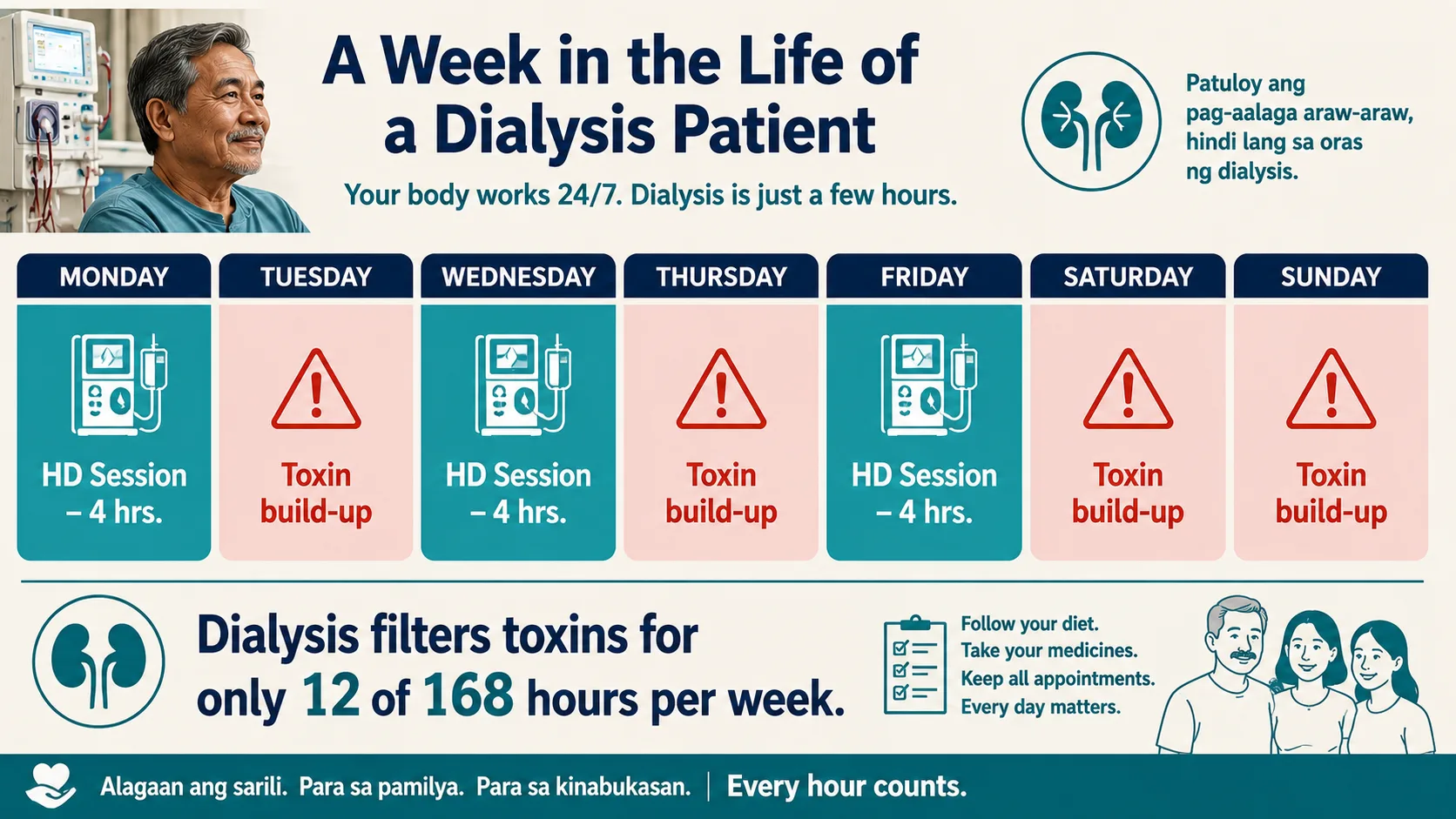
Think of a water tank on the roof that fills all week and is drained only on set days. Skip a draining, or cut one short, and the next one starts from a higher level. A patient’s body behaves the same way between sessions, with one difference that matters: some of what rises, such as potassium, gives no warning before it becomes dangerous.
Figure 9. Dialysis fills only a small part of the week. Every hour lost is a share of the only cleaning time the patient has.
Figure 10 · What a missed or shortened session leaves behind
FluidMore weight to remove next time, or breathlessness before then.
PotassiumIt rises silently between treatments.
WastesNausea, poor appetite, itching, tiredness.
A patternPatients who often miss or shorten sessions are admitted to hospital more often and die sooner than those who do not.
Minutes look small at the chair. The two calculations below show what they become.
Time lost over a year = minutes lost per session × sessions per week × 52. Example: 30 minutes × 3 sessions × 52 weeks = 4,680 minutes = 78 hours. 78 ÷ 4 hours = about 19 and a half full sessions lost in a year.
You do not decide when a treatment ends. Your part is to make sure the nurse knows, at the moment it matters, and that the record shows the real time delivered.
Situation
What the technician does
A patient asks to come off early
Tell the nurse at once. Do not stop the pump, change the time, or argue. The nurse talks with the patient and completes any form the unit uses
A patient arrives late
Tell the nurse the arrival time. The nurse decides whether the full time can still be given
A patient has not arrived
Tell the nurse by the time your unit sets, so that someone telephones the patient
Treatment is interrupted by alarms, clotting, or a toilet break
Record when the blood pump stopped and restarted. Minutes with the pump stopped are not treatment
A patient returns after a missed session
Say so to the nurse before setup. Watch for breathlessness, weakness, and a large weight gain
Figure 11 · Recording a shortened treatment
TimesThe prescribed duration, the actual start, and the actual end.
DeliveredThe treatment time shown on the machine.
ReasonIn the patient’s own words, in quotation marks.
NotifiedThe nurse’s name and the time.
PatternMention it at handoff if this is the second time or more.
Stop and reportA patient who missed a session and now has breathlessness, chest pain, marked weakness, or an irregular pulse is an emergency. Call the nurse immediately.
Lesson · part 4
Use teach-back and close the referral
Figure 12 · Teach-back in four steps
ExplainOne or two points, in plain words.
Ask“To be sure I explained it well, what will you do if…?”
ListenNotice anything that is missing or mixed up.
Explain againUse different words, then ask again.
A patient who nods has not necessarily understood. Teach-back checks your explanation, not the patient. Explain one or two points in plain language. Ask the patient to tell you the plan in his or her own words. If the answer shows a misunderstanding, explain it another way and ask again. Then record what you reinforced, what barrier remains, whom you notified, and the confirmed next step. Your teaching reinforces the care team’s plan. Eligibility, prescription changes, and individual counseling belong to the authorized team.7,8
What needs action today? The possible missed session. It needs a same-day handoff. Alert the dialysis nurse and follow the unit’s instructions for sorting out the transport and scheduling problem. Waiting for the next session is not a plan you can approve.
What can you explain, and what must the program confirm? You can explain that both home HD and PD exist and that they use different equipment and training. The local program must confirm whether she is suitable, whether a slot is available, and whether a care partner is required. Ask Ms. Reyes whether she wants her daughter involved in that later discussion.
What do you ask her to explain back? The contact plan for tomorrow. “To make sure I explained the next step clearly, what will you do if your ride falls through?” If Ms. Reyes says she will wait for her next slot, clarify the approved contact plan and ask her to explain it again. Example handoff: “Ms. Reyes may miss tomorrow’s session because she may have no ride. She asked about home treatment because of rotating shifts and travel. Her daughter works nights. Please advise on tomorrow’s attendance plan and route her home-treatment questions to the nephrology team.”
Figure 13. Teach-back in four steps. Four-step loop showing a technician and patient using teach-back.
Lesson · in practice
Recognizing distress and speaking respectfully with patients and families
Kidney failure brings loss: of work, of income, of favorite food, of travel, and of time. You see patients more often than almost anyone else on the team, three times a week, in the same chair. That is why you are often the first to notice a change, and why the change is worth reporting even when you cannot name it.
What you may notice
What to do
A talkative patient becomes silent, or a calm one becomes irritable
Ask one open question: “You seem quieter today. How are things?” Tell the nurse what you saw
Missed sessions, large weight gains, or poor grooming that are new for this patient
Report the change and when it began
Tearfulness, or talk of being a burden to the family
Listen. Do not hurry to cheer the patient up. Tell the nurse the same session
“I want to stop dialysis.”
Do not argue or agree. “I hear you. This matters, and I would like the nurse and the doctor to talk with you about it.” Tell the nurse now
Talk of wanting to die or of self-harm
Stay with the patient. Call the nurse to the chair immediately. Never promise to keep it secret
Fear or silence when a particular companion is present, or unexplained injuries
Tell the nurse privately
Figure 14 · Speaking with respect
NameUse the name and form of address the patient prefers.
LevelSit or bend to eye level. Do not talk over a patient to a coworker.
Plain wordsNo jargon, no scolding, no blame about weight or diet.
PrivacyLower your voice. Ask before discussing anything in front of a companion.
Honesty“I do not know, but I will find out who does” is a good answer.
LanguageUse the language the patient is comfortable in, or ask the nurse for an interpreter.
Families and companions. The patient decides who hears what, so ask the patient first, each time. Thank companions for their help, show them where to wait, and send their questions about care to the nurse. An angry relative is usually a frightened one. Listen, do not argue, and bring the nurse.
RememberYou are not expected to solve a patient’s distress. You are expected to notice it, respond kindly, and make sure the nurse knows the same day.
On the floor
Real situations: problems and solutions
These are fictional but typical. For each one, cover the answer, decide what you would do, then compare. Where a step depends on local rules, your unit’s procedure and your supervisor’s direction come first.
“Can I skip Saturday? I have a wedding.”
What you see
On a Wednesday, while you check his lines, a patient asks you quietly whether missing one session really matters.
What is likely going on
If the answer sounds discouraging or dismissive, he may simply skip without telling anyone.
What to do
Thank him for asking. Say that it does matter, and bring the nurse over so that the session can be rescheduled.
Why it matters
Missed sessions lead to fluid overload and high potassium. Most units can move a session if they know in advance.
A leaflet that confused the family
What you see
A patient’s son arrives with printouts. He read online that peritoneal dialysis is “better,” and he wants his father switched this week.
What is likely going on
The family is motivated, but they are working from general information. Whether a treatment suits his father depends on the patient, the home, and the local program.
What to do
Explain the basic difference using the unit’s approved material. Write down their questions, and arrange a conversation with the nurse or nephrologist.
Why it matters
Good decisions come from the patient’s goals and the team’s assessment together, not from which option sounds better.
No ride home
What you see
At 11:20, as her treatment ends, a patient says her usual tricycle did not come and she has no money for another ride.
What is likely going on
Transport problems are a leading reason that patients miss the next session.
What to do
Tell the nurse before the patient leaves. Units often have a social worker or a contact list for exactly this.
Mr. Rogelio Santos, who has dialyzed in the unit for years, says quietly during his second hour that he is thinking of stopping dialysis.
What is likely going on
This may be fatigue, low mood, a practical problem, or a considered wish. It is always serious.
What to do
Listen without arguing. Tell him you want the nurse to hear this, and report it the same day in his own words.
Why it matters
The care team can treat symptoms, depression, and burdens, and can discuss conservative care with him properly. Silence helps nobody.
Field notes
Ask “What is the hardest part for you right now?” before you explain anything.
Use the unit’s approved leaflets. Do not make up your own comparisons between treatments.
After you explain, ask the patient to tell you the plan in their own words. If it comes back wrong, change your explanation, not the patient.
Record what you reinforced and whom you told. Otherwise the next shift will not know.
Case review
Back to the case: Making treatment fit everyday life
Case debrief.
Skills lab · with your preceptor
Skills checklist: Treatment-options conversation
Materials: A fictional patient profile, facility-approved treatment-options material, mock contact instructions and a handoff form. The observer plays a patient who misunderstands the contact plan on the first teach-back. Rate each step satisfactory, needs practice or not observed. Your preceptor rates each step as satisfactory, needs practice, or not observed. Steps marked Critical must all be satisfactory before sign-off. This checklist supports supervised learning; your unit’s own procedure and competency form are the authority. A printable version of every checklist is on the trainer page.
Asks what matters most to the patient and identifies at least two practical barriers.
Obtains permission before involving a family member and identifies any language support needed.
Uses plain language to distinguish all five pathways and identifies the membrane used in PD.
Identifies a home HD machine, PD solution bag and PD cycler at an awareness level.
CriticalBrings the possible missed session to the nurse promptly.
CriticalDefers individualized treatment selection, schedule changes and eligibility decisions to the authorized team.
Asks the patient to explain the contact plan in their own words.
Clarifies a misunderstanding and repeats teach-back.
Hands off the patient’s priorities, practical barrier and unresolved referral question.
Records the education, escalation and agreed next step objectively.
Totals a mock one-day fluid record in milliliters and compares it with the stated allowance, without advising a change to the plan.
CriticalRecords a simulated shortened treatment with prescribed time, actual start and end times, the patient’s stated reason, and the nurse notified.
CriticalResponds to a scripted out-of-scope question by saying what the technician can do and naming whom the question goes to.
Placement activity. With the preceptor, identify the unit’s approved destinations for transport concerns, home dialysis education and transplant inquiries. Observe or simulate teach-back and record feedback using approved de-identified information.
Self-assessment
Check your understanding
Each visit draws 5 questions at random from this module’s 21-question bank. Choose the single best answer for each, then select Check answers; an explanation appears under the best answer. Select New set of questions for a different mix. A good target is 4 of 5 on two different sets. Nothing you select is sent anywhere; scoring happens in your browser.
Educational study material for dialysis technicians. It does not replace physician orders, the supervising nurse’s direction, approved unit procedures, manufacturer instructions, DOH licensing requirements, or supervised training.