How a dialysis unit runs during a shift, who does what, how to confirm a patient’s identity, and how to report and record a problem.
PublishedNailathalaGipatikPepalwal:ReferencesMga SanggunianMga TinubdanReng Reperensya:7Audience: Entry-level dialysis technicians and trainees · preceptors, head nurses, and training providersRead timeOras ng pagbasaOras sa pagbasaOras ning pamamasa:
This module is study material for dialysis technicians. It explains why safe practice works the way it does. It does not replace the physician’s orders, the supervising nurse’s direction, your unit’s approved procedures, or the manufacturer’s instructions for use. What a technician may do differs between countries and between facilities, so do only the tasks you are trained, assigned, and signed off to do. Every case is fictional.
Learning objectives
After this module you should be able to
Describe the unit’s work areas and the sequence of a treatment shift.
Distinguish technician, nursing, prescribing and equipment-service duties.
Verify identity using two approved identifiers and respond to a discrepancy.
Give an SBAR handoff and confirm instructions using check-back.
Document objective observations and protect confidential information.
Classroom 6 hSkills lab 4 hSupervised placement 10 h
Pre-testBefore you read, answer the 5 self-assessment questions and note your score. After the module, select New set of questions and compare. The difference is what you learned; the questions you still miss are what to reread.
Start here
The big picture, in plain words
In plain wordsA dialysis unit runs like an airport. Many people do different jobs, every step is checked, and nothing moves forward until the check is complete. A member of the ground crew does not fly the plane, but one who sees a fuel leak tells the captain before the plane moves. Your work as a technician is the same: prepare and check, notice, and report. You are never expected to decide alone.
The picture has a limit. A bag sent to the wrong city can be flown back. A dialyzer, a dialysate, or a fluid goal set up for the wrong person goes into a patient’s bloodstream, and it cannot be taken back. That is why the checks in this module come before the work, not after it.
Figure 1 · Key terms for this module
StationOne treatment place: a chair or bed, a dialysis machine, and the tubing set for one patient.
Two identifiersTwo facts that belong to one person only, such as full name and date of birth. A chair number is not an identifier.
EscalateTell the right person now, in clear words, because the problem is beyond your role.
SBARA four-part way to report: Situation, Background, Assessment, Recommendation.
Check-backRepeating an instruction aloud so that the other person can confirm you heard it correctly.
Near missAn error that was caught before it reached the patient.
Figure 2 · The three habits this module teaches
VerifyMatch the patient, the record, and the equipment before you act.
PauseWhen anything does not match, stop the work that depends on it.
ReportTell the nurse what you saw, what you did, and what you need.
Opening case · fictional
Case: A name that almost matched
Monday, 06:55. Mrs. Teresita Reyes, 58, a fictional patient, sits down at Station 3 and states her full name and date of birth. Her surname and first initial match the open treatment record, but her birth date differs. Two patients with similar names are on today’s roster. The senior technician, Mr. Dante Villanueva, says, “That’s her. She always sits there. Go ahead.” Patient-specific setup has yet to begin.
Before reading on, decide:
What would you pause?
Whom would you contact?
Where would you document the event?
Keep your answers in mind. The lesson gives you what you need, and the case review near the end shows one sound response.
Lesson · part 1
The unit during a shift
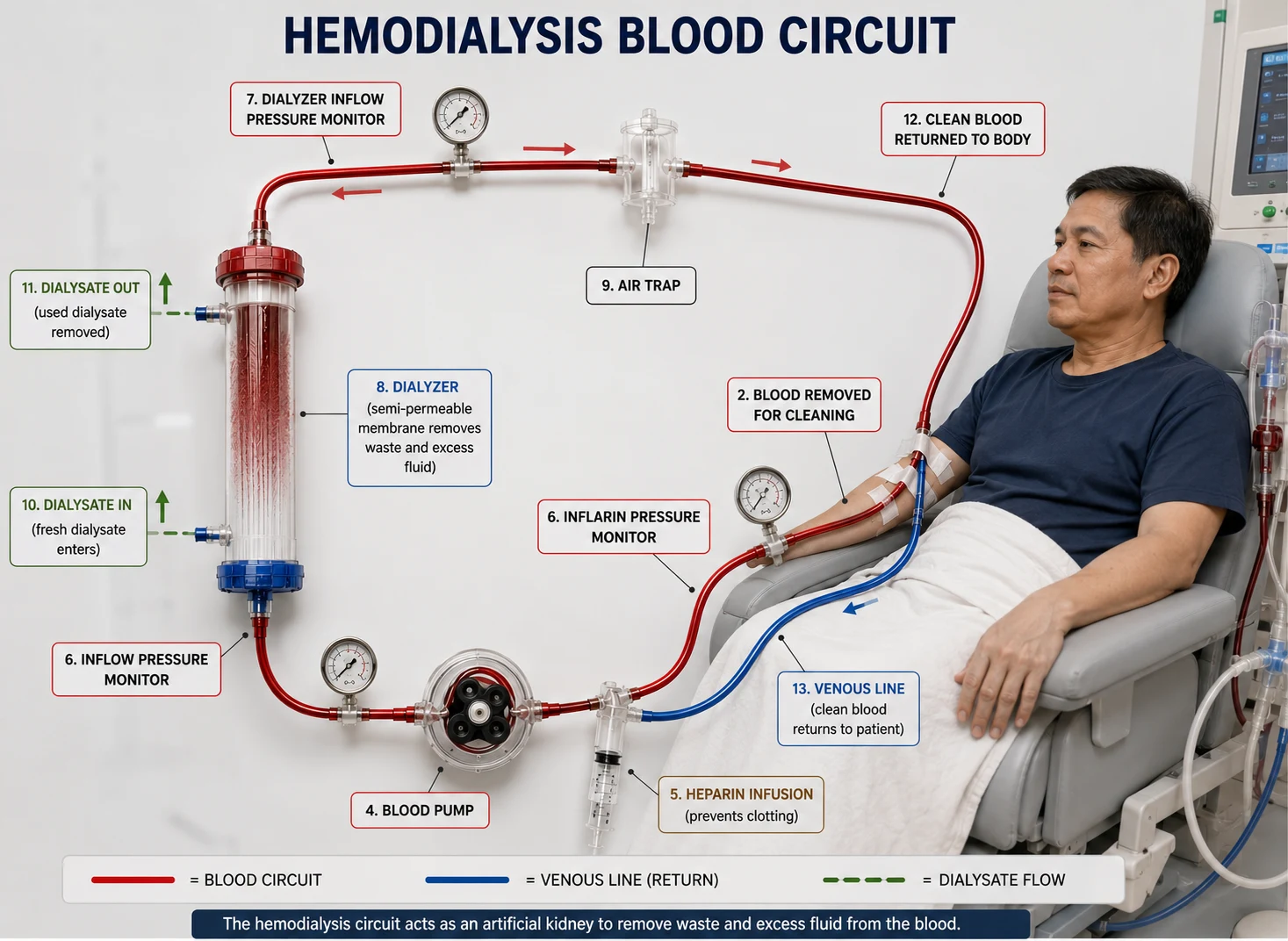
Figure 3. One dialysis station: the patient, the chair, the machine, and the tubing circuit that takes blood through the dialyzer and back. A station is prepared and checked for one patient at a time.
A dialysis station has four parts that must belong together: a chair or bed, a dialysis machine, the extracorporeal circuit (the tubing and filter that carry blood outside the body), and the patient’s treatment record. A clean chair says nothing about the machine, and a ready machine says nothing about who is sitting in it. Cleanliness, equipment readiness, and patient verification are three separate checks.
Learn the room before you need it. Find the clean supplies, the treatment area, the route for used items and waste, the emergency call point, and the exit. Ask who tracks water and equipment status.
Shift stage
Technician focus
Opening
Receive the handoff, confirm your assignment and who supervises you, and find out which stations or equipment are on hold.
Arrival
Introduce yourself, verify identity at the required point, and report any discrepancy.
Treatment
Complete the support tasks you are authorized for, and report symptoms, technical exceptions, or hazards promptly.
Completion
Hand off your assigned observations, finish the records, and follow the turnover procedure.
End of shift
State what is ready, what is on hold, and who owns each follow-up.
RememberTreat a clean station, a working machine, and a correctly identified patient as three separate checks. Passing one never passes the other two.
Figure 4. Map of a dialysis unit. Overhead plan of a small dialysis unit with labeled clean supply room, treatment stations, isolation room, waste route, water room, emergency cart, and exit.
Lesson · in practice
One patient, one treatment: who does what at each step
In plain wordsThink of renewing a document at a government office. You move from window to window in a fixed order: the form, the photo, the payment, the release. Each window trusts that the one before it did its job. A patient moves through the dialysis unit the same way, from the door to the chair and back to the door, and at each step the technician and the nurse have different jobs.
The picture has a limit. At an office, a skipped window costs you time, and a clerk sends you back to it. In the unit, nobody sends the patient back. A weight that was never checked becomes the basis of the fluid goal. An identity that was never confirmed becomes another patient’s prescription. Your work is to know the order, to do your own steps the same way every time, and to notice when a step before yours looks skipped.
Figure 5 · The patient’s path through the unit
ArrivalYou greet the patient and observe how he or she looks.
WeightYou measure and record the pre-treatment weight.
Identity at the stationYou check two identifiers against the treatment record.
Pre-treatment checksYou measure vital signs; the nurse assesses the patient and the access.
ConnectionThe nurse connects the patient and starts treatment.
TreatmentYou record readings at set intervals and report changes.
End of treatmentThe nurse returns the blood and disconnects.
Post-treatment checksYou measure vital signs and the post-treatment weight.
DepartureThe nurse decides that the patient is fit to leave.
TurnoverYou strip, clean, and disinfect the station.
Step
Technician
Nurse
Tell the nurse at once if
Arrival
Greets the patient. Notices how the patient looks, walks, speaks, and breathes
Is told about anything unusual
The patient looks unwell, is breathless or confused, or is bleeding
Weight
Checks that the scale reads zero. Weighs the patient the same way every time. Records the weight
Reviews the weight and sets the fluid removal goal within the prescription
The weight is far from the patient’s usual, or the patient cannot stand safely
Identity at the station
Checks two identifiers against the treatment record. Checks that the dialyzer and concentrates match the prescription sheet
Verifies the prescription and the machine settings
Anything does not match
Pre-treatment checks
Measures and records blood pressure, pulse, and temperature as assigned
Assesses the patient and the access. Decides whether treatment starts
A reading is outside the limits your unit sets, or the patient reports a new symptom
Connection
Has the primed circuit and supplies ready. Stays nearby
Inserts the needles or opens the catheter, connects, and starts treatment
You see air, a leak, or a loose connection
Treatment
Records readings at the interval the unit sets. Keeps the access in view. Answers alarms by looking and calling
Assesses, gives medication, and adjusts treatment
Any symptom, any alarm you cannot explain, any blood outside the circuit
End of treatment
Brings the supplies for returning blood and for dressings
Returns the blood, removes the needles or closes the catheter
Bleeding continues or the patient feels faint
Post-treatment checks
Measures post-treatment weight and vital signs as assigned
Decides whether the patient is fit to go home
Dizziness on standing, bleeding through the dressing, or a weight far from the target
Turnover
Removes and discards the circuit, cleans and disinfects (Modules 5 and 6)
Releases the station for the next patient
A step could not be completed
Notice the last column. At every step there is a point where you stop and tell the nurse. You do not need to know the cause to make that call. You need to see the change, say it clearly, and say it at once.
RememberYour unit’s written job description and your competency sign-off set the exact split of tasks. This table does not, and neither does a coworker’s idea of what is usual.1
Lesson · in practice
The technician’s day: opening, turnover, and closing
A unit usually runs two or three patient shifts in a day. Your duties gather at three points: before the first patient arrives, between shifts, and after the last patient leaves. Each point ends with a handoff to someone who was not there. Read the last column of the table as a test: when you finish, could the next person see exactly what you see?
When
Typical duties
Finished when
Opening, before the first patient
Read the logbook and receive the handoff. Confirm that the water system has been checked and released by the person assigned (Module 7). Switch on the machines and let each one complete its self-test. Check the concentrates. Stock each station. Check the scale. Set up and prime according to the schedule sheet
Every station is marked ready or on hold, and the nurse knows which
During each shift
Record readings on time. Answer alarms by looking and calling. Restock. Prepare supplies for the next shift away from occupied stations
The records are current at every interval
Turnover, between shifts
Wait until the patient has left the station. Remove and discard the used circuit. Wipe every surface and keep it wet for the contact time. Run the machine program your unit requires. Only then bring supplies for the next patient2
The station is clean, dry, and set up for the right patient
Closing, after the last patient
Run the end-of-day disinfection on every machine. Handle leftover concentrate as the procedure states. Remove waste and used linen. Count and restock. Complete the machine and cleaning logs. Report every fault in writing
The next opening team can read exactly what is ready and what is on hold
The order inside turnover is the point of turnover. Clean supplies set down on a surface that has not yet been disinfected are no longer clean, and they travel with the next patient. That is why the station is cleaned first and supplied second, never the other way around.
Stop and reportTurnover is the most hurried part of the day, and it is where shortcuts cause harm. Never bring the next patient’s supplies to a station that has not been cleaned. Never seat a patient at a machine whose disinfection or self-test did not finish. If the time is too short to do turnover properly, tell the nurse. Do not shorten the cleaning.
Lesson · part 2
Scope and escalation
Figure 6 · Who decides what
TechnicianPrepares and checks the equipment, performs assigned tasks, and observes, records, and reports.
Dialysis nurseAssesses the patient, directs care, and delegates and supervises tasks.
NephrologistWrites the dialysis prescription and is the one who changes it.
Biomedical and water staffFind and fix faults in the machines and the water system, and clear them for use.
Each member of the team owns a different kind of decision. You handle assigned technical preparation, checks, turnover, and records, and you assist the nurse within delegated scope. The nurse performs the nursing assessment and coordinates patient care and delegated duties. The nephrologist or another authorized prescriber makes prescription decisions. The designated biomedical or water-system team investigates relevant faults. Anything that affects patient care goes to the nurse or shift lead, even when the cause looks technical. For an unfamiliar task, confirm your assignment, competency sign-off, and supervision first. Philippine and international roles differ, especially for access handling, medication workflows, and starting or ending treatment.3,4
Identification works only when the patient supplies the answer. Ask the patient to state two approved identifiers, such as full name and birth date, and compare both against the approved source. If the patient cannot state them, follow the alternate verification process. If either differs, hold patient-specific setup and alert the supervising nurse. A familiar face and a usual seat are not identifiers. If the patient reports urgent symptoms, use the emergency procedure at once.5
Stop and reportWhen either identifier does not match, stop patient-specific setup and tell the supervising nurse. A habit such as “she always sits there” never replaces the check.
Figure 7. Who decides what. Four team members in a row, each with a short label of what they decide: technician, dialysis nurse, nephrologist, and biomedical and water staff.
Lesson · in practice
Patient identification: when to check, and name alerts
You already know the rule of two identifiers. This section adds three things: when you repeat the check, what does not count as an identifier, and what the unit does when two patients are easy to confuse.
Figure 8. Name alert. Two similar fictional names marked with name-alert stickers, with the two identifiers to check.
The check is repeated because every task you do for a patient carries that patient’s name forward. A weight, a dialyzer, a result, or a schedule attached to the wrong person does its harm quietly, often long after you have moved on.
Check identity before you
Because a mix-up would
Record a weight or vital sign
Put one patient’s numbers in another patient’s record, and the fluid goal is built on them
Set up a dialyzer, concentrate, or machine for a named patient
Deliver another patient’s prescription
Bring a reprocessed dialyzer to the station
Expose the patient to another person’s blood (Module 11)
Hand over any paper, result, or schedule
Give private information to the wrong person
Figure 9 · These are not identifiers
The chair or station numberPatients change seats, and you will not always know when.
A familiar faceMemory fails on a busy morning, even with patients you have known for years.
A yes to your questionA patient who is deaf, drowsy, or simply polite may agree to any name.
A relative’s word aloneUse it only as your unit’s alternate process allows.
Ask an open question, so that the patient supplies the answer: “Please tell me your full name and date of birth.” Do not ask, “Are you Mr. Cruz?” A closed question can be answered with a yes, and a yes proves nothing.
Name alerts. A name alert is a visible warning that two patients could be mistaken for each other. Many surnames are shared by a large number of families, so every unit meets this often. You will see it most on the busiest mornings, when two charts with the same surname sit side by side at the nurses’ station.
Situation
Example (fictional)
What the unit does
Same surname
Jose Santos and Josefina Santos
Marks both records, and both dialyzers where reuse is practiced, with a name-alert label. Seats the two patients apart or on different shifts where possible. Uses the full name with middle name and the date of birth every time. States the alert aloud at every handoff
Same full name
Two patients named Maria Reyes
Names that sound alike
Bautista and Batista
Relatives, or a senior and a junior
Ramon Garcia Sr. and Ramon Garcia Jr.
RememberWhen you notice a possible mix-up that nobody has labeled yet, you have found a name alert. Tell the nurse the same day so that both records are marked.
Lesson · part 3
Worked handoff and documentation
Figure 10 · SBAR, step by step
SituationWhat is happening right now, in one sentence.
BackgroundThe facts that explain it.
AssessmentWhat you think the problem is, or simply what does not match.
RecommendationWhat you need from the listener, and by when.
SBAR (Situation, Background, Assessment, Recommendation) puts the problem first and your request last. Here is the report for the opening case.
Situation. I have paused setup because of a patient identification mismatch.
Background. Two patients with similar names are scheduled. I have not started any patient-specific setup.
Assessment. The date of birth she stated differs from the record on the screen. Verification is not complete.
Recommendation. Please verify the correct record and tell me when setup can resume.
Notice that the report makes no guess about which patient she really is. If the nurse tells you to hold setup, repeat the instruction and wait for a yes. Then document the observation, time, action, person notified, and follow-up in the appropriate approved system. Make no entry in the unverified chart. For coursework, use approved channels and simulated or approved de-identified information.6,7
What do you pause? All patient-specific setup. Mr. Villanueva may be right, but a usual seat at Station 3 is not an identifier. Explain the delay to Mrs. Reyes quietly, so she does not feel accused.
Whom do you contact? The supervising nurse, with the SBAR report above. Repeat both approved checks once the correct record is found, and confirm who releases the hold.
Where do you document it? In the approved reporting system, as a near miss under the facility process, never in the unverified chart. Example entry in the approved reporting system: “06:55 — Stated date of birth differed from displayed treatment record. Held setup. Notified charge nurse at 06:56. Patient-specific setup had yet to begin.”
Figure 11. SBAR handoff card. Reference card with the four SBAR steps and a final check-back step.
Lesson · in practice
Reporting to the nurse: two worked SBAR examples
SBAR stands for Situation, Background, Assessment, Recommendation. It gives a spoken report a fixed shape, so the listener finds the problem in the first sentence and the request in the last. For a technician, two parts need care. The assessment is what you observed and measured, never a diagnosis. The recommendation is a clear request, not a hint.
Figure 12 · Have these ready before you speak
Who and whereThe full name and the station number.
Numbers with timesThe exact reading and when you took it.
What you have doneIncluding what you have not touched.
What you needCome now, come when free, or tell me what to do.
Example 1: a patient change
Example 2: an equipment fault
Situation
“Mrs. Dela Paz at Station 4 says she feels dizzy.”
“Machine 7 has failed its self-test twice.”
Background
“She is two hours into treatment. Her blood pressure was 150/90 at the start.”
“No patient is connected. Mr. Aquino is scheduled on it at 11:00.”
Assessment
“At 09:10 it is 96/58 and her pulse is 104. She is pale and yawning. I have not changed anything on the machine.”
“The screen reads ‘conductivity test failed’ both times. The concentrates are correct and in date. I have labeled it ‘Do not use.’”
Recommendation
“Please come and see her now.”
“Which machine should I set up for Mr. Aquino, and shall I call the biomedical technician?”
Notice what each report contains: a name and a place, the numbers with their times, what was done and not done, and a request the nurse can answer with one word or one action. Now compare the weak versions below.
Weak report
Why it fails
Stronger report
“Station 4 is not okay.”
No name, no numbers, no request
Example 1 above
“Her pressure dropped because too much fluid is coming off.”
It states a cause the technician cannot know
“Her pressure was 150/90 and is now 96/58.”
“Machine 7 is acting up again.”
The exact message is missing
Read the words on the screen aloud
Check-back. A spoken instruction can be heard two ways. Repeat what you were told and wait for a yes: “You want me to set up Machine 9 for Mr. Aquino and leave Machine 7 labeled. Correct?” Then record the time and the name of the person you told.
Lesson · in practice
Documentation rules, with good and poor entries
In plain wordsThink of the logbook a tricycle driver keeps for the owner of the vehicle: the date, the trips, the fuel, the money handed over. The owner was not on the road, so the logbook is the only way to know what happened. The treatment record works the same way for the next shift, the nephrologist, and an inspector. Write what you saw, measured, and did, with the time and your name.
The picture has a limit. A driver’s logbook is read by one person and settles a day’s accounts. A treatment record is read by many people, for years, and decisions about a patient’s care are built on it. It is also a legal document. Each rule below protects one of those uses.
Rule
Why
Write legibly in permanent ink, or under your own login
An entry nobody can read, or nobody can trace to you, protects no one
Record the real time of each observation
Trends depend on times
Sign every entry with your name and designation
Each entry needs an owner
Record what you measured, with units
“Normal” and “okay” are opinions, not measurements
Correct an error with a single line, then your initials, the date, and the time
The original must stay readable. No correction fluid, no erasing, no writing over
Mark a forgotten entry “late entry” with the time you are writing and the time of the observation
Backdating is falsification
Never chart ahead, and never chart for someone else
You can sign only for what you did and saw
Leave no blank lines or spaces
Anyone can fill in a blank later
Use only the abbreviations your unit approves
Private shorthand gets misread
Each good entry below answers the same questions: when, what exactly, and who was told. Each poor entry leaves the reader to guess.
Poor entry
Good entry
“BP ok.”
“08:30 BP 138/84, pulse 76, right arm, seated. J. Ramos, hemodialysis (HD) Tech.”
“Patient complaining again.”
“09:10 Patient states, ‘I feel dizzy.’ BP 96/58. Nurse L. Cruz informed at 09:11.”
“Machine problem, fixed.”
“06:20 Machine 7 failed conductivity self-test twice. Labeled Do not use. Charge nurse informed 06:22.”
A 09:30 reading written at 10:15 as if on time
“10:15 Late entry for 09:30: BP 122/76, pulse 80.”
Figure 13 · Confidentiality and conduct
Need to knowOpen and discuss a record only for the patient you are assigned.
No photosNever photograph patients, records, screens, or schedules on a personal phone.
No social mediaNot even without a name. A chair, a tattoo, or a date can identify someone.
Low voiceSpeak about a patient at the chair, not across the room, and never in the elevator or the canteen.
Callers and visitorsGive no schedule or health details. Refer the request to the nurse.
Gifts and moneyFollow unit policy. Never accept payment for a favor or a preferred slot.
RespectAsk before you touch, explain what you are doing, and keep the patient covered.
Stop and reportIf anyone asks you to change, backdate, or sign an entry for something you did not do or see, do not do it. Tell the charge nurse or your supervisor.
On the floor
Real situations: problems and solutions
These are fictional but typical. For each one, cover the answer, decide what you would do, then compare. Where a step depends on local rules, your unit’s procedure and your supervisor’s direction come first.
Two patients, one surname
What you see
Two patients named Santos are booked on the same morning shift. At 06:40 a treatment record is already open at station 3 when one of them sits down in the chair.
What is likely going on
The open record may belong to the other Santos. Similar names are one of the most common causes of wrong-patient errors, and a busy start makes the mistake easy.
What to do
Ask the patient to state full name and date of birth, and compare both with the record. If either one differs, stop the setup and tell the nurse.
Why it matters
A dialyzer, a dialysate, and a fluid goal set up for someone else can harm the person who is actually in the chair.
“Just do it, I’ll sign later”
What you see
At the start of a crowded afternoon shift, a coworker asks you to start a task you have only watched. She promises to sign your competency form afterward.
What is likely going on
The request skips supervision. A signature written after the fact does not make the task safe while you are doing it.
What to do
Say plainly that you have not been signed off, and ask your preceptor or the nurse how to proceed. Offer to help with the tasks you are cleared for.
Why it matters
Scope protects the patient, and it protects you. An unassigned task is a reportable event even when nothing goes wrong.
A phone call asking about a patient
What you see
At 09:15 the unit phone rings. The caller says she is a patient’s daughter and asks whether her mother came for dialysis today.
What is likely going on
You cannot confirm who is calling, or whether the patient wants information shared with this person.
What to do
Do not confirm or deny anything. Take the caller’s name and number, and pass the call to the nurse, following the unit’s disclosure procedure.
Why it matters
The Data Privacy Act protects health information. Even confirming that a patient came today is a disclosure.
A wrong entry on the wrong machine
What you see
Halfway through the morning you realize that you recorded a pre-use check under machine 6, when the machine you actually checked was machine 9.
What is likely going on
Two records are now wrong. Machine 6 appears checked when it was not, and machine 9 appears unchecked when it was.
What to do
Tell the nurse. Correct both entries by the approved method, so that the original entry stays readable, and check machine 6 before anyone uses it.
Why it matters
The next person decides from the record whether a machine is safe. A quiet fix hides a real gap.
Field notes
At the start of every shift, find out three things: who your supervising nurse is, which machines or stations are on hold, and where the emergency cart is.
Write down exact words and times. “07:10, patient said ‘I feel dizzy’” tells the nurse far more than “patient unwell.”
When you are unsure whether something is worth reporting, report it. The nurse can decide it was nothing; you cannot make that decision for the nurse.
Never photograph records, screens, or patients with your own phone.
Case review
Back to the case: A name that almost matched
Case debrief.
Skills lab · with your preceptor
Skills checklist: Shift-start verification and handoff
Use mock records for two similar names. The observer introduces a date mismatch and gives a hold instruction. Mark each item satisfactory, needs practice or not observed. Require satisfactory performance of all critical items before sign-off. Your preceptor rates each step as satisfactory, needs practice, or not observed. Steps marked Critical must all be satisfactory before sign-off. This checklist supports supervised learning; your unit’s own procedure and competency form are the authority. A printable version of every checklist is on the trainer page.
Locates clean supplies, waste route, emergency call point and exit.
Identifies nurse or preceptor and equipment escalation contact.
Introduces self, explains verification and speaks discreetly.
CriticalCompares two approved identifiers against the authorized source.
CriticalPauses patient-specific work and promptly escalates the mismatch.
Reports the mismatch, current status and requested next action using SBAR.
CriticalConfirms the hold using check-back and waits for clearance.
CriticalProtects identifiers and avoids entries in the unverified record.
Writes a factual, time-stamped entry in the correct mock reporting system.
Hands off the station status and identifies who owns follow-up.
CriticalIdentifies a name-alert pair on a mock schedule and states the steps the unit takes for both patients.
Gives an SBAR report on a simulated equipment fault with the exact screen message, times, action taken, and a clear request, then confirms the instruction with check-back.
CriticalCorrects a mock charting error with a single line, initials, date, and time, leaving the original readable.
Placement activity. During placement, log one example of shift handoff and one technical readiness check. Record the supervision level and preceptor feedback.
Self-assessment
Check your understanding
Each visit draws 5 questions at random from this module’s 21-question bank. Choose the single best answer for each, then select Check answers; an explanation appears under the best answer. Select New set of questions for a different mix. A good target is 4 of 5 on two different sets. Nothing you select is sent anywhere; scoring happens in your browser.
Educational study material for dialysis technicians. It does not replace physician orders, the supervising nurse’s direction, approved unit procedures, manufacturer instructions, DOH licensing requirements, or supervised training.