
How to use the drills: a sample typhoon week
A fictional 24-station unit runs all three tools before and during typhoon season. Each sample below is fully worked: load it to see the finished result and how the facilitator reads it, then clear it and run your own.
Read the transcript
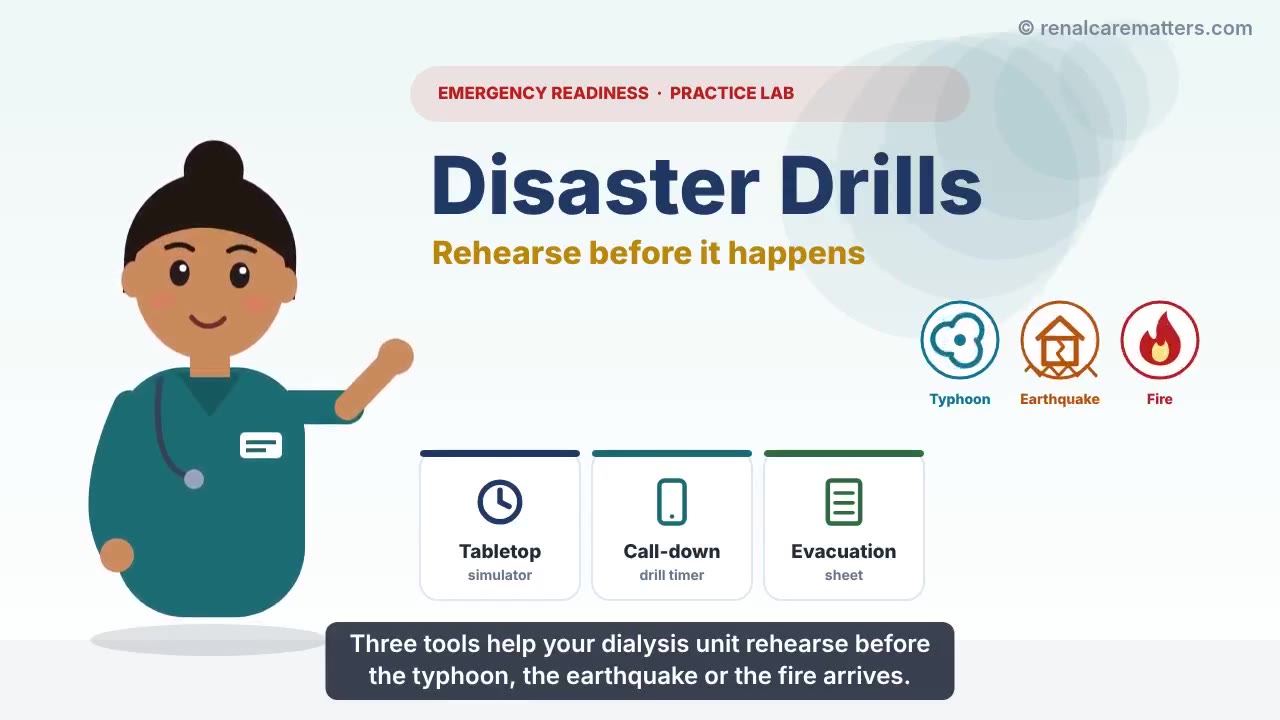
Welcome to Disaster Drills, the practice lab of the Disaster Preparedness course. Three tools help your dialysis unit rehearse before the typhoon, the earthquake or the fire arrives. Start with the sample typhoon week. Load each worked example to see a finished drill and how the facilitator reads it. Then clear it, and run your own. Tool one is the tabletop simulator. Gather the team around one screen, pick a scenario, and start the clock. The facilitator reads each inject aloud, the team decides out loud, and the recorder taps each action as it is said. At the end, a timeline shows every inject, the actions taken, and how long they took, against the teaching points. Use it for the hot wash and the after-action report. No one is scored. Tool two is the call-down drill. Before typhoon season, start the timer, phone everyone on the list, and mark each call. You see the share reached within two, six and twenty-four hours, and the wrong numbers to fix. Tool three is the evacuation sheet. Make it from your chair count, and print it blank for every shift. The charge nurse fills in each patient's mobility and helper, and the census nurse checks everyone off at the assembly point. Then try the ten branching cases. Each one puts you on a shift with a unit board, one decision at a time. Every case has a choice that breaks a hard rule, so you can see why the rule exists. Nothing you enter leaves your device. If any patients are still dialyzing during a drill, name a watcher who stays with them. Your unit protocol and your attending nephrologist decide every real event.
- Run the tabletop. The facilitator picks “Typhoon: Signal No. 3 by Thursday,” starts the clock and reads each inject aloud; the team decides out loud, and the recorder taps each action as it is said. The sample shows six injects over about 40 minutes, the actions the team said with how long each took, two actions nobody said, and the timeline for the hot wash.
- Test the call list. Enter how many people are on the list, start the drill, and tap one outcome per call. The sample: 58 people, 53% reached within 2 hours, 76% within 6 hours and 90% within 24 hours, with 3 wrong numbers to fix before the season.
- Print the evacuation sheet. Make the sheet from your chair count and print it blank for every shift; the charge nurse fills in mobility and helpers at the start of the shift. The sample shows a 12-station sheet filled during a fire drill.
Every number, initial and time in the samples is fictional. The call-down sample is kept on this device like a real drill; press Clear to remove it.
Disaster tabletop simulator
For a facilitator and a team around one screen. Pick a scenario (typhoon, earthquake, fire, long power outage, ashfall) and start the clock. Injects arrive on the exercise clock, or when the facilitator releases them. The facilitator reads each inject aloud, the team decides out loud, and the recorder taps each action as it is said. At the end, a timeline shows each inject, the actions recorded and how long they took, against the scenario’s teaching points: the evidence for the hot wash and the after-action report (Module 12). Shared display shows the current inject full screen. No individual is scored, and nothing leaves this device.
Run it with a named watcher if any patients are still dialyzing (the watcher rule). The scenarios follow the modules; your unit protocol and the attending nephrologist decide every real event.
Call-down drill timer
Test the call list before typhoon season. The safety nurse (or head nurse) starts the timer, the team phones every person on the list, and each call is marked: reached, message left, no answer, wrong number, or not able to come. The timer reports the share reached within 2, 6 and 24 hours and the wrong numbers to fix. It counts outcomes only: no names or phone numbers are entered, and the counts stay on this device. The 24-hour figure is your unit’s own measure; no external standard is claimed.
Evacuation and patient-accounting sheet
A one-page sheet made from your chair count: each station’s mobility category (walks alone, walks with help, wheelchair, stretcher), the assigned helper, the time off by staff, and a check-off column for the census nurse at the assembly point. Print it blank and fill it in at the start of every shift. Nothing is stored online; the filled sheet is a unit record under the Data Privacy Act.
Ten branching cases, one in each module
Each case puts you on the shift with a unit board (time, alert, power, water, patients on machines, staff, roads) and asks for one decision at a time. Every case has at least one choice that breaks a hard rule, so you can see why the rule exists.
- The map that missed the pump (Module 2)
- Signal No. 2 on a Sunday (Module 3)
- Mang Ernesto’s go-bag (Module 4)
- Signal No. 3 by Thursday (Module 5)
- Magnitude 6.8 at 9:40 a.m. (Module 6)
- Smoke from the reprocessing room (Module 7)
- Brownout at 4:20 p.m. (Module 8)
- Ash on the windshield (Module 9)
- Twelve chairs, forty patients (Module 10)
- The gate that wasn’t signed (Module 11)
Modules
- Module 1: Why Disasters Hurt Dialysis Patients Twice
- Module 2: Know Your Unit's Hazards and Dependencies
- Module 3: The Unit Plan and Who Commands
- Module 4: Ready Patients: Card, Diet, Medicines, Contacts
- Module 5: Typhoons and Floods
- Module 6: Earthquake on the Machine
- Module 7: Fire and Evacuation
- Module 8: Power, Water and Supplies
- Module 9: Heat, Ashfall and Outbreaks
- Module 10: Keeping Everyone Dialyzed: Priority, Placement, Tracking
- Module 11: Reopening Safely and Recovering
- Module 12: Running Drills That Change Practice
The drill program, the facilitator’s role and the observed stations are in the facilitator kit.