RACE and the extinguisher, oxygen and smoke, the emergency take-off for evacuation, mobility categories, the route, and the census at the assembly point.
PublishedNailathalaGipatikPepalwal:ReferencesMga SanggunianMga TinubdanReng Reperensya:2Audience: Every member of the dialysis unit: hemodialysis, charge, head and safety nurses, physicians-on-duty, the Dialysis Clinical Head and attending nephrologists, dialysis, water treatment, biomedical and reprocessing technicians, nurse assistants and support staff, social workers, records officers, dietitians, unit managers and ownersRead timeOras ng pagbasaOras sa pagbasaOras ning pamamasa:
This module is study material for dialysis teams. It explains the reasoning behind disaster decisions; it is not a unit protocol or an order set. Early dialysis, shortened sessions, priority rosters and emergency diets are decisions of the attending nephrologist and the Dialysis Clinical Head. Escalation follows your unit protocol, and you always ask the attending nephrologist for guidance. Every case, name, and identifier is fictional.
Learning objectives
After this module you should be able to
Use RACE (rescue, alarm, contain, extinguish or evacuate) as a teaching aid for the first actions in a fire.
Use a fire extinguisher with pull, aim, squeeze, sweep (PASS), and know when not to fight a fire.
Manage oxygen and smoke in a dialysis unit.
Evacuate patients by mobility category, after an emergency take-off by staff with the blood rule.
Account for every patient at the assembly point, with a named census nurse.
Classroom 1 hSkills lab 1 hSupervised placement 0 h
Pre-testBefore you read, answer the 5 self-assessment questions and note your score. After the module, select New set of questions and compare. The difference is what you learned; the questions you still miss are what to reread.
Start here
The big picture, in plain words
In plain wordsEvacuating a dialysis unit is like emptying a full jeepney through one door while several passengers are still tied to their seats. Somebody has to untie each one safely, somebody has to show the way, and somebody at the stop has to count heads before the jeepney drives off.
The picture has a limit: in a fire, smoke and heat set the clock, and the people “tied to their seats” are connected to circuits holding their own blood. That is why a fire response in a dialysis unit has two parts that must happen together: the general fire actions every building uses, and the dialysis-specific take-off and census that no general course teaches.
In one Taiwanese hemodialysis unit, a project of tabletop simulation, drills and audits raised staff fire-response knowledge and skill scores from about 58% to 100%. That was one before-and-after project, so it shows that a unit can learn this, not proof of better outcomes.1
Figure 1 · Key terms for this module
RACERescue, alarm, contain, extinguish or evacuate: a memory aid for the first actions in a fire.
PASSPull, aim, squeeze, sweep: a memory aid for using an extinguisher.
Mobility categoryHow a patient leaves the building (walks alone, walks with help, wheelchair, stretcher), set before the event.
Assembly pointThe agreed place outside where everyone gathers and is counted.
Census nurseThe named nurse who holds the patient list and accounts for every patient.
Horizontal evacuationMoving people away from the fire to a safer area on the same floor, behind a closed fire door.
Opening case · fictional
Case: Smoke from the reprocessing room
At 2:10 p.m., a nurse smells smoke and sees it coming from under the door of the dialyzer reprocessing room at the end of a ground-floor unit in Cebu City. Twelve patients are connected. Three use wheelchairs; one, recovering from a stroke, came on a stretcher. The fire alarm has not sounded.
A technician runs toward the reprocessing room with an extinguisher. Two nurses start disconnecting patients nearest the door. Nobody has the patient list in hand. The assembly point, by the plan, is the parking lot across the street.
Before reading on, decide:
What are the first four actions, and who does each?
How are the four patients who cannot walk moved, and by whom?
Who holds the census, and what happens if a name is missing at the assembly point?
Keep your answers in mind. The lesson gives you what you need, and the case review near the end shows one sound response.
Lesson · part 1
The first actions in a fire
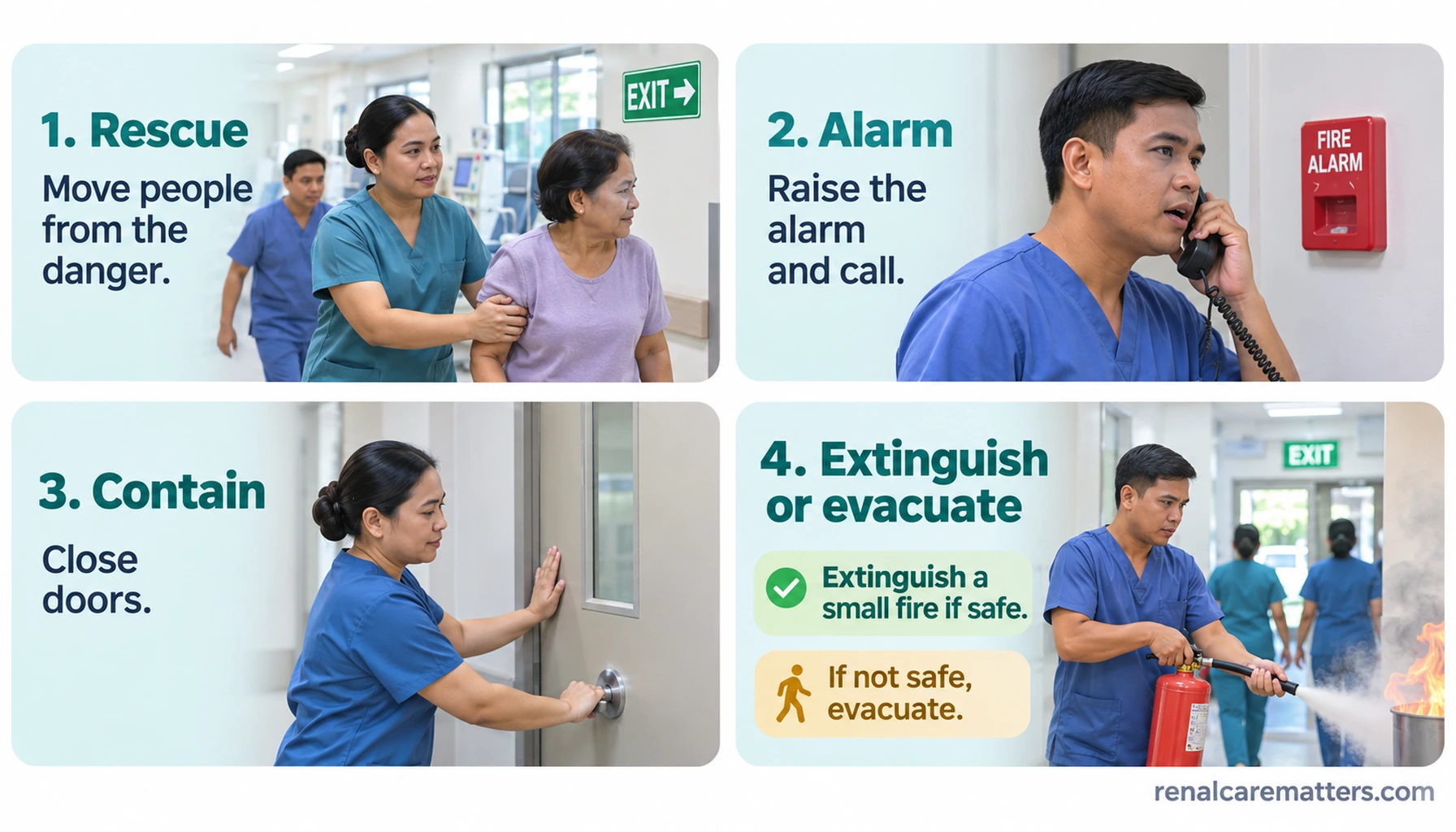
RACE is a teaching aid, not a strict order: in a real fire several things happen at once, done by different people.
Figure 2. RACE: rescue, alarm, contain, then extinguish a small fire or evacuate.
Rescue: move anyone in immediate danger away from the fire.
Alarm: raise the alarm and call the Bureau of Fire Protection and the hospital’s emergency number if hospital-based.
Contain: close doors to slow smoke and fire.
Extinguish or evacuate: fight only a small fire, with an exit behind you; otherwise evacuate.
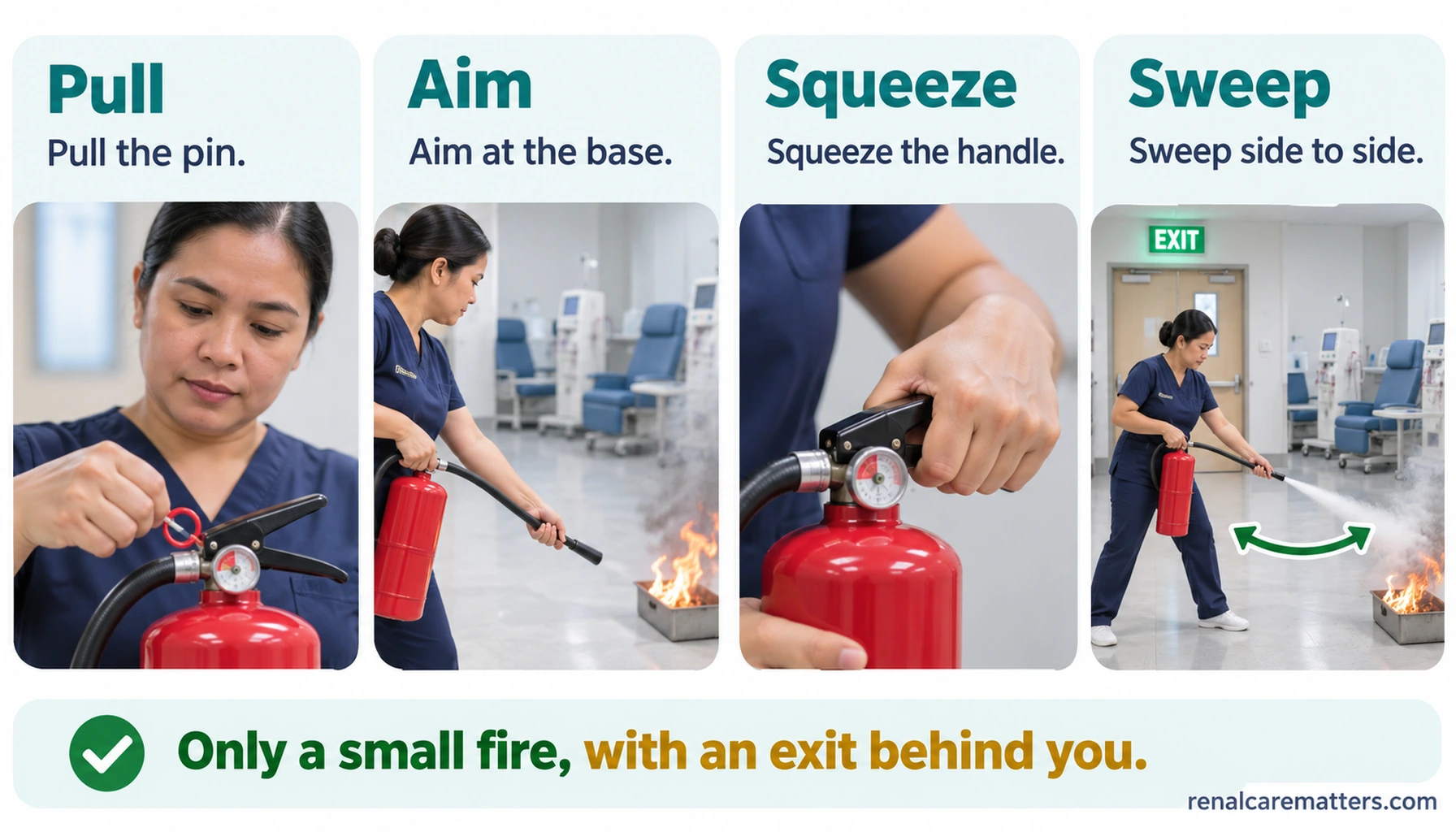
Figure 3. PASS: pull, aim, squeeze, sweep, and only for a small fire with an exit behind you.
To use an extinguisher, PASS: pull the pin, aim at the base of the fire, squeeze the handle, sweep side to side. Only a small fire, only with a clear exit behind you, and only if you are trained. A staff member never leaves a connected patient alone to fetch an extinguisher; that job belongs to someone without a patient.
Lesson · part 2
Oxygen makes fire burn faster
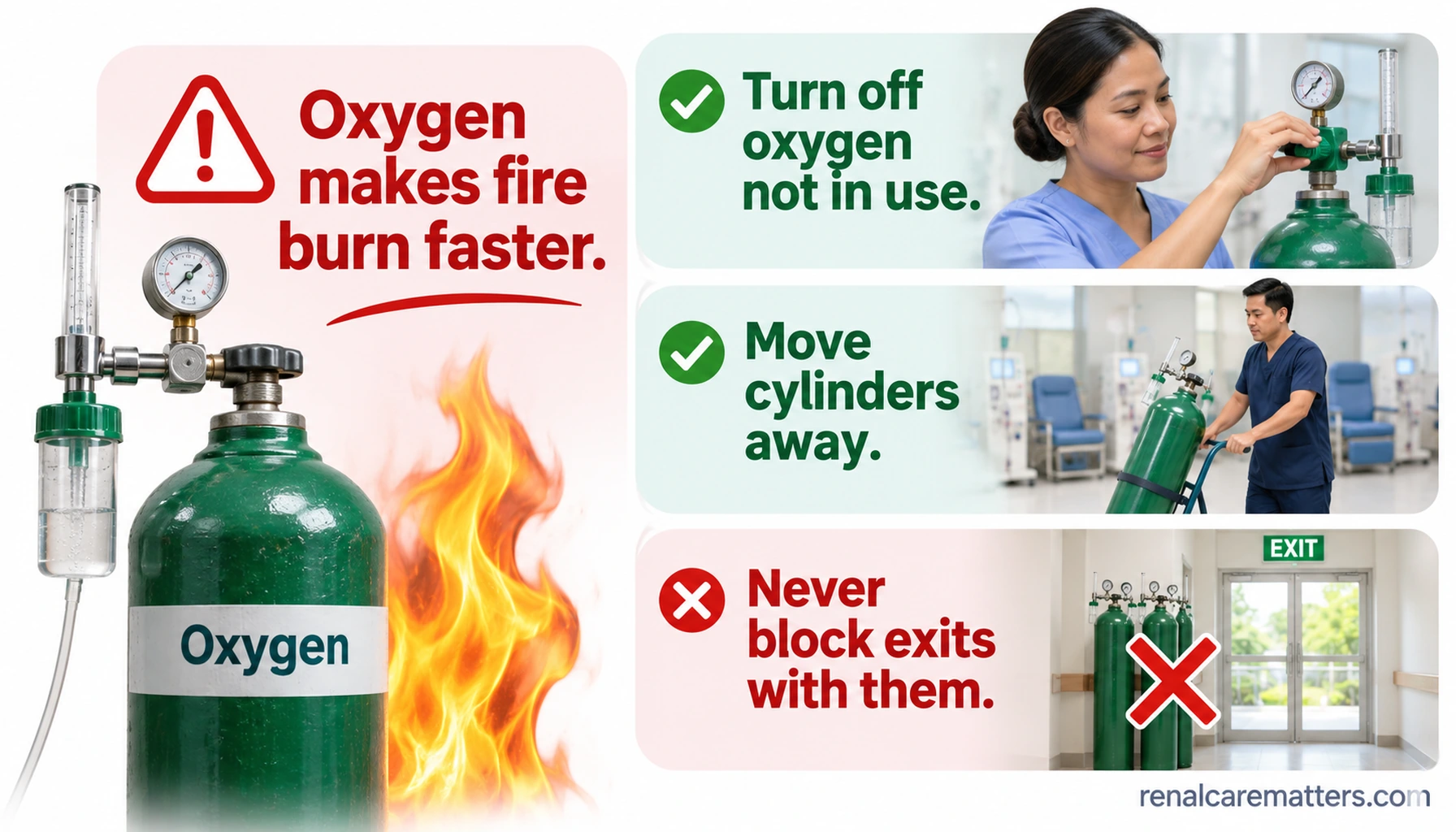
Oxygen does not burn, but it makes everything else burn faster and hotter. A dialysis unit stores oxygen cylinders for resuscitation and for patients who need it.
Figure 4. Oxygen makes fire burn faster. Turn off what is not in use and keep cylinders out of exits.
Turn off oxygen that is not in use, at the cylinder or wall outlet, if it is safe.
Move cylinders away from the fire if it is safe; keep them chained upright.
Never block exits with cylinders or equipment.
Smoke kills before heat. Stay low, close doors behind you, and do not use elevators in a fire. In a hospital-based unit, horizontal evacuation (to a safer area on the same floor, behind a closed fire door) is often the first step; the hospital’s plan decides.
Lesson · part 3
The emergency take-off, then out by mobility category
Take-off by staff. Patients are taken off by staff, one by one, with the same blood rule as in Module 6 and the Resuscitation Lab: blood that may contain air, is hemolyzed, or follows a severe reaction is never returned; otherwise return it if quick and safe, or clamp and disconnect. In a fire there is rarely time to return blood: clamp and disconnect is usually right. Close a central catheter’s own clamps before separating the lines; fistula needles are secured or removed as the unit’s protocol says, with pressure on the sites.
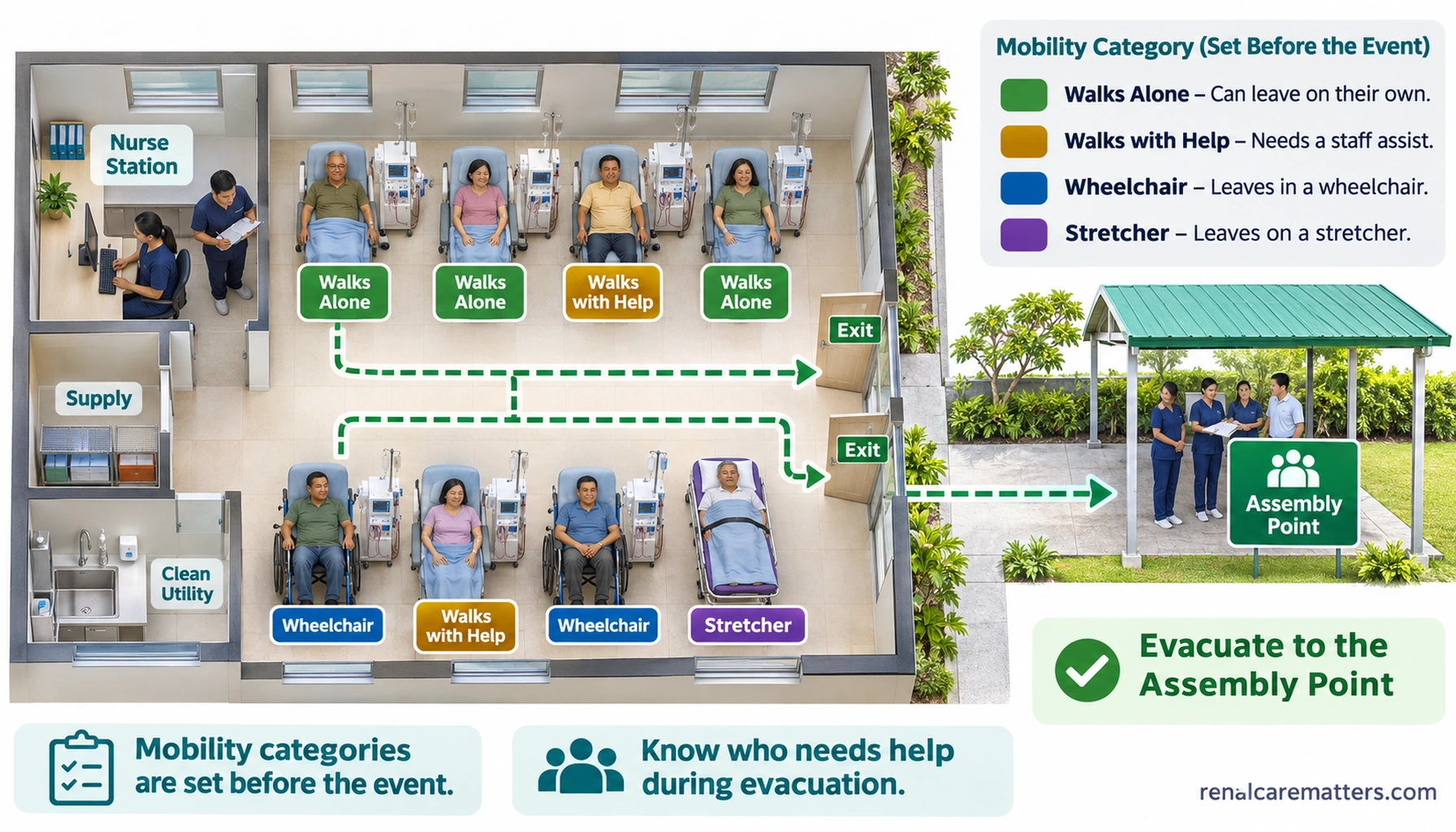
Mobility categories, set before the event. Each patient’s category is written on the evacuation sheet at the start of every shift: walks alone, walks with help, wheelchair, stretcher. Staff are assigned to the patients who cannot walk before anything happens. The printable evacuation sheet on the practice page lays this out by station.
Figure 5. Mobility categories are set before the event, so everyone knows who needs help to leave.
Order of leaving follows danger first (patients nearest the fire), then the plan. Walking patients go with a staff member to the assembly point; staff return for those who need help, wheelchairs and stretchers as the incident lead directs. Physician-on-Duty, Module 30 teaches the same rule from the physician’s side: patients who cannot walk are moved by staff assigned in advance, and everyone is counted at the assembly point.
RememberStaff take patients off with the blood rule; in a fire, clamp and disconnect is usually right. Mobility categories and helpers are set before the event, not during it.
Lesson · part 4
Account for every patient
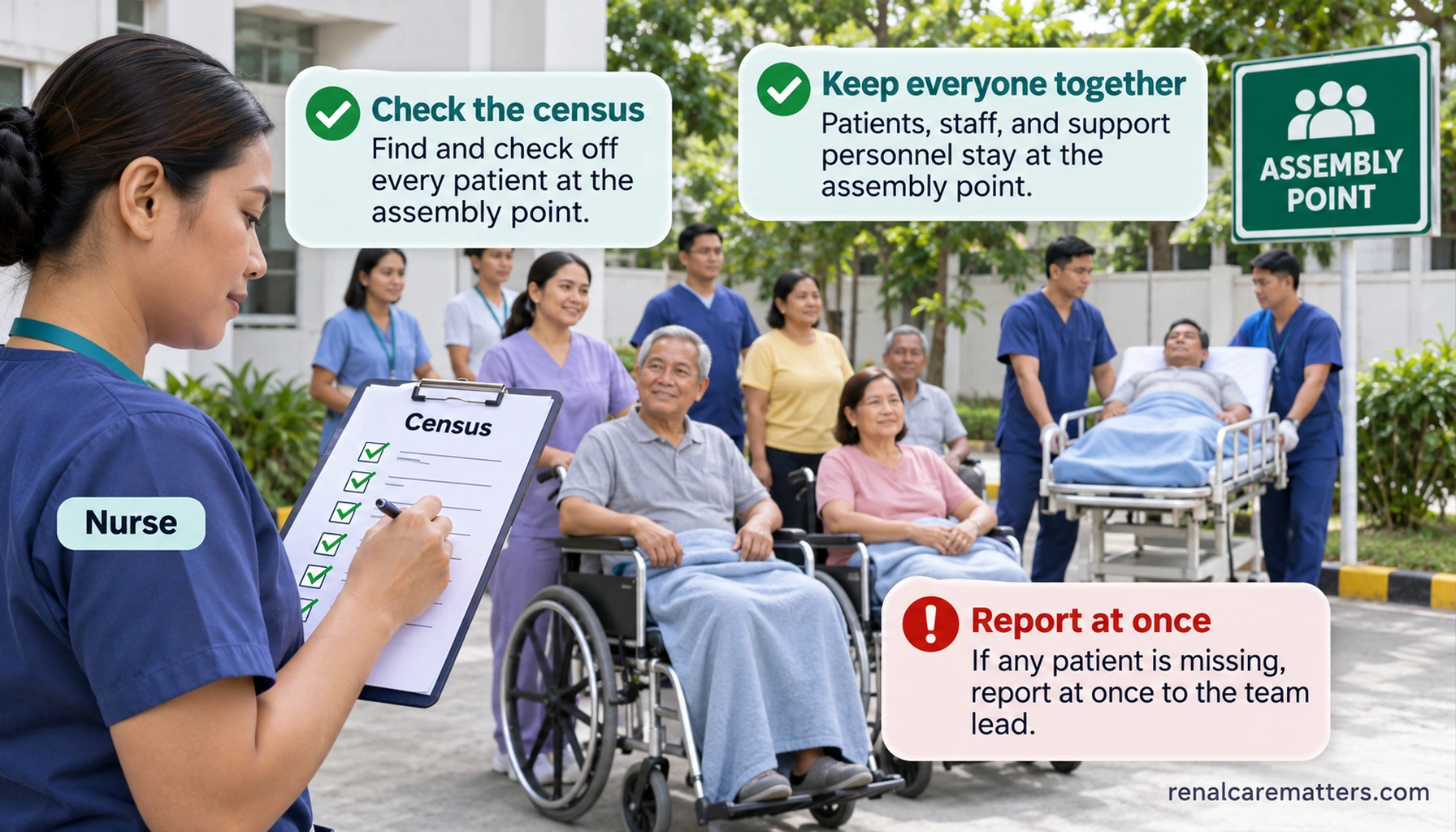
The most common failure in a real evacuation is not knowing who is out. One named census nurse takes the patient list (from the grab bag or the evacuation sheet) and checks off every patient at the assembly point: patients, then staff, companions and visitors.
Figure 6. A named nurse holds the census and checks every patient at the assembly point. Missing patients are reported at once.
If a name is missing, the census nurse reports at once to the incident lead, who tells the firefighters where the person was last seen. Staff do not re-enter a burning building to search. Everyone stays at the assembly point until the incident lead releases them, so the count stays true; patients who leave with family are recorded as leaving.
The safety nurse plans the routes, the assembly point and the census list, and runs the yearly evacuation drill, always with no patients on machines (Module 12). The Fire Code’s implementing rules call for fire exit drills “with sufficient frequency” where drills are required;2 the yearly frequency is an Academy suggestion.
Stop and callA patient or staff member missing at the assembly point: report to the incident lead at once and tell the firefighters. Never re-enter a burning building. Follow your unit protocol, and always ask the attending nephrologist for guidance about patients whose treatment was cut short.
🧒
Units that dialyze children
Plan car seats, strollers or carriers for small children, and keep the caregiver with the child. A child on a small circuit is taken off by staff with the pediatric team’s method. Children are counted by name at the assembly point like everyone else, with their caregivers.
On the floor
Real situations: problems and solutions
These are fictional but typical. For each one, cover the answer, decide what you would do, then compare. Where a step depends on local rules, your unit’s procedure and your supervisor’s direction come first.
The blocked exit
What you see
Oxygen cylinders and boxed supplies are stored against the rear exit door.
What is likely going on
An exit blocked by cylinders fails in exactly the event it exists for.
What to do
Clear it now, chain the cylinders elsewhere, and add exits to the daily check.
Why it matters
Exits are equipment too.
No list outside
What you see
At the assembly point nobody has the patient list; staff count faces.
What is likely going on
The census nurse was not named and the grab bag stayed inside.
What to do
Name the census nurse at the start of each shift and keep a list in the grab bag by the exit.
Why it matters
A count without a list cannot find who is missing.
The elevator
What you see
In a third-floor unit, a nurse heads for the elevator with a wheelchair patient during a fire alarm.
What is likely going on
Elevators can stop or open on a burning floor.
What to do
Use the stairs or horizontal evacuation per the building plan.
Why it matters
Plan the stair route for wheelchair and stretcher patients before the event.
Field notes
Update the evacuation sheet’s mobility categories at the start of every shift.
Walk the route to the assembly point once a quarter.
Case review
Back to the case: Smoke from the reprocessing room
The first actions. The nurse who saw the smoke raises the alarm (alarm), closes the reprocessing room door if it is safe (contain), and tells the charge nurse, who becomes incident lead. Someone without a patient calls the Bureau of Fire Protection. The technician may use the extinguisher only on a small fire with an exit behind him; reprocessing rooms hold chemicals, so if smoke keeps coming, he leaves and closes the door. Oxygen not in use is turned off.
Moving patients. The incident lead orders evacuation. Nurses take patients off one by one: clamp and disconnect, catheter clamps closed before separating lines, pressure on fistula sites. Patients nearest the smoke go first. The three wheelchair users and the stretcher patient have assigned helpers on the evacuation sheet; walking patients go out with a staff member to the parking lot.
The census. A named nurse takes the patient list and checks every name across the street. A missing name is reported to the incident lead and the firefighters; nobody goes back in. Two nurses disconnecting without a list, and a technician running alone at the fire, were the gaps; both are fixed by naming roles at the start of each shift.
Interactive case · fictional
Interactive case: Smoke from the reprocessing room
Work through a shift one decision at a time. The panel at the top changes with what you choose. After each choice you see why it is, or is not, the best move; after a weaker one you can try again or carry on and see where it leads. Your first choice at each step is scored. The score stays on this device and nothing is sent anywhere. In real practice, your unit’s protocol and the people responsible for each decision come first.
🚨 Emergency quick card:Fire or smoke. One screen each, saved for use with no signal. Print a copy for the crash cart.
Skills lab · with your preceptor
Skills checklist: Fire response, take-off and census
In a facilitated evacuation drill with no patients on machines, using manikins and a training circuit. Your preceptor rates each step as satisfactory, needs practice, or not observed. Steps marked Critical must all be satisfactory before sign-off. This checklist supports supervised learning; your unit’s own procedure and competency form are the authority. A printable version of every checklist is on the trainer page.
States RACE and assigns each action to a person.
Demonstrates PASS on a training extinguisher and states when not to fight a fire.
CriticalNever leaves a connected patient alone to fetch an extinguisher.
CriticalPerforms the emergency take-off with the blood rule and closes catheter clamps before separating lines.
Moves patients by their mobility category with the assigned helpers.
CriticalAs census nurse, accounts for every patient at the assembly point and reports any missing name at once.
Placement activity. Walk the evacuation route from your station to the assembly point and time it.
Self-assessment
Check your understanding
Each visit draws 5 questions at random from this module’s 10-question bank. Choose the single best answer for each, then select Check answers; an explanation appears under the best answer. Select New set of questions for a different mix. A good target is 4 of 5 on two different sets. Nothing you select is sent anywhere; scoring happens in your browser.
Lin, W.-H., Lin, Y.-J., Wang, M.-F., Yeh, S.-M., Hsu, T.-C., & Chang, Y.-T. (2021). [A project to improve the ability of hemodialysis staff to respond to fire emergencies]. Hu Li Za Zhi, 68(2), 65–74. https://doi.org/10.6224/JN.202104_68(2).09
Bureau of Fire Protection. (2019). Revised implementing rules and regulations of Republic Act No. 9514, the Fire Code of the Philippines of 2008. Republic of the Philippines.
Educational course and drill resource for dialysis units. It is not a hospital disaster plan, a licensing requirement, or a substitute for your unit’s approved protocol, the machine manufacturer’s instructions, or instructions from PAGASA, PHIVOLCS, the Bureau of Fire Protection or your local disaster office. Clinical decisions in a disaster (early dialysis, shortened sessions, priority, diet) belong to the attending nephrologist.