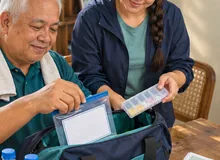
A one-page activation plan, simple incident command for a dialysis unit, triggers, communications when networks fail, and receiving-unit agreements.
PublishedNailathalaGipatikPepalwal:ReferencesMga SanggunianMga TinubdanReng Reperensya:8Audience: Every member of the dialysis unit: hemodialysis, charge, head and safety nurses, physicians-on-duty, the Dialysis Clinical Head and attending nephrologists, dialysis, water treatment, biomedical and reprocessing technicians, nurse assistants and support staff, social workers, records officers, dietitians, unit managers and ownersRead timeOras ng pagbasaOras sa pagbasaOras ning pamamasa:
This module is study material for dialysis teams. It explains the reasoning behind disaster decisions; it is not a unit protocol or an order set. Early dialysis, shortened sessions, priority rosters and emergency diets are decisions of the attending nephrologist and the Dialysis Clinical Head. Escalation follows your unit protocol, and you always ask the attending nephrologist for guidance. Every case, name, and identifier is fictional.
Learning objectives
After this module you should be able to
Write the eight parts of a one-page activation plan for a dialysis unit.
Describe a simple incident command structure for a dialysis unit, and explain why the safety nurse plans and drills but does not command during the event.
Set activation triggers from Philippine Atmospheric, Geophysical and Astronomical Services Administration (PAGASA) wind signals, Philippine Institute of Volcanology and Seismology (PHIVOLCS) reports and utility notices, and explain why the actions at each trigger are the unit’s own choice.
Keep communications working when mobile calls fail, and protect the call list as personal data.
Describe what a receiving-unit agreement must contain, and how a unit fits into its hospital’s disaster risk reduction and management (DRRM)-H plan or its LDRRMO.
Classroom 1 hSkills lab 0.5 hSupervised placement 0 h
Pre-testBefore you read, answer the 5 self-assessment questions and note your score. After the module, select New set of questions and compare. The difference is what you learned; the questions you still miss are what to reread.
Start here
The big picture, in plain words
In plain wordsA disaster plan is like the fire exit sign above a door: useful only if it is short, posted where people are, and the same for everyone. A thick binder in the manager’s office is a library, not a plan.
The sign has a limit: an exit sign tells you where to go, but a dialysis unit also has to decide who leads, who calls whom, which patients come early, and where they go if the unit closes. So the plan has two layers. The first is one page that anyone on the shift can open and follow. The second is the detail behind it (contact lists, agreements, the dependency map), kept up to date by the people who own it.
Reviews of disasters and kidney care keep finding the same gap: units with no written plan, or a plan nobody had practiced.1,2 After Hurricane Maria, a nephrology service in Puerto Rico listed its lessons: a plan shared with staff and patients before the storm, a registry of patients with updated phone numbers, relatives and an address rescuers can reach, a prearranged plan to move patients to another center, and attention to the staff’s own needs.3
Figure 1 · Key terms for this module
ActivationThe moment the plan is switched on, by a named person, for a named trigger.
TriggerA defined event that activates the plan or the next step of it, such as a wind signal.
Incident leadThe person who directs the response during the event.
Incident commandA simple structure that names who leads, who handles patients, equipment, tracking and outside contacts.
Call-downContacting every staff member and patient on the list in a set order.
Receiving-unit agreementA written agreement that another unit will treat your patients if you cannot.
Opening case · fictional
Case: Signal No. 2 on a Sunday
At 11:00 a.m. on a Sunday, PAGASA raises Tropical Cyclone Wind Signal No. 2 for Bulacan. A 16-station unit in Malolos is closed on Sundays. Its head nurse, who is also its acting safety nurse because no safety nurse has been named, is at a family lunch. The unit’s plan says: “Signal No. 2: activate the call-down; ask the attending nephrologist about early dialysis.”
The call list has 58 patients and 19 staff. The Monday–Wednesday–Friday group has 30 patients. The charge nurse for Monday lives in a barangay that flooded last year. One receiving unit is listed in the plan; its contact person retired in June.
Before reading on, decide:
Who activates the plan, and who leads once it is active?
Who is called first, and in what order?
What has to be fixed on the plan before the next signal?
Keep your answers in mind. The lesson gives you what you need, and the case review near the end shows one sound response.
Lesson · part 1
One page anyone on the shift can follow
The activation plan fits on one page, posted beside the nurses’ station and saved in the grab bag. Behind it sit the detailed documents, each with an owner.
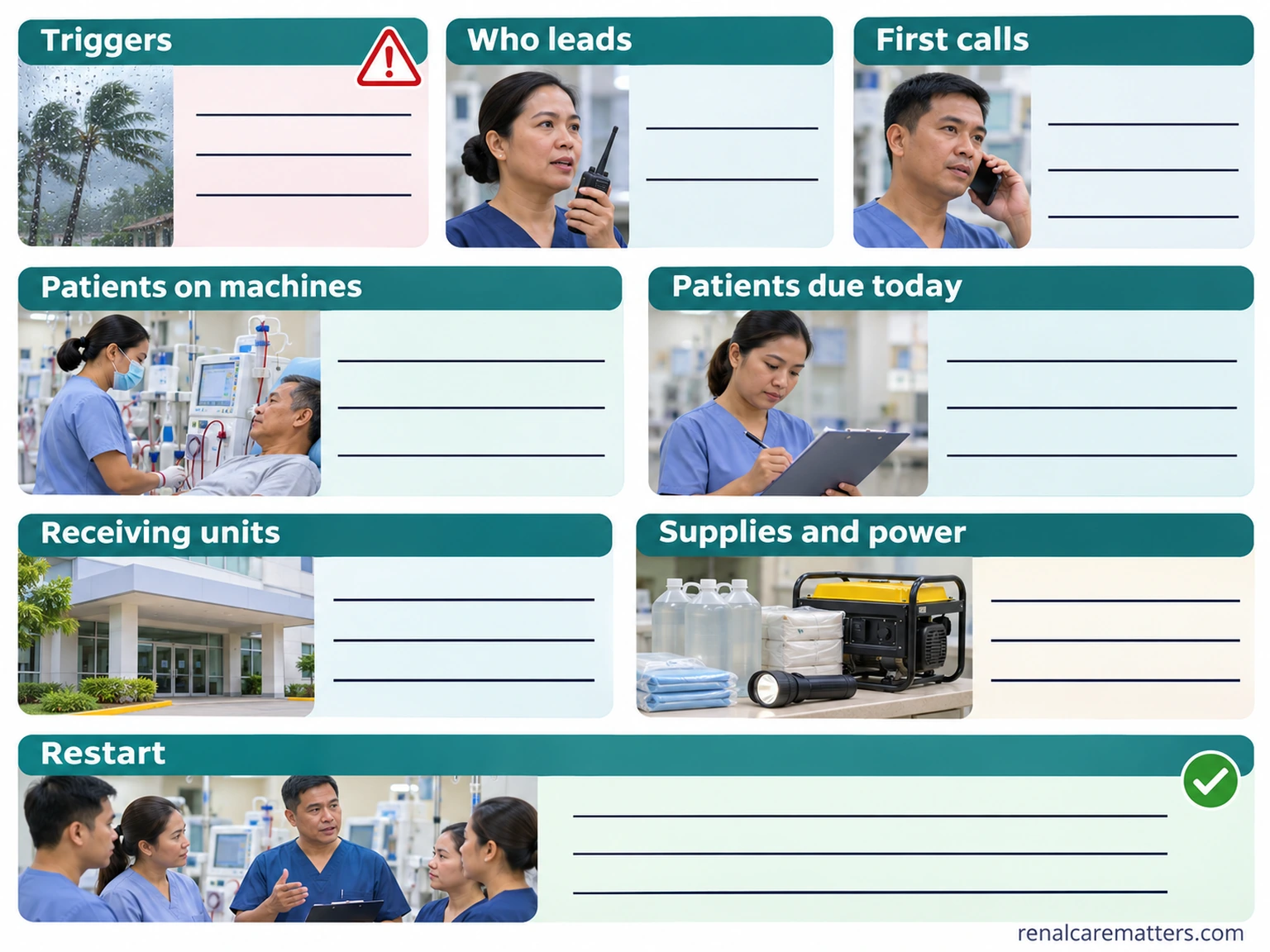
Figure 2. The unit plan fits on one page: triggers, who leads, first calls, patients, receiving units, supplies and restart.
Part
What it says
Owner of the detail
Triggers
What switches the plan on, and what happens at each level
Unit manager, with the Dialysis Clinical Head
Who leads
The incident lead by shift, and the deputy
Unit manager
First calls
The attending nephrologist, the Dialysis Clinical Head, the unit manager, the technicians
Safety nurse (or head nurse)
Patients on machines
The rule: stay with them; protect in place; staff take patients off
Head nurse
Patients due today
Call-down, early dialysis decision, transport
Charge nurse, with the attending nephrologist
Receiving units
Names, contact persons, what to send
Unit manager and social worker
Supplies and power
Fuel, water, supply buffer, generator check
Technicians
Restart
The five signed gates (Module 11)
Head nurse and Dialysis Clinical Head
A hospital-based unit writes its page inside the hospital’s disaster plan, which the Department of Health frames through its disaster risk reduction and management in health (DRRM-H) policy and its Hospitals Safe from Disasters policy.4,5 A freestanding unit writes its own page and coordinates warnings and evacuation routes with its city or municipal LDRRMO, set up under Republic Act No. 10121.6
Lesson · part 2
Incident command for a dialysis unit
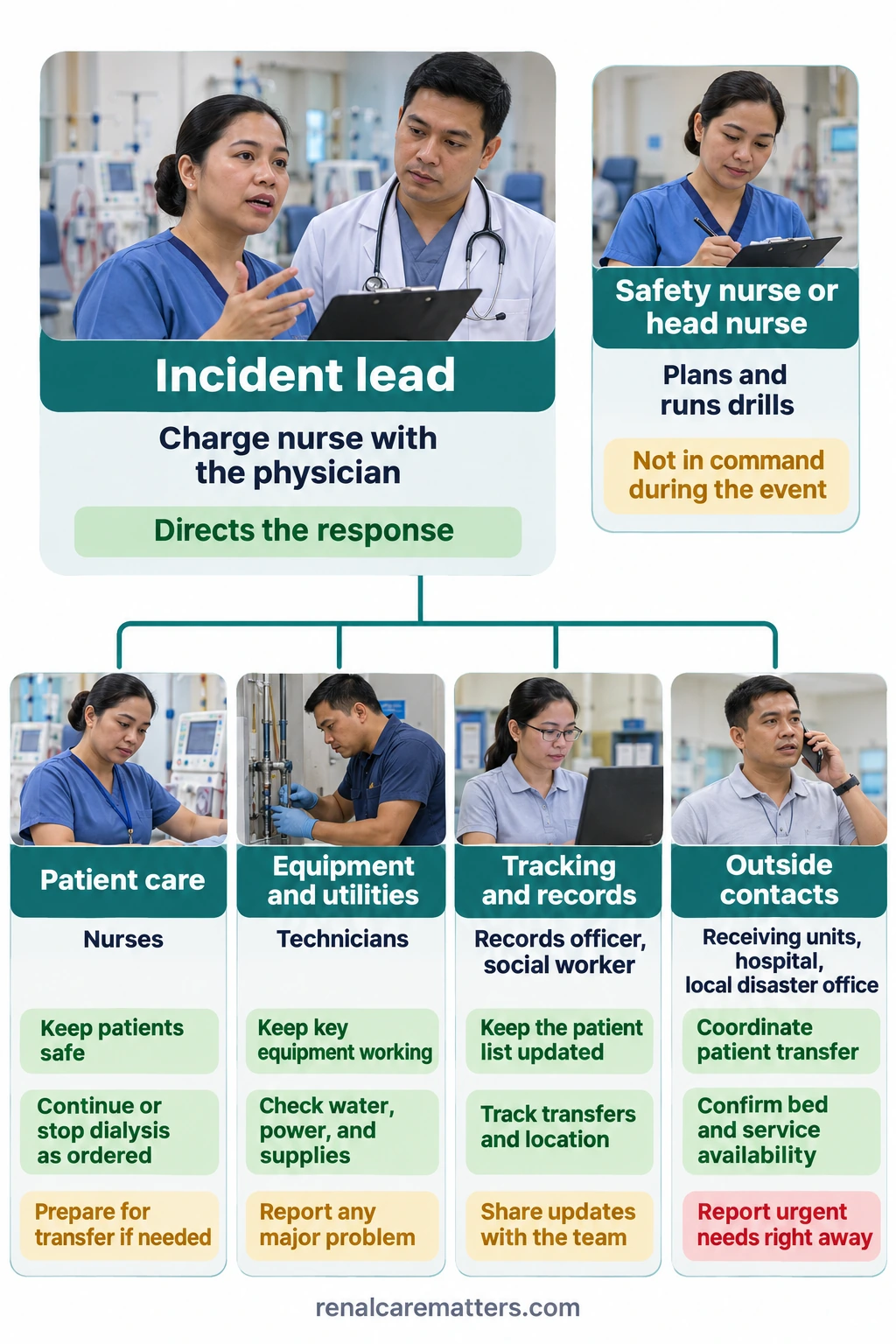
In an event, one person directs. In a dialysis unit that is the charge nurse, with the physician-on-duty (or the attending nephrologist by phone): they know the patients on the machines and can make clinical decisions. Four groups report to them.
Figure 3. Who commands during the event, and who does what. The person who runs the drills is not the one in command.
Patient care (nurses). Keep patients safe, continue or stop dialysis as ordered, prepare for transfer if needed.
Equipment and utilities (technicians). Keep key equipment working; check water, power and supplies; report any major problem.
Tracking and records (records officer, social worker). Keep the patient list updated, track transfers and locations.
Outside contacts. Receiving units, the hospital and the LDRRMO: confirm beds and services, report urgent needs.
The safety nurse plans and runs drills, but does not command during the event. The safety nurse (Special Dialysis Nurse Roles, Module 7) knows the plan best and often becomes the incident lead’s closest helper, but command stays with the people who carry clinical responsibility for the patients on that shift. Licensed engineers and technicians decide about the building, the water and the machines. Where no safety nurse is designated, the head nurse holds the planning role.
RememberOne incident lead per shift, with a named deputy. The safety nurse plans; the charge nurse and the physician command; technicians decide about equipment.
Lesson · part 3
Triggers: when the plan switches on
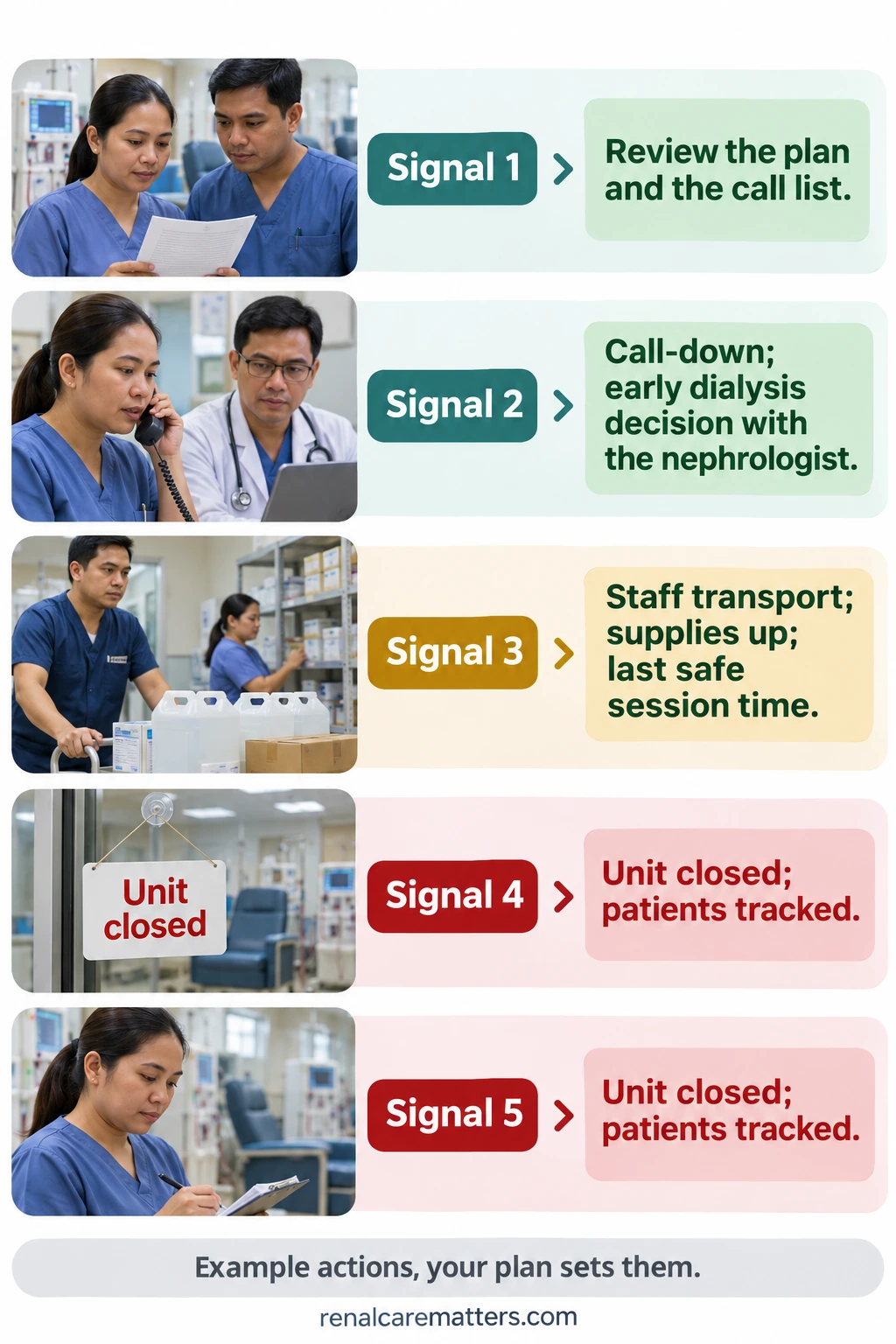
A trigger turns a vague worry into a set time to act. PAGASA’s five tropical cyclone wind signals each carry a wind threat and a lead time before the winds arrive: Signal No. 1, 39 to 61 km/h within 36 hours; No. 2, 62 to 88 km/h within 24 hours; No. 3, 89 to 117 km/h within 18 hours; No. 4, 118 to 184 km/h within 12 hours; and No. 5, 185 km/h or more within 12 hours.7 The lead time is what a unit uses.
Figure 4. Signals rise; so do the unit's actions. The actions shown are an example; your plan sets yours.
The actions in the figure are an example. Each unit sets its own, because a unit that floods at Signal No. 2 cannot wait for No. 4. A common pattern is: review the plan and the call list at Signal No. 1; start the call-down and ask the attending nephrologist about early dialysis at No. 2; arrange staff transport, stock up and set the last safe session time at No. 3; close and track patients at No. 4 or No. 5. Other triggers are a PHIVOLCS earthquake report or volcano alert, a utility notice of a long interruption, and the LDRRMO’s evacuation advice.
Name the person who declares each trigger (usually the incident lead or the unit manager), and write the time of activation on the record. A plan that activates “when things look bad” activates too late.
Lesson · part 4
Calls that still get through, and someone to send patients to
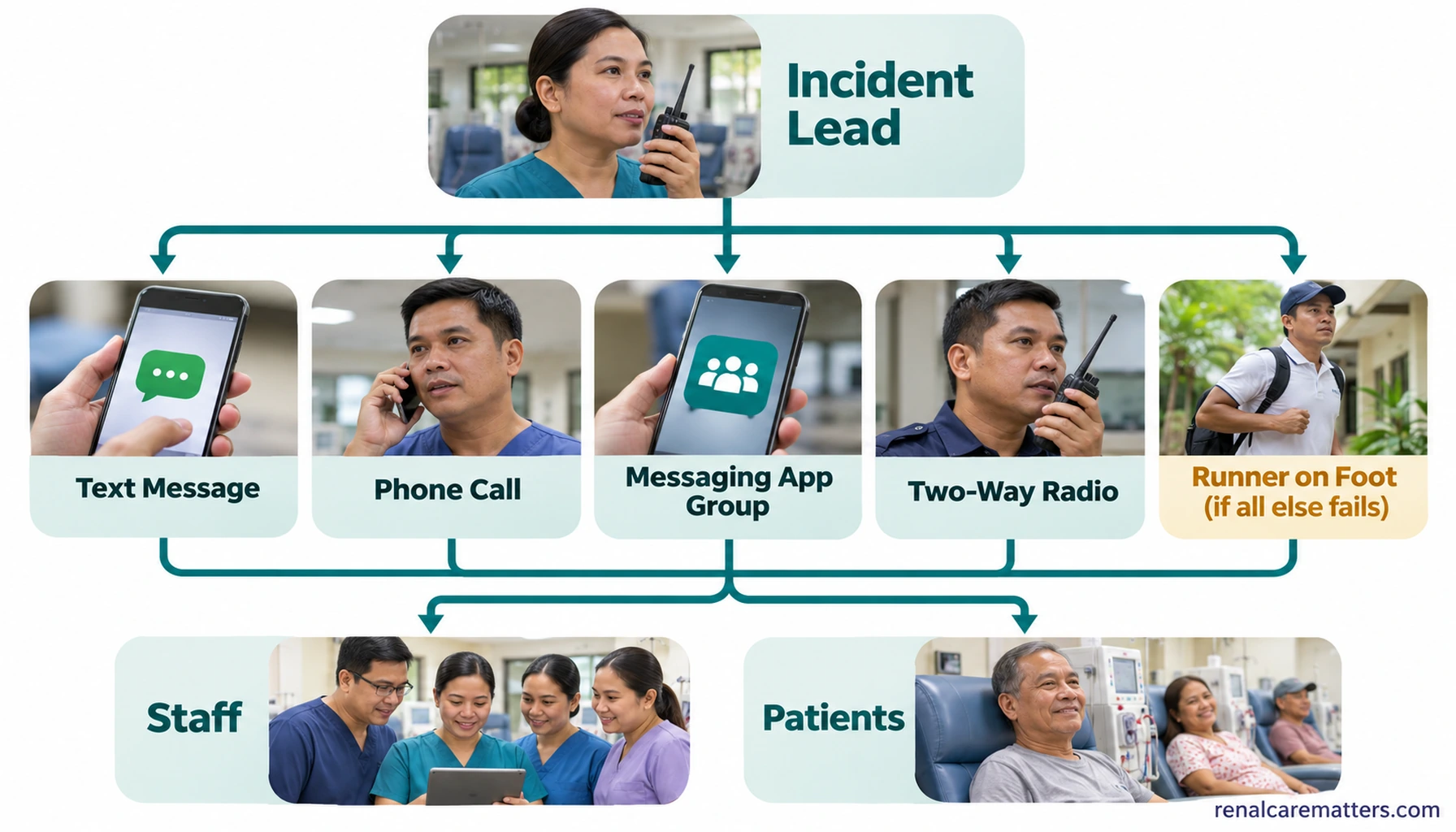
When networks are overloaded or towers lose power, voice calls fail first. Text messages often still get through, and a messaging group reaches many people at once. Build the call-down tree with more than one channel: text, call, messaging group, two-way radio between the unit and its generator room, and a runner on foot if all else fails.
Figure 5. When networks fail, have more than one way to reach staff and patients, down to a runner on foot.
Order the call-down by risk. Staff first (so the unit knows who can come), then patients due in the next 24 hours, then the rest. Every patient’s record shows two phone numbers and a family contact, checked before typhoon season.
Receiving-unit agreements. A receiving unit is useful only if someone there answers and knows what to expect. A written agreement names the contact person and a deputy, how many extra patients the unit could take and on which shifts, what you will send (a handoff with the prescription, access, last laboratory results, hepatitis status and medicines; Module 10), and how patients will be transported. Check the contacts every year; people move on.
The call list is personal data. Keep it as a unit document under the Data Privacy Act, share it only with the staff doing the call-down, and delete forwarded copies after the event.8
Stop and callWhen a trigger is reached and the incident lead cannot be reached, the deputy activates the plan and informs the unit manager and the Dialysis Clinical Head. Follow your unit protocol, and always ask the attending nephrologist for guidance on early dialysis or any change to treatment.
On the floor
Real situations: problems and solutions
These are fictional but typical. For each one, cover the answer, decide what you would do, then compare. Where a step depends on local rules, your unit’s procedure and your supervisor’s direction come first.
Two leaders
What you see
During a brownout, the charge nurse and a visiting nephrologist give different instructions to the same nurses.
What is likely going on
No one has been named incident lead for the event.
What to do
Name one lead aloud (the charge nurse with the physician), and route every instruction through them.
Why it matters
Two leaders give two plans.
The group chat
What you see
A staff member posts the full patient call list with addresses in a large group chat to speed up the call-down.
What is likely going on
Personal data has been shared beyond the people who need it.
What to do
Remove it, share the list only with the callers, and tell the unit manager.
Why it matters
The call list is protected under the Data Privacy Act.
“When things look bad”
What you see
The plan says to activate “when the storm looks serious.”
What is likely going on
A vague trigger activates too late.
What to do
Rewrite it as a named signal level or alert, and name who declares it.
Why it matters
A trigger must be clear enough for the deputy to use alone.
Field notes
Test the call-down tree before typhoon season and fix every wrong number.
Check receiving-unit contacts every year.
Case review
Back to the case: Signal No. 2 on a Sunday
Who activates and who leads. The plan names the trigger (Signal No. 2) and the person who activates it. On a Sunday that should be the on-call lead or the deputy, not whoever happens to read the news. Once active, the Monday charge nurse leads with the physician-on-duty; the acting safety nurse supports the call-down.
Call order. Staff first, to know who can come in Monday, especially the charge nurse from the flood-prone barangay. Then the 30 Monday patients, with the attending nephrologist’s decision on early dialysis. Then the rest.
What to fix. Name a deputy for every role, replace the retired contact at the receiving unit and add a second unit, and check every patient’s two phone numbers before the season. A call-down drill (Module 12) would have found the retired contact.
Interactive case · fictional
Interactive case: Signal No. 2 on a Sunday
Work through a shift one decision at a time. The panel at the top changes with what you choose. After each choice you see why it is, or is not, the best move; after a weaker one you can try again or carry on and see where it leads. Your first choice at each step is scored. The score stays on this device and nothing is sent anywhere. In real practice, your unit’s protocol and the people responsible for each decision come first.
🚨 Emergency quick card:Typhoon warning. One screen each, saved for use with no signal. Print a copy for the crash cart.
Skills lab · with your preceptor
Skills checklist: Writing and testing the one-page plan
With the head nurse and the unit manager, write or update the unit’s one-page activation plan and test it in a short tabletop. Your preceptor rates each step as satisfactory, needs practice, or not observed. Steps marked Critical must all be satisfactory before sign-off. This checklist supports supervised learning; your unit’s own procedure and competency form are the authority. A printable version of every checklist is on the trainer page.
CriticalIncludes all eight parts: triggers, who leads, first calls, patients on machines, patients due today, receiving units, supplies and power, restart.
CriticalNames the incident lead and a deputy for every shift.
Sets triggers with the unit’s own actions at each PAGASA signal level.
Builds a call-down tree with at least two channels besides voice calls.
CriticalLists at least two receiving units with current contact persons.
Keeps the call list as a protected unit document.
Placement activity. Run a 20-minute walk-through of the plan with the next shift’s charge nurse and record what was unclear.
Self-assessment
Check your understanding
Each visit draws 5 questions at random from this module’s 10-question bank. Choose the single best answer for each, then select Check answers; an explanation appears under the best answer. Select New set of questions for a different mix. A good target is 4 of 5 on two different sets. Nothing you select is sent anywhere; scoring happens in your browser.
Glossary & abbreviationsTalahulugan at mga daglatTalaan sa mga pulong ug daglatTalatinigan ampo reng daglatterms used on this page
Abbreviations
DOH
Department of Health — Philippines.
DRRM
Disaster risk reduction and management.
DRRM-H
Disaster risk reduction and management in health — The Department of Health’s policy framework for health-sector disaster planning.
LDRRMO
Local disaster risk reduction and management office — The city or municipal office for warnings, evacuation and local response.
PAGASA
Philippine Atmospheric, Geophysical and Astronomical Services Administration — The national weather agency; it raises the tropical cyclone wind signals.
PhilHealth
Philippine Health Insurance Corporation.
PHIVOLCS
Philippine Institute of Volcanology and Seismology — The agency that reports earthquakes, volcanic activity and tsunami warnings.
Terms in plain words
Activation
The moment the plan is switched on, by a named person, for a named trigger.
Trigger
A defined event that activates the plan or its next step.
Incident lead
The person who directs the response during the event.
Call-down
Contacting every staff member and patient on the list in a set order.
Receiving-unit agreement
A written agreement that another unit will treat your patients.
Sever, M. S., Luyckx, V., Tonelli, M., Kazancioglu, R., Rodgers, D., Gallego, D., Tuglular, S., & Vanholder, R. (2023). Disasters and kidney care: Pitfalls and solutions. Nature Reviews Nephrology, 19(10), 672–686. https://doi.org/10.1038/s41581-023-00743-8
Sandal, S., El Wazze, S., Nijjar, D., Ethier, I., Paparella, A. N., Hales, L., Finkle, S. N., Jha, V., & Stigant, C. (2025). A roadmap for disaster risk reduction and management in kidney care: A scoping review and content analysis. Journal of the American Society of Nephrology, 36(7), 1363–1379. https://doi.org/10.1681/ASN.0000000635
Bonilla-Félix, M., & Suárez-Rivera, M. (2019). Disaster management in a nephrology service: Lessons learned from Hurricane Maria. Blood Purification, 47(1–3), 199–204. https://doi.org/10.1159/000494580
Department of Health. (2019, October 29). National policy on disaster risk reduction and management in health (DRRM-H) (Administrative Order No. 2019-0046). Republic of the Philippines.
Educational course and drill resource for dialysis units. It is not a hospital disaster plan, a licensing requirement, or a substitute for your unit’s approved protocol, the machine manufacturer’s instructions, or instructions from PAGASA, PHIVOLCS, the Bureau of Fire Protection or your local disaster office. Clinical decisions in a disaster (early dialysis, shortened sessions, priority, diet) belong to the attending nephrologist.