Finding every patient within 24 hours, the medical priority roster, shortened sessions under six conditions, and placement at receiving units with a handoff.
PublishedNailathalaGipatikPepalwal:ReferencesMga SanggunianMga TinubdanReng Reperensya:6Audience: Every member of the dialysis unit: hemodialysis, charge, head and safety nurses, physicians-on-duty, the Dialysis Clinical Head and attending nephrologists, dialysis, water treatment, biomedical and reprocessing technicians, nurse assistants and support staff, social workers, records officers, dietitians, unit managers and ownersRead timeOras ng pagbasaOras sa pagbasaOras ning pamamasa:
This module is study material for dialysis teams. It explains the reasoning behind disaster decisions; it is not a unit protocol or an order set. Early dialysis, shortened sessions, priority rosters and emergency diets are decisions of the attending nephrologist and the Dialysis Clinical Head. Escalation follows your unit protocol, and you always ask the attending nephrologist for guidance. Every case, name, and identifier is fictional.
Learning objectives
After this module you should be able to
Find every patient within 24 hours of a disruption and track each one on a board.
Explain the medical priority roster: what goes into it and who sets it.
State the six conditions under which shortened sessions may be used, and the evidence behind them.
Place patients at receiving units with a complete handoff, and record every placement.
Classroom 1 hSkills lab 0.5 hSupervised placement 0 h
Pre-testBefore you read, answer the 5 self-assessment questions and note your score. After the module, select New set of questions and compare. The difference is what you learned; the questions you still miss are what to reread.
Start here
The big picture, in plain words
In plain wordsAfter a disaster, a dialysis unit is like a lifeboat with fewer seats than passengers. Somebody has to count everyone in the water, decide who comes aboard first, and wave down the other boats. Nobody is left without a plan, even if their seat is on another boat.
The picture has a limit. In a lifeboat, the order is often first come, first served. In a dialysis unit, the order is set by medical need: the time since the last treatment, the last potassium, fluid status and symptoms. That judgment belongs to the attending nephrologist, never to whoever answers the phone. And unlike a lifeboat, a unit can shorten the trip for some passengers, but only under strict conditions.
Planning for this is what separates disasters with excess deaths from those without. After Hurricane Katrina, the storm was not significantly associated with mortality among patients from 94 clinics in adjusted models;1 after Hurricane Maria, many patients were dialyzed outside Puerto Rico and mortality did not change significantly.2 Both teams point to coordinated placement and tracking.
Figure 1 · Key terms for this module
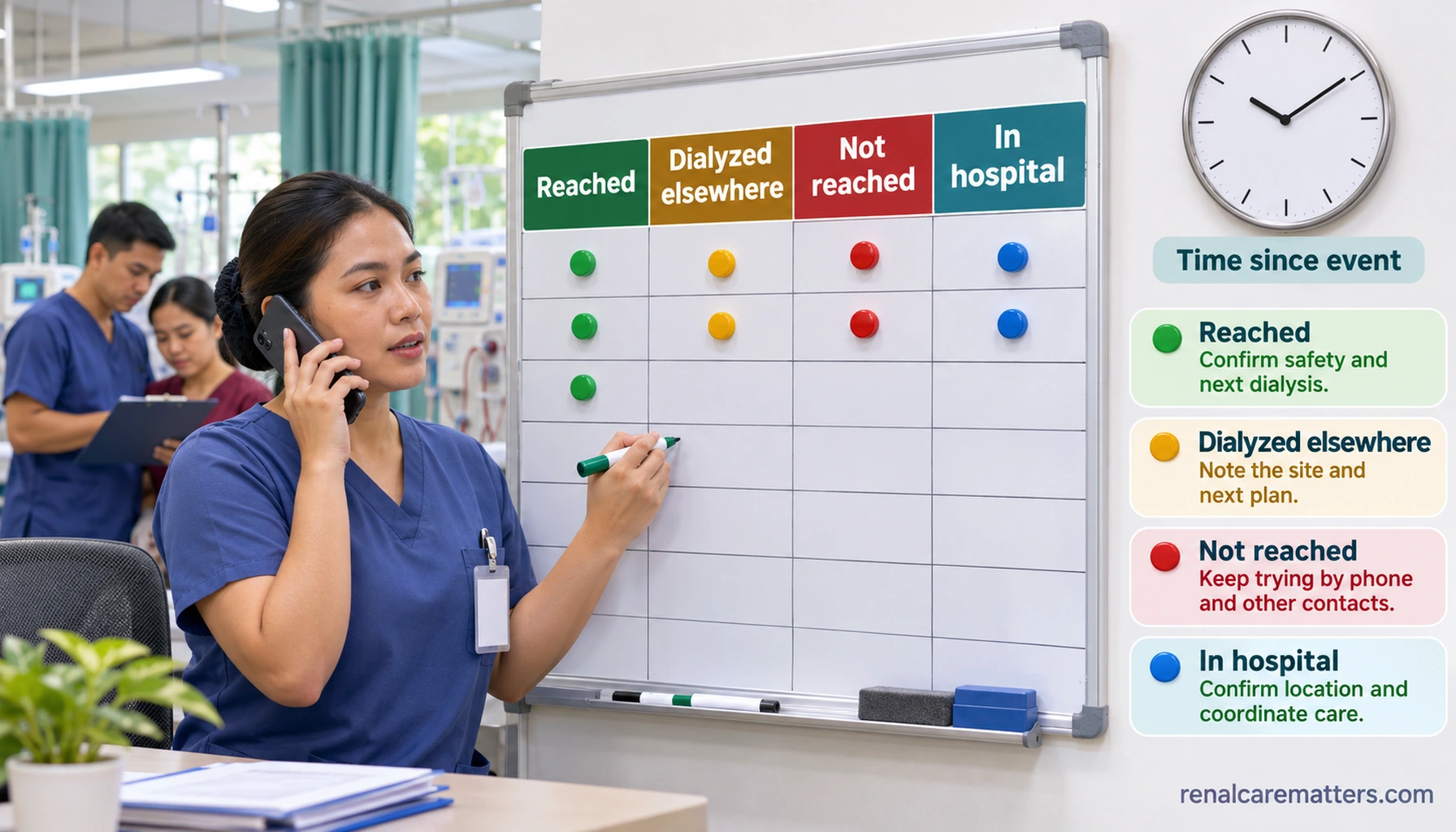
Tracking boardA board or list that shows where every patient is: reached, dialyzed elsewhere, not reached, in hospital.
Priority rosterThe attending nephrologist’s order for who dialyzes first when chairs, staff, water or power are short.
Shortened sessionA session cut below the prescribed length because of a real shortage, by written order.
Receiving unitAnother unit that treats your patients when yours cannot.
HandoffThe written information sent with a patient so another unit can dialyze them safely.
ReconciliationThe final record of who was dialyzed where and when (Module 11).
Opening case · fictional
Case: Twelve chairs, forty patients
Two days after a typhoon, a 20-station unit in Tacloban has power from its generator but only enough treated water and staff for 12 chairs for one long shift. Forty patients are due. Two receiving units, one in Ormoc and one in Palo, can each take six patients tomorrow if transport is arranged.
The tracking board shows 31 patients reached, 4 dialyzed at a hospital, and 5 not reached. Among those reached are a man whose potassium was 6.9 mmol/L on his last session, a woman with breathlessness and a 4 kg gain, and a young man who feels well and dialyzed four days ago.
Before reading on, decide:
Who decides who dialyzes today, and on what information?
Would shortened sessions help here, and under what conditions?
What goes with the patients sent to Ormoc and Palo?
Keep your answers in mind. The lesson gives you what you need, and the case review near the end shows one sound response.
Lesson · part 1
Find every patient within 24 hours
The first job after any disruption is a count. The call-down (Module 3) becomes a tracking board, updated every few hours, with one row per patient. The 24-hour target is the unit’s own measure of how well its plan works; no external standard is claimed.
Figure 2. Find every patient: a tracker that shows who is reached, dialyzed elsewhere, missing or in hospital.
Status
What to do next
Reached
Confirm safety, symptoms and the next dialysis
Dialyzed elsewhere
Note the site, the date and the next plan
Not reached
Keep trying by phone and other contacts; the social worker, barangay health workers and the local disaster risk reduction and management office (LDRRMO) can help find people
In hospital
Confirm the location and coordinate care
The board is a unit document holding personal data; keep it inside the unit and share only what each helper needs.3 In Miyagi, Japan, a regional network built after the 2011 earthquake now shares hemodialysis reports (prescription, laboratory data, allergies) among participating units, partly as a disaster backup for moving patients.4
Lesson · part 2
Who dialyzes first
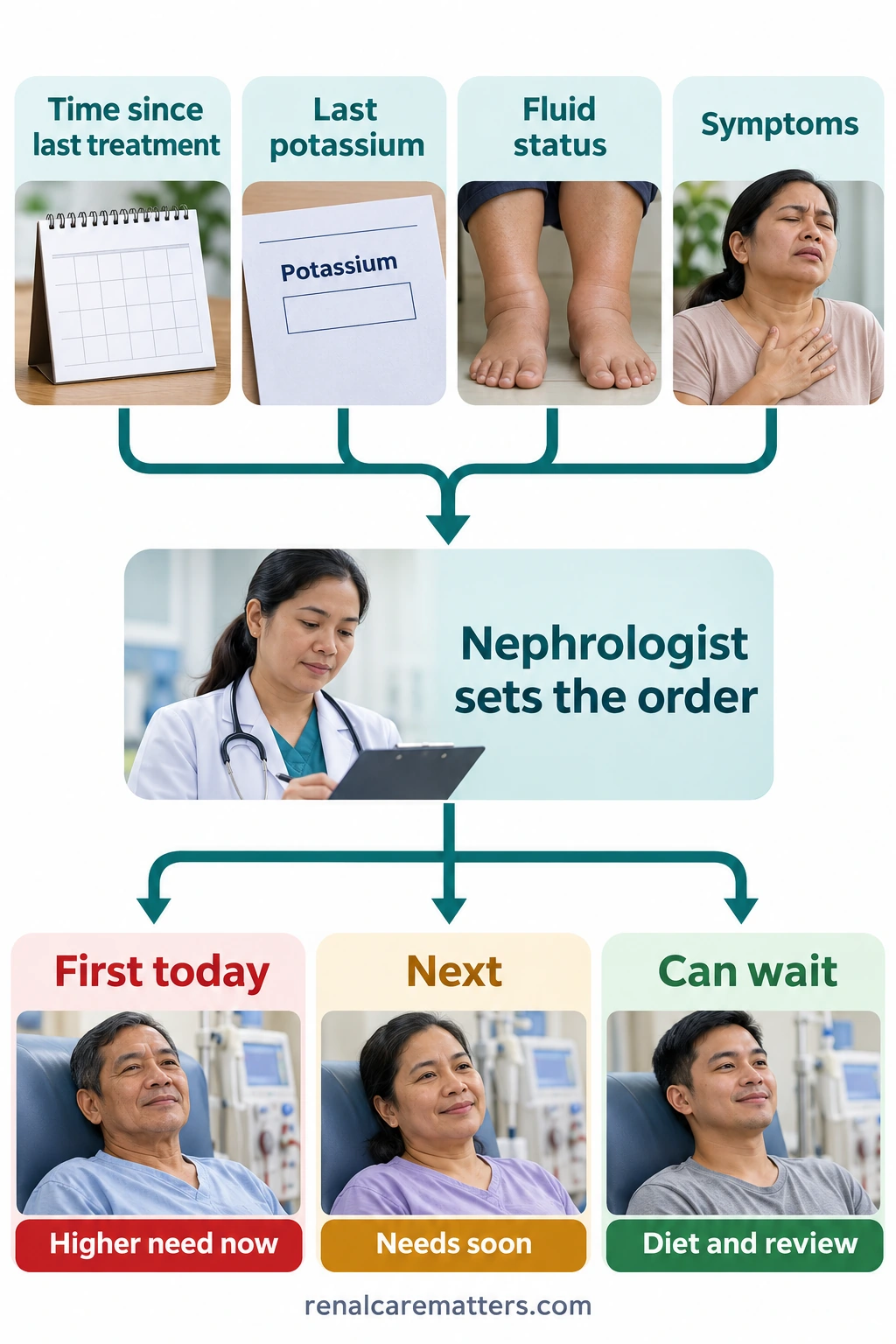
When there are fewer sessions than patients, the attending nephrologist sets the order from four inputs: time since the last treatment, the last potassium, fluid status, and symptoms (with missed sessions folded into time since treatment). The charge nurse and the tracking board supply the facts; the nephrologist decides.
Figure 3. Who dialyzes first is a medical decision. The nephrologist weighs time since dialysis, potassium, fluid and symptoms.
First today: higher need now, such as a high potassium, breathlessness, a large weight gain, or the longest time since treatment.
Next: needs dialysis soon.
Can wait: stable, recently dialyzed; the emergency diet and a review, with a planned slot.
The disaster triage list (Head Nurse toolkit, CALC-11) helps organize the facts for the nephrologist; it does not make the decision. A patient’s place on the list can change with a new symptom or a new laboratory result.
Lesson · part 3
Shortened sessions: only when all six conditions hold
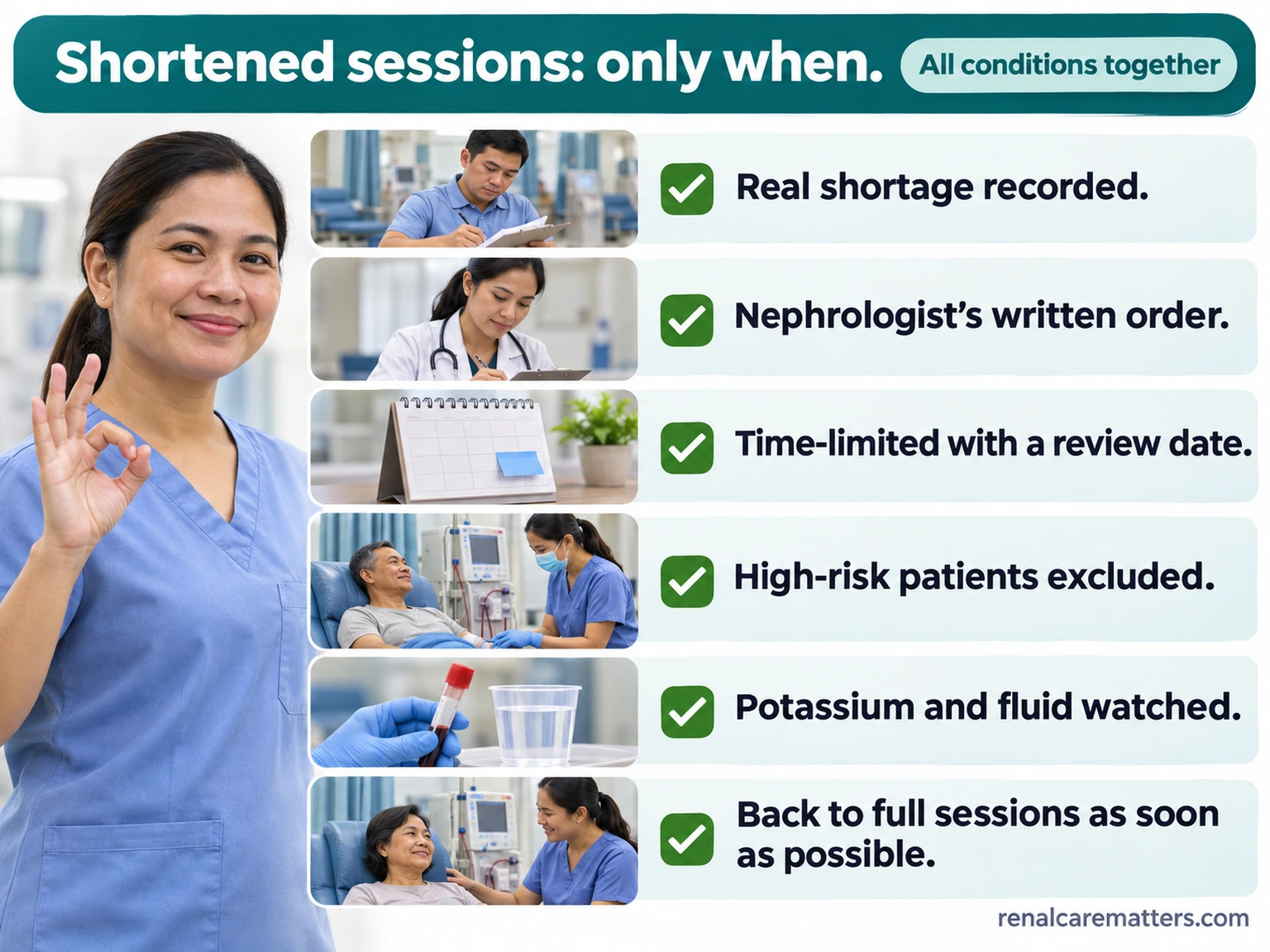
Shortening sessions spreads limited capacity across more patients. It is a conditional option (Dr. Rivero’s decision), never a routine prescription, and it is used only when all six conditions hold:
Figure 4. Shortened sessions are a conditional option, never a routine: six conditions, all at once.
A real shortage of chairs, staff, water or power, recorded by the Dialysis Clinical Head.
A written order from the attending nephrologist for each patient or group.
Time-limited, with a stated end date or review date.
Not for patients the nephrologist marks as high risk (for example, a recent high potassium, fluid overload or symptoms); they keep their full session or move first to a receiving unit.
Monitoring of potassium and fluid status while it lasts, with the emergency diet reinforced.
A return to the full prescription as soon as capacity allows, recorded in the reconciliation (Module 11).
The evidence is thin. After the 2011 Great East Japan Earthquake, two units in Fukushima shortened sessions by 0.5 to 1 hour for a month, and laboratory findings in 90 patients did not worsen.5 It was a small retrospective study. Say “was not associated with worse laboratory findings in one small study,” never “is safe.”
RememberShortened sessions need all six conditions, a written order and an end date. High-risk patients keep full sessions or move first.
Lesson · part 4
Placing patients at receiving units
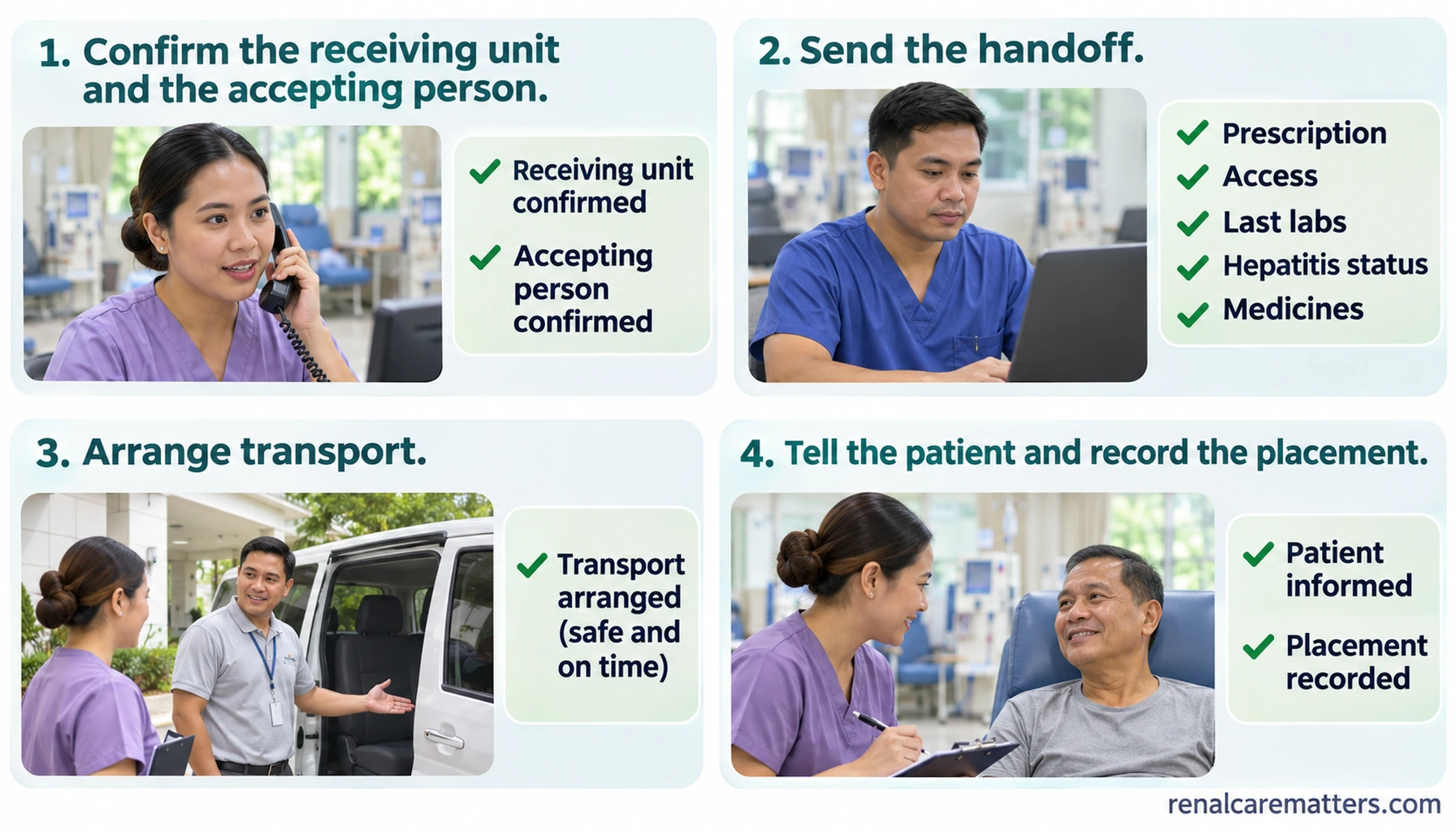
A receiving unit can dialyze a patient safely only with the facts. Send a handoff with every patient, and confirm the place before the patient travels.
Figure 5. Placing a patient at a receiving unit: confirm, send the handoff, transport, record.
Confirm the receiving unit and the person who accepts the patient, by name.
Send the handoff: the dialysis prescription, access type and side, last laboratory results (including potassium and hepatitis status), medicines, allergies, and dry weight.
Arrange transport that is safe and arrives on time.
Tell the patient and record the placement on the tracking board.
After Hurricane Irma, 129 hemodialysis patients were evacuated from St. Thomas in the US Virgin Islands to San Juan, Puerto Rico, where local nephrologists and dialysis centers treated them; the officials’ report describes how dialysis, medical care, shelter, food and transport all had to be arranged together, and how the patients had to move again when Hurricane Maria approached.6 The continuity planner helps plan how many patients each receiving unit can take on which shifts.
Stop and callA patient not reached after 24 hours, a patient with symptoms who cannot reach any unit, or no receiving unit able to take a high-priority patient: tell the incident lead and the attending nephrologist at once. Follow your unit protocol, and always ask the attending nephrologist for guidance.
🧒
Units that dialyze children
Few units can dialyze small children, so pediatric receiving units are named in advance. The pediatric nephrologist sets a weight-based emergency diet and the child’s priority, and the handoff includes the child’s weight, circuit and blood-line size, and the caregiver’s contact.
On the floor
Real situations: problems and solutions
These are fictional but typical. For each one, cover the answer, decide what you would do, then compare. Where a step depends on local rules, your unit’s procedure and your supervisor’s direction come first.
First come, first served
What you see
On the first day after a flood, patients are connected in the order they arrive at the door.
What is likely going on
No priority roster has been set.
What to do
Ask the attending nephrologist for the roster and connect by need; explain the order to those who wait.
Why it matters
Arrival order is not medical need.
The open-ended short session
What you see
Sessions were shortened by an hour during a water shortage, and three weeks later still are.
What is likely going on
No end date or review was set.
What to do
Ask the nephrologist to review, and restore full prescriptions as soon as capacity allows; record it.
Why it matters
Shortened sessions need an end date.
The handoff by text
What you see
A patient is sent to a receiving unit with only a text message naming her.
What is likely going on
The receiving unit lacks the facts to dialyze her safely.
What to do
Send the full handoff with the patient and confirm the accepting person.
Why it matters
Missing hepatitis status or prescription puts the patient and others at risk.
Field notes
Keep a printed tracking board template in the grab bag.
Rehearse the priority roster with the nephrologist in the tabletop exercise.
Case review
Back to the case: Twelve chairs, forty patients
Who decides. The attending nephrologist, from the tracking board and each patient’s time since treatment, last potassium, fluid status and symptoms. The man with a potassium of 6.9 mmol/L and the breathless woman with a 4 kg gain are likely first today; the young man who feels well and dialyzed four days ago is also overdue, so his place depends on the numbers for everyone else, and the nephrologist may send him to a receiving unit tomorrow.
Shortened sessions. Possibly, if all six conditions hold: the shortage recorded by the Dialysis Clinical Head (water and staff for 12 chairs), a written order per patient or group, an end date, high-risk patients (the two above) excluded, potassium and fluid monitoring, and a return to full prescriptions recorded. It is one option among several, beside the receiving units.
The handoff. For each of the twelve going to Ormoc and Palo: a named accepting person, the prescription, access type and side, last laboratory results with potassium and hepatitis status, medicines, allergies and dry weight; safe transport; the patient told; the placement on the board. The five not reached stay on the board until found.
Interactive case · fictional
Interactive case: Twelve chairs, forty patients
Work through a shift one decision at a time. The panel at the top changes with what you choose. After each choice you see why it is, or is not, the best move; after a weaker one you can try again or carry on and see where it leads. Your first choice at each step is scored. The score stays on this device and nothing is sent anywhere. In real practice, your unit’s protocol and the people responsible for each decision come first.
Skills lab · with your preceptor
Skills checklist: Tracking, priority and placement
In a tabletop (the “twelve chairs” scenario on the practice page) or after a real disruption. Your preceptor rates each step as satisfactory, needs practice, or not observed. Steps marked Critical must all be satisfactory before sign-off. This checklist supports supervised learning; your unit’s own procedure and competency form are the authority. A printable version of every checklist is on the trainer page.
Sets up a tracking board with the four statuses and updates it.
CriticalGathers time since last treatment, last potassium, fluid status and symptoms for the nephrologist without setting the priority.
CriticalStates all six conditions for shortened sessions.
CriticalExcludes patients marked high risk from shortened sessions.
CriticalWrites a complete handoff: prescription, access, last laboratory results with hepatitis status, medicines, allergies, dry weight.
Confirms the accepting person by name before the patient travels and records the placement.
Placement activity. Check that your unit’s receiving-unit agreements list a named contact and the handoff they expect.
Self-assessment
Check your understanding
Each visit draws 5 questions at random from this module’s 10-question bank. Choose the single best answer for each, then select Check answers; an explanation appears under the best answer. Select New set of questions for a different mix. A good target is 4 of 5 on two different sets. Nothing you select is sent anywhere; scoring happens in your browser.
Kutner, N. G., Muntner, P., Huang, Y., Zhang, R., Cohen, A. J., Anderson, A. H., & Eggers, P. W. (2009). Effect of Hurricane Katrina on the mortality of dialysis patients. Kidney International, 76(7), 760–766. https://doi.org/10.1038/ki.2009.268
Rivera-Hernandez, M., Kim, D., Nguyen, K. H., Thorsness, R., Lee, Y., Swaminathan, S., Mehrotra, R., & Trivedi, A. N. (2022). Changes in migration and mortality among patients with kidney failure in Puerto Rico after Hurricane Maria. JAMA Health Forum, 3(8), e222534. https://doi.org/10.1001/jamahealthforum.2022.2534
Ido, K., Miyazaki, M., & Nakayama, M. (2022). Hemodialysis record sharing: Solution for work burden reduction and disaster preparedness. JMIR Formative Research, 6(7), e32925. https://doi.org/10.2196/32925
Haga, N., Hata, J., Yabe, M., Ishibashi, K., Takahashi, N., Kumagai, K., Ogawa, S., Kataoka, M., Akaihata, H., & Kojima, Y. (2013). The Great East Japan Earthquake affected the laboratory findings of hemodialysis patients in Fukushima. BMC Nephrology, 14, 239. https://doi.org/10.1186/1471-2369-14-239
Avilés Mendoza, G. J., Finne, K. P., Torre Leon, F., Burke, L. M., Cabrera-Marquez, J., Mercado Casillas, A. M., Malave, G., Brown, C., Kelman, J., & Kopp, J. B. (2021). Observations from the emergency management of dialysis patients evacuated from the US Virgin Islands to Puerto Rico following hurricane Irma. BMC Health Services Research, 21(1), 1239. https://doi.org/10.1186/s12913-021-07194-6
Educational course and drill resource for dialysis units. It is not a hospital disaster plan, a licensing requirement, or a substitute for your unit’s approved protocol, the machine manufacturer’s instructions, or instructions from PAGASA, PHIVOLCS, the Bureau of Fire Protection or your local disaster office. Clinical decisions in a disaster (early dialysis, shortened sessions, priority, diet) belong to the attending nephrologist.